Roy Thomas (smiling gleefully): When Jerry [Robinson]’s article about what Bill Finger had done on Batman came out of course it made Bob Kane go ballistic the minute that he saw it. So he went to the editor of Batmania, and he wrote half a dozen pages of diatribe. Obviously Bob Kane did not want Bill Finger’s story told and took tremendous offense at it.1
The reaction of Roy Thomas to Bob Kane’s dismay at the exposure of his credit theft is telling. Thomas has made it his life’s work to suppress awareness of the same charges against Stan Lee, and to that end, he continues to discredit the Bill Fingers in Lee’s life. Compared to Lee, Kane was an amateur, because he was actually naïve enough to pay his uncredited collaborators for their work.
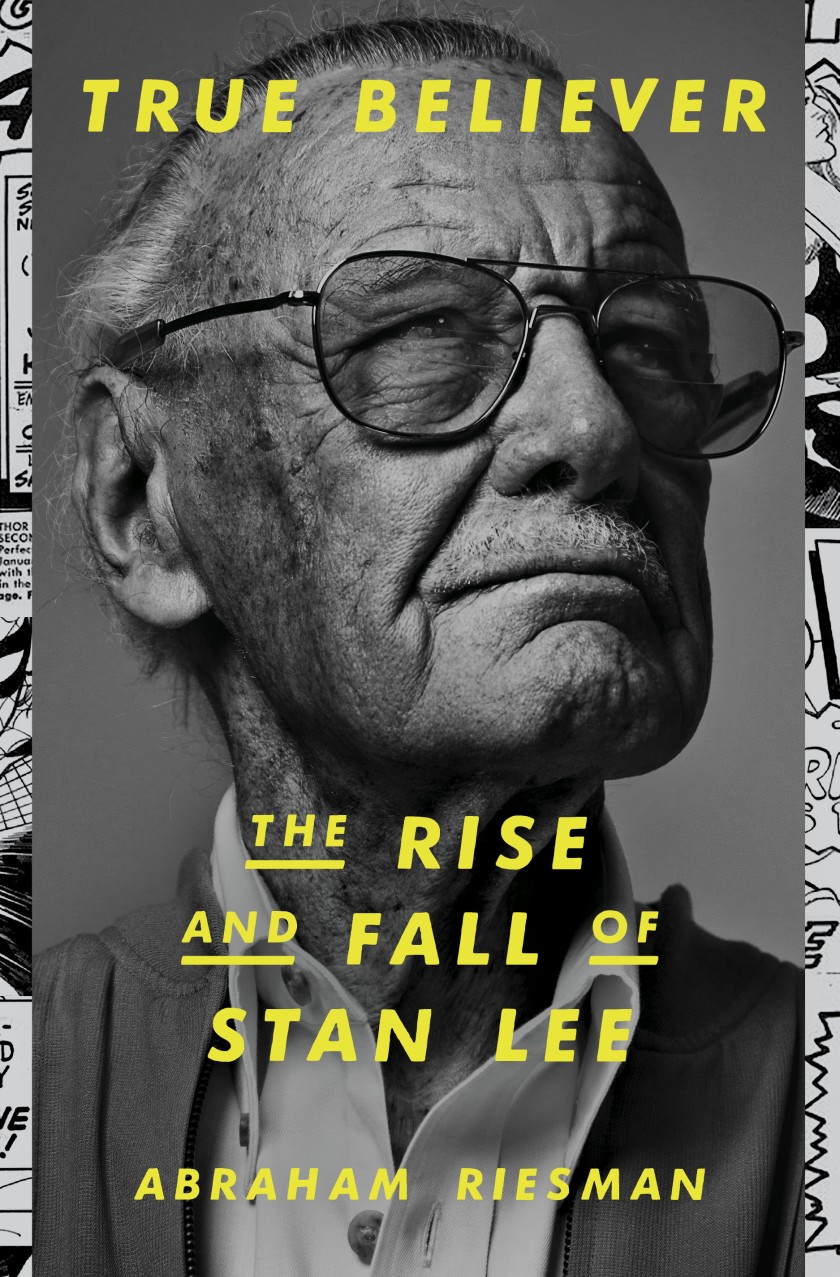
In Alter Ego 171, Thomas spells out the current state of the ever-evolving company version of Lee vs Kirby. The framework he uses this time is the expansion of his “rebuttal” of Abraham Riesman’s True Believer: The Rise and Fall of Stan Lee (the original piece appeared in The Hollywood Reporter in February). Thomas shows he has little use for logic, and absolute contempt for the physical evidence. The article reveals the difficulty of maintaining a false narrative in the face of scrutiny from the outside world.
Thomas’ complaints in the “rebuttal” boil down to this:
I feel the chief transgression of this book is how the author goes so far out of his way to undermine much of the received history and biography of Stan Lee.
The “received history” consists of various publicity campaigns in which Thomas was instrumental. These propaganda blitzes served to falsify the events of the ’60s and the late ’50s to give the company clear title to properties created by freelancers.
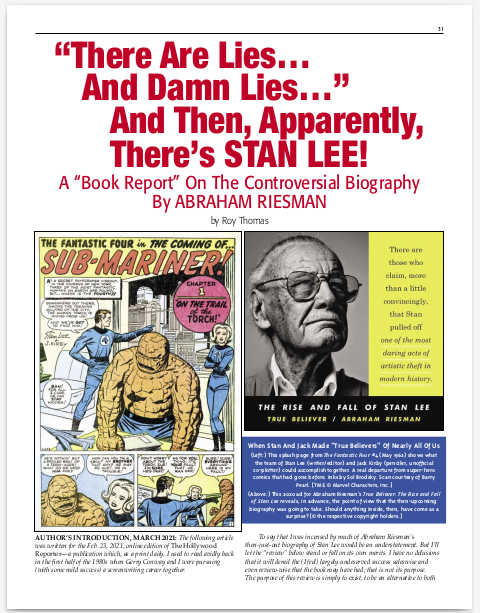 Unless specified with a footnote, the indented passages herein are taken from ‘“There Are Lies… And Damn Lies…” And Then, Apparently, There’s STAN LEE! A “Book Report” On The Controversial Biography By ABRAHAM RIESMAN,’ by Roy Thomas. Quotes within those passages are taken by Thomas from True Believer: The Rise and Fall of Stan Lee, by Abraham Riesman.
In Alter Ego 161, an earlier defense by Thomas of the company line on Kirby consisted wholly of
it’s well known…2
What’s well known? Thomas was suggesting it’s well known that Larry Lieber wrote full scripts for Kirby’s monster comics based on Lee’s plots. This is taken to be “well known” because it appeared in the pages of Alter Ego, 22 years ago. What’s with the fixation of finding some way, any way, to deny Kirby the writing credit he claimed? The answer is simple: if it became known that Kirby was a writer, his “collaborations” with Lee might be subject to more scrutiny.
Jack Kirby always claimed he wrote his own monster stories, but the official line as of 1974 was that Stan Lee wrote them. When that became problematic in 1999, the torch was passed and Larry Lieber was nominated.3
In 1997, Thomas told Jim Amash how he researched his second-hand history for the years that preceded his arrival at Marvel in 1965.
From what little I heard talking to Stan and Sol Brodsky…4
The freelancers might tell a different story, so it was safer not to consult them. By the time Alter Ego 161 was published in 2019, it was clear that Thomas was still ignoring the claims of Kirby and Ditko.
Alas, Mr Riesman is a journalist, and unlike lifelong industry fans like Thomas or hagiographers like Danny Fingeroth, he was compelled to throw out the “received history” and do the research from scratch. Apparently Thomas will need to learn the hard way not to contest Riesman on the grounds of research or documentation.
A chronology of making up history
The “received history” was developed in four stages. In 1961, as Larry Lieber once commented,5 Stan Lee decided to “write” Kirby’s comics; more on this later. Thomas started with the company in 1965, so this is the only stage for which he was not present and has no first-hand knowledge.
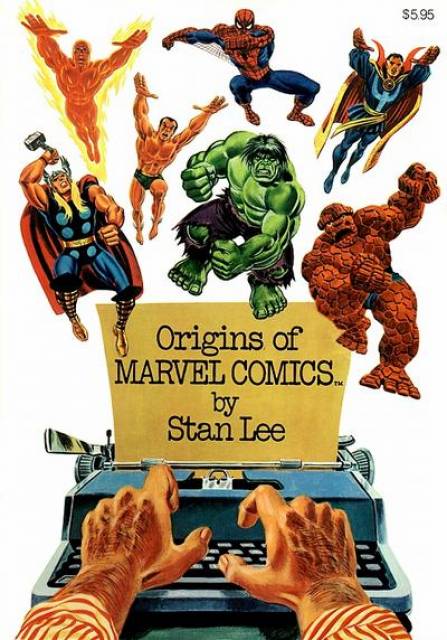 Between 1968 and 1974, Marvel’s new owners had a narrative established for them to consolidate control of the copyrights away from the freelancers who created the properties, culminating in Origins of Marvel Comics under Lee’s byline. In later decades, Lee is known to have had ghostwriters for everything; Origins might be no exception to the pattern. Kirby commented in his TCJ interview that Lee even had ghostwriters for his 1960s dialogue. A look further back in his career shows Lee recycling other people’s scripts under his own name, yet it was Kirby’s remark that drew outrage.
In 1998, in response to two events—Kirby’s death and the interview of Thomas that appeared in the Kirby Collector—Thomas was recruited by Lee and his attorney Arthur Lieberman to join the campaign. (Lieberman had entered the lives of Lee and Thomas in 1970 at the advent of one of Thomas’ greatest creations, Conan the Barbarian.) By the time of the Stan-Roy “interview” in Comic Book Artist that year, Thomas was directing the effort.
Stan: You know something, Roy? Now that you say it, that’s probably true…6
Finally, in a 2010 deposition in the case in which Marvel sued the Kirby family, with Lieberman at his side, Lee laid claim to sole creatorship of all the contested properties. In addition, that pesky Silver Surfer, not yet a contested property but a counterexample to the idea that Lee created all, was dispensed with by his legal team. Thanks to the presence of Thomas at the unveiling, Kirby had clear title, but in the deposition Lee became co-creator by virtue of making it “a separate character.” Thomas, formerly the only witness against, takes the opportunity in his “rebuttal” to incorporate this new truth in the narrative.
Discerning the truth
Some excerpts from the Thomas “rebuttal,” with Riesman’s work in quotes:
Both men were, I think, wrong… and that’s why Riesman is so ill-advised to use nearly every opportunity he gets to weight things in Jack’s favor and against Stan.
You think I’m exaggerating when I suggest that Riesman finds gratuitous excuses to favor Jack’s vision of things over Stan’s? I’m not.
He simply weighs Stan’s statements against Jack’s, without offering any real evidence that Jack’s memories are any more reliable than Stan’s.
“It’s very possible, maybe even probable, that the characters and plots Stan was famous for all sprang from the brain and pen of [artist writer Jack] Kirby….” “Possible,” yes. Lots of things are “possible.” But—“even probable”? Why? Riesman never really makes a credible case for that. He merely piles up verbiage and quotations: “He said… he said.”
Over and over again in the book—there isn’t room here to list them all—Riesman attempts to undercut Stan’s veracity.
“It was just two men in a room. Kirby relentlessly claimed until his dying day that his discussions were merely a matter of his telling Stan what was going to happen in a given plot, then going home and creating what he’d said he would create….” But hey—guess what: Stan Lee proclaimed to his dying day that he had had the initial idea for most of the 1960s Marvel heroes, with Jack being brought in later to help develop those characters. So why are we supposed to believe one man’s claim and not the other’s, given the lack of hard evidence?
Lee’s veracity can’t be undercut; he seldom told the truth. There is physical evidence, and in denying its existence, Thomas is hoping it will go away. Thomas says Lee was wrong, therefore by the “fine people” principle both men were wrong. No one will remember Thomas admitting Lee was wrong; Thomas won’t even remember for the duration of his article.
Bad memory, aka lying as a default setting
One of the things people have to realize about Stan Lee is that, like many another busy, forward-looking professional… he tended to discard (i.e., forget) events or discussions even in the recent past, once they were over and done with. That aspect of Stan’s personality could be maddening at times, but the fact remains: Stan was, in many ways, almost as forgetful as he generally portrayed himself as being. From the day I met him in 1965, he walked around with 3”x5” note cards in his shirt pocket, on which he’d scribble down things because he didn’t trust his memory. And, while some have argued that his “poor memory” was only a convenient shield against being held responsible for earlier decisions, I feel I spent more than enough time working with him between ’65 and ’74, in particular, to be certain that his notoriously bad memory was way more than just an artful dodge.
[Riesman] simply weighs Stan’s statements against Jack’s, without offering any real evidence that Jack’s memories are any more reliable than Stan’s.
Some people (Steve Ditko in particular) have suggested that poor memory is a reason to not be taken seriously when claiming creator credit. Lee repeatedly claimed “the world’s worst memory” and the like. Kirby never said he had a poor memory, yet propagandists like Thomas insist the unreliability is on both sides before saying their side is telling the truth. In 1986 Kirby said he and Lee both remembered clearly the events of 25 years earlier, and all that was necessary was for Lee to come clean. He expressed confidence that, knowing Lee, that would never happen.
Synopses
And [Riesman] weights things toward Jack’s view point with statements like the foregoing despite the fact, for instance, that partial synopses written by Stan for two of the first eight issues of the crucial Marvel flagship title Fantastic Four (including for #1) have been vouched for as existing since the 1960s.
Synopsis is a misnomer for the items promoted by Thomas as Lee’s documents of creation. Presumably typed by Lee, Chris Tolworthy shows convincingly that they were notes that suggested edits to the stories Kirby had turned in. The representation of the “synopses” as documents of creation, a view Thomas took up only after expressing his skepticism in 1997, is fraudulent.
“…I saw Stan’s plot for Fantastic Four #1, but even Stan would never claim for sure that he and Jack hadn’t talked the idea over before he wrote this.”7
The first “synopsis” to emerge (the one for #8) changed the direction of the Fantastic Four from Kirby’s dark science fiction to Lee’s light and fluffy. (Kirby wrestled control back some 40 issues later.)
If Stan Lee was engaging in an act of ex post facto forgery with that half-synopsis, it was surely the most inept attempt ever seen by man. And Stan was far from inept.
Thomas offers no evidence for this statement, because the “received history” is not about a Stan Lee who was inept. The physical evidence tells a different story.
Mark Evanier: [ FF #1] feels an awful lot more like Jack’s earlier work than anything that Stan had done to that date. So I find it very difficult to believe that Jack did not have input into the creation of the characters prior to the – that synopsis, whenever it was composed. And, also, I have the fact that I talked to Stan many times, and he told me – and he said it in print in a few places – that he and Jack had sat down one day and figured out what the Fantastic Four would be.
QUINN. And they discussed the plot before they actually – the drawings were done?
A. They discussed the plot before the alleged synopsis was done also.8
Amusing bit: Riesman wrote that “a rumor” said the FF #1 synopsis was created after the fact. Thomas refers to Evanier, one source of the rumor, as Kirby’s “one-time teenage assistant.” When Lee made Evanier a Vice President of Stan Lee Media, Thomas was having his loyalty rewarded by being handed the ghostwriting duties on the Spider-Man newspaper strip. Lee was paid $125k a year for having the strip written, but it’s a safe bet Thomas only got a fraction of that. Thomas exacts his revenge on Evanier with the “teenage assistant” crack, not realizing that it might bring to mind Kirby’s first teenage assistant, Stan Lee.
Lieber
Riesman even manages either to misunderstand Stan’s brother Larry Lieber on the way many of the early Marvel stories were written—or else, back in 1999, Larry himself was totally misremembering when he told me in a published interview that, to the best of his recollection, every single story he wrote was done in the script-in-advance format, never by the Marvel Method.
Riesman can’t misunderstand something that is insufficiently documented. Kirby said he wrote his own stories. Lieber has always been very malleable in the hands of his big brother whom, it’s clear in the pages of True Believer, treated him like dirt. Lieber’s name wasn’t mentioned in relation to Kirby’s stories before 1998, and he didn’t claim to have written full scripts for Kirby until after Kirby’s death.
 In 2011 Lieber was deposed in the Kirby case, and mentioned that he’d been reluctant to give the deposition. Lee convinced him with the “suggestion” that if he didn’t, he might lose his work on the Spider-Man newspaper strip, work he had at the whim of Lee (see page 30 in the linked PDF).
Case No. 11-3333 Appellants’ Opening Brief
Lieber also described his understanding of what would happen to a script after he turned it in.
MS. SINGER. Do you know what would happen to the script after Stan went over it and made whatever changes?
LIEBER. Yeah. It would be sent to the artist, I would guess.
Q. Okay.
A. Whether it was, you know, the various artists, yeah.
Q. Did you ever — did you have any contact with the story after
you turned it in and made whatever changes?
A. No.9
Thomas notes a couple of points in the book that Lieber later asked to be clarified. Thomas calls it Riesman’s “misinformation.”
Through his friend Frank Lovece, Larry has recently corrected this bit of misinformation on Facebook.
According to Larry in his recent remarks put on Facebook by his friend Frank Lovece, it was his older cousin-by-marriage Martin Goodman who committed that particular verbal vulgarity…
Lovece is a reporter beholden to the Marvel narrative, but Riesman recorded his interviews.
Thomas then expresses disbelief at a few things Lieber said to Riesman.
This is something I’d definitely need to check with Larry himself about before I believed it…
…but again, I’d want to hear that description from his own lips.
Again, it’s not that the lead-off pair of statements made by Riesman are necessarily untruths… I wasn’t in the room to hear precisely what Larry told him, and neither were you… but I’d want to hear it from Larry before I didn’t believe that he was, at the very least, misquoted.
Despite his rhetoric, Thomas will never check with Lieber because that kind of poking the actual first-hand accounts is not his style. He’s not a journalist or even an historian. Abraham Riesman not only checked with Lieber, but recorded his lengthy reminiscences. If Thomas were to approach Lieber, the implicit threat of his Marvel affiliation would precede him, and Lieber would alter his story accordingly.
Who was Stan Lee?
“‘When my mother died, our life changed dramatically.’ The change was not born of grief but rather of logistics.”
More of the same as on p. 14, really… this time, a quotation from Stan, followed by a judgment by Riesman. But perhaps, rather than criticize the author, we should all simply marvel at his ability to look inside the mind and heart of Stan Lee and know precisely what he meant by that quote, when the man was known for playing his emotional cards very close to his vest.
Jack Kirby always had the clearest view of his former teenage assistant. In this case he pegged it: Lee was a man with no empathy.
KIRBY: And my wife was present when I created these damn characters. The only reason I would have any bad feelings against Stan is because my own wife had to suffer through that with me. It takes a guy like Stan, without feeling, to realize a thing like that. If he hurts a guy, he also hurts his family. His wife is going ask questions. His children are going to ask questions.10
Freedland
It’s curious that Thomas, who hasn’t hesitated to spin Lee as the injured party in the Herald Tribune debacle, neglects to mention one of the exclusive revelations of True Believer: Riesman interviewed Nat Freedland. Freedland admitted to Riesman that he’d been sucking up to Lee in hopes of getting work with Marvel. This is notable because Thomas has tried to whitewash the incident in the past.
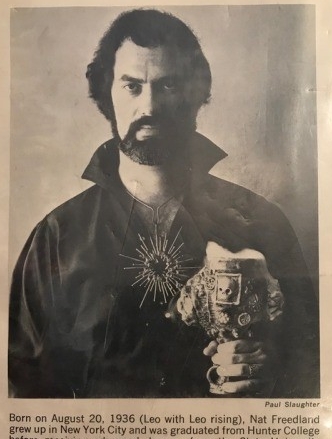
THOMAS: And, unfortunately, Stan kind of took the rap for [the tone of the article] from Jack and Roz, who somehow felt that Stan was trying to grab credit away from him, and though Stan could do that, he wasn’t doing that in this instance.11
Thomas is wrong: Lee was very much trying to grab credit. The purpose of staging the “plotting session” was to present Lee as the originator of the ideas. Thomas knew the story conference was atypical by the very fact that he was invited to attend.
Physical evidence
Stan Taylor: The problem here is not that we don’t have eyewitness testimony, it’s that we have conflicting eyewitness testimony. The people involved disagree. If we can’t rely on first-person testimony, what can we do? Criminal detectives have other words for this: evidence, and modus operandi. We can do what historians, detectives, and scientists have always done: ignore the hearsay, mythology, and personal claims and look at the actual physical evidence, in this case, the original comic books, and contemporaneous documentary evidence from unbiased sources. Human behavior is repetitive, we all have our m.o, — our method of operation. It is this human trait that detectives use to narrow down the lists of suspects in any mystery.12
What comprises the physical evidence? The published comics are the main source, but there’s more. Kirby’s original art from the monster and early superhero period (visible online and in IDW Artist’s Editions) contains his pencilled lettering in the balloons and captions of stories where the writing has been retroactively credited to others. Kirby said in interviews that his documents of creation were a “blitz” of concept sketches that he used to present his characters on spec. Most of these have been absorbed into the published work, as cover figures like Iron Man, or Marvel Masterworks posters like the FF. At least one Spider-Man page and a pair of Nick Fury pages, however, survived long enough to be discussed. Taylor used the physical evidence, mainly the published work attributed to Lee, Kirby, and Ditko, to make a convincing case for Kirby bringing the Spider-Man character and plots to Stan Lee before the first story conference.

On the other side of the ledger, there are no surviving scripts (although Thomas devotes two pages of the article to a “Marvel Method script” from the ’70s that involved neither Lee nor Kirby). There are two “synopses” that may have been Lee’s attempt to change the direction of what Kirby had already written and drawn. The only physical evidence for writing, including the absence of Lee’s signatures, favours Kirby.
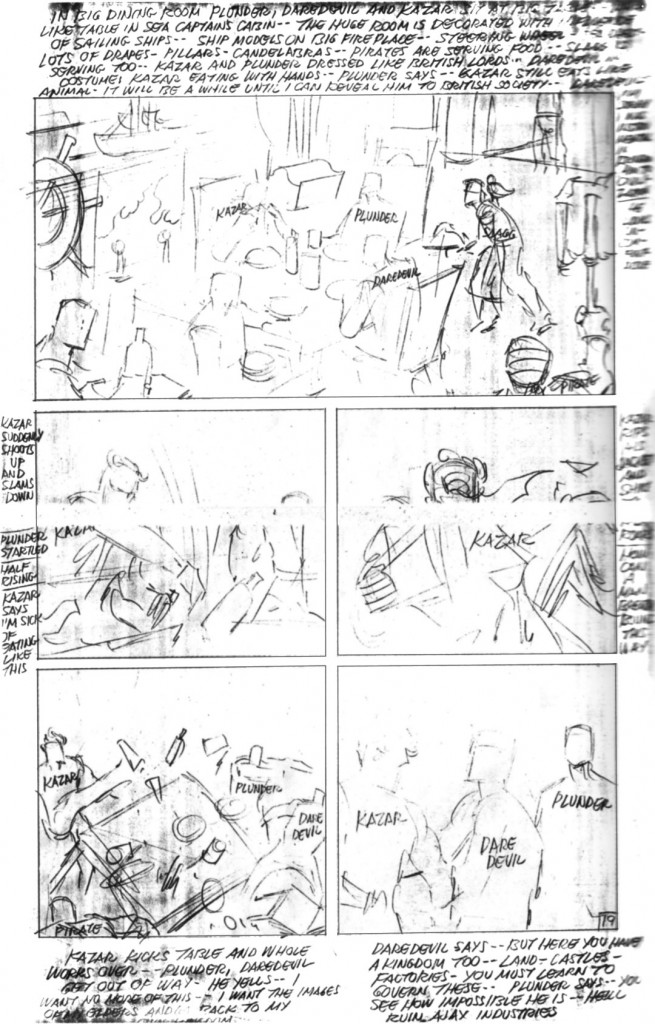
Roy Thomas’ attitude toward the physical evidence is troubling. While in the Marvel offices, Jim Shooter encountered a Kirby Spider-Man presentation page, and Jim Steranko was assigned Kirby’s Nick Fury presentation pages to ink. Thomas was closer to that evidence than nearly everyone else for fifteen years. After expressing doubt regarding the timing of the FF #1 “synopsis” in a 1997 interview, he was persuaded the following year to embrace and extend the Lee creation myth.
Some examples of recent Thomas pronouncements that don’t stand up to the physical evidence are detailed here.
Audience
Caption: Frankly, Ye Editor finds it ludicrous that anyone would believe that Stan would’ve bothered to fake such a document [an FF outline] anytime… but especially back in the 1960s!
Thomas mocks the Riesman/Evanier “synopsis” takedown for the benefit of his audience. “Ye Editor” is an inside joke, a fun way for adults to secretly signal each other based on Lee’s cod Shakespeare.
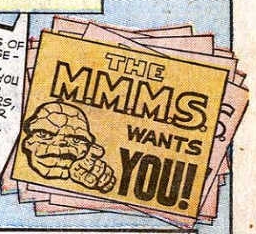
Caption: When Stan and Jack Made “True Believers” Of Nearly All Of Us
It was not Kirby’s goal to make True Believers, it was his goal to tell an entertaining story and sell comics. Lee’s rebirth in the ’60s on the backs of his collaborators came with the realization that if he befriended his readers, he could make them enemies of anyone who called out his managerial abuses.
…in any subsequent edition, Crown Books should change the book’s subtitle. Because he isn’t likely to have convinced anyone who has access to (or interest in) any facts or intelligent observations that lie outside its pages.
“Come to Alter Ego to get all the facts and intelligent observations.” The magazine may run a Jack Kirby tribute issue, but it will never show him respect because he disrespected the flag of Stan Lee. The special brand loyalty to which it caters values the characters above the creators, and their friend in management (Lee) over labour (the freelancers).
But, no matter how well the Random House publicity machine manages to hype this book, as long as it stands as currently published, with Stan all but written off as an inveterate liar whose most important creation was his public persona (when it was actually the concept and direction of the Marvel Universe, an idea that was anathema to Jack Kirby, as per in-book quotes), it will remain undeserving of the high praise heaped upon it by people who, for the most part, don’t really know what the hell they’re talking about.
“People who don’t read Alter Ego don’t really know what the hell they’re talking about.” Thomas sidesteps having to prove Lee is not an inveterate liar with the implication that the “received history” answers all.
Propaganda
Michael J Vassallo: reading Stan Lee: How Marvel Changed the World, by Adrian Mackinder. Another book on Stan, mining the same rubbish. The prologue to the book is not inaccurate as it goes into great length explaining how Stan was positioning himself as a pseudo-military leader of the legion of Marvel fans. Phrases like “face front’” and “True Believer,” makes it obvious the author knows Stan was organizing a cult following. As the author said, “They didn’t just read. They believed.”13
Having served in the US Army Signal Corps during WWII, Lee was aware of the power of propaganda. If it could ever be said that he’d read a book (like Trump and his bedside copy of Mein Kampf), it would be The True Believer: Thoughts on the Nature of Mass Movements.

Mark Seifert commented on a blog post about Jean Shepherd’s trademark use of the word “Excelsior.”
Mark Seifert: I’ve been researching the usage of “Excelsior” word by Marvel Comics legend Stan Lee. There too, there have been widespread claims that it doesn’t really mean much. And some that claim that Stan got it from Shepherd (he didn’t, we’ll get to that in a minute). But it does have specific meaning, as you say. Fwiw, I can give you a little additional context, I believe.
First off: Like Shepherd, Stan Lee was in the Signal Corps during WW2. After the war and their service, I believe they were both engaged in a little Cold War era propaganda as well. I’m not necessarily implying that’s a bad thing (that’s above my pay grade!), but their usage of it was very certainly purposeful and with specific intent.
Keep going. Achieve. Don’t let anything stop you.
In Stan’s case, as you might know, he also uses the terms “True Believer” and “Face Front” frequently. Both of these had gained relatively common usage as terms of propaganda in that era.
“True Believer” a very popular book about the psychology of mass movements by Eric Hoffer in the 1950s, also had a cover on the paperback version which shows a man climbing upward with the classic “Excelsior” banner.
“Face Front” was thrust into usage in that era by syndicated newspaper columnist George Matthew Adams, which a little research shows ran a syndicate that frequently engaged in propaganda. Its meaning is pretty close to the meaning of Excelsior. Basically: stand up, together, and face the enemy.
These are all terms of the trade of mass influence, and in the case of Excelsior, being used regularly by trained Signal Corps veterans who both had access to a mass audience.
In my opinion, there are conclusions to be drawn from that.14
The True Believer: Thoughts on the Nature of Mass Movements, 1951
Some excerpts.
Page numbers are taken from the Harper Perennial Modern Classics edition, 2019.
p 50 A rising mass movement attracts and holds a following not by its doctrine and promises but by the refuge it offers from the anxieties, barrenness and meaninglessness of an individual existence. It cures the poignantly frustrated not by conferring on them an absolute truth or by remedying the difficulties and abuses which made their lives miserable, but by freeing them from their ineffectual selves–and it does this by enfolding and absorbing them into a closely knit and exultant corporate whole.
p 130 Propaganda by itself succeeds mainly with the frustrated. Their throbbing fears, hopes and passions crowd at the portals of their senses and get between them and the outside world. They cannot see but what they have already imagined, and it is the music of their own souls they hear in the impassioned words of the propagandist. Indeed, it it easier for the frustrated to detect their own imaginings and hear the echo of their own musings in impassioned double-talk and sonorous refrains that in precise words joined together with faultless logic.
p 131 [Dr Goebbels] sounds apologetic when he claims that “it cannot be denied that more can be done with good propaganda than by no propaganda at all.”
p 155 …the true believer who is wholly assimilated into a compact collective body has found a new identity and a new life. He is one of the chosen, bolstered and protected by invincible powers, and destined to inherit the earth… The true believer is eternally incomplete, eternally insecure.
p 173 The genuine man of words himself can get along without faith in absolutes. He values the search for truth as much as truth itself. He delights in the clash of thought and in the give-and-take of controversy. If he formulates a philosophy and a doctrine, they are more an exhibition of brilliance and an exercise in dialectics than a program of action and the tenets of a faith. His vanity, it is true, often prompts him to defend his speculations with savagery and even venom; but his appeal is usually to reason and not to faith. The fanatics and the faith-hungry masses, however, are likely to invest such speculations with the certitude of holy writ, and make them the fountainhead of a new faith.
p 175 However, the freedom the masses crave is not freedom of self-expression and self-realization, but freedom from the intolerable burden of an autonomous existence. They want freedom from “the fearful burden of free choice,” freedom from the arduous responsibility of realizing their ineffectual selves and shouldering the blame for the blemished product. They do not want freedom of conscience, but faith–blind, authoritarian faith.
Lee’s True Believers aside, this 70-year-old book has echoes in current events that are alarming.
Lee took to heart a strategy attributed to Goebbels15 in his dealings with Kirby, joking with the True Believers about Kirby’s greed or incompetence, and in a serious moment, accusing him of evil for disputing the creation mythology. Thomas carries on the tradition: his favourite accusation is that Kirby was greedy because of his belief that he wasn’t fairly compensated for his share of the work.
Thomas includes an exercise in the “rebuttal” in which he proves that in today’s dollars, Kirby’s pay was nothing to sneeze at. He fails to mention Lee’s ill-gotten freelance writing pay on over 10,000 pages Kirby produced, or Kirby’s back-breaking 7-day schedule while Lee and Thomas put in a verifiable two to three days in the office. Something else that goes unmentioned is the motivation for Lee’s extortion racket, laid plain in Riesman’s book: the terrible price Lee was paying to keep his wife and daughter in the style to which they were accustomed.
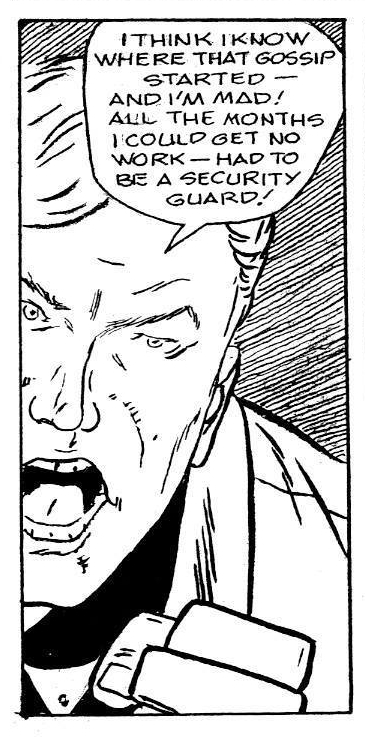
Thomas noted in his 1981 TCJ interview that Marvel was a vindictive company, and that Lee himself could be vindictive on occasion.16 But although his examples of the targets of Lee’s vindictiveness were from the ’70s (Wein and Conway, both writer/editors), he didn’t mention writer/artist Dick Ayers, who sued for reprint fees and lost. Lee stripped Ayers of his assignments and spread the word that he’d had a mental breakdown.
Propaganda in the “rebuttal”
Caption: Fantastic Four #10… Stan Lee and Jack Kirby were shown in their office… trying to come up with a new storyline. In these panels, none other than Dr. Doom waltzes in and takes over… it seems unlikely that Stan would’ve approved such a scene a couple of years later… because it would’ve undermined the reality he was increasingly seeking in the Marvel line.
“The reality [Lee] was increasingly seeking in the Marvel line,” yes, reality in the line of superhero comics is one of those things that needs to be chanted repeatedly, without thinking about what’s being said.
One of the things people have to realize about Stan Lee is that, like many another busy, forward-looking professional—and Stan was, as my keen-eyed wife Dann put it after a bit of observation, “one of the most future-oriented people” she ever met…
Jack Kirby was a prophet: many accounts (including that of Thomas) talk about his in-person predictions of the future coming true. There are many examples of it in his comic stories. Lee was a follower: Kirby’s account of Marvel’s creation was that Lee was immobilized by his disintegrating career prospects (cancellation of his newspaper strip, shutdown of the comics operation by Goodman), and Kirby stepped in.
“The general public is typically aware of only one narrative of the Marvel revolution: ‘Stan came up with all the characters, plots, and dialogue; Jack just came up with the visuals.’” Actually, if the “general public” knows only the version of events that Riesman paraphrases above, that’s hardly Stan’s fault. First, it’s because the “general public” never read the many, many places in the pages of Marvel’s 1960s comics wherein Stan praised Jack Kirby’s contributions to the skies, often giving him credit for what amounts to co-plotting stories, and on occasion even saying that Jack was likely to come up with a particular story all on his own.
“Not Stan’s fault” is a common theme in Thomas’ retelling, and it’s related to the falsehood that “he never knew why they quit.” It’s “not Stan’s fault” that everyone believes he’s the creator, plotter, writer, and “artist;” if only he hadn’t constantly portrayed himself that way, and had corrected interviewers whenever they got it wrong. It’s “not Stan’s fault” that Kirby and Ditko didn’t make clear their desire to get paid for their work before “stabbing him in the back” and quitting.
At odds with the “not Stan’s fault” line of reasoning are his 1987 interview comment, “the characters’ concepts were mine,”17 and his 2010 deposition,18 wherein he claimed that every creation was his. Lee’s run-of-the-mill propaganda was directed at his readers, but these comments were for general consumption. Thomas, under oath for his own deposition, said Lee misspoke if he ever said “artists” were expected to plot.
Q. Are you aware that Stan Lee, in interviews, has stated that in 1960s, under the Marvel Method, that artists were expected to plot stories?
MS. KLEINICK: Objection; states facts not in evidence.
A. I haven’t any knowledge of that. It would have, you know, surprised me; but if he did, he probably misspoke.19
This leads seamlessly into one of the biggest lies of the “received history”: Lee always praised his collaborators.
[Thomas quotes Lee via Barry Pearl]: “Comicbooks are a collaborative medium. Had I not worked with artists like Jack Kirby, Steve Ditko, John Romita, John Buscema, Gil Kane, all the rest of them, Gene Colan, Syd Shores—yes, Syd Shores, too—Dick Ayers, Joe Sinnott, all those guys… my stories would not have looked as good…. Those guys were writers themselves. But they would write with pictures…. It was a total collaboration affair and sometimes I feel a little guilty, you know: ‘Stan did this, Stan did that.’ I did it, but I did it with them. And they really deserve as much [credit] as I ever get.” You won’t find that quote, in full or in part, in Riesman, either.
Lee often said Kirby was very creative.20 If the actual words are parsed, it can be seen that he never credited him with creating a copyrightable property. Kirby was called a great plotter, but the physical evidence shows that he never received a plot credit. Ditko demanded a plot credit and was stripped of his Hulk assignment (it was given to Kirby so Lee would continue to receive the full writing page rate). Lee didn’t speak to Ditko for over a year, until he finally quit.
It’s important to note that each time Thomas or Lee used the word “artist” to describe Kirby or another one of the writers, it was designed to diminish their contribution and plant the idea that someone else was doing the writing. A better term would be writer/artist, and, in one instance, creator/writer/artist.
Produced by…
…as Riesman’s quotes testify, Stan often—not invariably, but often—gave Jack credit for doing much, even most of the actual plotting. By mid-1966, Stan, eager to accommodate Jack, stopped listing himself as “writer” in the credits and readily agreed to the mutual credit Jack suggested: “Produced by Stan Lee and Jack Kirby.” If Jack wanted still more credit than that, it doesn’t seem he ever made his wishes clearly known to Stan.
The “Produced by” story is one Roy Thomas is fond of telling. Roz Kirby seemed to speak derisively of the wording when she told John Morrow that they asked for credit all the time.21
This time, Thomas tells the story as fact, but as recently as two years ago, his use of the word “reportedly” reveals that he got it second-hand.
Should Stan perhaps have made some additional accommodation with Jack? The point can be argued—in retrospect, I wish he had—but remember, Stan had reason to believe the matter had been settled to Jack’s satisfaction when the two of them agreed that future stories would be credited as “a Stan Lee & Jack Kirby production,” the phrasing Jack reportedly chose himself.22
Kirby asking for a “Produced by” credit is a Stan Lee story. Mark Evanier contributes to the mythology by relating Lee’s revelation to him that in another magnanimous gesture (the Lee/Thomas version of history is full of them), he offered Kirby and Ditko a plot credit at the same time.23 (It’s not clear from this fairy tale that Ditko was forced to demand it.) In Lee’s telling, Kirby’s response was no, just put “Produced by.”
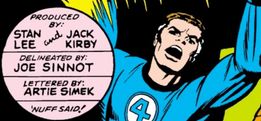
What puts the lie to this one is, again, the physical evidence: it took Lee from April 8, 1965 (Amazing Spider-Man #26, Ditko’s first plot credit) until August 9, 1966 (FF #56, the first “Produced by” credit) for Lee to give Kirby the credit Lee claims Kirby asked for in lieu of a writing credit, a period of 16 months. What Thomas, Evanier, and Lee fail to mention is that Ditko received plotting pay with his credit, taken out of Lee’s writing page rate. A “Produced by” credit didn’t cost Lee a dime, and still didn’t earn Kirby any pay for his writing.
Backstab
…Stan not only refers to Jack as “one of the greatest artists in the whole world,” but, in the very next sentence, acknowledges that Jack “started most of the characters with me.” Yeah, he’s saying that about the guy who he felt had stabbed him in the back in 1970 when he started working for DC Comics before even bothering to tell him he was quitting, and who had then viciously lampooned him as “Funky Flashman”!
A member of the general public might infer from the circumstances that the matter of stolen writing pay could never have been settled to Kirby’s satisfaction. It’s common knowledge in the outside world that Kirby turned off the tap on new creations after Lee butchered his Cocoon Man story, and began stockpiling concept sketches for his next opportunity. Kirby finally quit after tolerating the Marvel Method for nine years. It’s not a mystery, even though Lee pretended for decades that he didn’t know why. Now Thomas has taken up the mantle.
Vicious? Funky Flashman was undoubtedly the most accurate portrait of Lee we’re ever likely to see, by someone who had worked closely with him but was not beholden to him. Marvel has since outlawed this kind of thing from former employees. Stabbed in the back? Let’s keep in mind that Kirby’s writing pay was extorted for the better part of a decade by the man who, upon Kirby’s departure, immediately began claiming sole creatorship.
Stan Taylor’s approach was to look for patterns. The obvious pattern here is that repetitive Roy Thomas anecdotes concerning Kirby and Lee were designed to conceal something. When a point is belabored in the official version, a little scrutiny should turn up the truth behind it in the form of an accurate Kirby claim.
Conclusion
Abraham Riesman is a journalist. His book is based on new interviews with Lieber, Thomas, Romita, Freedland, O’Neil, and many others. The quotes are accurate because the interviews were recorded. Riesman paid for his own fact checker, publisher Random House paid a separate fact checker, and historian (the real kind, not the Marvel kind) Dr Michael J Vassallo fact checked it. There is no other book about Stan Lee that has been as thoroughly checked against known facts.
Coming back to the “received history,” who is receiving it? The received history is received by the True Believers. Riesman has written a biography for the rest of us, the “general public” who have no use for the company mythology.
I’d like to add a corollary to Stan Taylor’s approach to the first-hand testimony: if the account of one of the people involved is consistently borne out by the evidence, and the other is consistently proven false, it’s appropriate to conclude that the former is a significant contribution to our understanding of the history. That of the latter should be called out at every opportunity.
Footnotes
back 1 The Hulu documentary Batman & Bill, 2017.
back 2 Letters pages, Alter Ego 161, November 2019.
back 3 “A Conversation with Artist-Writer Larry Lieber,” interviewed by Roy Thomas, Alter Ego V3No2, Fall 1999.
back 4 Roy Thomas interviewed by Jim Amash, conducted by phone in September 1997, published in The Jack Kirby Collector #18, January 1998.
back 5 “A Conversation with Artist-Writer Larry Lieber,” interviewed by Roy Thomas, Alter Ego V3No2, Fall 1999.
back 6 “Stan the Man & Roy the Boy,” A Conversation Between Stan Lee and Roy Thomas, Comic Book Artist #2, Summer 1998.
back 7 Roy Thomas interviewed by Jim Amash, conducted by phone in September 1997, published in The Jack Kirby Collector #18, January 1998.
back 8 Mark Evanier deposition, 9 November 2010, Justia, Dockets & Filings, Second Circuit, New York, New York Southern District Court, Marvel Worldwide, Inc. et al v. Kirby et al, Filing 65, Exhibit 8.
back 9 Larry Lieber deposition, 7 January 2011, Justia, Dockets & Filings, Second Circuit, New York, New York Southern District Court, Marvel Worldwide, Inc. et al v. Kirby et al, Filing 65, Exhibit 4.
back 10 Jack Kirby interviewed by Gary Groth, conducted in summer of 1989, The Comics Journal #134, February 1990.
back 11 “The Terrific Roy Thomas,” panel conducted by Matt Herring, The Jack Kirby Collector #74, Spring 2018.
back 12 Stan Taylor, “Spider-Man: The Case for Kirby,” 2003, available at the Kirby Museum website.
back 13 Michael J Vassallo, Marvel Method group, 10 September 2021.
back 14 Mark Seifert, 10 August 2019 comment on the “Jean Shepherd–Excelsior!!!!!” post at Gene Bergmann’s Jean Shepherd Quest blog.
back 15 Accuse the other side of that of which you are guilty, a misquote, according to Wikiquote.org. It’s possibly based on this actual quote: “The cleverest trick used in propaganda against Germany during the war was to accuse Germany of what our enemies themselves were doing.”
back 16 “The thing that was truest in that article [‘Roy Thomas Leaves Marvel,’ Journal #56] was the analysis that Marvel has had a tendency in recent years to be very vindictive toward people who leave it to work for the competition. They go far beyond any kind of professional reaction. Stan generally has reasonably good and humane instincts, but once in a while he’ll just decide that if somebody does something, he’s never going to work for Marvel again. He did this with Len, and with Gerry, though to date he’s never said it about me.”—Roy Thomas, interviewed by Rob Gustaveson, The Comics Journal #61, Winter 1981.
back 17 Janet Bode, A Comic Book Artist KO’d: Jack Kirby’s Six-Year
Slugfest with Marvel, The Village Voice, 8 December 1987.
back 18 Stan Lee deposition, 13 May 2010, Justia, Dockets & Filings, Second Circuit, New York, New York Southern District Court, Marvel Worldwide, Inc. et al v. Kirby et al, Filing 102, Exhibit 1.
back 19 Roy Thomas deposition, 27 October 2010, Justia, Dockets & Filings, Second Circuit, New York, New York Southern District Court, Marvel Worldwide, Inc. et al v. Kirby et al, Filing 102, Exhibit K.
back 20 “Jack was about the best. He was really the most creative artist of all, because he was more than an artist. I call him a great conceptualizer. He could conceive of stories and follow them through. All I would have to do with Jack is give him a very brief outline on what to do, and he would just do the whole story. After a while when we were rushed, I didn’t even give him an outline, he just did whatever story he wanted and I’d come back and I’d put it in the copy.”—Michael Allen, “Stan ‘The Man’ Lee,” Overstreet’s Comic Book Quarterly Vol 1 #4, April-June 1994.
back 21 When asked if this credits change was the result of Kirby actively asking for it, Jack’s wife insisted: “Of course! He used to ask for it all the time…We always asked for a lot of things all the time, and finally they put down ‘Produced by…’ because it’s just ridiculous, you know.”—Roz Kirby interview conducted 12 December 1995 by John Morrow, The Jack Kirby Collector #10, April 1996.
back 22 Letters pages, Alter Ego 161, November 2019.
back 23 Stan told me something interesting. There was one point in the Spider-Man books when the credits changed from “Art by Steve Ditko” to “plotted and drawn by Steve Ditko…” Stan said that simultaneously he offered the same thing to Kirby— to give him a co-writing credit—and Jack, instead, asked that the credits read “Produced by Stan Lee and Jack Kirby” or some variation of that. If you look at the credits, very rarely after that did it say “Written by Stan Lee.” Jack asked to keep it ambiguous, and Stan went along with it.—Mark Evanier, “Comic Interview,” cited by Barry Pearl in Alter Ego 170, July 2021.
 accordingtokirby