A Dramatic Shift in the Jack Kirby Story After His Death, Part Two
Where did Mark Evanier get his Challengers narrative, the one that evolved from post to post in 1996 and 1997? Kirby died in 1994, so only Simon was left to convince him that Kirby hadn’t said what he said. Jim Simon’s comment in Part One shows that discussions were underway between Evanier and the Simon camp, and Evanier wrote the definitive version in his letter/email ultimately read by Harry Mendryk.
In 1998 at SDCC, with Roz Kirby still in the picture, Evanier hosted a Joe Simon Tribute Panel during which Simon mentioned his involvement in pitching Challengers. Evanier’s intro (transcribed for TJKC #25—the panel without the intro is here) is a work of fiction, a monstrous betrayal of his one-time mentor. It contains his standard line, his motivation for outsourcing Kirby’s life to others.
Now, as we all know Jack was not the greatest interview in the world and once or twice when he was interviewed people would get him mad…
The reality was that the partnership ended with some acrimony and Kirby was reluctant ever to talk about it. Simon, the right kind of interview for Evanier, was only too happy to jump into the breach. Evanier brags about his exclusive interviews with Stan Lee, Simon, and Sol Brodsky, but did he ever sit down for an in-depth interview with Kirby? Apart from Evanier, Kirby had plenty of incisive interviewers, including Gary Groth, but Evanier’s comment above is probably a Lee-slanted dig at Groth specifically.
As early as 1981, Evanier was consorting with Stan Lee over lunch. Lee told him an easily refuted lie which Evanier proceeded to read into the historical record in Comics Interview #2. (This was the same interview where Evanier revealed his knowledge that Lee was paid for plotting.)
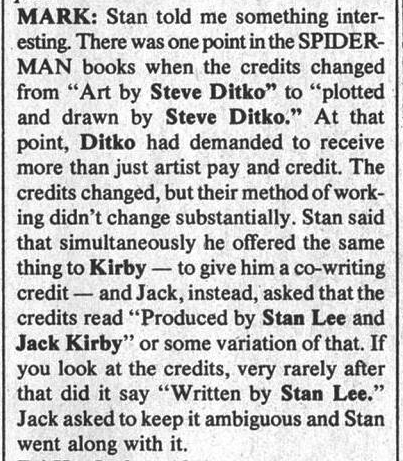 Did Evanier bother to run Lee’s claim past Kirby? No, he simply chose to believe Lee wouldn’t lie to him, rendering fact checks unnecessary. The actual history shows Lee was so incensed when Ditko demanded the plotting pay that he stripped him of 10 pages a month worth of assignments (The Hulk in Tales to Astonish) and stopped speaking to him. Kirby’s supposed response to Lee was “keep it ambiguous,” but Roz told Gary Groth in the TCJ interview exactly what they thought of the “Produced by” credit. Evanier disputes both of these facts. He needs to take it up with Roy Thomas, who confirmed it was Lee who stopped speaking to Ditko, and claimed for himself creatorship of the “Produced by” credit.
In 1990, Evanier must have been AWOL when Roz asked Kirby’s friends, including Jim Amash and David Schwartz, not to show him Simon’s book or mention they’d “read or even knew about it.” Amash noted, “That book really upset her.” How close was Evanier to Kirby between his departure from Kirby’s employ in 1972 and Kirby’s funeral?
Evanier’s intro to the 1998 Simon panel transfers nicely to his intro to The Art of the Simon and Kirby Studio, no facts necessary. He concludes, “Joe Simon, though older, outlived his famous partner by nearly eighteen years. For much of that time, he did what he’d done so well since the day they met. He protected the interests of Simon and Kirby.” To buy the “and Kirby” part of this claim, an explanation is required for why the guy looking out for the partnership left his partner behind in East Williston during his upward ascendancy from one exclusive neighbourhood to another, ultimately landing in an oceanfront mansion. Fifteen years after Simon’s departure, Kirby took a strings-attached loan from Martin Goodman to escape to the west coast.
The right kind of interview subject for Mark Evanier is a confident smooth talker who makes a show of taking him into their confidence. He should have approached every interview with a guard on his credulousness, but when I suggested in September 2019 (on a Steve Bissette post about Steve Ditko) that the proper approach to any pronouncement by Lee was to consider it a lie and then try to prove otherwise, Evanier replied that was a “dandy” way to not find the truth. (He has yet to convince me that anything Lee confided in him was the truth.) What did Kirby ever do to him to be designated an unreliable witness?
And having actually dealt with Stan Lee and worked for him and knowing lots and lots of other people who did, I do not buy into the premise that if you catch him lying about one thing, it’s fair to assume he’s lying about everything. If you’re interested in the truth, that’s a dandy way to not find it.
The facts aren’t in need of a smooth-talking interview subject, they are visible in the work. In The Lost Jack Kirby Stories, Chris Tolworthy demonstrated how to discern a Kirby story by applying ten tests. His example was one of S&K’s earliest collaborations, Blue Bolt. The first issue was strictly Simon, and when Kirby joined the mix, the result was strictly Kirby: the transition was dramatic. Test #7 is Elitism, and Tolworthy shows it to be common in Simon’s work, noting the thread through Prez, Brother Power the Geek, and The Green Team. By contrast, “Kirby’s passion was that all men are created equal… power inequality is a bad thing. With Blue Bolt, Kirby has to use the character he is given, but he removes all traces of elitism.”
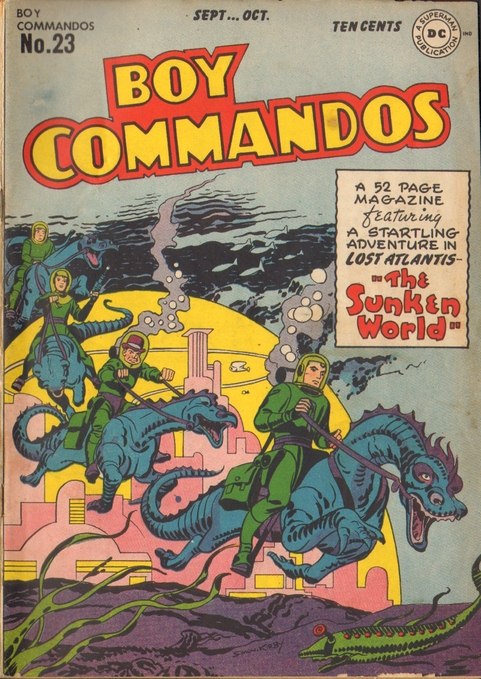 Evanier is particularly bad at identifying inkers. His slight of Frank Giacoia when he insists the Orion presentation piece was inked by Don Heck is relatively minor compared to the attribution of Kirby’s inking to Simon throughout the partnership. When Kirby returned to DC after the war, he wrote, pencilled, inked, and even coloured an issue of Boy Commandos, #23. Examining this issue should enable any inking spotter to see Kirby’s inks in his subsequent work. A good rule of thumb is Kirby’s pencil jobs, from that point up to and including some of his late ’50s work at DC, were predominantly inked by Kirby; if he inked, he likely wrote. Joe Simon’s artistic efforts were often done away from the studio, and speak for themselves.
The most compelling argument against Simon’s involvement in Challengers of the Unknown is the lack of physical evidence. Simon kept nearly everything that was produced, whether it belonged to him or not: all of the art used in The Art of the Simon and Kirby Studio came from his estate before being sold by Heritage. No S&K studio production materials or concept sketches related to Challengers exist, or Simon would have produced them (as he’d done for anything else he claimed).
Any official Kirby biography will ultimately be written by those who gain by minimizing his achievements, without the benefit of his review or even rudimentary fact checking against his own version of events. Despite Evanier’s snide remark amidst a decades-long Stan Lee-instigated smear campaign, the 1989 Comics Journal interview by Gary Groth remains the most accurate account we have from the three men, Kirby and the two collaborator/biographers who outlived him.
 accordingtokirby