This would qualify as an excerpt from an upcoming book but was dropped in the final edit.
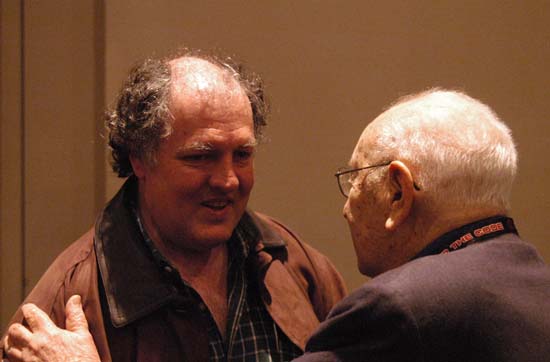
Jim Amash: You’re right about Roz not wanting to show Jack the Simon book. As a matter of fact, Roz even told me not to tell Jack I had read or even knew about it. That book really upset her.[1]
One person who didn’t get the memo from Roz about Joe Simon’s The Comic Book Makers was Mark Evanier. In 1998 he hosted a tribute panel for Simon at the San Diego Comic Con, and in its introduction[2] he detailed his machinations after Kirby’s death.
Mark Evanier: [Jack] gave some quoted interviews where he said some things about Joe that he regretted; and he said to me—one of the last times I saw him—that he wanted to call Joe and apologize to him or interview someplace else and make up for it. He passed away before that could happen. A couple of days after Jack passed away, I was with Roz and she asked me to please try to tidy up a couple of those little things that had not been done before Jack passed away—a couple of legal matters and a couple of things—outreach to people that I’m in touch with. I got in touch with Joe and it was really one of the most wonderful things in my life to know this man.
The idea that Kirby said regrettable things about Simon in interviews is itself a misrepresentation: Kirby was very careful with his words and more often than not demurred when asked about Simon’s contribution. Was Evanier really enlisted by Kirby to make things right? He wasted no time in casting Simon as the wronged party.
Worse, like Lee, Simon took advantage of Evanier’s gullibility to secure the “official” biographer’s endorsement for claiming certain of Kirby’s achievements as his own. Evanier is an unfortunate mixture: susceptibility to a smooth-talking interview subject, with no filter against being lied to. The question arises, how close was Evanier to the Kirby household toward the end if he’s still oblivious to the feelings of Roz regarding Joe Simon? Even Jim Steranko knew:
Jim Steranko: I had to fight to get paid for characters I created & wrote for him. He kept my presentation art without paying me, and later sold the material and kept the $$$. I once offered to pencil a series starring one of my characters and, in his infinite wisdom, he said, “YOU CAN’T DRAW!” Bottom line: swindler. Don’t believe me? Ask Kirby’s wife Roz![3]
Since she was alive at the time, did Roz approve Evanier’s overture to Simon? She wouldn’t have approved of the fruit of their liaison.
Why was Mark Evanier carrying water for, even fabricating on the spot, Joe Simon’s version of events after Kirby was no longer around to fact check it? Why did he aid and abet Simon by extrapolating from a legal document that doesn’t say what he said it did?
Mark Evanier: the very first thing Jack said to me about Joe was, “Joe could do everything! Joe could write ’em, he could pencil ’em, he could ink ’em, he could letter ’em.'”
Why wouldn’t Jack Kirby say nice things about Joe Simon, or exaggerate his talents? Kirby was a genuinely kind and generous human being. For Simon’s part, he rarely missed an opportunity to let his jealousy show by minimizing Kirby’s contributions or putting him down.
STEVE RINGGENBERG: How did you come to be inking over Kirby’s pencils on that “Race to the Moon” story?
AL WILLIAMSON: Well, Joe Simon gave me the job. Here’s something interesting: when I brought the first two or three jobs in, he said, “Now that you’ve inked it, what do you think?” And I said, “Oh, he’s great.” And he said, “Oh, don’t you think he’s not as good as you thought?” And I said, “No, I think he’s better than what I thought.” He was looking for me to say, “No, Jack Kirby can’t draw.” Sheesh. I loved doing those ink jobs. They were a lot of fun.
In the same interview,[4] Williamson describes Simon badmouthing him to Angelo Torres behind his back.
Mark Evanier: Now, as we all know Jack was not the greatest interview in the world and once or twice when he was interviewed people would get him mad—y’know you could push his hot buttons occasionally and make him mad about something; and sometimes he didn’t know the value of what he was getting mad at.
Here Evanier includes a put-down for Gary Groth’s TCJ interview.[5] This is the crux of his beef with Kirby: he resents him for giving an in-depth interview, not to him, but to Groth. To talk up his upcoming biography, Evanier touts epic exclusive interviews with Lee, Brodsky, and presumably as of 1996, Joe Simon, none of whom had reason to be remotely objective where Kirby’s concerned. Calling Kirby a lousy interview allows Evanier to dismiss what Kirby said while he was alive. The result is that Kirby’s former collaborators, who did grace Evanier with interviews, get to tell the Jack Kirby story.
What made Evanier disregard Kirby’s point of view while Kirby was alive? He was taken in by Lee’s heinous lie about plot credit, and committed it to print in his 1981 interview in Comics Interview #2:
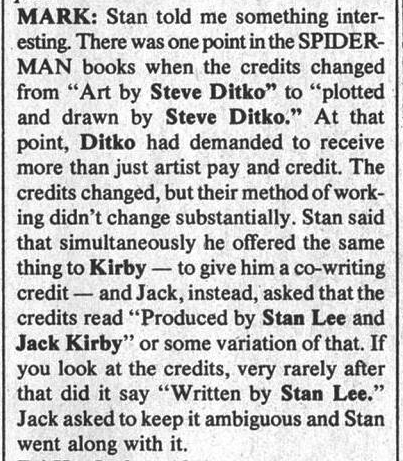
Lee’s timing is off with this fictitious anecdote and Evanier didn’t bother to check it with Kirby or the published work. The “Produced by” credit appeared over a year after Ditko’s plot credit and subsequent departure.
Patrick Ford: In the interview, Evanier comments he had just had lunch with Lee “a couple of weeks ago.” This is apparently where Evanier got the information Ditko asked for writing credit and money. Aside from Lee telling Evanier Ditko asked for writing money Lee told a bald faced lie by saying nothing changed between Lee and Ditko after Ditko asked for money. That’s a lie where the basic fact isn’t even in dispute. No one believes nothing changed. Lee himself admitted that as far back as the Nat Freedland interview in 1966. Even Roy Thomas today says it was Lee who stopped speaking to Ditko.
Lee begins using the Ditko plot credit on Amazing Spider-Man #26 and says he offered Kirby the same. Issue #40 of the Fantastic Four was published the same month (April 8, 1965). Ditko began getting the plot credit Lee claims Kirby turned down in favor of a “Lee-Kirby Production” credit. FF #40 credits Kirby for “artwork,” Lee is credited with “script.” FF #55 credits Kirby with “penciling” and Lee with “script.” This a year and a half after Lee claims he offered Kirby the same plot credit he “gave” to Ditko. It wasn’t until August 9, 1966 (long after Ditko quit in November 1965) that the first “Co-” credit appears in FF #56. Within a few months Lee was using the same credit on just about everything. Needless to say these facts make Lee’s claim highly suspect and it’s disappointing that Evanier not only didn’t double check with Kirby but didn’t bother to look and see that it took Lee from April 8, 1965 (ASM #26) until August 9, 1966 (FF #56) for Lee to give Kirby the credit Lee claims Kirby asked for in lieu of a writing credit. A period of 16 months.
Ferran Delgado: And let’s not forget Amazing Spider-Man #100 [the credit box that reads “Created & Written by Stan Lee”].[6]
Altruism?
Mark Evanier: And the more I learn about what Joe did for Jack in his career, the more I learn about what he did for Jack during all the years they were together; when, later on, Joe protected the rights to a lot of things that Simon & Kirby co-owned, he gave Jack his share—things a lot of people wouldn’t touch at the time. He voluntarily took the expense and the trouble to legally protect those things.
Evanier was misled: these claims of Simon’s, uncritically relayed, are provably false. Simon potentially made deals with the work of Kirby (and others) for decades without cutting Kirby in. Evanier himself testified[7] as much:
Mark Evanier: I am at a loss to explain why there was a Foxhole #7 done by Charlton writers and artists. When I asked Jack about it, he said there was no such comic; that Charlton would have had no right to do that. Then I showed it to him and he was baffled how it could have come about. Simon didn’t recall, either, but said that maybe (because the company was in dire straits due to the flood) they gave permission to use the title… or something.
In the Bruce Hamilton interview,[8] Kirby admitted he was aware that a reprint deal had been arranged behind his back.
BRUCE: Are you familiar with this new publisher Skywald? Do you know the story behind some of the old comics they’re reprinting?
JACK: Well, it’s probably a simple story. I don’t know the story behind it, but I’ve done the same thing in the past myself. Purchasing old artwork cuts down on costs. I see they got hold of some of my old Bullseyes. I don’t know how they did that, but I’m quite sure they bought it legitimately; but I don’t know from whom.
For The Art of Jack Kirby, Ray Wyman, Jr conducted an estimated 40 hours of interviews with Jack (and Roz) Kirby. Gary Groth figures the TCJ #134 interview, spread over two sessions, exceeded three hours. For whatever reason, Mark Evanier has no such repertoire of Kirby interviews on which to draw, so he resorts to dismissing Kirby as an interview subject and playing up his “exclusive” interviews with those who didn’t get enough of taking from Kirby while he was alive. In addition, the very vapourware announcement of his “official” biography nearly 30 years ago has prevented other efforts from being published. Wyman’s interviews are relegated to excerpts in the pages of the Kirby Collector.
The 1998 Simon panel intro was expanded by Evanier into a 14-page introduction to Abrams’ The Art of the Simon and Kirby Studio (2014).
Mark Evanier: Joe was better at designing covers and splash (opening) pages. His time spent in newspapers and advertising had taught him much about typefaces and designing so as to grab the reader’s attention. Joe was also better at inking…
Evanier, who doesn’t have a clue in discerning[9] Kirby’s (or others’) inking, is the last person who should be pontificating on who was S&K’s best inker. He gets it wrong, not based on what can be seen in the work, but based on what he was told after Kirby’s death.
Mark Evanier: Joe was better at designing covers and splash (opening) pages. His time spent in newspapers and advertising had taught him much about typefaces and designing so as to grab the reader’s attention. Joe was also better at inking…Joe Simon, though older, outlived his famous partner by nearly eighteen years. For much of that time, he did what he’d done so well since the day they met: He protected the interests of Simon and Kirby.
Mark Evanier clearly demonstrates here that he doesn’t know what he’s talking about. His willful and spectacular ignorance regarding Kirby’s contribution is being used to perpetuate Simon’s myths. Simon’s forté was running the business, something at which on occasion he also proved to be inept.
It was Kirby who was the master inker at S&K, inking his own work and touching up pages inked by others in the studio. It needs to be noted that the Abrams book is comprised of original art belonging to Kirby and others that was retained by Simon until his death in 2011. Simon protected the interests of Joe Simon.
Evanier has used his position as Kirby expert to arrogate the telling of Kirby’s story to a pair of lifelong prevaricators while peddling disdain for Kirby’s more accurate account. Worse, the ghost of Jack Kirby that he channels can be made to deliver any words or attitudes that suit the Lee-Simon narrative.
ENDNOTES
[1] Jim Amash, Kirby-L mailing list, 29 January 2000.
[2] “More than your average Joe,” The Jack Kirby Collector #25, August 1999.
[3] Twitter, 15 July 2013.
[4] Al Williamson interviewed by Steve Ringgenberg, The Comics Journal #90, May 1984.
[5] The Comics Journal #134, February 1990.
[6] Marvel Method group, 27 December 2023.
[7] EC Yahoo Group, 8 March 2004.
[8] Rocket’s Blast Comicollector #81, 1971.
[9] A page on the Kirby Museum website about the New Gods #1 cover takes a sly dig at Evanier who insists Kirby’s Orion concept drawing was inked by Don Heck rather than Frank Giacoia. A quarter of a century after the UK’s Mike Lake made the call, Evanier was a lone holdout in accepting George Klein as the inker of the first two FF issues until he was given a personal consultation on the evidence by Michael Vassallo.
 accordingtokirby