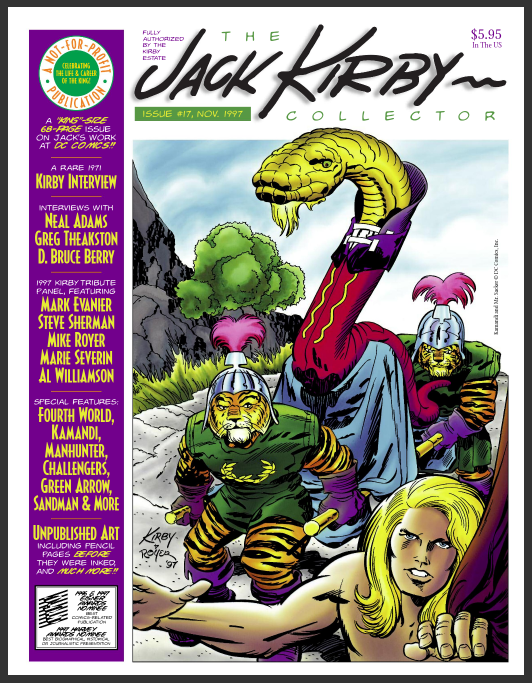
 It’s been a long time since a new issue of The Jack Kirby Collector was an event, or even an experience to be savoured (like the one above). The preview of #94 is online and it continues the trend. It includes a Kirby-Lee radio interview transcript previously printed in Stan Lee Universe, as well as the transcript of a Kirby-Lee convention panel featuring Mark Evanier and Danny Fingeroth. Here’s a rundown of the current cadre of the magazine’s contributors.
mark evanier
When I think of Evanier buttonholing Roz Kirby (not sure if this is accurate but I picture it at a funeral) to be ordained as the “official” Kirby biographer, 1 a scene from The Big Chill comes to mind (paraphrased):
Evanier: Hey Jack, you know, we go back a long way.
Kirby: Wrong, a long time ago we knew each other for a short period of time.
Following the end of his professional relationship with Kirby, Evanier showed his willingness to read Stan Lee’s nonsense claims directly into the interview record without bothering to call Kirby for a fact check. 2
Three years before epic Kirby interview season began (Gary Groth’s self-contained interview and the beginning of Ray Wyman, Jr’s 40 hours of recordings over three years), Evanier had his own chance. His Kirby interview was published in Amazing Heroes #100, and although some nice sentiments were expressed by Kirby, Evanier simply didn’t have what it took to interview him. Unlike Groth, he shied away from tough and timely questions about Marvel—he didn’t want to hear the answers. (Unknown to Evanier and everyone else, the Leonard Pitts, Jr interview conducted just a few months earlier covered the same ground as Groth’s, but it wouldn’t be made public for decades.)
And what about the optics of bringing Marv Wolfman along to the interview? The pair 3 represented the stolen art collecting establishment at a time when Kirby’s art was a sensitive topic. 4 Were they trying to send the message, “Jack, if you persist in making waves, some of your ‘friends’ are going to get hurt”?
After Kirby’s death, Evanier by necessity became the enemy of a good Kirby interview because he didn’t have one of his own. That’s when he labelled Kirby “confused” and a lousy interview. His first crack at a biography, King of Comics 5 was sufficiently damaging to Kirby for its unambitious scope; the ultimate work promises to be told by the “good” interview subjects (Lee, Simon, and Brodsky) who will be permitted to divide the spoils of Kirby’s legacy between them. In the readership of the Kirby Collector, Evanier has found the audience for his someday biography: those who want Kirby to be seen and not heard.
roy thomas
Roy Thomas is the world’s biggest Kirby denier. The very truth about Kirby’s life threatens the narrative Thomas has spent his career crafting since Kirby’s departure from Marvel in 1970.
Twenty issues ago (#74) I wrote in to object that an interview with Thomas was featured in a publication ostensibly about Kirby. The very next issue was Stuf Said, in which Thomas was cited extensively. Morrow wrote of him “in working with him since 1997, I’ve never found him to be anything less than 100% fair, professional, and honest.” Amusingly, Thomas is one of those people who can scarcely open his mouth without telling a lie about Jack Kirby.
Roy Thomas is not shy about his politics: he’s Stephen Miller to Kirby’s Biden, accusing him of Lee’s misdeeds. In recent years, he and his “manager” have been posting far right-wing podcasts. 6 Thomas is not alone in his leanings among the TwoMorrows stable: Pierre Comtois, author of the Marvel in the 1960s/1970s/1980s series shares his MAGA bent on social media. In Book 2 of his series, Comtois was permitted by his publisher to rail against Kirby, portraying him as the homewrecker who abandoned his surrogate dad and ruined his childhood.
will murray
Will Murray is the long-time comics “journalist” who twice in the last century gave us the “secret” or “hidden” origins of the Atlas monster stories that had in fact been written and drawn exclusively by Jack Kirby. In 1984, Murray revealed after talking to Stan Lee that although Kirby influenced the stories, Lee was the writer. In another interview, Murray tried to pin Lee down about why the stories weren’t signed (not a single Kirby “monster” story was ever signed by Lee), but when Lee said if he signed it, he wrote it, Murray failed to follow up with a list of unsigned stories.
After Kirby’s death a decade later, Murray was let in on yet another “exclusive” secret by the Marvel brain trust which he shared with the world: Larry Lieber secretly wrote Kirby’s monster stories from Lee’s plots. Nothing about this so-called revelation is true: Kirby plotted and dialogued his own stories. If Lee came up with a plot, it was by reading Kirby’s completed pages. Before he started getting credits in December 1962, Lieber never wrote for Kirby, and the physical evidence says not even then. The credits were fraudulent: Kirby blasted Lee and quit those titles as soon as he’d caught on.
Murray has recently made regular appearances in Alter Ego and Kirby Collector, sometimes with multiple pieces per issue. The trouble with Murray’s point of view is its grounding in the Marvel mythos, how the “revelations” he’s presenting spring out of the Lee-Thomas narrative. His articles are not suitable for a publication about Jack Kirby.
danny fingeroth
Danny Fingeroth is a Stan Lee hagiographer who constructed a false narrative about Kirby (“he was bitter”) in order to explain away negative testimony against Lee by the early ’60s Marvel writers, Kirby, Steve Ditko, and Wallace Wood. His very appearance in the Kirby Collector, like that of Thomas, is a travesty. Hopefully his presence is an aberration and he will only be around for this Kirby Collector Stan Lee tribute issue.
Like Comtois, Fingeroth’s stunted adulthood was forged amid the tragedy of an imaginary household broken up by Kirby, while Lee taught him to read with 50-cent words he didn’t know how to use.
john morrow
After 14 years and 41 straight issues, I passed up on the opportunity to buy Kirby Collector #58, The Wonder Years, off the rack. 7 The cost of a subscription to Canada has always been prohibitive, and I’m thankful I wasn’t dinged the price of two subscription issues for this monstrosity.
John Morrow signalled his intentions for the future of his “Jack Kirby publication” with The Wonder Years. It’s a re-imagining of the nearly decade-long Kirby-Lee team-up on Fantastic Four by Mark Alexander, a guy who up until his then-recent death lived in the fantasy world where Kirby executed Lee’s cosmic vision. In an afterword, Morrow provides a weak disclaimer stating he’s in disagreement with a few of Alexander’s assertions.
The last hard copies of Kirby Collector I bought were four issues between #61 and #66. The only ground-breaking articles in the last forty issues are contained in this span, one by Mike Breen 8 and one by Jean Depelley. 9
The doddering, demented fascist gangster currently tasked with destroying the planet enjoys a concerted effort called “sanewashing” at the hands of the complicit mainstream media. Stuf Said (my own dissection starts here) was Morrow’s attempt at whitewashing Lee’s gangster phase, presenting selected Kirby quotes but drowning them out with the help of a rogues’ gallery of self-interested revisionists, including Thomas, Larry Lieber, and John Romita. Joe Simon’s fabulist accounts are presented as fact.
John Morrow has surrounded himself with true believers, both contributors and readers, MMMS cultists who prefer dwelling in a simpler time when Lee’s “artists” knew their place. He sides with Thomas, Comtois, and Fingeroth, believing that, despite what the only reliable witness besides Kirby himself, Steve Sherman, said to the contrary, bitterness defined Jack Kirby. They’re only able to see him in terms of their own frame of reference. At the end of Stuf Said, we’re left with the feeling that Kirby was bitter and mean-spirited enough to commit Funky Flashman, but with no sense that Stan Lee spent a decade stealing pay from multiple freelancers and even longer publicly smearing those who disagreed with his methods. That’s the kind of world the cult members want to inhabit, and Morrow provides it.
Casting about for something nice to write, I remember a favorite review that once said about Immortal Beloved, whatever its failings as a film, it had a helluva soundtrack. The artwork in The Jack Kirby Collector can’t be beat, but like Silver Age Marvel, the editorial content ignores Kirby’s writing and never lives up to its promise.
Thanks to Four Color Sinners and their unwavering persistence.
Footnotes
back 1 This effectively put a stop to further editions of the best Kirby biography to date, the then-new Art of Jack Kirby.
back 2 The “Produced by” credit, Comics Interview #2. See here for details.
back 3 With Kirby safely dead, Evanier bragged on Kirby-L about the Journey Into Mystery #83 (Thor’s origin issue) splash framed in his office while explaining that holding members of the thieves’ market to account wasn’t cut-and-dried, that there were grey areas not considered by the artist-victims. Wolfman had been the public face of a company Silver Age stolen art liquidation operation. Now he’s comfortable enough to advertise sales from his cache on Facebook while continuing to protect the Art Thief-in-Chief and his lieutenant. Guilty by association (she’s in the event’s photographs), Irene Vartanoff had the sense to deflect while conducting the company’s official post mortem of the 1960s theft rampage: “Brodsky said not to tell Lee what’s left or he’ll help himself.”
back 4 Wolfman appeared the same year on an SDCC panel regarding Marvel’s return of Kirby’s original art. Presumably he held the opinion that Marvel could be held accountable to return the art but individuals could not.
back 5 Four Color Sinners has a good assessment of King of Comics here.
back 6 Four Color Sinners again.
back 7 Having chosen to write Kirby-centred books denouncing the worldview being presented, I got the book a few years later from Amazon at a discount. For the same reason, after quitting on principle after the Thomas interview, I resumed getting the PDFs of new issues.
back 8 The Breen article proves that Kirby added the finished dialogue to Fantastic Four #6 himself, and all Stan Lee did was sign the splash pages. Breen comments that this was the normal workflow between the two; typically the only exception was Lee’s dialogue after the fact. Unremarked in the article is Lee’s incredible laziness, which will be the subject of future books by others.
back 9 Jean Depelley’s article puts the lie to another detail of Lee’s false origin stories, that Amazing Fantasy was slated to be cancelled before he snuck in Spider-Man, a character Martin Goodman supposedly hated. Depelley shows convincingly that Ditko and Kirby both drew stories for further issues of the title before it was cancelled. Kirby’s entry was dismembered and run over a year later with a Lee blurb falsely claiming Kirby ripped off a Ditko story. Ditko and/or Sol Brodsky had swiped the fight scene of the Kirby version for Amazing Spider-Man #1.
 accordingtokirby