Hi John,
It was nearly six years ago that I wrote to ask you if you knew what your Alter Ego editor was up to (calling Kirby advocates “***holes,” asterisks his, through a third party on the letters page right above my own letter). Instead of addressing my concern, you asked me to stop “insulting” you with criticism in your inbox. I’ve lost the compulsion to find nice things to say, so here we are.
For the purpose of this discussion, I’d like to introduce you to these mantras. I’ll come back to them later. The first one, if spoken out loud, gets you branded a Lee hater; “for starters” is implied after the third one.
1 Jack Kirby was a writer
2 Roy Thomas didn’t arrive on the scene until 1965
3 Stan Lee stole ten years of Kirby’s writing pay
In an earlier letter, I wrote to tell you that I thought it was inappropriate to include a Roy Thomas interview in the Kirby Collector. That was one issue after your “Big Boy Pants” editorial criticizing readers who refused to Learn to Love Stan Lee. (I can’t imagine you have many of those left.)
From your reply…
Your implication that we’re pandering to Lee fans to make sales is simply off-base. I don’t see things in the same black and white view as you. I respect your opinions and way of looking at things; I hope you’ll try to respect mine, even if you don’t agree with them, and aren’t interested in purchasing our publications.
Maybe the best example I can give you is a conversation I had with Roz Kirby before she died. I told her I was thinking of running an interview with Stan in TJKC, and asked if that would bother her. She thought about it for a few seconds, then said, “That’s fine. Just don’t let him say anything stupid.” Not a “Don’t you dare give that man a forum to badmouth my husband” or anything like that. If Roz was okay with it, and at a time when Jack really wasn’t getting a smidgen of the respect he’s getting now, I’m confident I’m doing okay by her, and the whole Kirby family.
I dealt with the Thomas interview in a three-part blog post starting here.
The very next issue was Stuf Said, in which Thomas was awarded the honoured position of Kirby expert.
 Your magnum opus, an exploration of things said that demands a verdict but cops out, fails even to do justice to an actual court case, Marvel’s lawsuit against the Kirby family. You were an inside witness to the proceedings, having access (unlike nearly everyone else on the planet) to Lee’s unredacted depositions, but like Mark Evanier you incuriously passed at the chance.
In your Stuf Said account you seemed to have it in for Kirby family attorney Marc Toberoff, accusing him of Making Shit Up. When readers set you straight on the facts, you removed the last sentence in the paragraph.
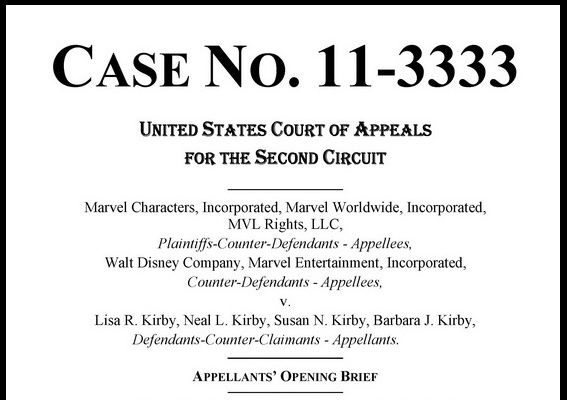
 Toberoff’s assertions in his opening appeal brief (below, see here for PDF) were backed up with citations . You characterized his early strategy as “dead in the water,” yet you failed to acknowledge he was playing the long game: he took the case to the steps of the Ginsberg Supreme Court, and he won.
 You quote Lee’s May 2010 deposition but don’t mention that he was deposed again on December 8th. The excerpts you chose appear to be tailored to your conclusion, “I don’t think Lee is lying here, but to be fair, these are skillfully asked (and answered) questions. Read them closely…”
John, after you’ve wallowed in this stuff for nearly 30 years, I’m fairly certain you wouldn’t recognize a lie if it bit you on the ass: close reading is not necessary. The word perjury doesn’t appear once in either edition of Stuf Said, yet Lee claimed, one by one, that he created every property in question (here’s my collection of excerpts from which not a single statement, made under oath, is true). Marvel’s lawyers couldn’t have written a more slanted account of the court proceedings than Stuf Said. Oh, wait…
The most important quote in Stuf Said, sadly drastically edited, came from Steve Sherman (full quote following). I considered it important enough to include in other blog posts and both of my books. It would have been better placed next to Lee’s testimony because it is central to the truth you studiously avoid in the book, and as integral to the story of Jack Kirby as Mantra #1.
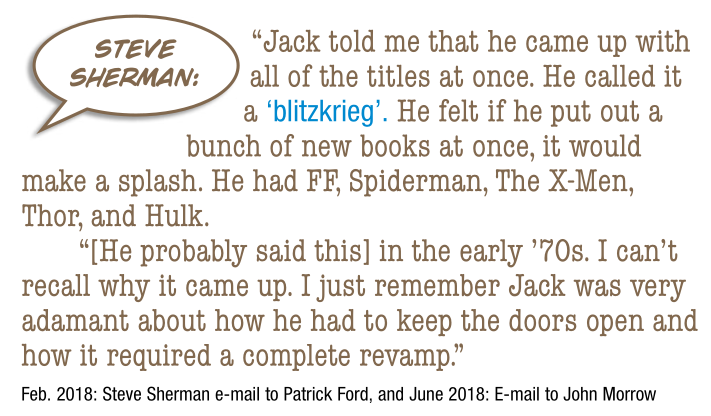
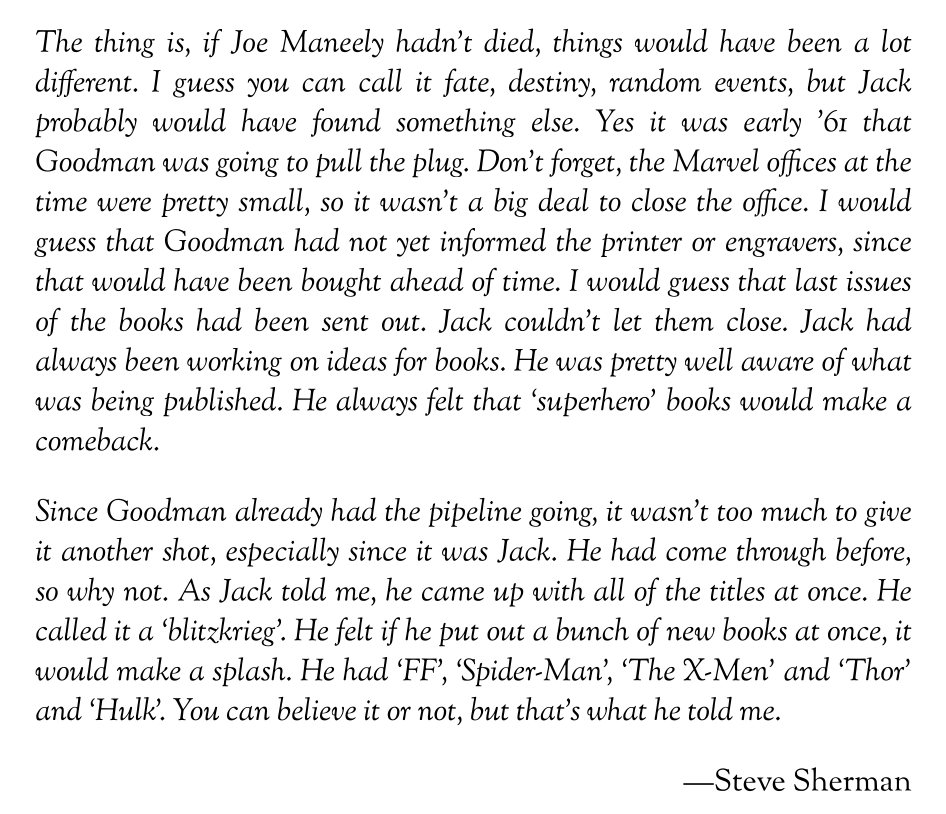 It wasn’t the only time Kirby had told the story. 1 Unlike Mark Evanier, Steve Sherman tended to take Kirby at his word.
The latest issue
TwoMorrows was instrumental in the spread of the Roy Thomas “received history,” giving it a platform in 1998 in issues of Comic Book Artist and Alter Ego under the same cover. Thomas had told Jim Amash just months earlier (and here keep Mantra #2 in mind) that his knowledge of events prior to his arrival at Marvel came from Stan Lee and Sol Brodsky. Both Lee and Brodsky were management to Kirby’s labour, giving Thomas the Company Man fuel for his preconceptions. (Yet Thomas was deeply embedded in the operation and knows better than anyone alive the magnitude of the lies he tells.)
 That brings us to Kirby Collector #94.
Let’s start with the letters page. Thomas takes Richard Kolkman to task for suggesting Peter Parker was named after Peter Parr from an unused 1950s Kirby comic strip proposal. Thomas is spouting his usual wall of nonsense: 2 the likely true answer is that Kirby named the character in his Spider-Man concept pages along with Uncle Ben. Steve Ditko later wrote that it was between Kirby and Lee to make the call as to which of them originated the concepts.
Next, Thomas suggests Kolkman had it wrong crediting Larry Lieber with “all the scripting,” and says Lee plotted, citing the GCD and “other authorities.” The GCD is an authority on nothing, having cynically farmed out its research to Marvel lawyers. After 2014 the site issued a blanket credit that says “Stan Lee ? (plot) Larry Lieber ? (script)” on all of Kirby’s “monster” stories.
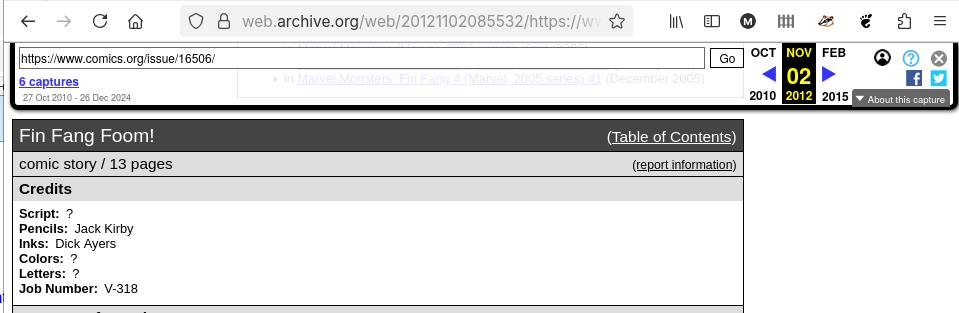
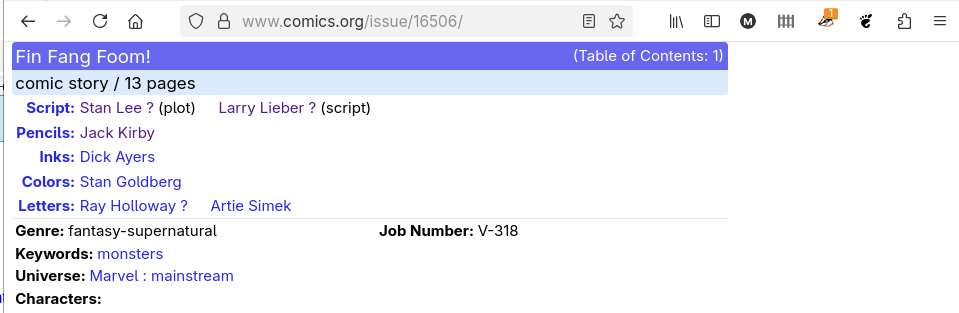
The only places the site is to be trusted is where it says “Nick Caputo indexed this issue after holding the physical comic in his hands.”
Here Thomas creates a circular reference, citing a source that parrots the false narrative he helped bring into being in the late 1990s. When he asserts Larry Lieber had anything to do with Kirby’s monster stories, he’s repeating a lie invented in 1995. Stan Lee first took credit for a monster story in 1973 by adding a “script” credit to the reprint of “The Two-Headed Thing” in Monsters on the Prowl #26; he hadn’t signed the original story in 1962, or a single other instance of a Kirby monster story. His next mention was in Origins of Marvel Comics when he claimed he and Kirby were “having a ball doing the monster stories.” Lee maintained this charade through the early ’90s and Kirby’s death. With Kirby out of the picture, Lee enlisted his brother to claim he’d written the Kirby monster stories. This revelation came courtesy of the ever credulous Will Murray with his Lieber article in Comics Scene #52 in 1995.
Not only is there no physical evidence that Lieber had anything to do with a Kirby story before his first credits on stories cover dated December 1962, it’s provably false that he scripted at least two of those first-credited stories, which were scripted by Kirby. Lieber received a total of ten script credits on Kirby stories over three months before being fired as Kirby’s credited scripter. The action was likely demanded by Kirby when he learned that his writing pay was being redirected to not one but two freeloading Lieber brothers. We can probably safely round it up to an even zero that were legitimately “scripted” by Lieber before the fact (and Lieber insisted that he only ever worked full script rather than Marvel Method, adding dialogue after the fact).
Please do me this favour, John. While Will Murray is writing for the Kirby Collector, and Larry Lieber is still alive, have them reprise their 1995 interview. The key question to be asked is, “Larry, why did you never mention this while Kirby was alive?”
At the end of the Thomas letter, you direct readers to Evanier and Fingeroth discussing “Lieber’s early Marvel work” as though it’s a fact. Let’s take a look.
I’ve never seen it, and of course I would say that’s an outright lie.3
Danny Fingeroth is a Lee hagiographer, hence JAKD (Just Another Kirby Denier). He has no place in a Kirby publication, even as a guest, so of course he’s right at home in this particular Lee tribute issue of the Kirby Collector. In Fantastic Four #1 Panel by Panel, Evanier lent his imprimatur to the Lee narrative by insinuating Kirby’s TCJ declaration (above left) was a lie:
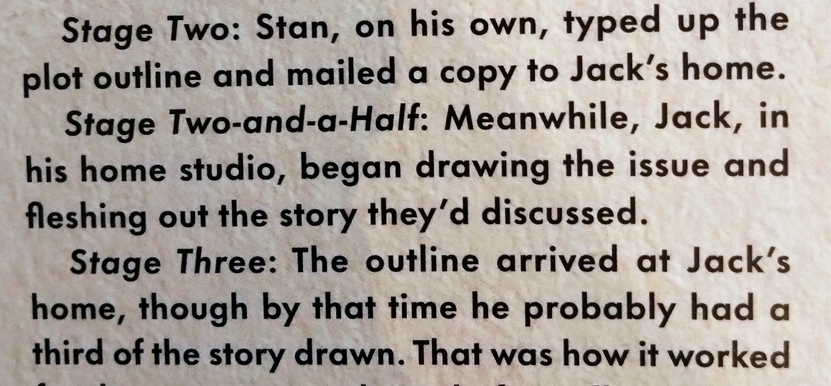
Perhaps no one informed Evanier that after allegedly being seen by Thomas in Lee’s office “late ’60s,” the alleged “synopsis” turned up in the Marvel offices “behind a drawer” in 1982.
In the panel transcript, Evanier actually had a couple of good things to say about Kirby, such as setting Fingeroth straight that Kirby never sued Marvel, and that Kirby and Lee never reconciled. Sadly he then chose to comment on the “monster” stories, making it obvious that he hasn’t read them. (In fact his entire body of writing makes it obvious he hasn’t read much of any of Kirby’s work from before 1961 or after 1978.)
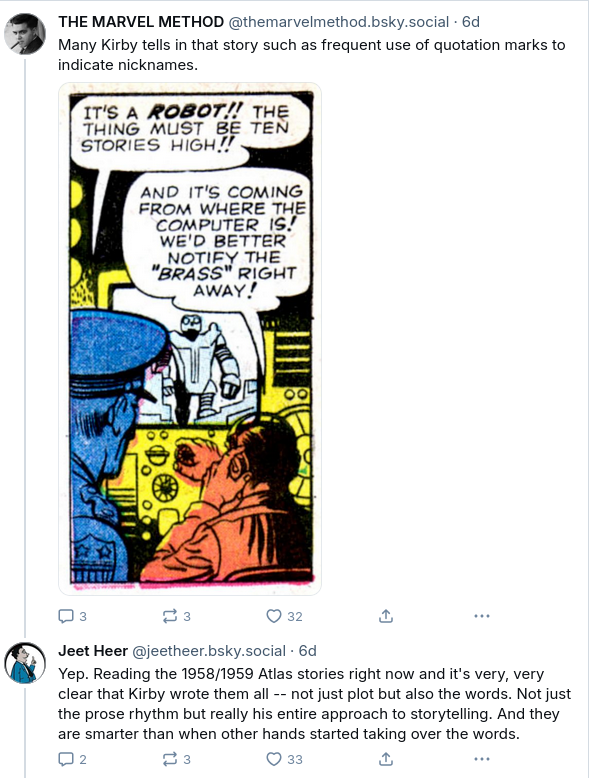 At the end of the panel transcript, an excerpt from another Thomas interview is presented, this time with Alex Grand, just a couple of MAGA bros shooting the breeze. The two cults, MAGA and the MMMS, have many parallels.
Featured here is one of Thomas’ greatest hits. He tells the familiar drawn out story of how he was instrumental in the re-hiring of Kirby, but the punchline is always that Kirby’s hiring was presented to him by Lee as a fait accompli and he really had no say in the matter. The purpose of the anecdote is to make out that Kirby’s Funky Flashman story could have been a consideration in the decision (but wasn’t).
The moral of Funky Flashman is Mantra #3 (and Lee’s criming didn’t stop at wage theft, but more on that in the near future). With you as publisher and with your whole-hearted agreement, Thomas is permitted to repeatedly make the case that Kirby’s action was bitter and mean-spirited, yet nothing could be further from the truth. Kirby responded to a decade of wage theft by way of his craft, in a manner that was measured, accurate, and brilliant. Thomas promotes the idea of Lee as victim who “didn’t know why they left,” when the reality is Lee drove them away one by one with malice aforethought when they wouldn’t willingly accede to his self-enrichment at their expense.
Jack Kirby accurately assessed Stan Lee as a man without empathy. 4 He also had something to say that applied to Roy Thomas, although not by name: “something is missing.” Thomas in the Kirby Collector #74 interview:
the thing I remember about it is Jack was very friendly, because I was still in awe of Jack, you know? Despite the fact that I had hit the wall with that New Gods stuff and everything.
Kirby in 1983: 5
Glorious Godfrey I felt was a parable. The New Gods were a parable. I’ve read interviews with other artists who say that, well, they try to figure out the New Gods and they don’t know what it’s really all about. And I think that’s sad, because they themselves lack something… they themselves lack something which keeps them from understanding what a parable is. It keeps them from understanding a relationship of this parable with our own times.
You’ve given Thomas a platform, and you look the other way while printing Lee’s propaganda. Because Roz Kirby didn’t tell you “don’t you dare give that man a forum to badmouth my husband,” you made it your goal to provide a forum for Kirby to be badmouthed at every turn with the repetition of their lies.
In your email response I quoted above, you told me Kirby Collector probably wasn’t for me because, in your words, I couldn’t muster even 1% credit for Lee in the “collaboration.” Re-characterizing my position so you can knock it down is a cheap rhetorical cheat favoured by MMMSers, so that tells me precisely where you stand. The truth is that Lee contributed a lot to the finished product, but nearly nothing in advance of Kirby the creator and master storyteller putting pencil to paper to write and draw completed stories.
The apparent purpose of the Kirby Collector, to quote a movie based on Dickens, is “to preserve a way of life that one knew and loved.” But like “America” when it was “great,” Marvel of the 1960s was not great for Kirby or the other freelancers. Thanks in part to Marvel itself, people are reading the stories and looking at the art, and unlike you and the writers you publish, they’re going to believe Jack Kirby and the physical evidence over the false narrative. You’re not going to succeed in MSGA, making Stan great again. The truth about Kirby will be known despite, not because of, The Jack Kirby Collector.
Mike
Footnotes
back 1 I came in with presentations. Kirby to James Van Hise, “A Talk with the King,” Comics Feature #44, May 1986.
And I came up with this blitz. I came up with The Fantastic Four, I came up with Thor (I knew the Thor legends very well), and the Hulk, the X-Men, and The Avengers. Kirby to Gary Groth, The Comics Journal 134, February 1990.
The Sherman quote appears in my book, Kirby At Marvel:1956-1963, Second Edition as well as in Ferran Delgado’s Sky Masters of the Space Force: The Complete Sunday Strips in Color (1959-1960).
back 2 The Roy Thomas Rebuttal Strategy is avoid responding to the physical evidence that was just presented and pontificate like he knows better simply by virtue of having worked with Lee in the ’60s. My own encounter is documented here.
back 3 Jack Kirby to Gary Groth, The Comics Journal 134, February 1990.
back 4 It takes a guy like Stan, without feeling, to realize a thing like that. If he hurts a guy, he also hurts his family. His wife is going ask questions. His children are going to ask questions.—Jack Kirby to Gary Groth, The Comics Journal 134, February 1990.
back 5 Jack Kirby video interview by Theakston and DiSpoto, 17 March 1983.
 accordingtokirby