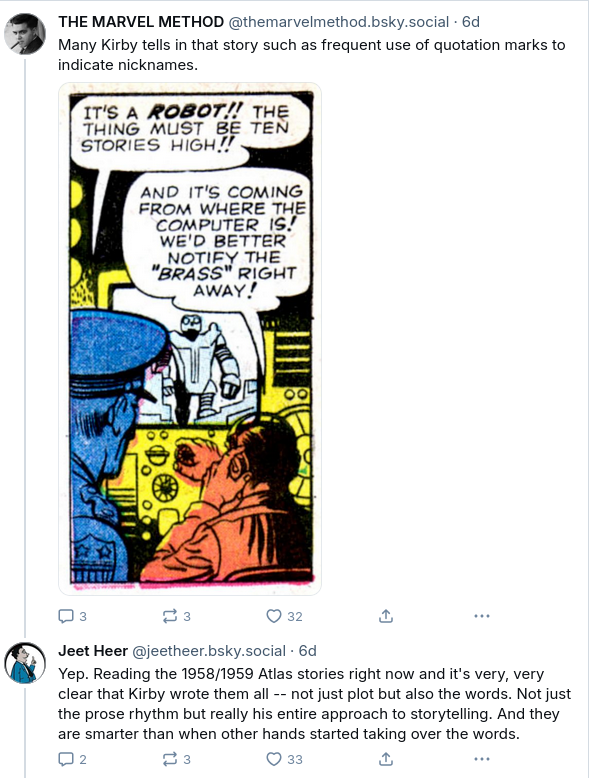
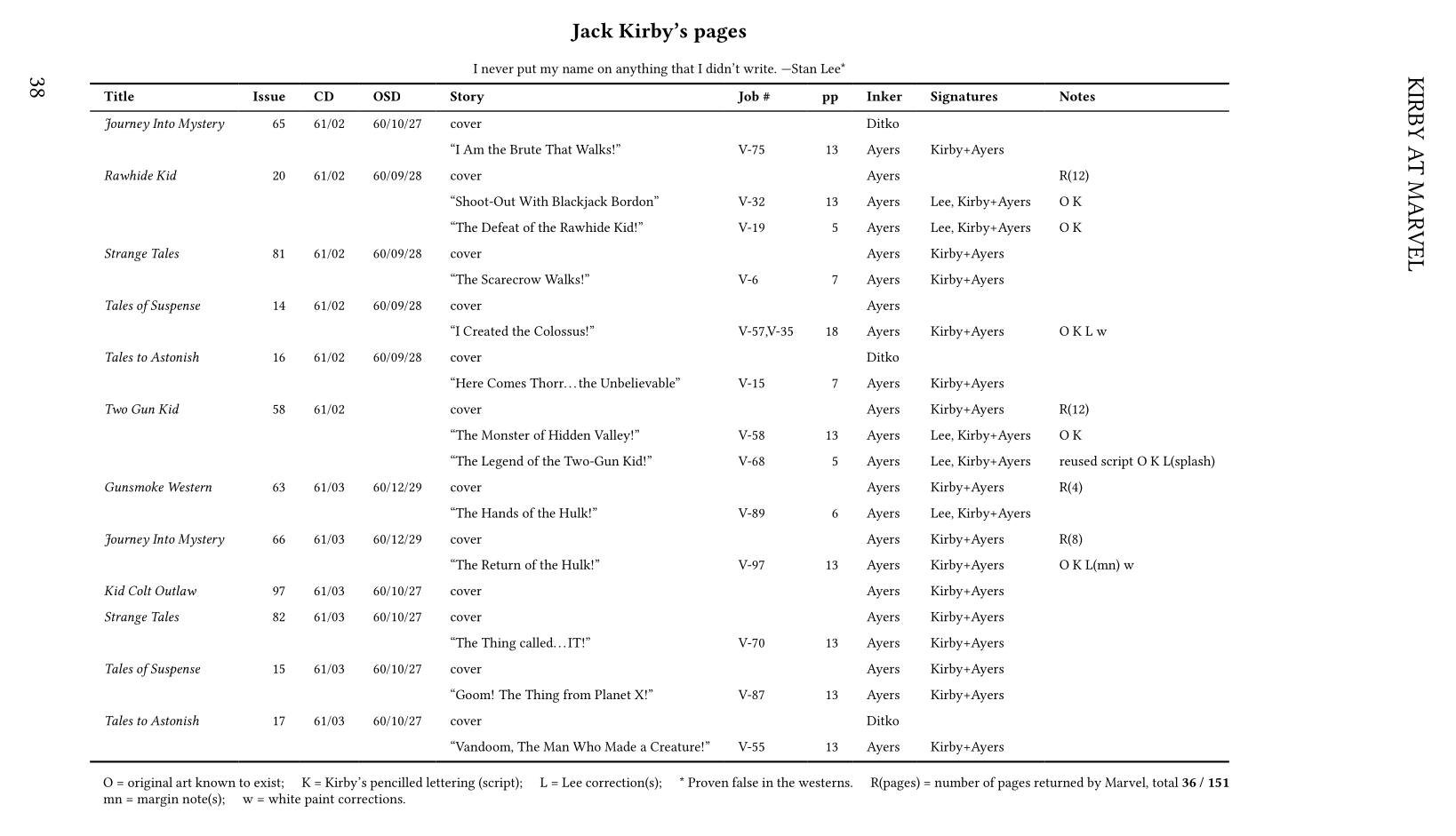
During his ambitious undertaking to read through Jack Kirby’s life’s work, Jeet Heer discovered an omission in my story listing in Kirby at Marvel. He sent me a correction for the table in Chapter 4 (1963).
One small correction: in the index for Love Romances #105, both stories have credit — they read “story by Stan Lee” although Kirby didn’t sign — and I suspect Lee had minimum contribution. One indication that Lee was trying to ride Kirby’s coat tail across the Marvel line even in the romance books that were almost dead.
The content is already updated at Lulu.com; Amazon, which requires jumping through an extra hoop, will follow. The increased printing cost compared to last year combined with currency fluctuations required some price adjustments. I noted that although some of the prices are up slightly, the Canadian price is down by $3.
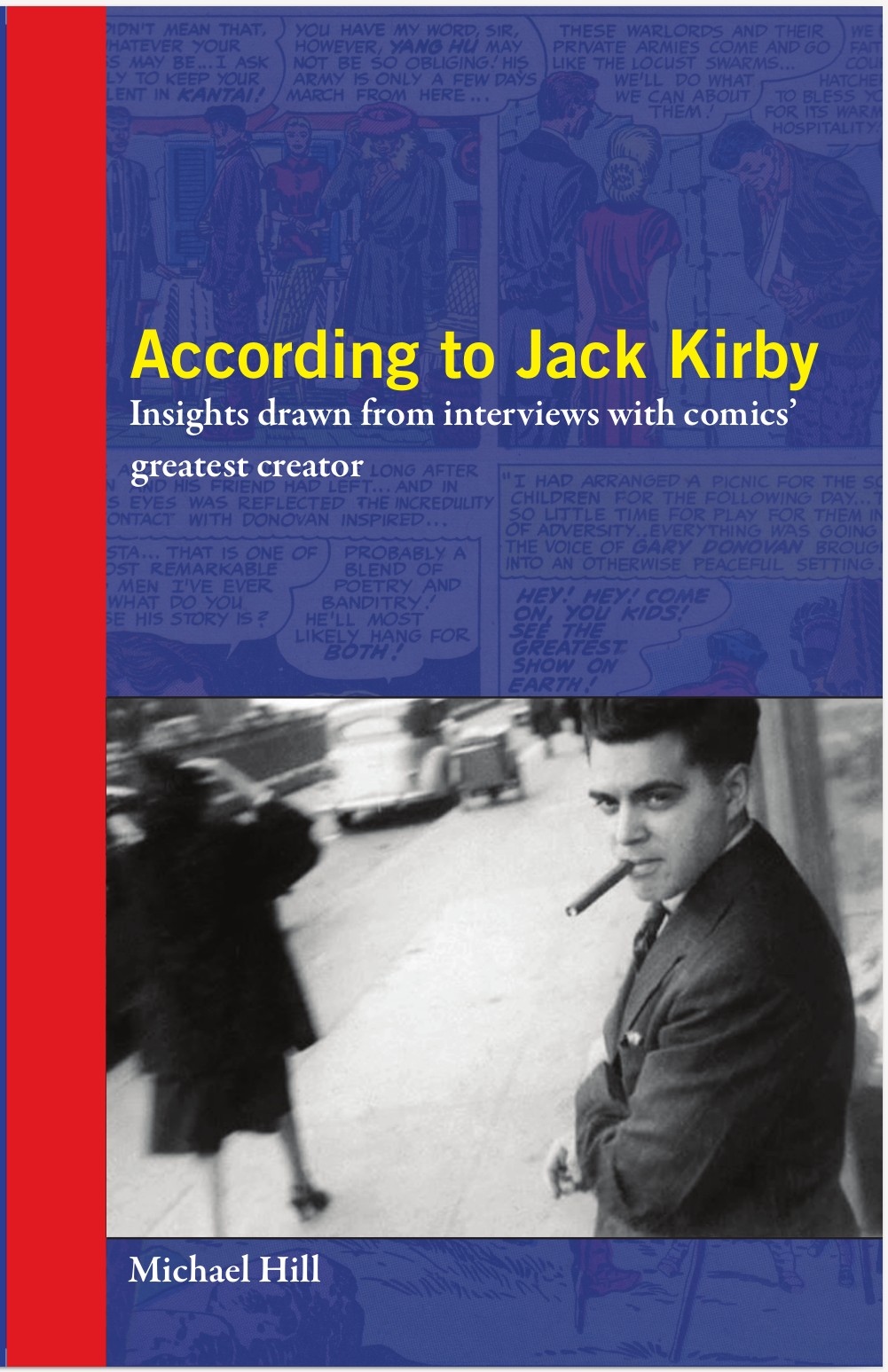
I added this blog to my Goodreads author page, so a word about where the books can be found. For my first book and the first edition of the second I formatted the manuscripts using Pressbooks online and published on Lulu.com. There wasn’t much effort involved to also publish Kirby at Marvel 1e through Amazon’s KDP program, so it was available in both places.
For the second edition of Kirby at Marvel, I typeset the book on my laptop using LaTeX. I wrote about details of the process here.
For reasons undisclosed, Amazon rejected the PDF of the manuscript I generated using free software. For it to be accepted, I needed to flatten the file which had the effect of measurably reducing the quality of the reproduction, particularly the images: the PDF size went from 58 megabytes (Lulu) to 14.2 megabytes (Amazon). Amazon is convenient but the Lulu version is visibly superior.
Steve Meyer helpfully provided this link for locating my books in the Lulu bookstore.
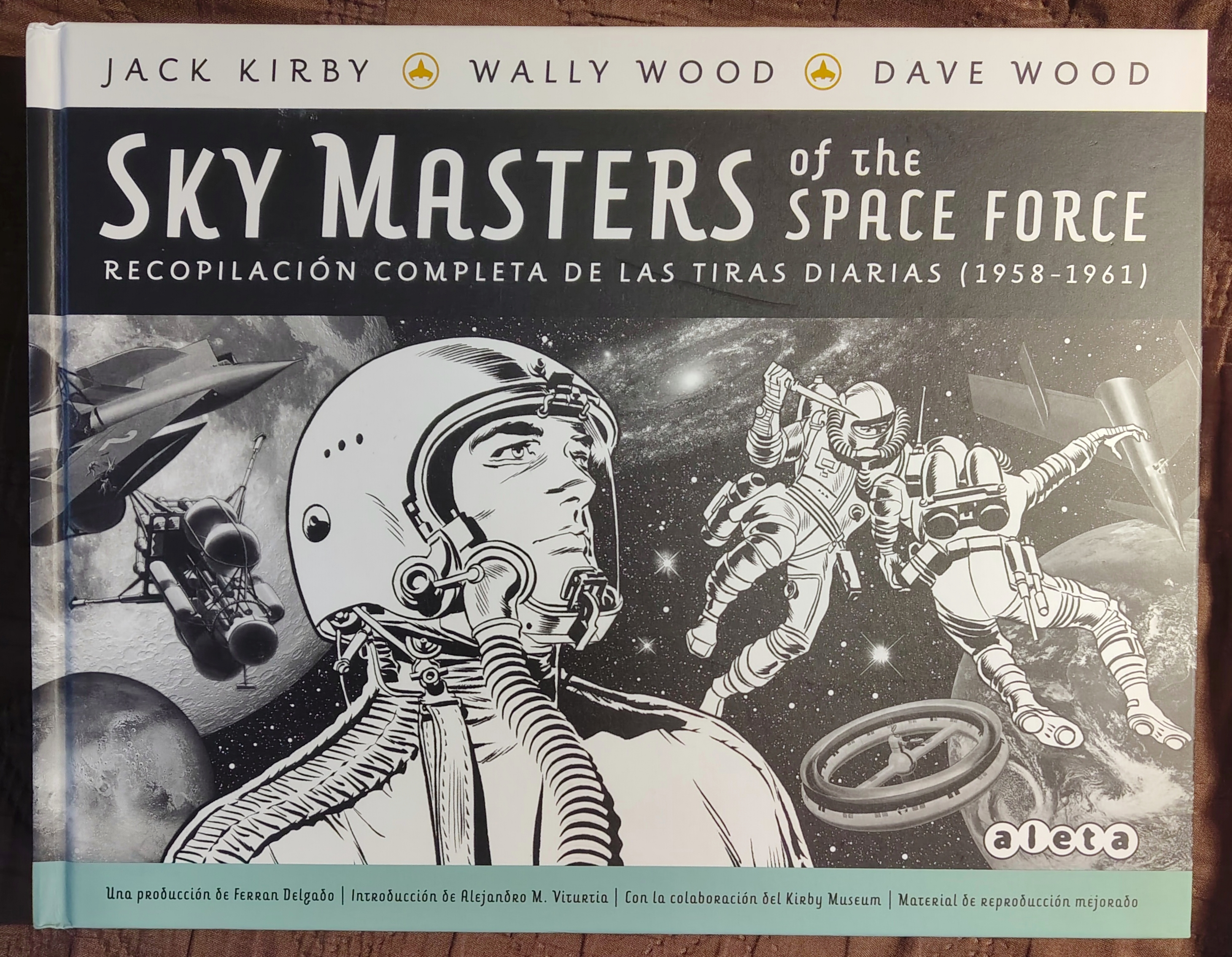
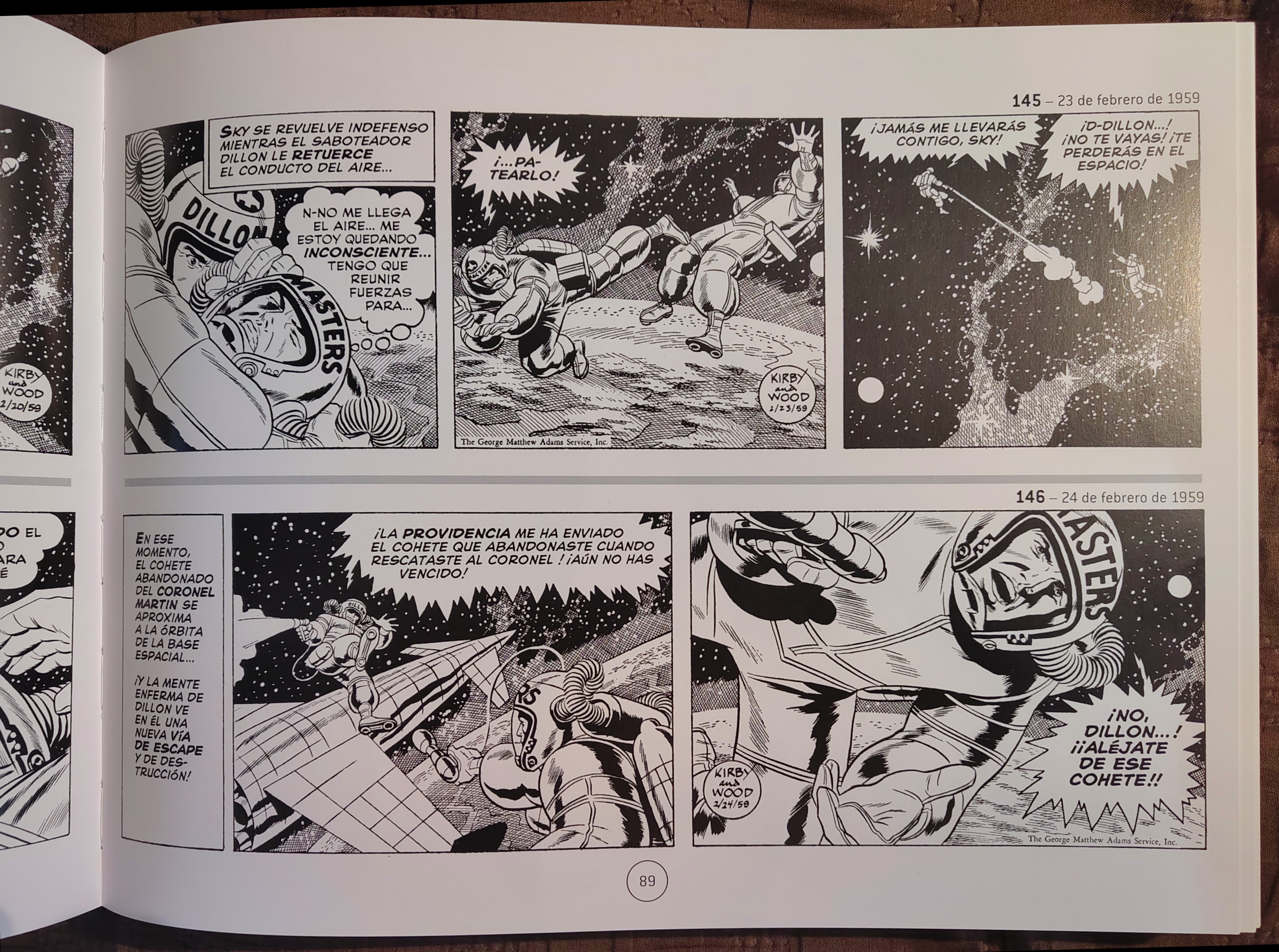
I recently began reading the complete run of Jack Kirby’s Sky Masters daily newspaper strips in Spanish. This endeavour is nothing short of a joy thanks to the exquisite Sky Masters of the Space Force: Recopilación de todas las tiras diarias (1958-1961).
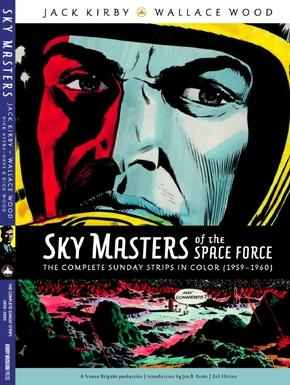
The book’s curator, Ferran Delgado, is the mastermind behind the magnificent book Sky Masters: The Complete Sunday Strips in Color from 2018 that was republished as a Kirby Museum initiative in 2025. It is still available at the Museum table at select shows.
Both books were a labour of love for Ferran who could never expect to see a reasonable return on his investment. Much of the material came from the remarkable personal collection he had amassed including printer’s proofs.
Ferran says most of the original English lettering was by Joe Letterese, with contributions by Wallace Wood, and Kirby himself. One of Ferran’s rare talents is lettering in a style, and here in re-lettering the entire run in Spanish, he provides a gorgeous uniform style.
Like the Sundays book, this thing is a beast, weighing in at nearly 1.75 kg (over three pounds) and measuring 11.25″ wide by 8.75″ tall. The size and quality at which the strips are reproduced, two per page, puts previous efforts (Theakston and Hermes) to shame. Greg Theakston pioneered the work in the late ’90s but when he couldn’t complete the collection he fudged the ending, pretending it didn’t exist. The Hermes edition is just a cheap copy of Theakston’s work, defects intact, designed to take away the market from a more caring and faithful undertaking.
I’m personally delighted for the opportunity to read this book in Spanish. Much of my pre-Canadian ancestry is from England and Scotland, but my maternal grandmother was from Chile. My mother’s two oldest siblings were born there, but when the family immigrated to Quebec (in 1929) the two were strongly discouraged by their elementary school peers from using one of the languages of their childhood. My mother, born in 1936, never learned Spanish. I can’t think of a better way to reconnect with the language than through this work of Kirby’s, magnificently presented.
Ferran continues to share his Sky Masters research on Facebook. He had a recent post in the Marvel Method group in which he ties the judge’s decision in the Schiff case to Kirby’s decision to stop producing Sunday strips. At or about the date of the judge’s decision, Kirby resorted to cutting up daily strips to cobble together the final Sunday strip (recently sold at Heritage).
There are still copies of Sky Masters of the Space Force: Recopilación de todas las tiras diarias available from the author. The publisher may still offer it for sale for 39.90 Euros: I’ll update this post when it’s confirmed. Both of these options come with exorbitant shipping rates from Spain thanks to the one-man withdrawal of the United States from the rest of the world. The publisher recommends Amazon, where I found one reseller with one remaining copy, but there appear to be dozens available through AbeBooks.
DC Comics has nearly figured out how to present Kirby’s work with the Absolute Fourth World books, but they still fall short of what Ferran has done with his Sky Masters productions. The Fourth World (1970-85) may be chronologically the next Kirby work worthy of the deluxe treatment, but Ferran has set the standard for presentation.
Someone I used to know but lost touch with nearly four decades ago came to my attention on Facebook recently. They had moved to the States and become radicalized, and after they shared an offspring’s post canonizing Charlie Kirk, I blocked them. I am at a loss to know what journey took them to that point, but since as I understand it they were once trained in how to recognize cults, they would be deeply offended at the suggestion that Charlie Kirk idolatry is indicative of one.
In a Facebook group comment regarding my last blog post, I was taken to task for refusing to “look past often incremental differences of opinion.” The commenter went on to bemoan the “bias” in the Marvel Method group and the fact that he was “thrown off”: he had misrepresented what was said in a posted article in order to take issue with it. The article in question was by Elana Levin, and the accusation was that the claim was made, either in the article or in the post about it, that Glorious Gotfried [sic] was Donald Trump. (It wasn’t.)
The commenter’s misconceptions are that Marvel Method is a discussion group, and that the physical evidence is subject to opinion. Patrick Ford created the group as a place to park any evidence he came across, with the intention of opening it to NO participants, only readers. In other groups, discussions are hijacked by Lee proponents to create the idea that there are two sides to the story, Kirby’s and Lee’s. The evidence itself is not debatable, but the goal is to make enough noise that the “discussion” is seen as having two valid points of view.
Kirby’s history is evidence-based, and his own account agrees with it. There’s no room for “incremental differences of opinion” like those held by Roy Thomas. Thomas can’t win based on the evidence so he ignores it and spins bullshit to be accepted based on his credentials of having worked with Stan Lee. The purpose of those “incremental differences” is to introduce the idea that facts and evidence can have an element of uncertainty. Stan Lee was solely and exclusively the liar, but the goal is to create uncertainty among casual readers who will walk away saying, “yeah, they both lied.” The Cult of Lee is alive and well where debating the evidence is permitted.
The first edition of my second book received a single Canadian review. The reviewer began with his credentials, that is, his fitness to have an opinion about Jack Kirby (always a bad sign). He wrote that he has been a Kirby fan for over 50 years, the sort of claim which generally means the next words out of his mouth will be designed to shit all over Jack Kirby. This technique was coined by the leader of the cult himself, Stan Lee, who would declare himself Jack’s Biggest Fan before taking away Kirby’s achievements. He did this while convincing his followers, who are easily misled, that he was praising Kirby. Some of Lee’s biggest fans pose as “Jack’s biggest fan” in order to perform the same maneuver.
My Canadian reviewer concluded that I was angry, and that I’m “biased and a Stan Lee hater.” It is beyond some people’s imagination that the truth could be written about Lee clinically rather than out of anger. They believe that Kirby would only reveal his personal experience with Lee out of bitterness. It’s not necessary to hate Stan Lee to understand who he was, and the idea that I or Jack Kirby could only tell the truth out of hatred comes from people with the propensity to hate.
Protect yourselves
Facebook is that fabulous place where you can catch up with people you knew decades ago, before you both moved away. It also has a useful feature called blocking for when you find out they grew up to be cultists. I didn’t know my commenter but I wasted no time blocking him, and for the same reason. He believes that if facts are open to debate, then any argument, even if rooted in Lee’s falsehoods, will be treated as a valid “side.” The same principle is applied by today’s mainstream media when they treat both sides of any discussion as though they are equally valid.
No, when we start from scratch with the evidence, everything shows that Kirby told the truth and what Lee said was almost entirely false. There is no truth on both sides. We only need to listen to the freelancers who were silenced by Lee’s preemptive strikes and his threat to deny them work.
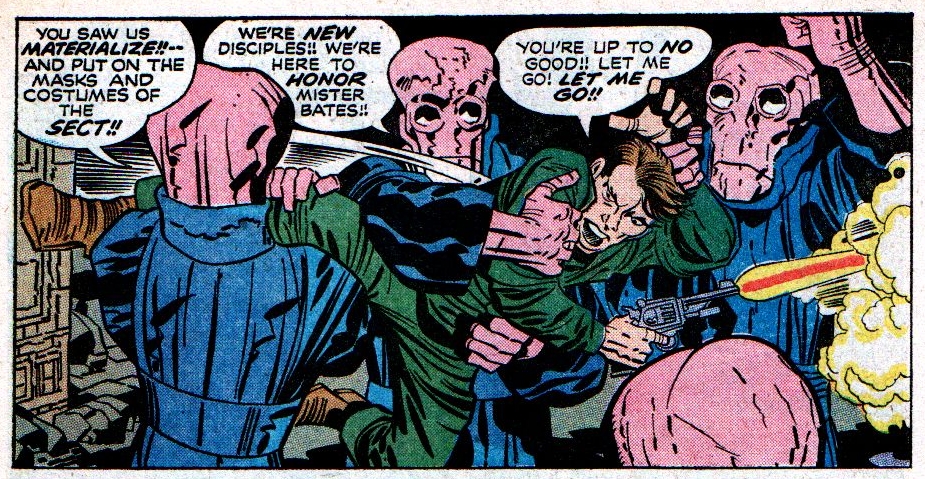
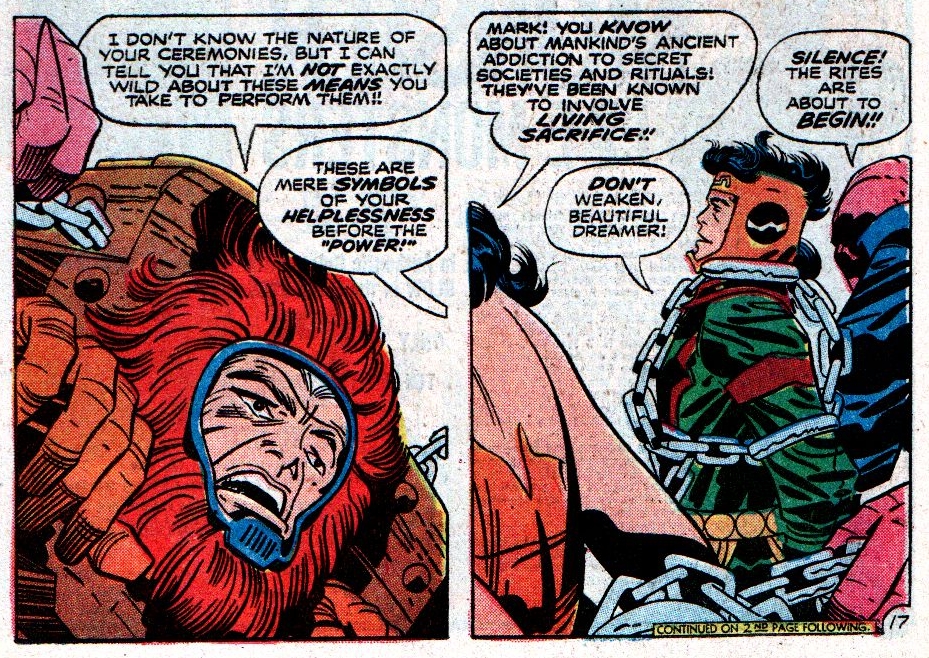
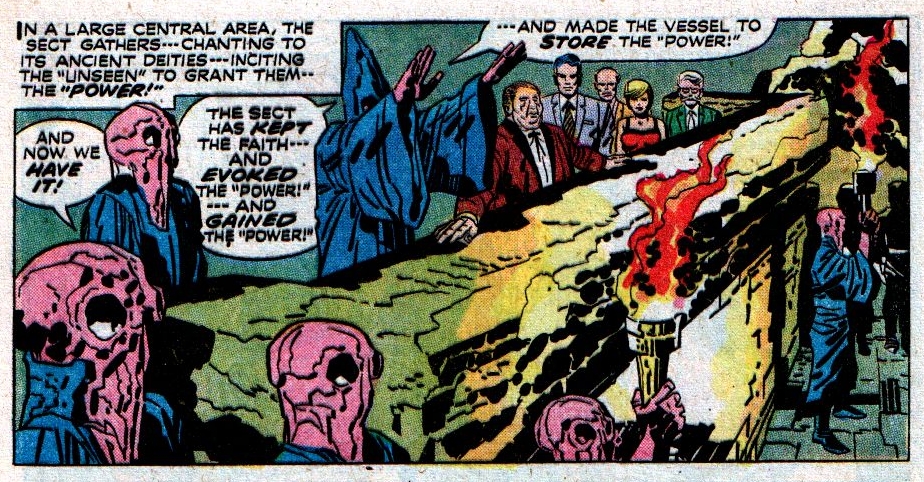
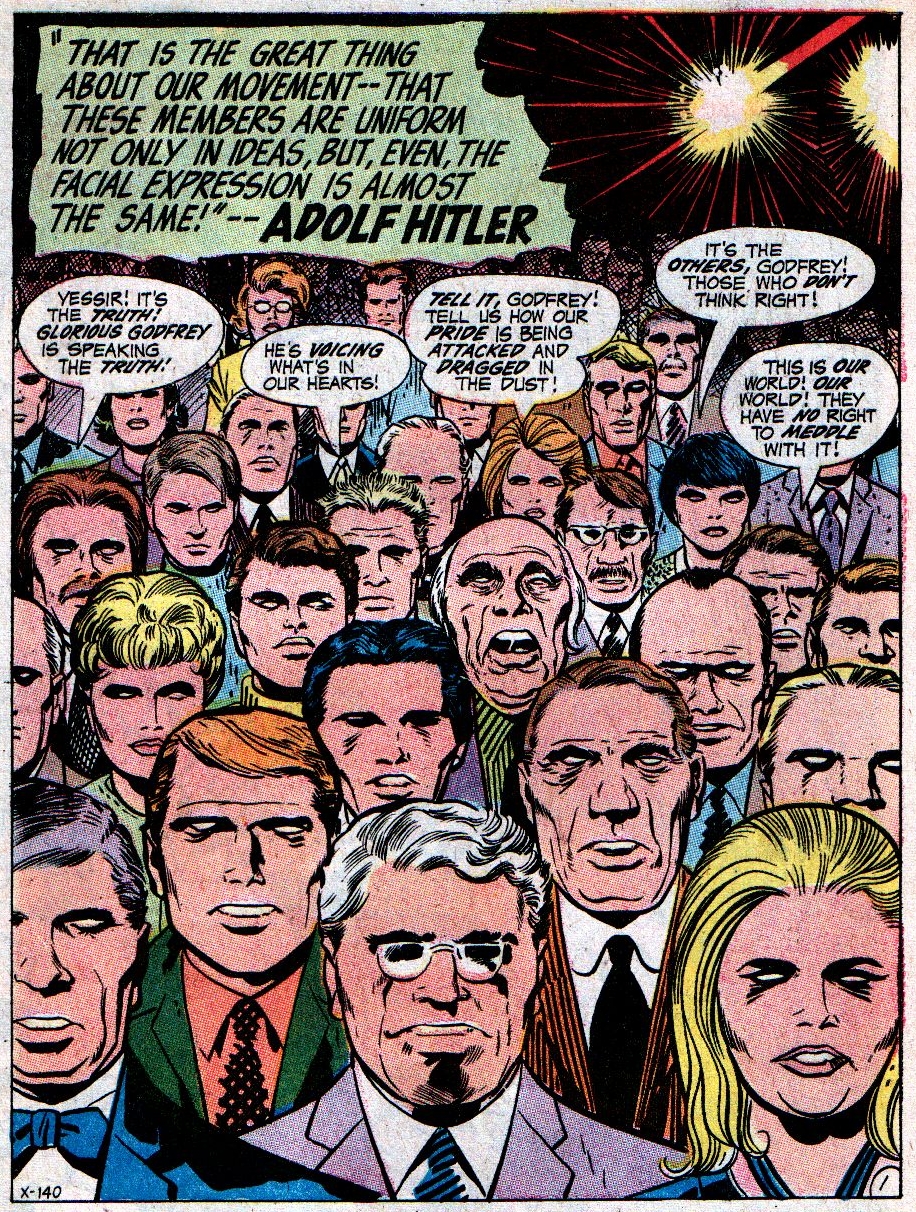
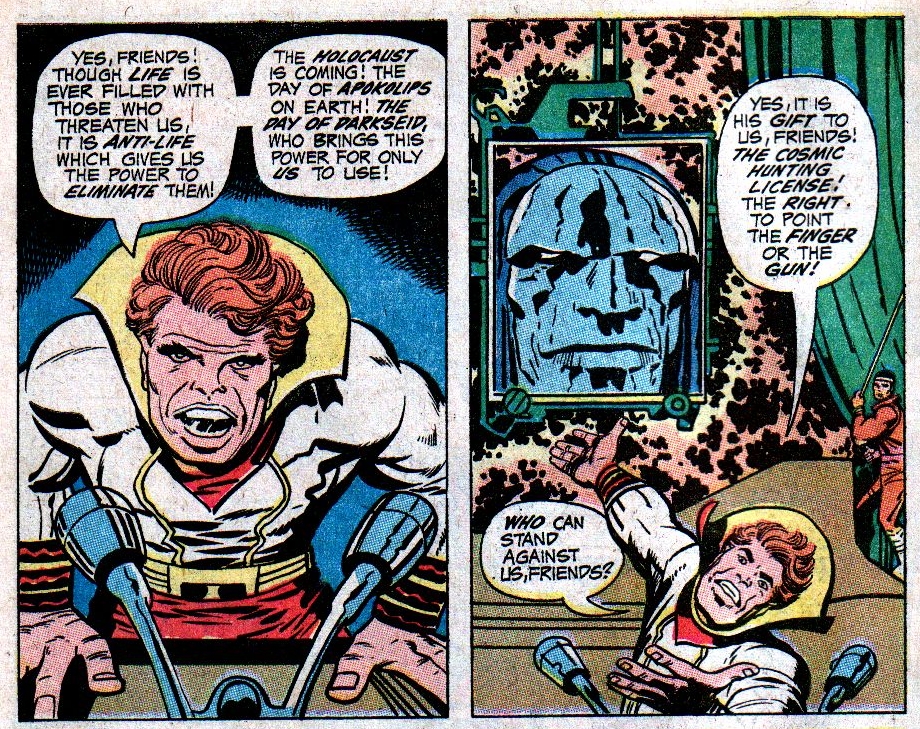
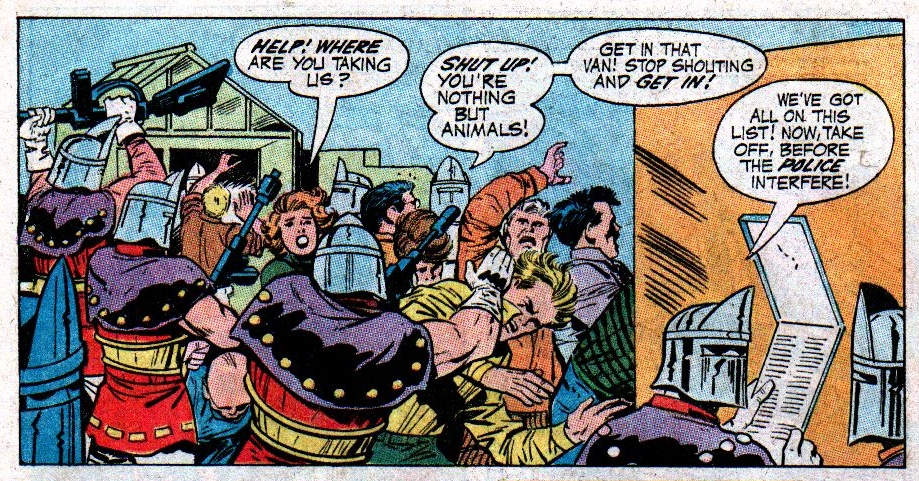
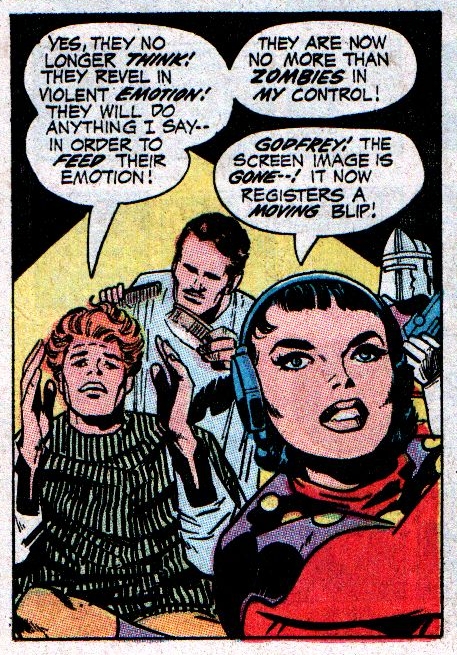
Jack Kirby had something to say about cults
The Sect: Masked, Darkseid and Desaad infiltrate a secret society in The Forever People #8. Kirby’s dialogue speaks for itself.
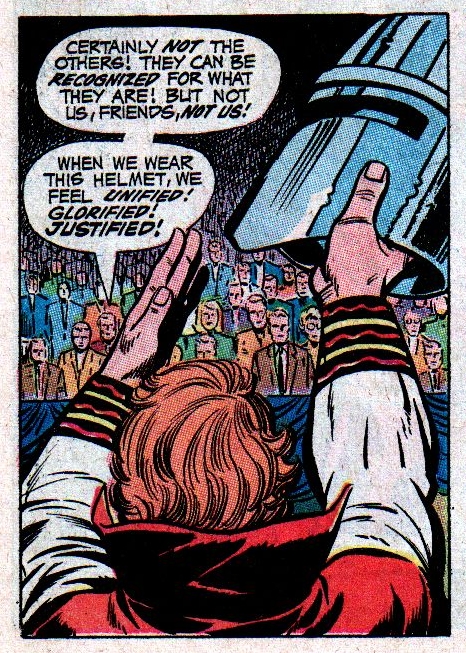
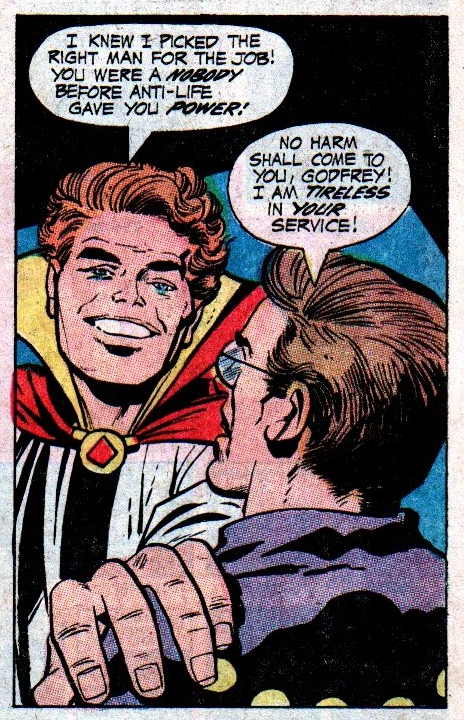
Glorious Godfrey and the Justifiers from The Forever People #3.
The face covering and absolution of personal responsibility.
Mark Evanier was the source of the information that Glorious Godfrey was based on Arthur Godfrey and Billy Graham. A photo of Graham exists that is close enough to one of the above Godfrey panels that it could have been used by Kirby as a photo reference.
What turned Kirby’s attention to Billy Graham? The caricature may have been triggered by an interview response from Stan Lee the year before.
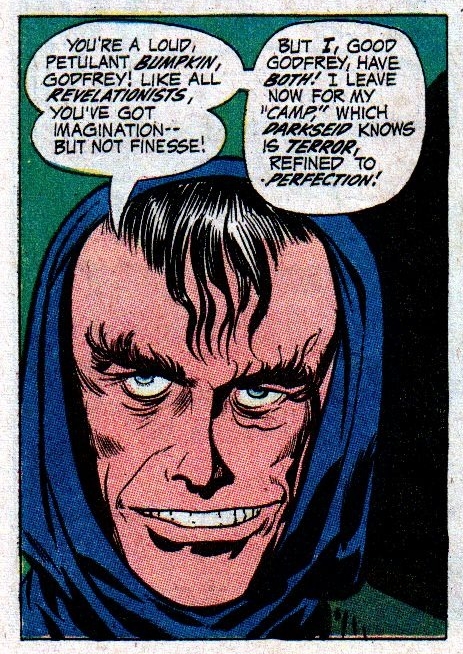
I don’t think Funky Flashman was Jack’s first commentary on Stan in the Fourth World books. Glorious Godfrey preaches faith to true believers, but is himself a skeptic on the existence of the Anti-Life Equation. In Forever People 3, he says to Darkseid, “I believe in Anti-Life…but it can only be induced in others by means of inventive selling!”
Darkseid responds: “I like you Glorious Godfrey! You’re a shallow, precious child—the revelationist, happy with the sweeping sound of words!”
This was cover dated July, 1971. One year earlier, Stan himself had said this: “I love the rhythm of words. I’ve always been in love with the way words sound. Sometimes I’ll use words just because of the sound of one playing upon the other.” 3
And later in the same interview, astonishingly: “I may become the Billy Graham of comics.”
I would love to pick Bob Beerbohm’s brain right about now regarding his unofficial history of the term Marvel zombies.
Like Jasper Sitwell five years earlier, the Roy Thomas analogue puts in an appearance here.
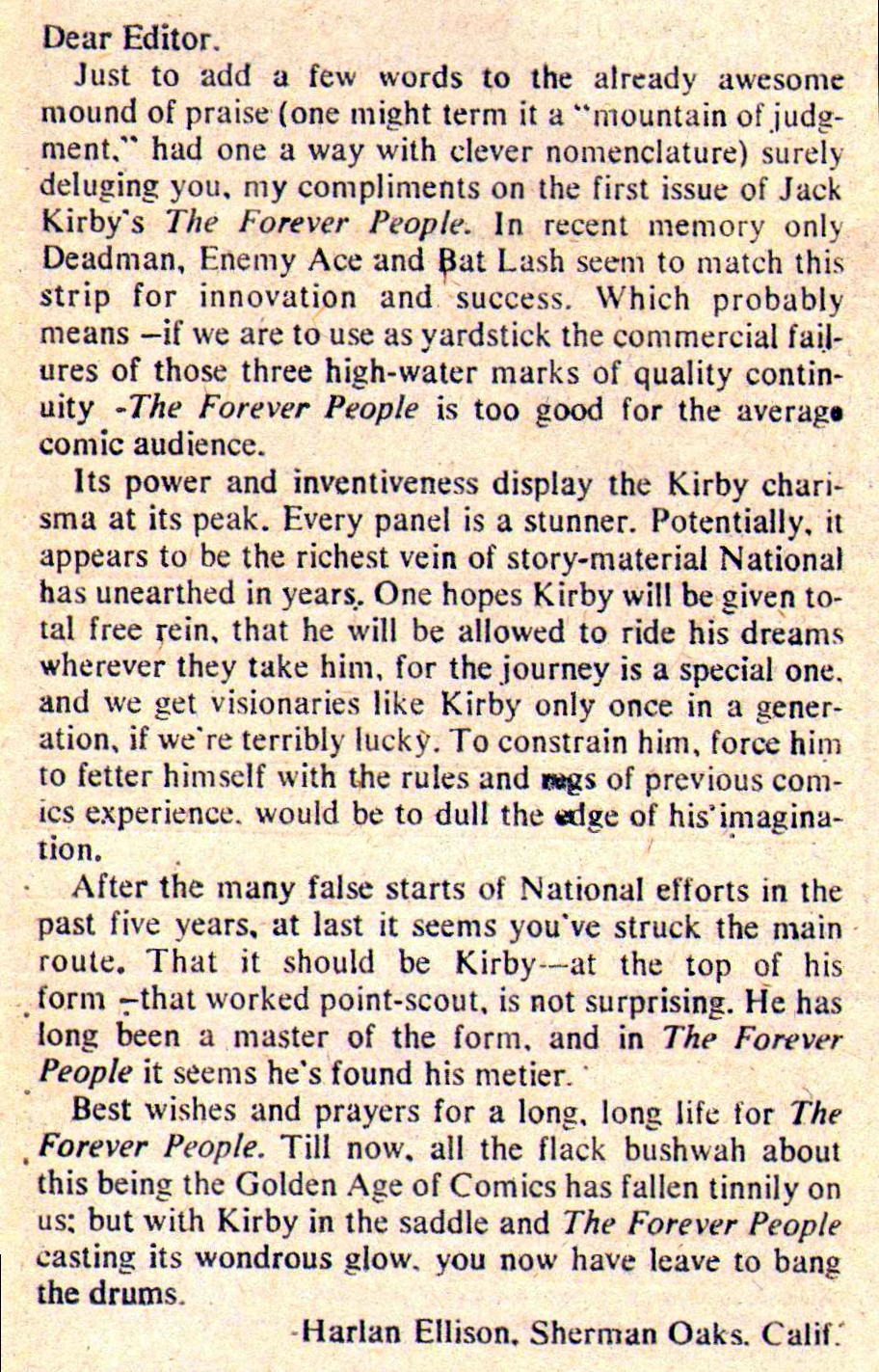
That very issue of The Forever People contained this letter. Eleven years after The Forever People #3, Stephen King may have held out some hope for us 40+ years in the future in his foreword to Ellison’s Stalking the Nightmare.
If the cult of celebrity sucks, it sucks because it’s as disposable a a Handi-wipe or a Glad Bag or the latest record by the latest Group of the Moment… You don’t make it over the long haul on the basis of your personality.
In 2025, King was called bitter by the Kirk idolaters when he pointed out that Kirk advocated for gays to be stoned to death.
Of course Glorious Godfrey was not Donald Trump; in her article, Elana Levin was simply noting Kirby’s remarkable prescience. What’s indisputable is that Desaad is a member of the current administration, although Kirby drew him with a toupée.
Footnotes
back1 Stan Lee to Ted White, 1966, printed in Castle of Frankenstein #12, 1968.
It was nearly six years ago that I wrote to ask you if you knew what your Alter Ego editor was up to (calling Kirby advocates “***holes,” asterisks his, through a third party on the letters page right above my own letter). Instead of addressing my concern, you asked me to stop “insulting” you with criticism in your inbox. I’ve lost the compulsion to find nice things to say, so here we are.
For the purpose of this discussion, I’d like to introduce you to these mantras. I’ll come back to them later. The first one, if spoken out loud, gets you branded a Lee hater; “for starters” is implied after the third one.
1 Jack Kirby was a writer
2 Roy Thomas didn’t arrive on the scene until 1965
3 Stan Lee stole ten years of Kirby’s writing pay
In an earlier letter, I wrote to tell you that I thought it was inappropriate to include a Roy Thomas interview in the Kirby Collector. That was one issue after your “Big Boy Pants” editorial criticizing readers who refused to Learn to Love Stan Lee. (I can’t imagine you have many of those left.)
From your reply…
Your implication that we’re pandering to Lee fans to make sales is simply off-base. I don’t see things in the same black and white view as you. I respect your opinions and way of looking at things; I hope you’ll try to respect mine, even if you don’t agree with them, and aren’t interested in purchasing our publications.
Maybe the best example I can give you is a conversation I had with Roz Kirby before she died. I told her I was thinking of running an interview with Stan in TJKC, and asked if that would bother her. She thought about it for a few seconds, then said, “That’s fine. Just don’t let him say anything stupid.” Not a “Don’t you dare give that man a forum to badmouth my husband” or anything like that. If Roz was okay with it, and at a time when Jack really wasn’t getting a smidgen of the respect he’s getting now, I’m confident I’m doing okay by her, and the whole Kirby family.
I dealt with the Thomas interview in a three-part blog post starting here.
The very next issue was Stuf Said, in which Thomas was awarded the honoured position of Kirby expert.
Your magnum opus, an exploration of things said that demands a verdict but cops out, fails even to do justice to an actual court case, Marvel’s lawsuit against the Kirby family. You were an inside witness to the proceedings, having access (unlike nearly everyone else on the planet) to Lee’s unredacted depositions, but like Mark Evanier you incuriously passed at the chance.
In your Stuf Said account you seemed to have it in for Kirby family attorney Marc Toberoff, accusing him of Making Shit Up. When readers set you straight on the facts, you removed the last sentence in the paragraph.
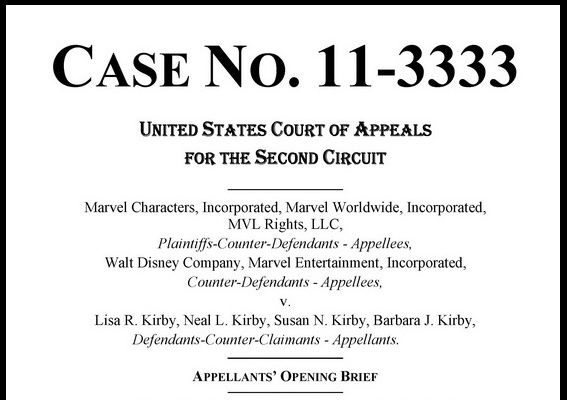
Toberoff’s assertions in his opening appeal brief (below, see here for PDF) were backed up with citations . You characterized his early strategy as “dead in the water,” yet you failed to acknowledge he was playing the long game: he took the case to the steps of the Ginsberg Supreme Court, and he won.
You quote Lee’s May 2010 deposition but don’t mention that he was deposed again on December 8th. The excerpts you chose appear to be tailored to your conclusion, “I don’t think Lee is lying here, but to be fair, these are skillfully asked (and answered) questions. Read them closely…”
John, after you’ve wallowed in this stuff for nearly 30 years, I’m fairly certain you wouldn’t recognize a lie if it bit you on the ass: close reading is not necessary. The word perjury doesn’t appear once in either edition of Stuf Said, yet Lee claimed, one by one, that he created every property in question (here’s my collection of excerpts from which not a single statement, made under oath, is true). Marvel’s lawyers couldn’t have written a more slanted account of the court proceedings than Stuf Said. Oh, wait…
was Stuf Said ghostwritten by Marvel?
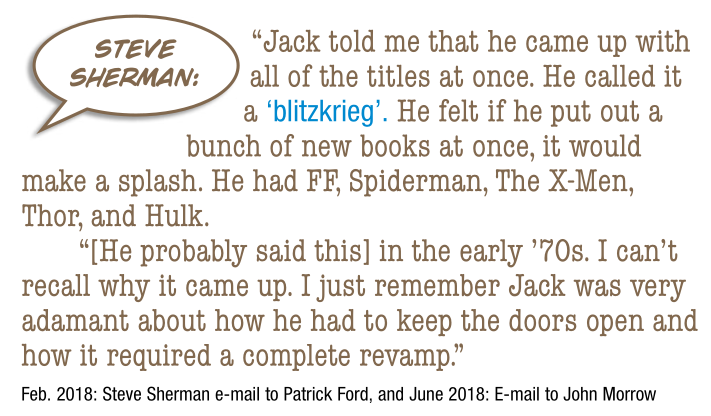
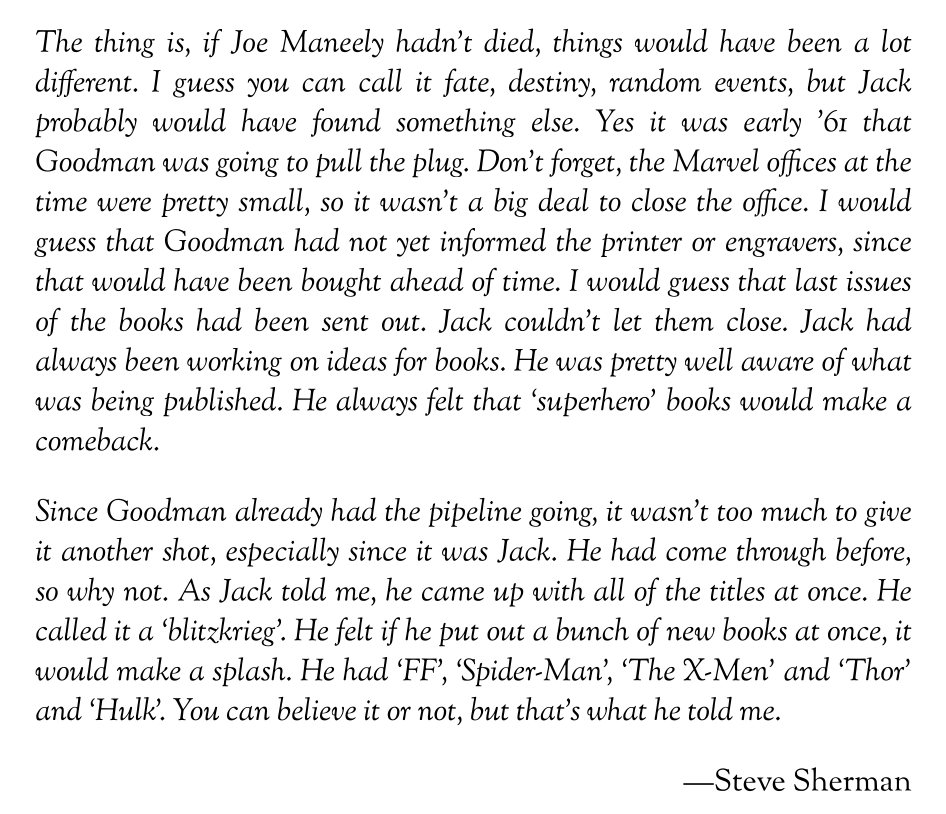
The most important quote in Stuf Said, sadly drastically edited, came from Steve Sherman (full quote following). I considered it important enough to include in other blog posts and both of my books. It would have been better placed next to Lee’s testimony because it is central to the truth you studiously avoid in the book, and as integral to the story of Jack Kirby as Mantra #1.
It wasn’t the only time Kirby had told the story. 1 Unlike Mark Evanier, Steve Sherman tended to take Kirby at his word.
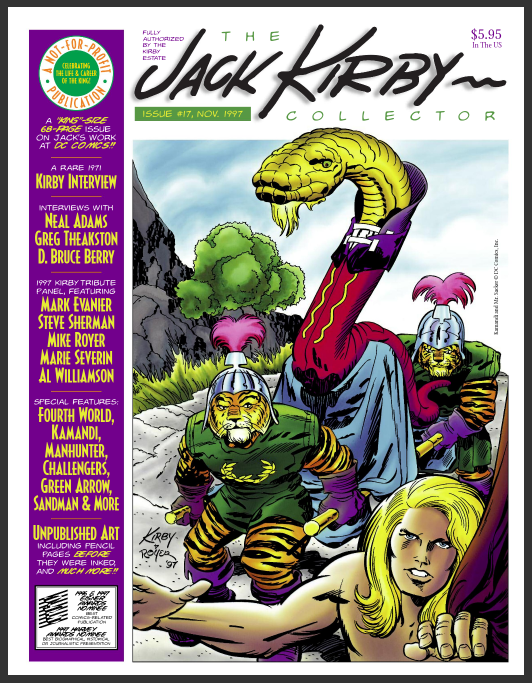
The latest issue
TwoMorrows was instrumental in the spread of the Roy Thomas “received history,” giving it a platform in 1998 in issues of Comic Book Artist and Alter Ego under the same cover. Thomas had told Jim Amash just months earlier (and here keep Mantra #2 in mind) that his knowledge of events prior to his arrival at Marvel came from Stan Lee and Sol Brodsky. Both Lee and Brodsky were management to Kirby’s labour, giving Thomas the Company Man fuel for his preconceptions. (Yet Thomas was deeply embedded in the operation and knows better than anyone alive the magnitude of the lies he tells.)
That brings us to Kirby Collector #94.
Let’s start with the letters page. Thomas takes Richard Kolkman to task for suggesting Peter Parker was named after Peter Parr from an unused 1950s Kirby comic strip proposal. Thomas is spouting his usual wall of nonsense: 2 the likely true answer is that Kirby named the character in his Spider-Man concept pages along with Uncle Ben. Steve Ditko later wrote that it was between Kirby and Lee to make the call as to which of them originated the concepts.
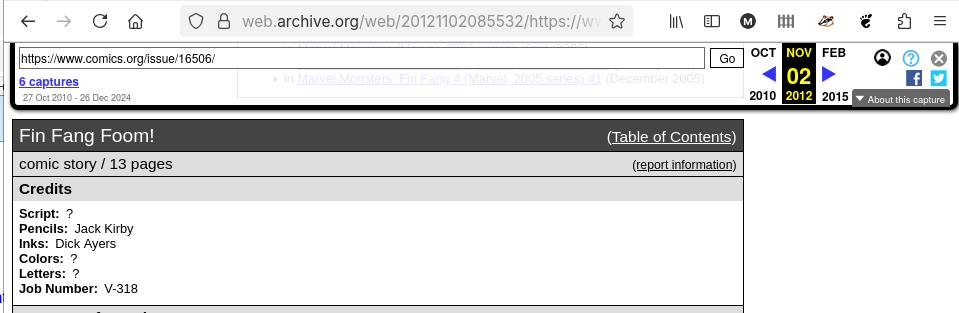
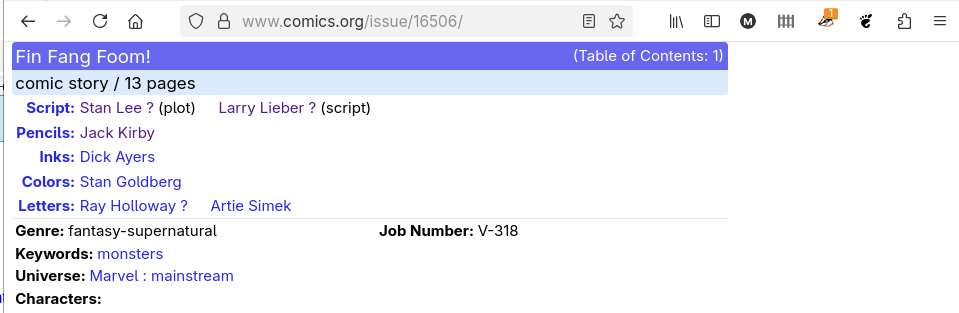
Next, Thomas suggests Kolkman had it wrong crediting Larry Lieber with “all the scripting,” and says Lee plotted, citing the GCD and “other authorities.” The GCD is an authority on nothing, having cynically farmed out its research to Marvel lawyers. After 2014 the site issued a blanket credit that says “Stan Lee ? (plot) Larry Lieber ? (script)” on all of Kirby’s “monster” stories.
20122025
The only places the site is to be trusted is where it says “Nick Caputo indexed this issue after holding the physical comic in his hands.”
Here Thomas creates a circular reference, citing a source that parrots the false narrative he helped bring into being in the late 1990s. When he asserts Larry Lieber had anything to do with Kirby’s monster stories, he’s repeating a lie invented in 1995. Stan Lee first took credit for a monster story in 1973 by adding a “script” credit to the reprint of “The Two-Headed Thing” in Monsters on the Prowl #26; he hadn’t signed the original story in 1962, or a single other instance of a Kirby monster story. His next mention was in Origins of Marvel Comics when he claimed he and Kirby were “having a ball doing the monster stories.” Lee maintained this charade through the early ’90s and Kirby’s death. With Kirby out of the picture, Lee enlisted his brother to claim he’d written the Kirby monster stories. This revelation came courtesy of the ever credulous Will Murray with his Lieber article in Comics Scene #52 in 1995.
Not only is there no physical evidence that Lieber had anything to do with a Kirby story before his first credits on stories cover dated December 1962, it’s provably false that he scripted at least two of those first-credited stories, which were scripted by Kirby. Lieber received a total of ten script credits on Kirby stories over three months before being fired as Kirby’s credited scripter. The action was likely demanded by Kirby when he learned that his writing pay was being redirected to not one but two freeloading Lieber brothers. We can probably safely round it up to an even zero that were legitimately “scripted” by Lieber before the fact (and Lieber insisted that he only ever worked full script rather than Marvel Method, adding dialogue after the fact).
Please do me this favour, John. While Will Murray is writing for the Kirby Collector, and Larry Lieber is still alive, have them reprise their 1995 interview. The key question to be asked is, “Larry, why did you never mention this while Kirby was alive?”
At the end of the Thomas letter, you direct readers to Evanier and Fingeroth discussing “Lieber’s early Marvel work” as though it’s a fact. Let’s take a look.
I’ve never seen it, and of course I would say that’s an outright lie.3
Danny Fingeroth is a Lee hagiographer, hence JAKD (Just Another Kirby Denier). He has no place in a Kirby publication, even as a guest, so of course he’s right at home in this particular Lee tribute issue of the Kirby Collector. In Fantastic Four #1 Panel by Panel, Evanier lent his imprimatur to the Lee narrative by insinuating Kirby’s TCJ declaration (above left) was a lie:
Perhaps no one informed Evanier that after allegedly being seen by Thomas in Lee’s office “late ’60s,” the alleged “synopsis” turned up in the Marvel offices “behind a drawer” in 1982.
In the panel transcript, Evanier actually had a couple of good things to say about Kirby, such as setting Fingeroth straight that Kirby never sued Marvel, and that Kirby and Lee never reconciled. Sadly he then chose to comment on the “monster” stories, making it obvious that he hasn’t read them. (In fact his entire body of writing makes it obvious he hasn’t read much of any of Kirby’s work from before 1961 or after 1978.)
At the end of the panel transcript, an excerpt from another Thomas interview is presented, this time with Alex Grand, just a couple of MAGA bros shooting the breeze. The two cults, MAGA and the MMMS, have many parallels.
Featured here is one of Thomas’ greatest hits. He tells the familiar drawn out story of how he was instrumental in the re-hiring of Kirby, but the punchline is always that Kirby’s hiring was presented to him by Lee as a fait accompli and he really had no say in the matter. The purpose of the anecdote is to make out that Kirby’s Funky Flashman story could have been a consideration in the decision (but wasn’t).
The moral of Funky Flashman is Mantra #3 (and Lee’s criming didn’t stop at wage theft, but more on that in the near future). With you as publisher and with your whole-hearted agreement, Thomas is permitted to repeatedly make the case that Kirby’s action was bitter and mean-spirited, yet nothing could be further from the truth. Kirby responded to a decade of wage theft by way of his craft, in a manner that was measured, accurate, and brilliant. Thomas promotes the idea of Lee as victim who “didn’t know why they left,” when the reality is Lee drove them away one by one with malice aforethought when they wouldn’t willingly accede to his self-enrichment at their expense.
Jack Kirby accurately assessed Stan Lee as a man without empathy. 4 He also had something to say that applied to Roy Thomas, although not by name: “something is missing.” Thomas in the Kirby Collector #74 interview:
the thing I remember about it is Jack was very friendly, because I was still in awe of Jack, you know? Despite the fact that I had hit the wall with that New Gods stuff and everything.
Glorious Godfrey I felt was a parable. The New Gods were a parable. I’ve read interviews with other artists who say that, well, they try to figure out the New Gods and they don’t know what it’s really all about. And I think that’s sad, because they themselves lack something… they themselves lack something which keeps them from understanding what a parable is. It keeps them from understanding a relationship of this parable with our own times.
You’ve given Thomas a platform, and you look the other way while printing Lee’s propaganda. Because Roz Kirby didn’t tell you “don’t you dare give that man a forum to badmouth my husband,” you made it your goal to provide a forum for Kirby to be badmouthed at every turn with the repetition of their lies.
In your email response I quoted above, you told me Kirby Collector probably wasn’t for me because, in your words, I couldn’t muster even 1% credit for Lee in the “collaboration.” Re-characterizing my position so you can knock it down is a cheap rhetorical cheat favoured by MMMSers, so that tells me precisely where you stand. The truth is that Lee contributed a lot to the finished product, but nearly nothing in advance of Kirby the creator and master storyteller putting pencil to paper to write and draw completed stories.
The apparent purpose of the Kirby Collector, to quote a movie based on Dickens, is “to preserve a way of life that one knew and loved.” But like “America” when it was “great,” Marvel of the 1960s was not great for Kirby or the other freelancers. Thanks in part to Marvel itself, people are reading the stories and looking at the art, and unlike you and the writers you publish, they’re going to believe Jack Kirby and the physical evidence over the false narrative. You’re not going to succeed in MSGA, making Stan great again. The truth about Kirby will be known despite, not because of, The Jack Kirby Collector.
Mike
Footnotes
back1I came in with presentations. Kirby to James Van Hise, “A Talk with the King,” Comics Feature #44, May 1986.
And I came up with this blitz. I came up with The Fantastic Four, I came up with Thor (I knew the Thor legends very well), and the Hulk, the X-Men, and The Avengers. Kirby to Gary Groth, The Comics Journal 134, February 1990.
The Sherman quote appears in my book, Kirby At Marvel:1956-1963, Second Edition as well as in Ferran Delgado’s Sky Masters of the Space Force: The Complete Sunday Strips in Color (1959-1960).
back2 The Roy Thomas Rebuttal Strategy is avoid responding to the physical evidence that was just presented and pontificate like he knows better simply by virtue of having worked with Lee in the ’60s. My own encounter is documented here.
back3 Jack Kirby to Gary Groth, The Comics Journal 134, February 1990.
back4It takes a guy like Stan, without feeling, to realize a thing like that. If he hurts a guy, he also hurts his family. His wife is going ask questions. His children are going to ask questions.—Jack Kirby to Gary Groth, The Comics Journal 134, February 1990.
back5 Jack Kirby video interview by Theakston and DiSpoto, 17 March 1983.
…I think for modern audiences the FF comic book is a bit like Citizen Kane in the sense that the innovations of the original have been strip-mined and absorbed into comic book and film culture… to the point where what once seemed groundbreaking and sophisticated now seems cliche and childish.
It’s got a lot of good points. Probably more than any MCU product to date it shows Jack Kirby proper respect… Nice to see Susan portrayed as the most powerful member of the team, which she clearly is.
The Surfer wasn’t terrible but I’m not a fan of this version of the character. By that I don’t mean the gender swap. Shalla Bal or Norrin Radd, the Zenn La origin cooked up by Stan Lee behind Kirby’s back is repulsive to me. Kirby’s version was, like the angels of the bible, created by his god. There’s no life before Galactus. That’s why his discovery of human feelings and his rebellion are so impactful. The Zenn La Surfer, whether Shalla or Norrin, is a mass murderer on a galactic scale who finally suffers an overdue attack of conscience.
David Lawrence
Four Color Sinners has the story on Marvel’s real motivation for switching the gender of the character here. I think Kirby, who created strong female characters based on his wife and daughter, would be fine with a female Surfer.
I agree with nearly everything in these reviews.
A thought for what never saw the light of day
Never let anyone accuse you of saying Stan Lee did nothing. The incurious and inept editor did a lot to Kirby’s stories, and all of it was damaging. Tom Scioli wrote a good assessment for TCJ of Lee’s appropriation and bastardization of Kirby’s Surfer.
Chris Tolworthy details Kirby’s original intentions in The Lost Jack Kirby Stories, now an appendix to Volume 1 of the second edition of Jack Kirby’s History of the Future. Greatly expanded is the section covering issues 48 to 51.
The lost Galactus saga (Fantastic Four #48-51, March-June 1966)
The original saga was much longer, and Galactus did not lose. Here are the clues.
Clue 1: The series reboots with FF #51
This is the biggest clue, and it is not obvious unless you read all of Kirby’s Fantastic Four. If you just dip into the odd issue then you don’t see the progression. But if you read from issue #1 to the end then you see that time passes and everything moves forward: Reed and Sue date, they get married, they have a child, they retire from the team to raise their family (or would have done, if the editor had allowed it). Johnny starts in high school at age 16, then graduates and starts college and visibly grows up…
Chris Tolworthy
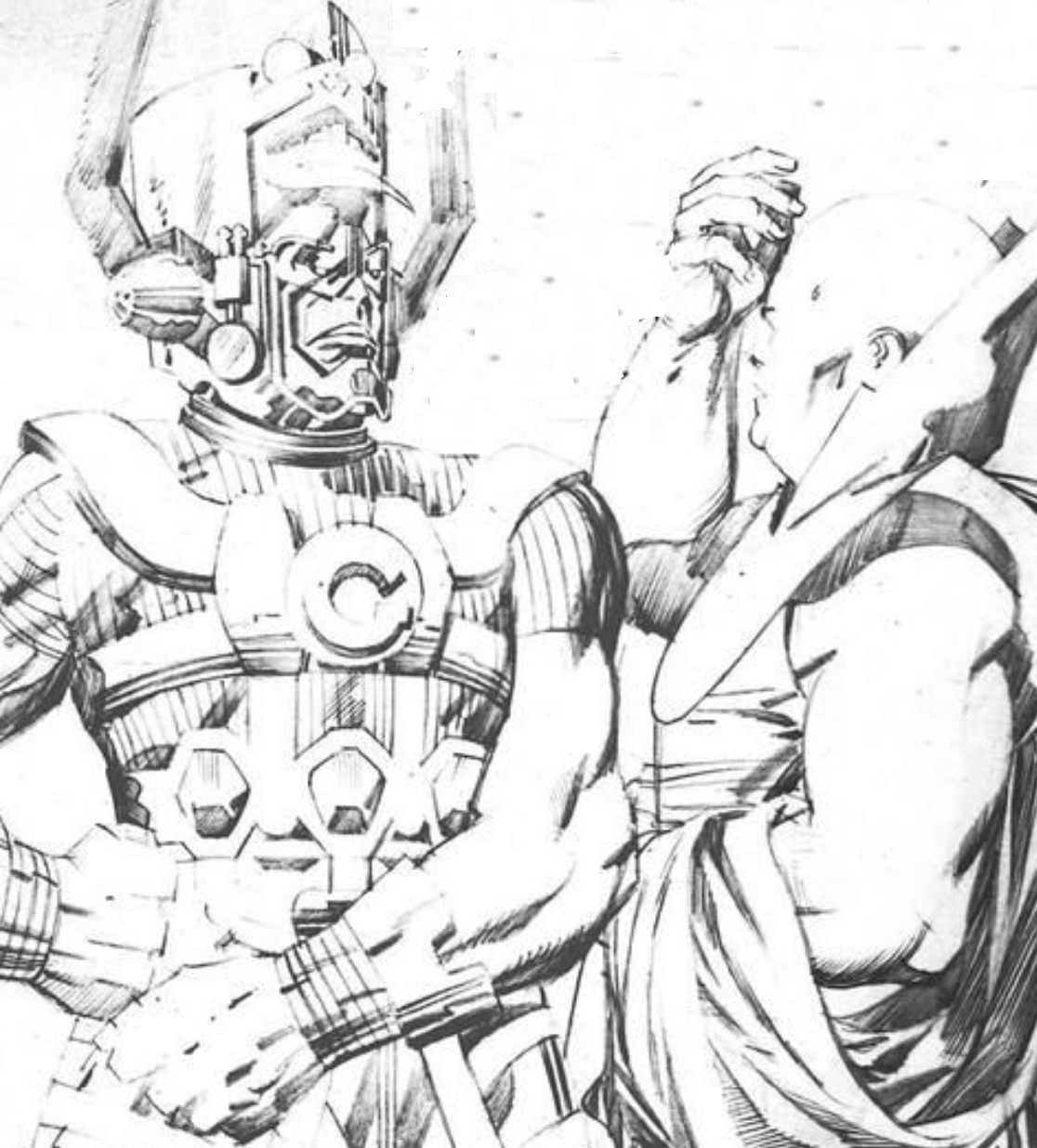
It’s interesting to compare Kirby’s conception of Galactus to Lee’s. Kirby created a character who is not a villain. Kirby’s Galactus is simply going about his business.
Kirby’s Surfer is a blank slate, as opposed to the disjointed character seen in Lee’s rewrite where the Silver Surfer is somehow at the same time a sensitive man with a past and the person who marks worlds for slaughter.
It is likely Kirby intended Galactus and the Watcher to be not only of the same race but brothers who took different paths. One the warrior wearing the garb modeled after a Roman Centurion. The other the toga-wearing sophist.
It’s up to us to keep this information alive in the face of the endless reprints of the published (compromised) version. Even if the Jack Kirby Collector were so inclined (and they haven’t been for some 70 issues), the declining readership seems more interested in Stan Lee’s classical influences (having rejected the idea that he paid other people to do his reading).
My last post ended with this line…
…like Silver Age Marvel, the editorial content ignores Kirby’s writing and never lives up to its promise.
Mark Marderosian responded…
That’s why the Fantastic Four are unreadable for me. You can glimpse greater, more timeless stories straining to be realized, which makes it ultimately just an exercise in frustration to be avoided.
I am in no way invested in Kirby’s FF, which I only experienced in reprints. When Kirby left Marvel in 1970, he shook off the dust of Lee’s crummy little operation and went on to do better things. (That’s where I came in.) Kirby got over having his creations ripped away from him, and it costs me so much less to do the same. Kirby didn’t hate Stan Lee, but he understood him.
As Darrell Epp and Patrick Ford have been saying, this discussion is not for someone who believes “This Man, This Monster!” was the greatest comic ever. (Chris Tolworthy has that covered as well.) It’s a discussion for generations who aren’t invested in the original comics, who may be open to hearing what needs to be said about Jack Kirby.
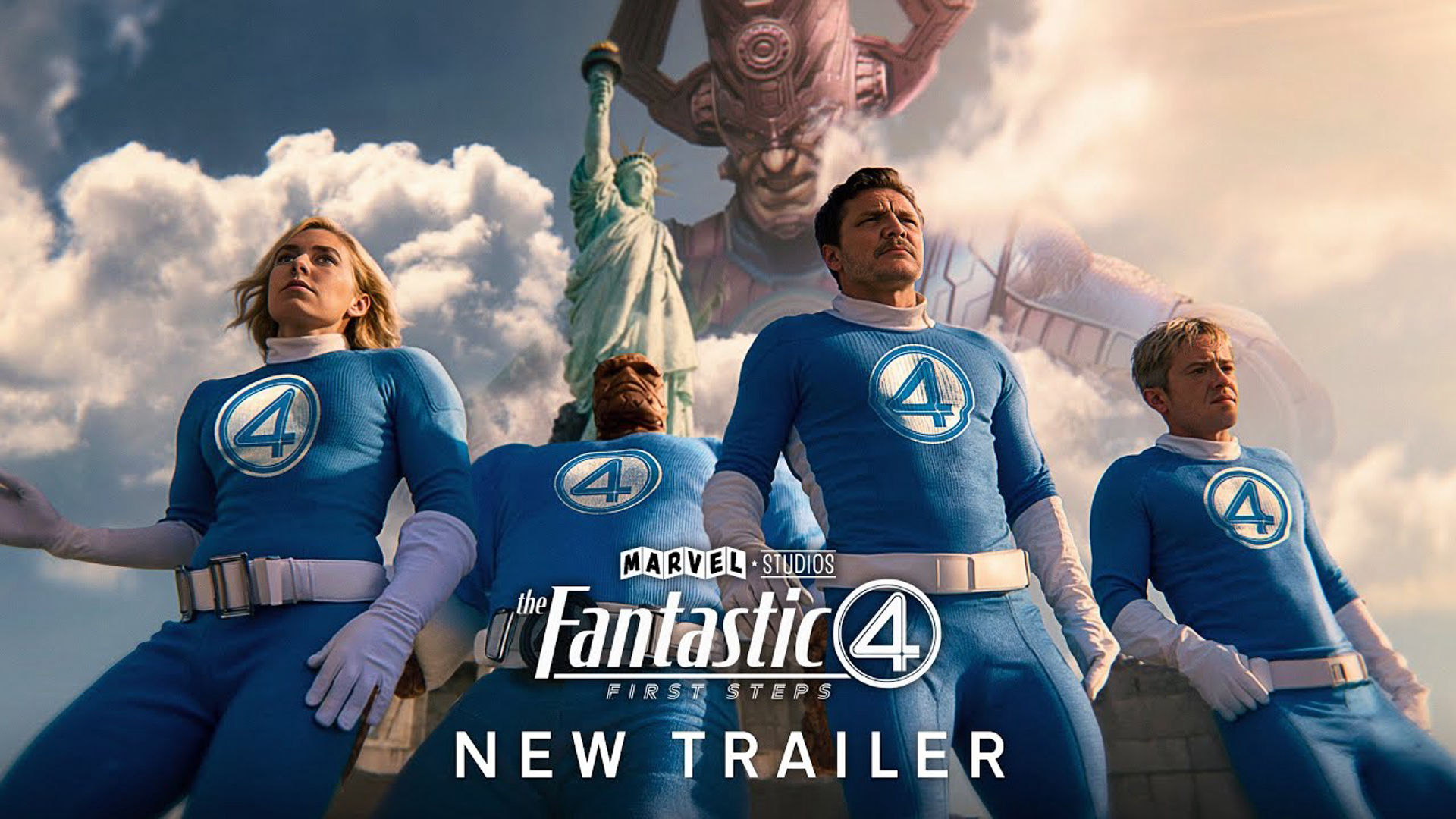
Fantastic Four: First Steps was the best Marvel movie I’ve seen. The last one I saw (Avengers: Infinity War) was the worst, which for me makes it the worst in or out of the MCU. I dislike that the Surfer is Lee’s character rather than Kirby’s original, and it’s sad that Galactus started so well but was reduced to a regular-scale rampaging monster. But…
I love the futuristic New York of the 1960s. It’s just like Kirby imagined it: all the guys are wearing fedoras, and not everyone is white. The movie captures the enthusiasm of the space race as well as Kirby’s quiet moments and character interactions. An inordinate number of American characters (plus Galactus, who wasn’t American) are played by familiar UK actors, possibly a sign of things to come. The best part is that it honours Jack Kirby’s preference to be isolated from the rest of the Marvel universe, even if it’s only for this one movie.
It’s been a long time since a new issue of The Jack Kirby Collector was an event, or even an experience to be savoured (like the one above). The preview of #94 is online and it continues the trend. It includes a Kirby-Lee radio interview transcript previously printed in Stan Lee Universe, as well as the transcript of a Kirby-Lee convention panel featuring Mark Evanier and Danny Fingeroth. Here’s a rundown of the current cadre of the magazine’s contributors.
mark evanier
Mark Evanier hasn’t contributed fresh content to his Kirby Collector column for years, but under its banner the magazine publishes transcripts to his ubiquitous convention panels. Like Kirby’s characters without Kirby, these transcripts have limited interest for me mostly because Kirby isn’t there.
When I think of Evanier buttonholing Roz Kirby (not sure if this is accurate but I picture it at a funeral) to be ordained as the “official” Kirby biographer, 1 a scene from The Big Chill comes to mind (paraphrased):
Evanier: Hey Jack, you know, we go back a long way. Kirby: Wrong, a long time ago we knew each other for a short period of time.
Following the end of his professional relationship with Kirby, Evanier showed his willingness to read Stan Lee’s nonsense claims directly into the interview record without bothering to call Kirby for a fact check. 2
Three years before epic Kirby interview season began (Gary Groth’s self-contained interview and the beginning of Ray Wyman, Jr’s 40 hours of recordings over three years), Evanier had his own chance. His Kirby interview was published in Amazing Heroes #100, and although some nice sentiments were expressed by Kirby, Evanier simply didn’t have what it took to interview him. Unlike Groth, he shied away from tough and timely questions about Marvel—he didn’t want to hear the answers. (Unknown to Evanier and everyone else, the Leonard Pitts, Jr interview conducted just a few months earlier covered the same ground as Groth’s, but it wouldn’t be made public for decades.)
And what about the optics of bringing Marv Wolfman along to the interview? The pair 3 represented the stolen art collecting establishment at a time when Kirby’s art was a sensitive topic. 4 Were they trying to send the message, “Jack, if you persist in making waves, some of your ‘friends’ are going to get hurt”?
After Kirby’s death, Evanier by necessity became the enemy of a good Kirby interview because he didn’t have one of his own. That’s when he labelled Kirby “confused” and a lousy interview. His first crack at a biography, King of Comics5 was sufficiently damaging to Kirby for its unambitious scope; the ultimate work promises to be told by the “good” interview subjects (Lee, Simon, and Brodsky) who will be permitted to divide the spoils of Kirby’s legacy between them. In the readership of the Kirby Collector, Evanier has found the audience for his someday biography: those who want Kirby to be seen and not heard.
roy thomas
Roy Thomas is the world’s biggest Kirby denier. The very truth about Kirby’s life threatens the narrative Thomas has spent his career crafting since Kirby’s departure from Marvel in 1970.
Twenty issues ago (#74) I wrote in to object that an interview with Thomas was featured in a publication ostensibly about Kirby. The very next issue was Stuf Said, in which Thomas was cited extensively. Morrow wrote of him “in working with him since 1997, I’ve never found him to be anything less than 100% fair, professional, and honest.” Amusingly, Thomas is one of those people who can scarcely open his mouth without telling a lie about Jack Kirby.
Roy Thomas is not shy about his politics: he’s Stephen Miller to Kirby’s Biden, accusing him of Lee’s misdeeds. In recent years, he and his “manager” have been posting far right-wing podcasts. 6 Thomas is not alone in his leanings among the TwoMorrows stable: Pierre Comtois, author of the Marvel in the 1960s/1970s/1980s series shares his MAGA bent on social media. In Book 2 of his series, Comtois was permitted by his publisher to rail against Kirby, portraying him as the homewrecker who abandoned his surrogate dad and ruined his childhood.
will murray
Will Murray is the long-time comics “journalist” who twice in the last century gave us the “secret” or “hidden” origins of the Atlas monster stories that had in fact been written and drawn exclusively by Jack Kirby. In 1984, Murray revealed after talking to Stan Lee that although Kirby influenced the stories, Lee was the writer. In another interview, Murray tried to pin Lee down about why the stories weren’t signed (not a single Kirby “monster” story was ever signed by Lee), but when Lee said if he signed it, he wrote it, Murray failed to follow up with a list of unsigned stories.
After Kirby’s death a decade later, Murray was let in on yet another “exclusive” secret by the Marvel brain trust which he shared with the world: Larry Lieber secretly wrote Kirby’s monster stories from Lee’s plots. Nothing about this so-called revelation is true: Kirby plotted and dialogued his own stories. If Lee came up with a plot, it was by reading Kirby’s completed pages. Before he started getting credits in December 1962, Lieber never wrote for Kirby, and the physical evidence says not even then. The credits were fraudulent: Kirby blasted Lee and quit those titles as soon as he’d caught on.
Murray has recently made regular appearances in Alter Ego and Kirby Collector, sometimes with multiple pieces per issue. The trouble with Murray’s point of view is its grounding in the Marvel mythos, how the “revelations” he’s presenting spring out of the Lee-Thomas narrative. His articles are not suitable for a publication about Jack Kirby.
danny fingeroth
Danny Fingeroth is a Stan Lee hagiographer who constructed a false narrative about Kirby (“he was bitter”) in order to explain away negative testimony against Lee by the early ’60s Marvel writers, Kirby, Steve Ditko, and Wallace Wood. His very appearance in the Kirby Collector, like that of Thomas, is a travesty. Hopefully his presence is an aberration and he will only be around for this Kirby Collector Stan Lee tribute issue.
Like Comtois, Fingeroth’s stunted adulthood was forged amid the tragedy of an imaginary household broken up by Kirby, while Lee taught him to read with 50-cent words he didn’t know how to use.
john morrow
After 14 years and 41 straight issues, I passed up on the opportunity to buy Kirby Collector #58, The Wonder Years, off the rack. 7 The cost of a subscription to Canada has always been prohibitive, and I’m thankful I wasn’t dinged the price of two subscription issues for this monstrosity.
John Morrow signalled his intentions for the future of his “Jack Kirby publication” with The Wonder Years. It’s a re-imagining of the nearly decade-long Kirby-Lee team-up on Fantastic Four by Mark Alexander, a guy who up until his then-recent death lived in the fantasy world where Kirby executed Lee’s cosmic vision. In an afterword, Morrow provides a weak disclaimer stating he’s in disagreement with a few of Alexander’s assertions.
The last hard copies of Kirby Collector I bought were four issues between #61 and #66. The only ground-breaking articles in the last forty issues are contained in this span, one by Mike Breen 8 and one by Jean Depelley. 9
The doddering, demented fascist gangster currently tasked with destroying the planet enjoys a concerted effort called “sanewashing” at the hands of the complicit mainstream media. Stuf Said (my own dissection starts here) was Morrow’s attempt at whitewashing Lee’s gangster phase, presenting selected Kirby quotes but drowning them out with the help of a rogues’ gallery of self-interested revisionists, including Thomas, Larry Lieber, and John Romita. Joe Simon’s fabulist accounts are presented as fact.
John Morrow has surrounded himself with true believers, both contributors and readers, MMMS cultists who prefer dwelling in a simpler time when Lee’s “artists” knew their place. He sides with Thomas, Comtois, and Fingeroth, believing that, despite what the only reliable witness besides Kirby himself, Steve Sherman, said to the contrary, bitterness defined Jack Kirby. They’re only able to see him in terms of their own frame of reference. At the end of Stuf Said, we’re left with the feeling that Kirby was bitter and mean-spirited enough to commit Funky Flashman, but with no sense that Stan Lee spent a decade stealing pay from multiple freelancers and even longer publicly smearing those who disagreed with his methods. That’s the kind of world the cult members want to inhabit, and Morrow provides it.
Casting about for something nice to write, I remember a favorite review that once said about Immortal Beloved, whatever its failings as a film, it had a helluva soundtrack. The artwork in The Jack Kirby Collector can’t be beat, but like Silver Age Marvel, the editorial content ignores Kirby’s writing and never lives up to its promise.
Thanks to Four Color Sinners and their unwavering persistence.
Footnotes
back1 This effectively put a stop to further editions of the best Kirby biography to date, the then-new Art of Jack Kirby.
back2 The “Produced by” credit, Comics Interview #2. See here for details.
back3 With Kirby safely dead, Evanier bragged on Kirby-L about the Journey Into Mystery #83 (Thor’s origin issue) splash framed in his office while explaining that holding members of the thieves’ market to account wasn’t cut-and-dried, that there were grey areas not considered by the artist-victims. Wolfman had been the public face of a company Silver Age stolen art liquidation operation. Now he’s comfortable enough to advertise sales from his cache on Facebook while continuing to protect the Art Thief-in-Chief and his lieutenant. Guilty by association (she’s in the event’s photographs), Irene Vartanoff had the sense to deflect while conducting the company’s official post mortem of the 1960s theft rampage: “Brodsky said not to tell Lee what’s left or he’ll help himself.”
back4 Wolfman appeared the same year on an SDCC panel regarding Marvel’s return of Kirby’s original art. Presumably he held the opinion that Marvel could be held accountable to return the art but individuals could not.
back5Four Color Sinners has a good assessment of King of Comicshere.
back7 Having chosen to write Kirby-centred books denouncing the worldview being presented, I got the book a few years later from Amazon at a discount. For the same reason, after quitting on principle after the Thomas interview, I resumed getting the PDFs of new issues.
back8 The Breen article proves that Kirby added the finished dialogue to Fantastic Four #6 himself, and all Stan Lee did was sign the splash pages. Breen comments that this was the normal workflow between the two; typically the only exception was Lee’s dialogue after the fact. Unremarked in the article is Lee’s incredible laziness, which will be the subject of future books by others.
back9 Jean Depelley’s article puts the lie to another detail of Lee’s false origin stories, that Amazing Fantasy was slated to be cancelled before he snuck in Spider-Man, a character Martin Goodman supposedly hated. Depelley shows convincingly that Ditko and Kirby both drew stories for further issues of the title before it was cancelled. Kirby’s entry was dismembered and run over a year later with a Lee blurb falsely claiming Kirby ripped off a Ditko story. Ditko and/or Sol Brodsky had swiped the fight scene of the Kirby version for Amazing Spider-Man #1.
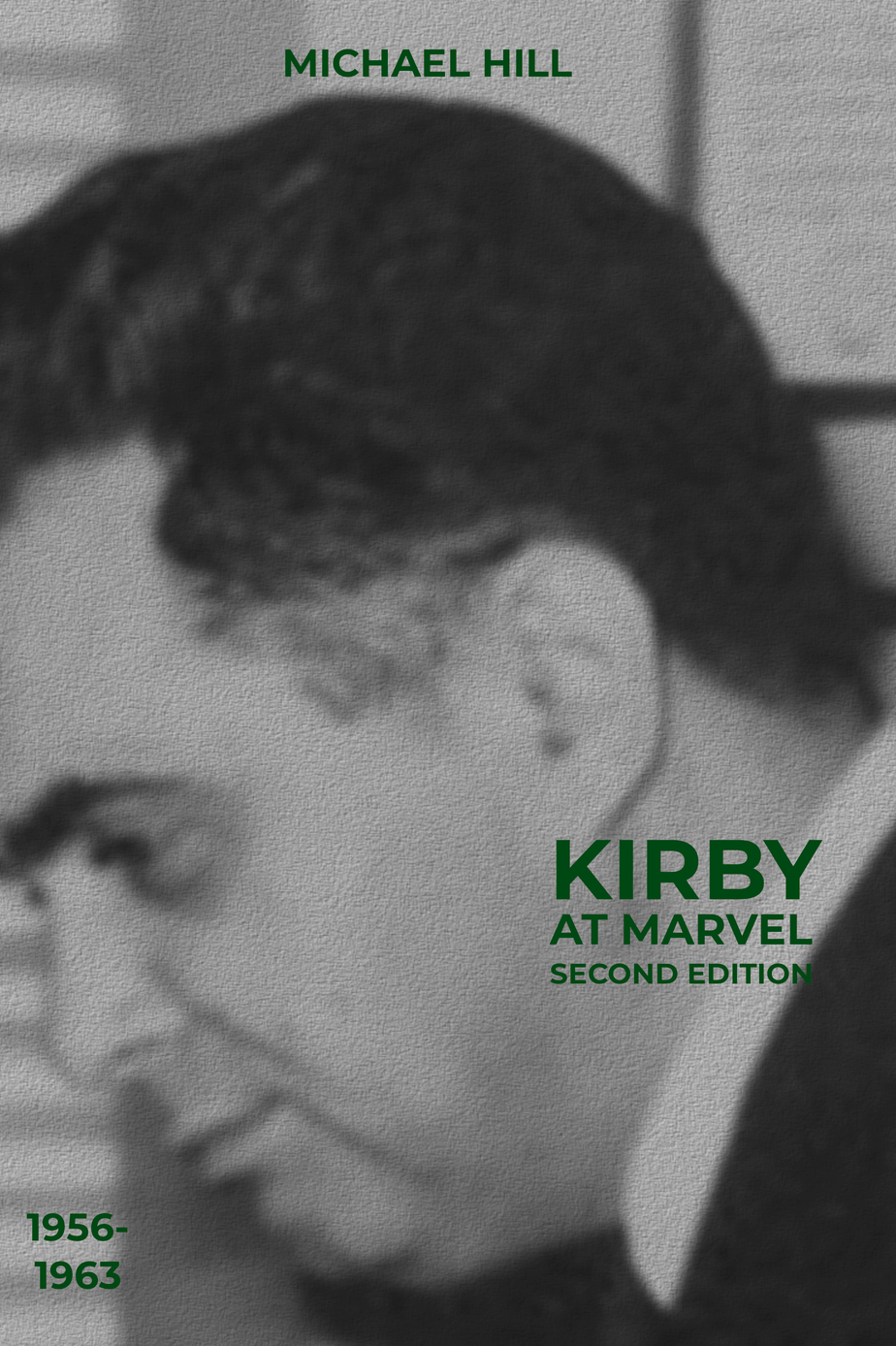
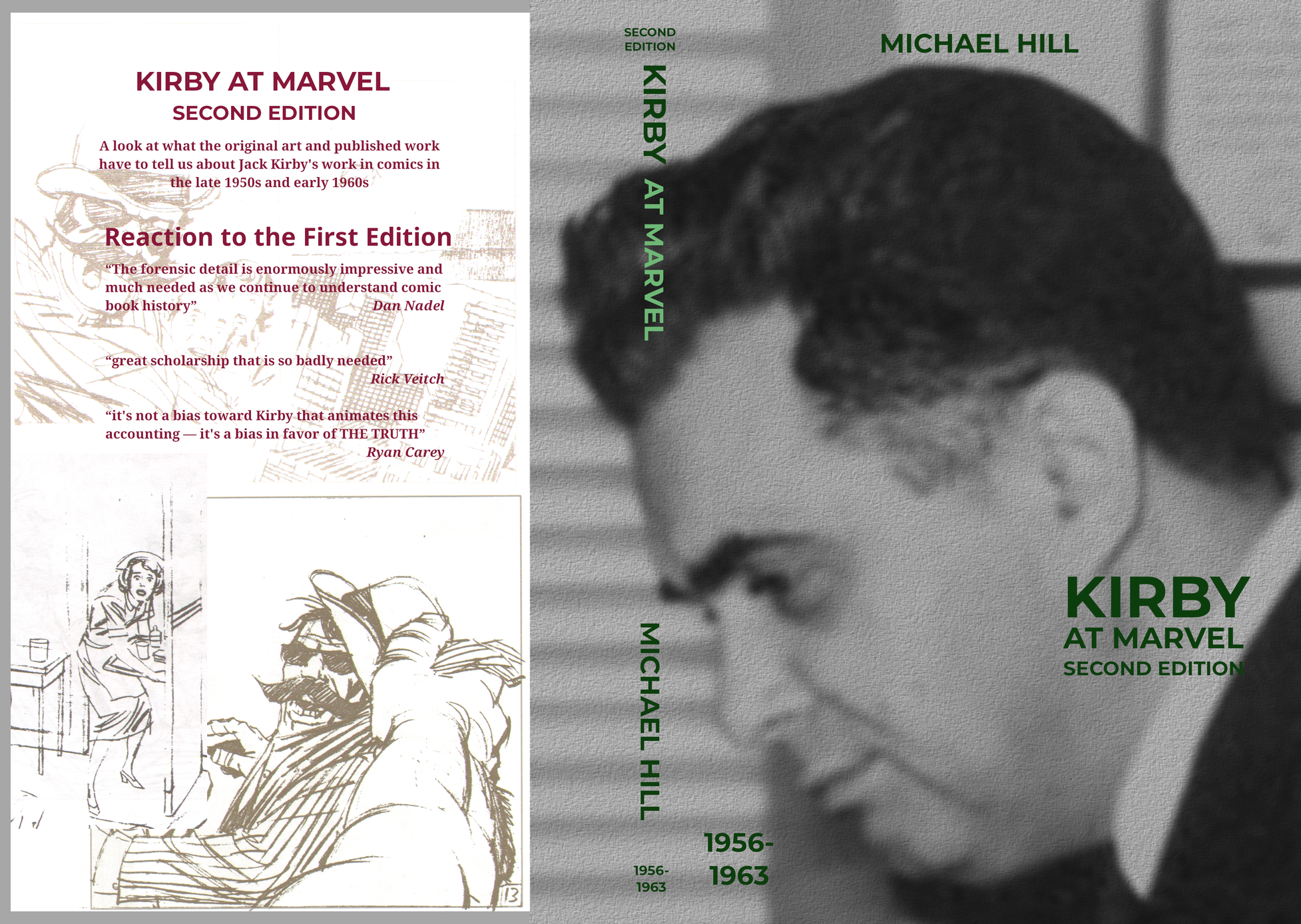
The second edition of Kirby At Marvel is now live at Lulu.com and Amazon.
new content
At the end of each chapter I’ve added tables showing Kirby’s stories with known data including whether pages are known to exist as original art and what that tells us.
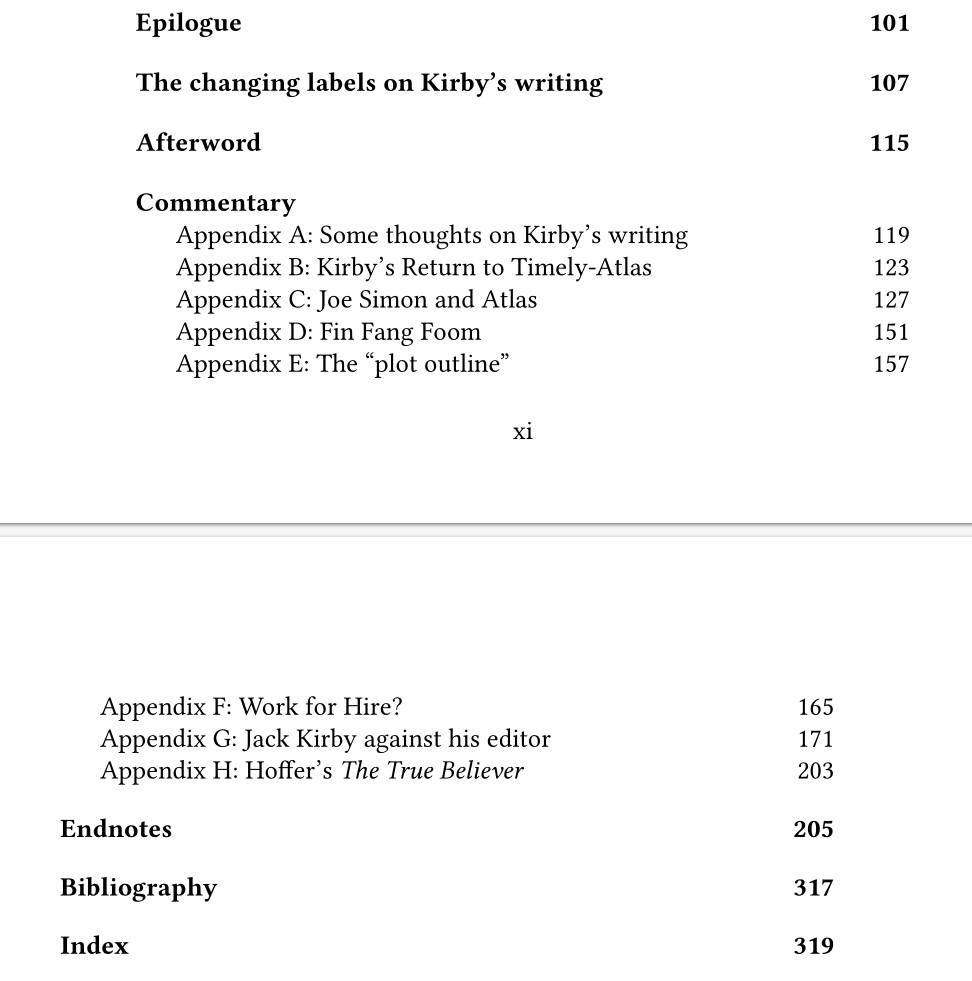
I have pulled assorted information from the Endnotes, and organized and expanded it under a number of topics in the Commentary section.
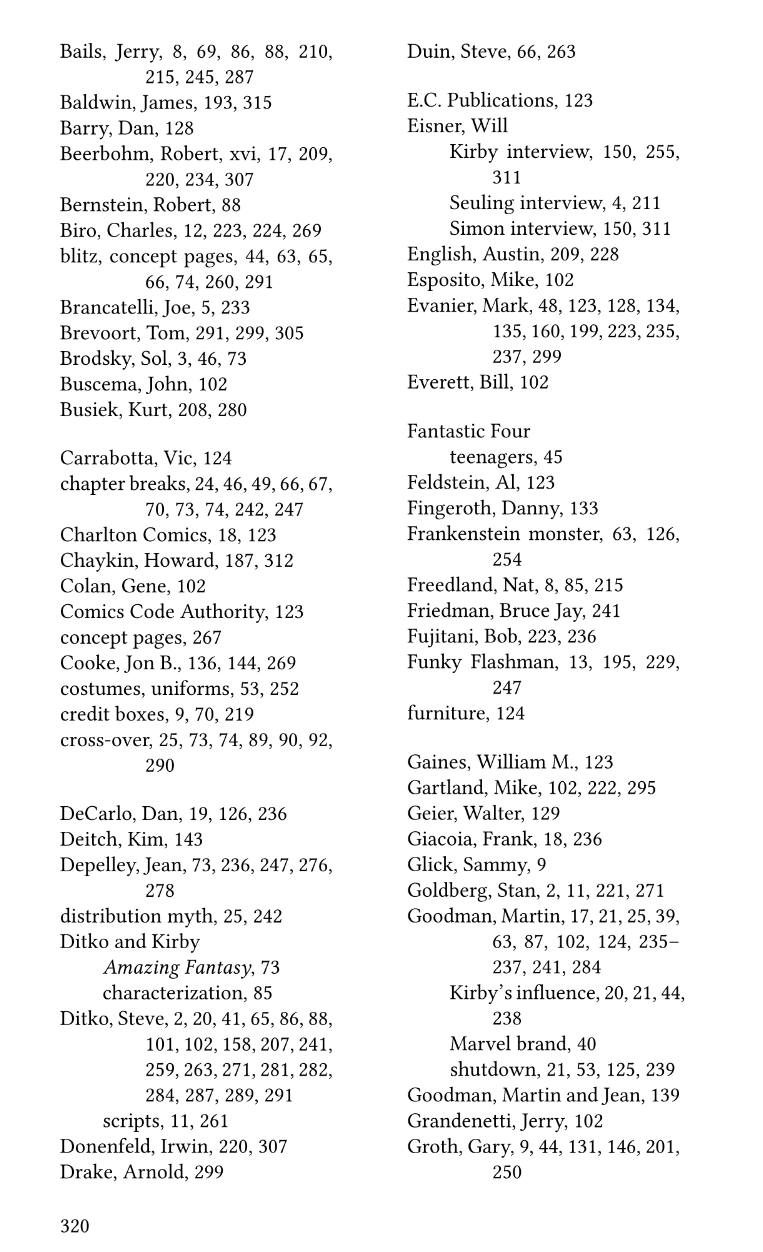
The book now weighs in at 343 pages and is fully indexed.
differences
I typeset this edition myself using free software. Lulu handled the published file with aplomb, and the result is perfect. The images I used have sufficient contrast in black and white to show what I need them to show.
The Amazon KDP process gave me a much harder time. Shown at the top is the cover as required by Amazon, with an extra border added in the bleed edge on the back cover because the process couldn’t find the edge when it was just white.
The initial upload of the manuscript got me the error that Amazon doesn’t accept output from the free software I used. A flattening procedure needed to be applied to deal with things like embedded fonts (Lulu does this automatically). I applied such a procedure to the file from the command line and the file was accepted. Alarmingly, the PDF was reduced to a quarter of its size, making me wonder what kind of information was filtered out.
Unlike the finished Lulu book, the pages of the book from Amazon are slightly less white. The book doesn’t lie flat while it’s resting: the pages of roughly the top half buckle to create a split that looks like the book has been stored down face down, open in the middle (even though the spine is still square and flat). The images are muddy and dim and show far less contrast, so the all-important pencilled lettering in the panels is harder to make out. This may be a result of the flattening process; I’ll experiment.
Depending on where you place the order, the price of the book should be the same or similar at Lulu or Amazon. We cancelled our Prime account in March, and if you’re not particularly attached to free or smaller shipping charges, please consider getting it from Lulu. It’s a superior product.
See threeearlierposts for details. Click links below for article or message.
date unknown, possibly never
Jack Kirby tells Mark Evanier about the creation of Challengers of the Unknown
Summer 1989
Gary Groth: over three hours of interview time with Kirby and Roz 1
August 1989 through 1992
Ray Wyman, Jr: 40 hours of interviews with Kirby and Roz 2
1990
Roz Kirby implores the friends around the house not to show Kirby The Comic Book Makers by Simon or even let on that they’d read it; Evanier is not present for the admonition
1994
Kirby dies; Evanier is appointed “official biographer” effectively suspending further editions of Wyman’s book, and promises Roz he will “tidy up” the loose end of the “regrettable” way KIRBY failed to sufficiently credit SIMON when in reality it was always the other way around 3
1996-97
on Kirby-L over the course of months, Evanier manufactures on the fly a scenario where Simon is involved in the creation of Challengers4
2004
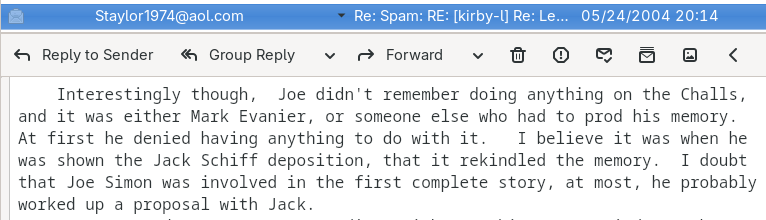
on Kirby-L, Stan Taylor and Harry Mendryk carry on for Evanier who left the list in 1999: Taylor says Simon had no memory of working on Challengers, had his memory prodded by Evanier; Mendryk says Simon showed him an email from Evanier setting out the story they settled on 5
someday, possibly never
Evanier publishes a Kirby biography based on the false recollections of Simon, Lee, and Brodsky; Kirby did not interview for the project, so his version can be superseded
Jack Kirby’s legacy is sufficiently diminished by the Lee (and Simon) slant of the Jack Kirby Collector. He doesn’t need a biography that subsumes his point of view in favour of theirs.
This would qualify as an excerpt from an upcoming book but was dropped in the final edit.
2008 photo by Harry Mendryk.
Jim Amash: You’re right about Roz not wanting to show Jack the Simon book. As a matter of fact, Roz even told me not to tell Jack I had read or even knew about it. That book really upset her.[1]
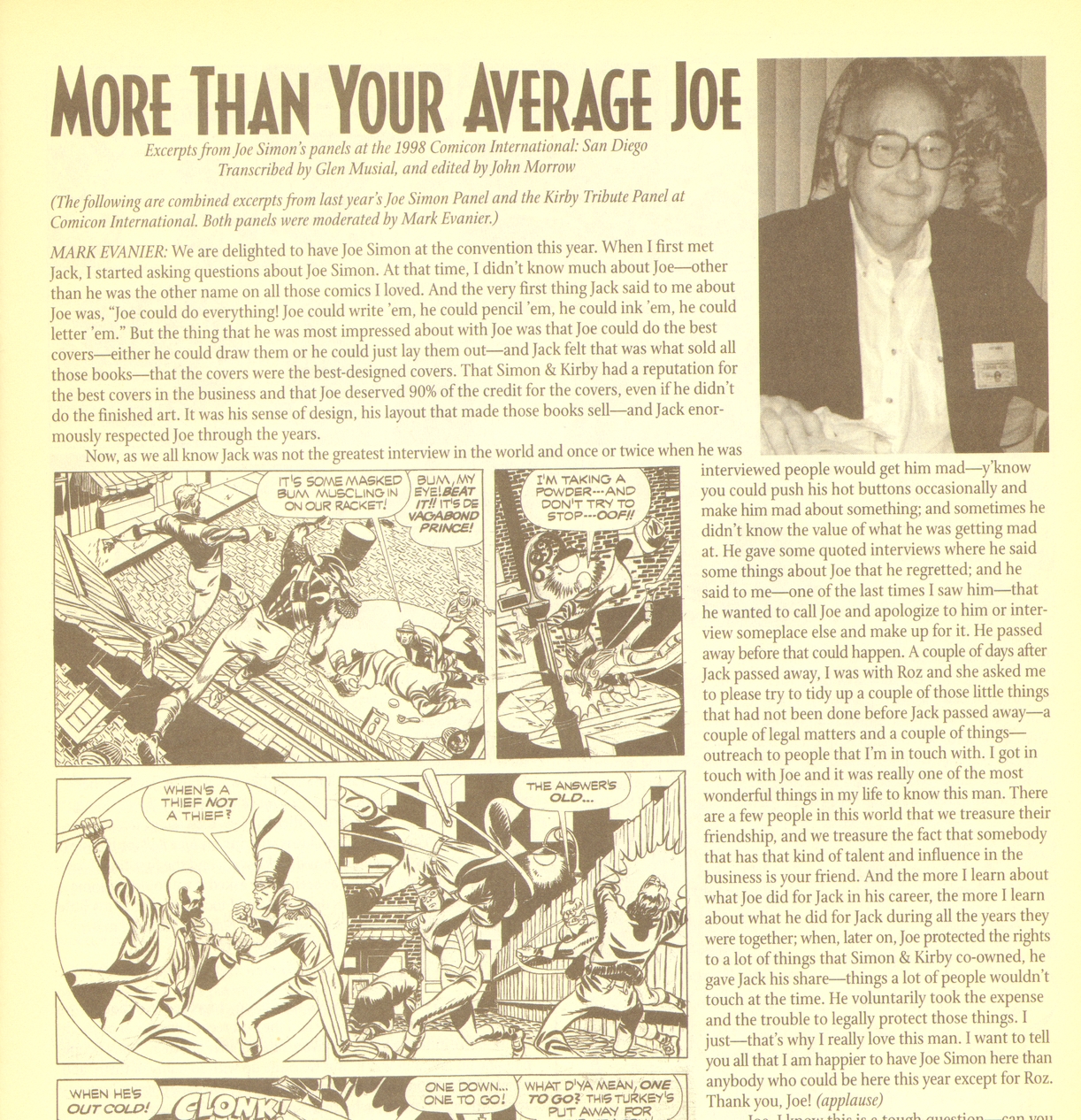
One person who didn’t get the memo from Roz about Joe Simon’s The Comic Book Makers was Mark Evanier. In 1998 he hosted a tribute panel for Simon at the San Diego Comic Con, and in its introduction[2] he detailed his machinations after Kirby’s death.
Mark Evanier: [Jack] gave some quoted interviews where he said some things about Joe that he regretted; and he said to me—one of the last times I saw him—that he wanted to call Joe and apologize to him or interview someplace else and make up for it. He passed away before that could happen. A couple of days after Jack passed away, I was with Roz and she asked me to please try to tidy up a couple of those little things that had not been done before Jack passed away—a couple of legal matters and a couple of things—outreach to people that I’m in touch with. I got in touch with Joe and it was really one of the most wonderful things in my life to know this man.
The idea that Kirby said regrettable things about Simon in interviews is itself a misrepresentation: Kirby was very careful with his words and more often than not demurred when asked about Simon’s contribution. Was Evanier really enlisted by Kirby to make things right? He wasted no time in casting Simon as the wronged party.
Worse, like Lee, Simon took advantage of Evanier’s gullibility to secure the “official” biographer’s endorsement for claiming certain of Kirby’s achievements as his own. Evanier is an unfortunate mixture: susceptibility to a smooth-talking interview subject, with no filter against being lied to. The question arises, how close was Evanier to the Kirby household toward the end if he’s still oblivious to the feelings of Roz regarding Joe Simon? Even Jim Steranko knew:
Jim Steranko: I had to fight to get paid for characters I created & wrote for him. He kept my presentation art without paying me, and later sold the material and kept the $$$. I once offered to pencil a series starring one of my characters and, in his infinite wisdom, he said, “YOU CAN’T DRAW!” Bottom line: swindler. Don’t believe me? Ask Kirby’s wife Roz![3]
Since she was alive at the time, did Roz approve Evanier’s overture to Simon? She wouldn’t have approved of the fruit of their liaison.
Why was Mark Evanier carrying water for, even fabricating on the spot, Joe Simon’s version of events after Kirby was no longer around to fact check it? Why did he aid and abet Simon by extrapolating from a legal document that doesn’t say what he said it did?
Mark Evanier: the very first thing Jack said to me about Joe was, “Joe could do everything! Joe could write ’em, he could pencil ’em, he could ink ’em, he could letter ’em.'”
Why wouldn’t Jack Kirby say nice things about Joe Simon, or exaggerate his talents? Kirby was a genuinely kind and generous human being. For Simon’s part, he rarely missed an opportunity to let his jealousy show by minimizing Kirby’s contributions or putting him down.
STEVE RINGGENBERG: How did you come to be inking over Kirby’s pencils on that “Race to the Moon” story?
AL WILLIAMSON: Well, Joe Simon gave me the job. Here’s something interesting: when I brought the first two or three jobs in, he said, “Now that you’ve inked it, what do you think?” And I said, “Oh, he’s great.” And he said, “Oh, don’t you think he’s not as good as you thought?” And I said, “No, I think he’s better than what I thought.” He was looking for me to say, “No, Jack Kirby can’t draw.” Sheesh. I loved doing those ink jobs. They were a lot of fun.
In the same interview,[4] Williamson describes Simon badmouthing him to Angelo Torres behind his back.
Mark Evanier: Now, as we all know Jack was not the greatest interview in the world and once or twice when he was interviewed people would get him mad—y’know you could push his hot buttons occasionally and make him mad about something; and sometimes he didn’t know the value of what he was getting mad at.
Here Evanier includes a put-down for Gary Groth’s TCJ interview.[5] This is the crux of his beef with Kirby: he resents him for giving an in-depth interview, not to him, but to Groth. To talk up his upcoming biography, Evanier touts epic exclusive interviews with Lee, Brodsky, and presumably as of 1996, Joe Simon, none of whom had reason to be remotely objective where Kirby’s concerned. Calling Kirby a lousy interview allows Evanier to dismiss what Kirby said while he was alive. The result is that Kirby’s former collaborators, who did grace Evanier with interviews, get to tell the Jack Kirby story.
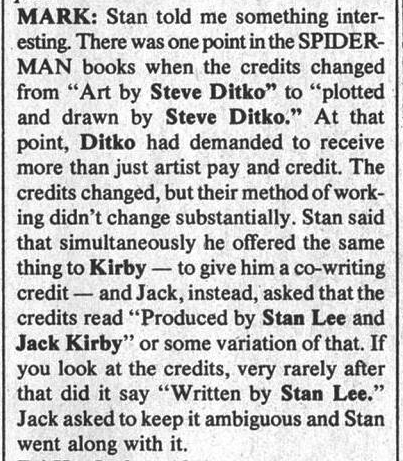
What made Evanier disregard Kirby’s point of view while Kirby was alive? He was taken in by Lee’s heinous lie about plot credit, and committed it to print in his 1981 interview in Comics Interview #2:
Lee’s timing is off with this fictitious anecdote and Evanier didn’t bother to check it with Kirby or the published work. The “Produced by” credit appeared over a year after Ditko’s plot credit and subsequent departure.
Patrick Ford: In the interview, Evanier comments he had just had lunch with Lee “a couple of weeks ago.” This is apparently where Evanier got the information Ditko asked for writing credit and money. Aside from Lee telling Evanier Ditko asked for writing money Lee told a bald faced lie by saying nothing changed between Lee and Ditko after Ditko asked for money. That’s a lie where the basic fact isn’t even in dispute. No one believes nothing changed. Lee himself admitted that as far back as the Nat Freedland interview in 1966. Even Roy Thomas today says it was Lee who stopped speaking to Ditko.
Lee begins using the Ditko plot credit on Amazing Spider-Man #26 and says he offered Kirby the same. Issue #40 of the Fantastic Four was published the same month (April 8, 1965). Ditko began getting the plot credit Lee claims Kirby turned down in favor of a “Lee-Kirby Production” credit. FF #40 credits Kirby for “artwork,” Lee is credited with “script.” FF #55 credits Kirby with “penciling” and Lee with “script.” This a year and a half after Lee claims he offered Kirby the same plot credit he “gave” to Ditko. It wasn’t until August 9, 1966 (long after Ditko quit in November 1965) that the first “Co-” credit appears in FF #56. Within a few months Lee was using the same credit on just about everything. Needless to say these facts make Lee’s claim highly suspect and it’s disappointing that Evanier not only didn’t double check with Kirby but didn’t bother to look and see that it took Lee from April 8, 1965 (ASM #26) until August 9, 1966 (FF #56) for Lee to give Kirby the credit Lee claims Kirby asked for in lieu of a writing credit. A period of 16 months.
Ferran Delgado: And let’s not forget Amazing Spider-Man #100 [the credit box that reads “Created & Written by Stan Lee”].[6]
Altruism?
Mark Evanier: And the more I learn about what Joe did for Jack in his career, the more I learn about what he did for Jack during all the years they were together; when, later on, Joe protected the rights to a lot of things that Simon & Kirby co-owned, he gave Jack his share—things a lot of people wouldn’t touch at the time. He voluntarily took the expense and the trouble to legally protect those things.
Evanier was misled: these claims of Simon’s, uncritically relayed, are provably false. Simon potentially made deals with the work of Kirby (and others) for decades without cutting Kirby in. Evanier himself testified[7] as much:
Mark Evanier: I am at a loss to explain why there was a Foxhole #7 done by Charlton writers and artists. When I asked Jack about it, he said there was no such comic; that Charlton would have had no right to do that. Then I showed it to him and he was baffled how it could have come about. Simon didn’t recall, either, but said that maybe (because the company was in dire straits due to the flood) they gave permission to use the title… or something.
In the Bruce Hamilton interview,[8] Kirby admitted he was aware that a reprint deal had been arranged behind his back.
BRUCE: Are you familiar with this new publisher Skywald? Do you know the story behind some of the old comics they’re reprinting? JACK: Well, it’s probably a simple story. I don’t know the story behind it, but I’ve done the same thing in the past myself. Purchasing old artwork cuts down on costs. I see they got hold of some of my old Bullseyes. I don’t know how they did that, but I’m quite sure they bought it legitimately; but I don’t know from whom.
For The Art of Jack Kirby, Ray Wyman, Jr conducted an estimated 40 hours of interviews with Jack (and Roz) Kirby. Gary Groth figures the TCJ #134 interview, spread over two sessions, exceeded three hours. For whatever reason, Mark Evanier has no such repertoire of Kirby interviews on which to draw, so he resorts to dismissing Kirby as an interview subject and playing up his “exclusive” interviews with those who didn’t get enough of taking from Kirby while he was alive. In addition, the very vapourware announcement of his “official” biography nearly 30 years ago has prevented other efforts from being published. Wyman’s interviews are relegated to excerpts in the pages of the Kirby Collector.
The 1998 Simon panel intro was expanded by Evanier into a 14-page introduction to Abrams’ The Art of the Simon and Kirby Studio (2014).
Mark Evanier: Joe was better at designing covers and splash (opening) pages. His time spent in newspapers and advertising had taught him much about typefaces and designing so as to grab the reader’s attention. Joe was also better at inking…
Evanier, who doesn’t have a clue in discerning[9] Kirby’s (or others’) inking, is the last person who should be pontificating on who was S&K’s best inker. He gets it wrong, not based on what can be seen in the work, but based on what he was told after Kirby’s death.
Mark Evanier: Joe was better at designing covers and splash (opening) pages. His time spent in newspapers and advertising had taught him much about typefaces and designing so as to grab the reader’s attention. Joe was also better at inking…Joe Simon, though older, outlived his famous partner by nearly eighteen years. For much of that time, he did what he’d done so well since the day they met: He protected the interests of Simon and Kirby.
Mark Evanier clearly demonstrates here that he doesn’t know what he’s talking about. His willful and spectacular ignorance regarding Kirby’s contribution is being used to perpetuate Simon’s myths. Simon’s forté was running the business, something at which on occasion he also proved to be inept.
It was Kirby who was the master inker at S&K, inking his own work and touching up pages inked by others in the studio. It needs to be noted that the Abrams book is comprised of original art belonging to Kirby and others that was retained by Simon until his death in 2011. Simon protected the interests of Joe Simon.
Evanier has used his position as Kirby expert to arrogate the telling of Kirby’s story to a pair of lifelong prevaricators while peddling disdain for Kirby’s more accurate account. Worse, the ghost of Jack Kirby that he channels can be made to deliver any words or attitudes that suit the Lee-Simon narrative.
ENDNOTES
[1] Jim Amash, Kirby-L mailing list, 29 January 2000.
[2] “More than your average Joe,” The Jack Kirby Collector #25, August 1999.
[3] Twitter, 15 July 2013.
[4] Al Williamson interviewed by Steve Ringgenberg, The Comics Journal #90, May 1984.
[5] The Comics Journal #134, February 1990.
[6] Marvel Method group, 27 December 2023.
[7] EC Yahoo Group, 8 March 2004.
[8] Rocket’s Blast Comicollector #81, 1971.
[9] A page on the Kirby Museum website about the New Gods #1 cover takes a sly dig at Evanier who insists Kirby’s Orion concept drawing was inked by Don Heck rather than Frank Giacoia. A quarter of a century after the UK’s Mike Lake made the call, Evanier was a lone holdout in accepting George Klein as the inker of the first two FF issues until he was given a personal consultation on the evidence by Michael Vassallo.
 During his ambitious undertaking to read through Jack Kirby’s life’s work, Jeet Heer discovered an omission in my story listing in Kirby at Marvel. He sent me a correction for the table in Chapter 4 (1963).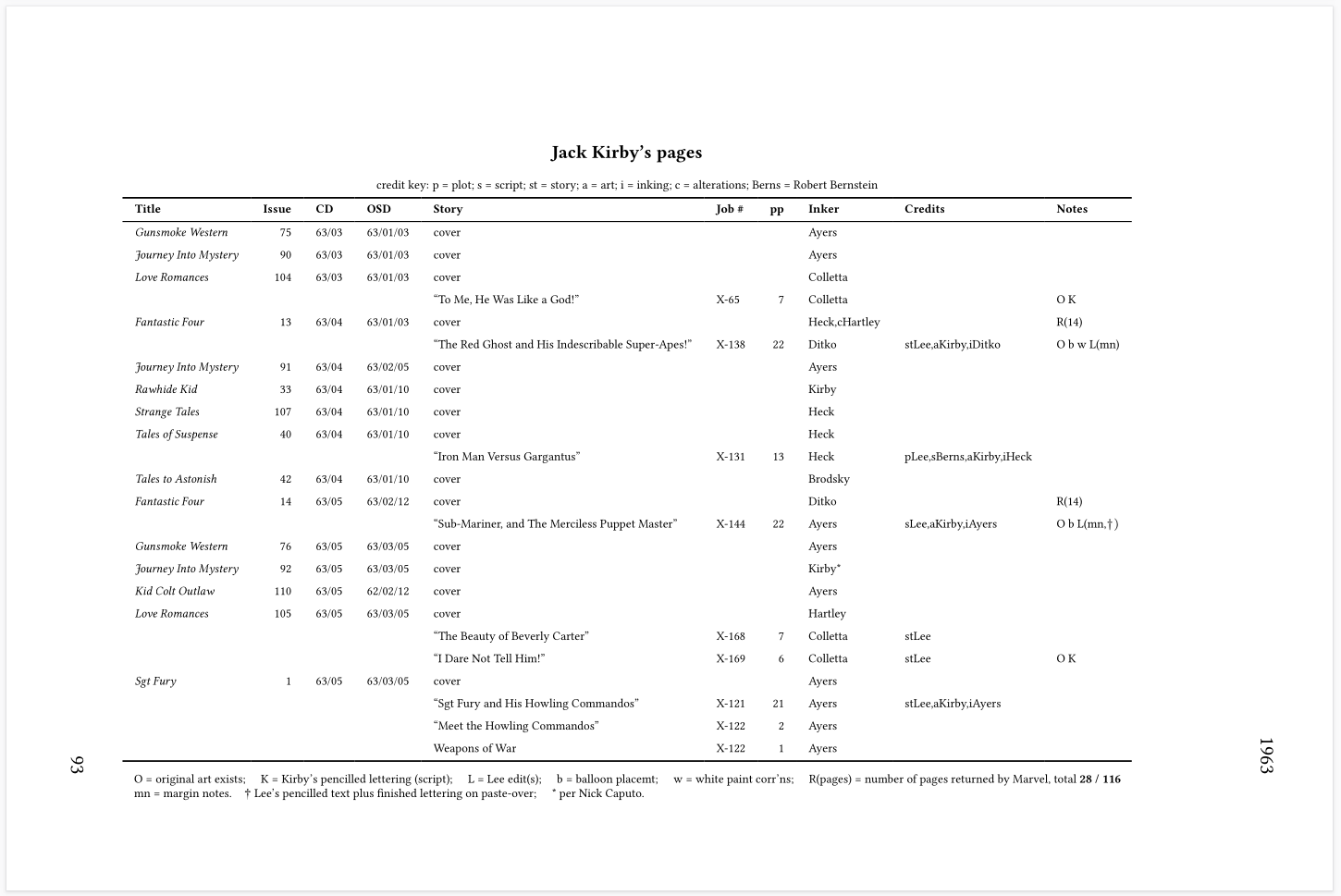

 accordingtokirby