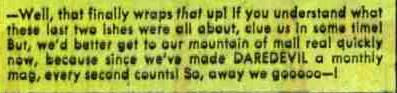
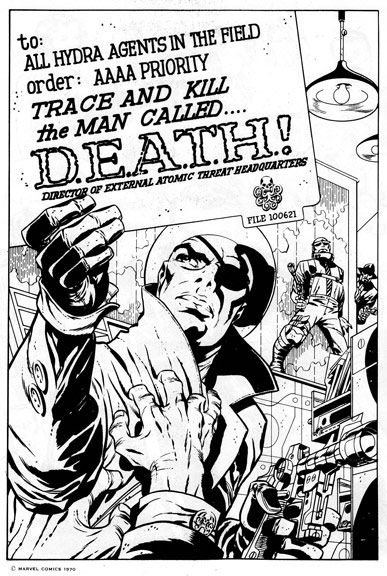
Kirby was rarely, if ever, late with the FF pages

Stuf’ Said p 27: This is very telling. The book is running late, and Stan hasn’t finished dialoguing it, but the pencil art is in by now. Yet Stan has no idea what it is about, which leads me to believe Kirby has plotted it without Stan’s involvement. Either way, it’s definite that the duo is using some form of the “Marvel Method” at this point.
One reason it would be running so late: FF #7 is when the mag goes from bi-monthly to monthly publication. So the change from their old production schedule means making up a month on the schedule to get it to press on time. Thus, it makes sense Stan might turn Jack loose as the deadlines tighten, and let Kirby plot issues around this period by himself. This lends more credence to the idea that Kirby writes the dialogue on FF #6. Jack is an accomplished pro who’s done countless books before. So Stan can feel confident turning it over to him if he is running late and needs help on it.

Correction: Lee “turned Jack loose” in general because he felt confident in Kirby doing the writing without pay. Lee doesn’t know the plot until Kirby turns in the pages.

FF6_Namor

“definite that the duo is using some form of the ‘Marvel Method’ at this point”? The practical application of the Marvel Method from its inception (FF #1, see previous definition), was that Kirby would plot, write, and pencil a story; he would relate the story to Lee in the story conference when he turned over the pages; then Lee would add the dialogue.

31[33]: Stan continues to correspond with Jerry Bails, one of the prominent names in fandom: [Lee] “You’re right about Al Hartley’s art work not being right for Thor. Actually, Al specializes in teen-age strips (he does the Patsy Walker mag for us) and simply pinch-hit Jrny. Into Mystery because it was an emergency—Jack was busy with an FF ish that was late, Joe Sinnott was tied up with another job, etc.”
The “emergency” Lee refers to is actually more involved than he lets on. While Kirby skips drawing the Thor feature in Journey into Mystery #90–92, he spends this time course-correcting the Human Torch feature in Strange Tales #108 and 109, and giving a creative push to the new Iron Man strip in Tales of Suspense #40 and 41—which would easily account for an issue of Fantastic Four running late.

Might I suggest that despite multiple such accusations by Lee to third parties and on letters pages, Kirby was rarely, if ever, late with FF pages? Again, Morrow should question everything.

“Al Hartley wanted to work on an adventure strip, so I took Thor away from Kirby.” See how silly that sounds?

Kirby’s creative push on Iron Man included the design of the character, and likely included the first story drawn. Why Heck’s story with Kirby’s plot appeared first is the puzzle. (See Further information, p 28.)

36[38]: Lee goes on to reveal more about how frantic things are at Marvel: [Lee] “Can we level with you? We can’t tell you what the next FF will be because we haven’t decided on a plot yet. So we won’t say ‘Don’t miss the greatest, most thrilling, etc. etc.’ All we’ll say is—we’ve got to dream up a story in the next couple of days, and have it drawn pronto if we wanna make our deadline!”

“Can we level with you?” We’re about to do anything but level with you. It’s what we say before we don’t level with you.

Lee hasn’t decided on the plot because he hasn’t yet seen the plot in Kirby’s pencilled pages. When Kirby’s pages arrive, I predict Lee will have a revelation.

40[43]: Plans are afoot for the summer, but it’s still a bit early to finalize them, as Stan eludes: [Lee] “We are definitely going to publish a Spiderman annual!… We don’t know the exact content yet because we haven’t written it yet! In fact, we don’t know when we’ll get the time to write it.”

“We.” Ditko hasn’t submitted his pages yet.

40[43]: The two main stories are mentioned by title, though it says some of the other features are “still top secret”, likely meaning they haven’t been decided upon yet at the time of this writing.

“decided upon”? Lee hasn’t received Kirby’s pages yet.

41[44]: Meanwhile, as Lee composes the letter column for Sgt. Fury #11—a title Jack hasn’t been involved with beyond covers for four issues—Kirby is name-dropped by Stan: [Lee] “Hey Kirby—FF’s a week late!”

The odds are against it.

41[44]: Is Kirby ever late, unless Stan has overloaded him with too much work?

Not even then.

NEXT: Lee was not a plotter
Back to Contents

Lee was not a plotter

Stuf’ Said p 19[18]: Larry Lieber: “Stan made up the plot, and then he’d give it to me, and I’d write the script … I would follow from Stan’s plots.”

Like Thomas, Lieber was only repeating what he’d been told by Lee. There’s no evidence that Lee “made up” plots even if he was dispensing plots.

34[36]: Barry Pearl recounts what Ayers has to say in 2009 about plotting with Stan: “Dick told us how Stan called him one day [in early 1965] and said, ‘I can’t think of a story for Sgt. Fury #23. We won’t have an issue unless you think of something!’ …”

…and…

34[36]: Another Marvel regular [Goldberg] recounted his own plotting experiences with Lee… “One time I was in Stan’s office and told him, ‘I haven’t got another plot.’ Stan got out of his chair, walked over to me, looked me in the face, and said very seriously, ‘I don’t ever want to hear you say you can’t think of another plot.’ Then he walked back and sat in his chair. He didn’t think he needed to tell me anything more. After that, I could think of a plot in two seconds.”

The question that needs to be asked is if Lee was leaning on Ayers and Goldberg for plots, how in the world could anyone believe he was providing plots to Kirby?

54[60]: [WALLACE WOOD]: “I enjoyed working with Stan on Daredevil but for one thing. I had to make up the whole story. He was being paid for writing and I was being paid for drawing but he didn’t have any ideas. I’d go in for a plotting session and we’d just stare at each other until I came up with a storyline. I felt that I was writing the book but not being paid for writing.

“But remember that issue of Daredevil I wrote? Stan said it was hopeless and that he’d have to rewrite the whole thing. Then I saw it when it came out and he’d changed five words, less than an editor usually changes. I think that was the last straw.”

As Morrow has noted here, Wood wasn’t given writing credit, even begrudgingly, without ridicule in the letters and text pages.

Daredevil10caption

Wood1

Wood2

48[52]: Lee gives readers his rationale for assigning Kirby to layout so many strips:
[Lee] “Jack needs another pair of hands for all the strips we’d like him to do, but instead of giving him a break by taking a strip away completely, we try to have him make rough layouts for the next penciler, so that the strip will still have that ol’ Kirby magic no matter who does it!”

Lee meant to say “no matter who adds the dialogue, me or some guy in the office.” “Kirby magic” means a story written by Kirby (see Further information, p 45).

86[92]: This month, Kirby’s drawing Thor #155, but as Glen Gold discovered on the original art from the issue, Stan is making very direct comments in the margins to someone, that the dialogue isn’t working, and he suggests fixes. This leads to the supposition that someone in the office may well’ve been ghost-writing on this, or Lee is at least having someone else in the office fix things that, in hindsight, he doesn’t feel worked well on his own dialogue.

And yet Kirby suggesting this in 1989 remains “egregious” as this book goes to print.

88[94]: [Lee] “[Ego, the Living Planet] was Jack’s idea, too. I remember I said, ‘You’ve got to be kidding.’ He said, ‘No, let’s get a living planet, a bioverse.’ Well, I didn’t want him to think I was chicken. I said, ‘All right, you draw it, I’ll write it.’”

Lee inadvertently reveals his m.o. for working with Kirby, the one that’s been in place from the start: Kirby idea, Kirby-drawn story, Lee overwriting. To get an idea of the calibre of Lee “plotting” without Kirby, Chris Tolworthy suggests looking at specific titles when Kirby was absent, like FF after 102, or the six Thor stories in Journey Into Mystery during Kirby’s hiatus.

NEXT: Simon says
Back to Contents

Simon says

Stuf’ Said p 6: Always the consummate businessman, Simon was more renowned for his deals than his creative work, although he was a very adept artist in his own right. But Kirby tended to get the lion’s share of the creativity credit in their relationship, while Simon steered the duo’s financial boat with a steady hand from one company to another. He had a flair for coming up with concepts and gimmicks that would stand out from the crowd, and he always looked out for Kirby’s best interests as well as his own.

“adept artist”? No. A perhaps competent artist who employed ghosts and whose credited work is so varied in style that it is impossible to know whether the work is by Simon or one of his hired hands. Like someone else we know, he “had a flair” for putting his name on Kirby’s work.

Simon “looked out” for his own interests. The failure of Mainline left him in substantially better straits than the Kirbys (see p 12, below).

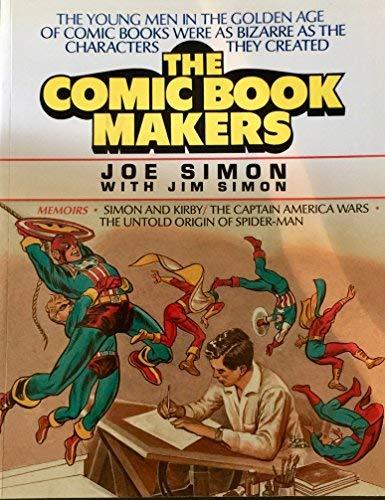
ComicBookMakers1990

Jim Amash, Kirby-L, 29 January 2000: “You’re right about Roz not wanting to show Jack the Simon book. As a matter of fact, Roz even told me not to tell Jack I had read or even knew about it. That book really upset her.

“Another thought. Dan Barry and Charles Paris both told me that they remembered Jack sitting in the DC bullpen writing and drawing stories at the same time. In fact, Dan’s comment was (censored for language), ‘I don’t know how Kirby could write and draw 5 pages a day but I used to see him do it.’

“I think we have to give weight to the fact that Kirby sat down alone in Thousand Oaks and wrote and drew his own stories without Simon or Lee. So there’s little doubt that Jack could do it. The question how often did he do it when he worked with Joe Simon. It seems to me that there was more than one way Jack did stories back then and that we’ve about mentioned them all by now.

“Joe Simon has been known to embellish facts also. He claimed he laid out and had lettered the 1970’s Sandman story by Simon-Kirby. When I pointed out to him that Royer did the lettering and that penciled pages showed Jack’s drawing and handwriting and nothing of Simon’s, he backed off that claim. Until his next interview.”

Rodrigo Baeza, 2013: Steranko had the following to say about Joe Simon yesterday on Twitter…
‘I had to fight to get paid for characters I created & wrote for him. He kept my presentation art without paying me, and later sold the material and kept the $$$. I once offered to pencil a series starring one of my characters and, in his infinite wisdom, he said, “YOU CAN’T DRAW!” Bottom line: swindler. Don’t believe me? Ask Kirby’s wife Roz!’

9: “We created Captain America… Jack and I turned out so much stuff that we had many work methods. At the beginning, I would write the story right on the art board, making very rough layouts. Then Jack would tighten up the drawing, and if he had to, help with the story. We were both prolific writers. Then I would ink it. That was the true Simon and Kirby stuff.”

This interview was recorded in 1990, the year of publication of the first edition of The Comic Book Makers, the book that had upset Roz Kirby. Simon couldn’t keep his story straight. Here’s one of his embellishments, told to Jim Amash, printed in 2008. 41

JA: Did Jack occasionally write his own stories?

SIMON: I didn’t let him write a story when I was with him, but he worked with the scripts. He was a good editor. He’d put some nice phrases in there, but his stories were all fragmented.

On closer examination it can be seen that stories pencilled and inked by Kirby since his return from the war were also written by Kirby, and many of the books produced by the studio feature a solo Kirby lead story (writing, pencils, inks). In TJKC #25, Morrow reprinted what he introduced as a “revealing interview with the King” by James Van Hise… 42

VAN HISE: How much of your own writing were you doing then?

KIRBY: All of it. I’ve always done my own writing. When I got into comic books I began needing people like Joe Simon, and finally Joe and I got together to do Captain America. We were both professionals, and we were both capable of writing the stuff, but Joe did most of the business. He was a big guy, six foot three, very impressive, and he had college experience which I didn’t have—but I had a unique storytelling ability, so although he was quite capable of doing so, he never had to write the stories. I’d write the stories on Captain America or whatever we’d be working on and Joe did business with the publisher because he could meet the publisher on an equal footing. I was younger and I was the kid with the turtleneck sweater who was always working.

VAN HISE: What was the actual breakdown of work between you and Joe Simon on Captain America as far as penciling, inking, etc.?

KIRBY: Well, I did most of it because I had the time. I was constantly working. Joe had duties as an editor and he might be an editor in the publishing house and he’d be having contacts with the publisher that I didn’t.

Kirby’s answers call to mind the reflections of Jack Katz on working in the S&K studio a number of years later… 43

KATZ: Jack would work at his own desk there, and Joe would come in during the morning, and subtly stare at us. Then Jack would go to lunch, and when he came back, Joe would leave for the day. I think he was looking for financing, I’m not sure…

JA: How many hours a day do you figure Kirby was working?

KATZ: I left late. He would get in early. He was always there before I came in. I used to come in at nine. Joe was there quite often. But then he’d take off, and he would take some pages with him.

S&K studio writers Kim Aamodt and Walter Geier spoke to Amash for Alter Ego #30 (November 2003)…

AAMODT: Well Simon and Kirby wrote the plots. They sat there and wrote them, and that’s what we followed… Jack did more of the plotting than Joe. Jack’s face looked so energized when he was plotting that it seemed as if sparks were flying from him… Joe was good, but not as creative as Jack was… I remember Jack Kirby was very good about making up titles. I remember giving him a lame title, and Jack said, “No. We’re going to call it ‘Under the Knife.’” It was a surgical story. I was impressed that Jack came up with titles so quickly… I really sweated out plots, unlike Jack Kirby. Jack just ignited and came out with ideas, and Joe’d just kind of nod his head in agreement.

JA: Do you think Joe did much writing?

AAMODT: I really don’t know. I always just thought of him as being a counterpart to Kirby. I just saw him handle the business end. I always said, “Joe was on the ground and Jack was on cloud nine.” Jack was more the artist type; he had great instincts.

GEIER: Every time I went up there, I saw both of them [Simon and Kirby]. And they always gave the writers the plots. Jack Kirby was great about that; he always came up with the plots…

JA: What did you think of Simon and Kirby?

GEIER: I liked them. They were real characters. They were kind of like street guys. Joe Simon was not what I’d call “Ivy league.” Joe used to sit there when the writers came in for conferences. They sat there and made up the plots for the writers. Jack did most of that. Joe would say something once in a while, but Jack was the idea man.

10: Before completing their work on Captain America Comics #10, Timely’s accountant reveals to Kirby and Simon that they are being cheated out of promised profits from the title as originally negotiated with Goodman.

Simon’s explanation may be “commonly known” but requires confirmation independent of Simon.

12: Simon & Kirby’s own comics company Mainline goes out of business, resulting in lean times and the pair parting ways. Kirby goes looking for other work, mainly from DC Comics. Why exactly do Simon and Kirby stop working together? Kirby is hesitant to share too many details about it…

It was “lean times” for the Kirbys (see p 159 under Just Plain Wrong). Simon seems to have done well, moving into an oceanfront mansion, and in possession of what would eventually prove to be a small fortune in original art (from inside and outside the studio).

Kirby’s reticence is not unlike how one would act under threat of legal action by, say, the famously litigious Simon.

13: The remaining finished Mainline material goes to Charlton Comics to be published.

Simon also used the material, and the intellectual property, to make deals behind Kirby’s back.

Mark Evanier, EC Yahoo Group (8 March 2004): “My understanding is that the Charlton deal was a partnership. Simon and Kirby had finished most of two issues of each of their existing Mainline comics (IN LOVE, FOXHOLE, POLICE TRAP and BULLSEYE) and two issues of two new books (WIN-A-PRIZE and a new, as yet unnamed humor comic). They had a lot of money and time invested in the leftover material and wanted to get it into print quickly to recoup their money.

“George Dougherty suggested Charlton. They made a deal where Simon and Kirby would supply the contents and Charlton printed and distributed. The gross was to be split on some sort of formula and the idea was that once they had some idea of how the books were selling, they might negotiate an ongoing relationship to keep doing them. Simon and Kirby retained ownership of the material and magazines. (The material for their humor comic wound up in Charlton’s FROM HERE TO INSANITY on some sort of separate deal.)

“Even before they got any sales reports, Joe and Jack had soured on Charlton and gone off looking for other venues in which to work. Then the hurricane hit Charlton and Joe and Jack never got any sales figures, and Jack thought they never even received any money beyond a modest advance Charlton had given them. There was no further talk of Simon and Kirby doing stuff with Charlton.

“I am at a loss to explain why there was a FOXHOLE #7 done by Charlton writers and artists. When I asked Jack about it, he said there was no such comic; that Charlton would have had no right to do that. Then I showed it to him and he was baffled how it could have come about. Simon didn’t recall, either, but said that maybe (because the company was in dire straits due to the flood) they gave permission to use the title…or something.”

Similarly, Kirby was not consulted when a deal was made with Skywald for reprinting his Bullseye material (Sundance Kid #s 1 and 2), as noted by Bruce Hamilton. 44

97[105]: Martin Goodman had, in 1966, convinced Kirby that he’s being left out by Simon, and to sign a deposition describing the creation of Captain America in terms favorable to Marvel, with the understanding that Kirby will receive a payment equal to whatever Simon receives. As Joe would reveal decades later in his book The Comic Book Makers, Goodman paid most of Simon’s settlement directly to Simon’s attorney to shortchange Kirby, by paying him only the same smaller $3750 amount that Simon directly received.

Simon’s book definitely needs to be experienced, but the book and his interviews should not be taken as a recounting of facts. This is a good place to mention Simon’s dealings with Goodman in the 1960s…

Patrick Ford, Marvel Method group, 1 February 2019: “It’s sad how common it is to see people say that Kirby sided with Marvel against Simon. Kirby’s story, the one he always told, was that he and Simon were on staff at Timely and were charged with creating super heroes to populate Goodman’s publications.

“Simon’s story completely cuts Kirby out of the creation of the character Captain America and also marginalizes Kirby’s contribution to the ten issues of CAPTAIN AMERICA COMICS. As Simon describes it Kirby was nothing more than a penciler who tightened up Simon’s layouts. As there were at least ten creators who wrote, penciled, inked and lettered CAPTAIN AMERICA COMICS #’s 1-10 Kirby was just one of them.

“Why would Kirby have sided with Simon? In his book Simon claims that Kirby ‘bristled’ in 1965 when Goodman told Kirby that Simon was ‘trying to cut Kirby out.’ Aside from the obvious fact that Simon would not have been present in any meeting between Goodman and Kirby in 1965 the fact is that Simon WAS cutting Kirby out.”

104[114]: Kirby pushes for the payment due him from Marvel, equal to what Joe Simon received in November 1969 for settling the Captain America suit. On June 29, Marvel sends a letter confirming Kirby will sign a release form like the one Simon signed, and in return Kirby will receive $2535 (the same $3750 amount Simon received directly, less the $1000 balance that remains on his 1968 loan, plus interest). But Kirby doesn’t sign the release and get his payment, for a full two years.

This story may originate with Simon. The part about the secret payment through his lawyer needs to be independently confirmed. See p 97 above.

145[161]: [Chronological recap.]

A nice summary. Again, watch out for Simon statements taken literally.

NEXT: Lee misrepresents
Back to Contents

Footnotes

back 41 Joe Simon interviewed by Jim Amash, Alter Ego #76, 2008.

back 42 “Jack Kirby in the Golden Age,” originally published in Golden Age of Comics #6, November 1983, and reprinted in The Jack Kirby Collector #25.

back 43 Jack Katz interviewed by Jim Amash, Alter Ego #92, March 2010.

back 44 Kirby interviewed by Bruce Hamilton in Rocket’s Blast Comicollector #81, April 1971, reprinted in TJKC #18, January 1998.

Lee misrepresents

Stuf’ Said p 23[22]: [Lee] “…I stumbled onto [the Marvel Method]. I’d be writing all the stories, and I’d be working on a Fantastic Four and the artist who’s doing Dr. Strange would come and say, ‘Stan, I’ve finished my script . I need another’. But I’ve got the typewriter going for F.F. and I couldn’t stop. And I couldn’t let him sit around doing nothing.”

Lee wasn’t keeping “artists” busy. His page count at this point was lower than it was before the implosion. He was not too busy to write eight publications per month (and indeed was not even responsible for writing all of them). There is no evidence that he wrote a script (see Sinnott, p 15 under Assumes facts not in evidence).

Here are the titles containing Lee-signed stories in the two-month period leading up to FF #1:

Rawhide Kid
Patsy Walker
Kathy
Life with Millie
Gunsmoke Western
Kid Colt Outlaw
Love Romances
Linda Carter Student Nurse
Millie the Model

Lee’s first signed fantasy story is one of Ditko’s, the month before the cover date of FF #1. He signed three of Ditko’s that month; he didn’t sign any of Kirby’s, that month or any other. (See links under Assumes facts not in evidence, p 15.)

Patrick Ford, the Marvel Method group, 15 April 2019: “A fact which contradicts Lee’s claim that the Marvel Method came about because Lee was so busy he no longer had time to write full scripts is Lee wasn’t writing anything close to ‘the whole line.’ He was writing about half the line. And curiously even after the hero books began replacing the monster-fantasy titles Lee continued to have his brother and other writers assigned to hero titles while Lee seemed to prefer MILLIE, PATSY and Westerns to costumed heroes. Once the super hero titles were in, more or less, full swing Lee chose not to write: Thor, Iron Man, Ant-Man, the Human Torch.”

34[36]: [Lee] “…90% of the ‘Tales of Asgard’ stories were Jack’s plots, and they were great! He knew more about Norse mythology than I ever did (or at least he enjoyed making it up!). I was busy enough just putting in the copy after he drew it.”

I’m going to go with 100%.

38[41]: TURNING POINT!
[Lee] “I wrote it… this is my writing, to remind me [what] to say… to let me know that that’s what I wanted to put in. It’s funny; historians always write about Jack’s notes. They never write about the notes that I put in, because I always erased them, once the script was done.”

Not a turning point. Lee was simply making notes to himself during the kind of story conference Kirby maintained was the usual procedure: Kirby described the story he’d pencilled to Lee when he delivered the pages. See Kirby’s description in the Pitts interview, Stuf’ Said p 137[150].

117[129]: Lee discusses the departure of Kirby, and whether he could’ve done his New Gods books at Marvel: [Lee] “He could have. I don’t really know why he left. I think it was a personal thing. Jack never told me.”

This repeated lie calls for a translation: “I was stealing from him and he finally got tired of it. When the new owners decided who was to be appointed creator, I threw Jack under the bus… I did the same later with Chip and the position of Publisher.”

118: [Lee] “…with Ditko I have less of an understanding. Steve was a very mysterious character.”

More of the interview…

[Charles] Murray: Could you tell me what happened to Steve Ditko, and why he’s wasting his time with poor mystery titles for a small company?

Lee: It’s the same thing as with Kirby—only with Ditko I have less of an understanding. Steve was a very mysterious character… But, little by little, he became tougher and tougher to work with… it was like Chamberlain giving in to Hitler, the more I appeased him, the harder he got to work with. Finally, it reached the point where he didn’t even come up to the office with his artwork—he’d just mail it in. Then one day he said he was leaving. (see Stuf’ Said p 118[130]) 45

Chamberlain appeasing Hitler? Lee is concealing his decision to stop speaking to Ditko. Thomas, and by extension, Brodsky, corroborate Ditko’s version of events that he brought his artwork to the office in person up until the last day.

Translation: “Steve demanded plotting pay, and that cut into the page rate I was stealing from him. I couldn’t let him think I was going to tolerate that.” (My putting words in Lee’s mouth should give Morrow an idea why it’s problematic to add Kirby’s colour code to the things Lee says Kirby said.) Ditko’s writings should be presented to counter this nonsense, particularly his letter to Comic Book Marketplace (Stuf’ Said p 150[164]).

In your Comic Book Marketplace #61, July 1998, page 45, Stan Lee talks about “…a very famous scene…” of the trapped Spider-man lifting heavy machinery over his head.
The drama of that sequence was first commented on and popularized by Gil Kane.
Stan says “I just mentioned the idea…I hadn’t thought of devoting that many pages to it…”
I was publicly credited as plotter only starting with issue #26. The lifting sequence is in issue #33.
The fact is we had no story or idea discussion about some Spider-man books even before issue #26 up to when I left the book.
Stan never knew what was in my plotted stories until I took in the penciled story, the cover, my script and Sol Brodsky took the material from me and took it all into Stan’s office, so I had to leave without seeing or talking to Stan.
Steve Ditko, New York 46

It’s a lie that Lee didn’t know why Ditko left. Indeed, he was making contingency plans with Romita.

124[136]: [Lee] “This is how Jack Kirby and I created the Silver Surfer, one of our most popular characters…”

Will this statement be allowed to stand uncontested?

133[145]: Lee has specifically claimed credit for Thor’s buddies: [1998] [Lee] “I made [the Warriors Three] up. I specifically remember that I did them because I wanted a Falstaff-type guy, a guy like Errol Flynn, and then I wanted a guy like Charles Bronson who was dire and gloomy, riddled with angst. Those three were mine.”

The defensive language is interesting, but as with many “historical” statements from this “interview” (the timing of which is critical… see Lieber comes into his own), it’s a lie.

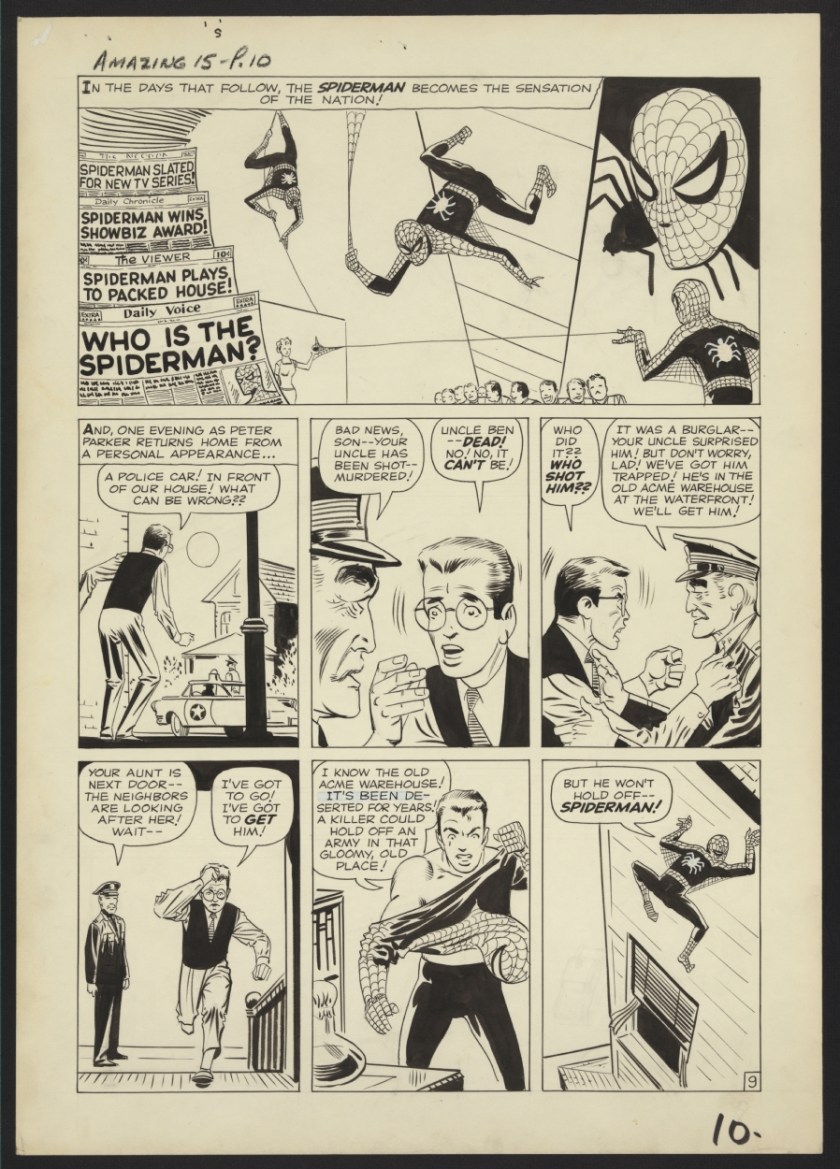
AF15p10s

135[148]: At this late stage, it’s hard to know for sure what happened to all the Kirby art that wasn’t on Irene Vartanoff’s 1980 inventory count, but an interesting piece of history recently appeared online that adds to the discussion.

…and…

147[160]: Lee gives his account of what happened to the original art in the early days at Marvel Comics: [Lee] “Back then… we actually tore up and threw away all the pages of artwork… whatever didn’t get destroyed was simply given away to anybody who’d take it.”

“At this late stage” (Lee having handed the reins to his daughter), things are going to become more and more clear. Stories like the “loyalty test” (p 141[155]) need to be considered in light of how they would benefit or assuage the conscience of someone who had “rescued” that art.

Kevin Melrose regarding “Hollywood Treasure” (Comic Book Resources, November 2010): ‘Second, and by far the most interesting, is the suggestion that Lee’s garage could be the mother lode of Silver Age original art. Toward the end of the video, after Lee has gone, host Joe Maddalena tells his associates: “This is a great start to a great relationship. His guy was telling me — I said, ‘Does he have any artwork?’ He goes, ‘Boxes and boxes in the garage.’ I said, ‘What do you mean, garage?’ He goes, ‘Storage units full.’ I said, ‘Well, supposedly I’ve heard him say he doesn’t have anything.’ The guy said, ‘Storage units full of artwork.’ He goes, ‘He has no idea what he has. He’s never looked at it’.” Maddalena, owner of Profiles in History auction house, hopes (naturally) to gain access to the art for appraisal. Watch the video after the break. Hollywood Treasure airs Wednesdays on Syfy.’

144[150]: [Lee] “That was when I called the lawyer, and I said, ‘Should we sue him?’”

This was nothing more than posturing. Marvel would never have let Lee near a courtroom given the actual evidence for his claims.

NEXT: Thomas explains
Back to Contents

Footnotes

back 45 Stan Lee interviewed by Charles Murray, Fantasy Advertiser v3 n55, April 1975.

back 46 Steve Ditko, letter to the editor, Comic Book Marketplace #63, October 1998.

Thomas explains

Stuf’ Said p 37[40]: Roy Thomas: “Jerry told me he had dropped Stan a line to ask for a copy of a Marvel script to go with ones he’d received from Julie Schwartz for Justice League and the like… In 1961 and 1962, Stan was working hard to keep a number of artists busy all at the same time, so it would make perfect sense that he might make up the first part of a story off the top of his head and send it off to Jack, figuring that either (a) he’d send the rest later, (b) he’d relate the last part of the story to Jack in person or over the phone by the time he needed it, or (c) Jack would devise an ending himself.”

…and…

69[75]: Roy Thomas offered me more thoughts on its lineage…

Sometimes the truth lies in the most verbose and convoluted explanation. Sometimes that explanation just shows the lengths required to cover up the original deception. Thomas is given free rein to do this in Stuf’ Said, his remarks uncontested. In a couple of instances, Morrow provides contradictory evidence, but not in the same place, and not tied to Thomas’ declarations.

101[111]: Roy Thomas: “You can see where almost anybody would be upset in that kind of circumstance… [Stan] knew there were some difficulties, but he certainly didn’t see it coming that Jack was quitting, or I never got any indication of it… with Jack, he sort of bottled it up, and Stan knew there were problems, but he didn’t know how deep they ran.”

On the contrary, treating Kirby like just another freelancer was clearly in the best interests of PF&C, and Lee embraced the role he was given. To suggest that the con man is oblivious to the feelings of his mark is one thing; to portray the thief as the victim is outrageous.

Morrow does the same thing…

36[147]: At the beginning of August, Stan Lee and Jack Kirby have an encounter at the Marvel Comics 25th Anniversary party being held at this year’s San Diego Comic-Con. Marvel’s editor-in-chief, Jim Shooter, is witness to the meeting, and later recounts, “I’m watching history here. They’re really getting friendly again. They really seemed to be becoming friends. Then Stan says, ‘Ya know, Jack, I don’t care who owns [the Marvel character copyrights]. I don’t care who gets the credit. You can own it, you can have the credit. I’d just like to work with you once more’.” Kirby allegedly nods and says, “Well, that will be fine,” but Roz Kirby, pulling her husband away from the conversation, says, “Over my dead body.” As I’d expect in such a situation, Lee is offended.

Although Lee continued stealing Kirby’s accomplishments every time he opened his mouth, even at Marvel’s 25th Anniversary, the Kirbys were expected to “get over it” so Lee could be the offended party.

Thomas’ 1981 TCJ interview is a clinic on quitting Lee.

HOUSEROY

115[127]: [Thomas] “And all I could say to Jack was, ‘The only thing between you really is that Stan was a little hurt about the way you left, but that’s not a big deal. And the Funky Flashman stuff bothered him a little bit, because it seemed, to Stan at least, somewhat mean-spirited.’ I said to Jack, ‘I don’t take the Houseroy stuff that personally, because you don’t know me. My relationship to Stan was somewhat like what you said, and partly it’s just a caricature because I was there. And the name ‘Houseroy’ is clever as hell, and I kinda like it.’ I’m even a sympathetic character because I got tossed to the wolves. But I said, ‘We can get past that. Stan would love to have you back; he never wanted you to leave’.”

This is very magnanimous of Thomas who denies that he took offense at Kirby’s Houseroy but behaves otherwise. Despite having personal experience taking advantage of others through the Marvel Method, he dismisses Kirby’s valid grievances against Lee. Thomas seems oblivious to the irony in his recent demands for proper credit from DC Comics when he’s been on the credit misdirection side for over fifty years.

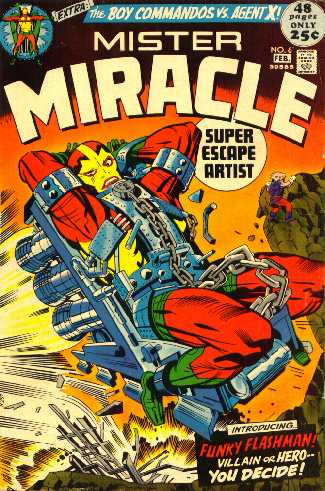
“I don’t take the Houseroy stuff that personally, because you don’t know me.” It turns out that Kirby knew Thomas very well, because in 1972 he accurately predicted Thomas’ inescapable legacy as valet to the Lee myth (see “Funky Flashman,” Mister Miracle #6).

SCHOOLED BY KIRBY ON THE MARVEL METHOD

121[133]: [Thomas] “Jack agreed to do it—under one condition. He insisted that I plot out the stories, panel by panel, and send him that to pencil from. And I balked at that. I could see that Jack was determined that he wasn’t going to add one incident, one thought, to the story that I hadn’t given him. And if I was going to have to do that, I really didn’t see any special value in having Jack pencil the FF at that point. I’d prefer to work with Rich Buckler or someone else Kirby-influenced. So that was the end of my attempt to get Jack to do Fantastic Four.”

Translation: “Jack really didn’t see any special value in having me get paid the writing page rate if he was going to be doing the writing.” You’d think the reality of Kirby’s situation might have occurred to Thomas when he was asking him to work Marvel Method.

DISCIPLINES OF THE ENDURING MARVEL HISTORIAN

6: …[Roy Thomas] remains a fan at heart, relentless in his pursuit of documenting comic book history. While admittedly loyal to Stan Lee for helping his creative career blossom, Roy also has one of the sharpest memories I’ve ever encountered, and in working with him since 1997, I’ve never found him to be anything less than 100% fair, professional, and honest.

It bears mentioning that if it weren’t for Thomas being present when Lee opened the package from Kirby, Lee would be known as the creator of the Silver Surfer.

Thomas explained the secret of his “relentless” approach to being an historian to Jim Amash…

Amash: In that period when Marvel introduced The Inhumans, Galactus, and the Black Panther, would you say those were all co-creations, or did Jack come in like he did with the Silver Surfer and say, “Stan, I have these characters”?

Thomas: From what little I heard from talking to Stan and Sol Brodsky, the Silver Surfer was kind of an exception, although there may have been a few villains that were created by Jack. [emphasis mine] 47

Thomas may have had the title of historian thrust upon him, but for the period of time he was not an eyewitness, his idea of research is “what little I heard from talking to Stan and Sol Brodsky.” He documented a discussion he once had with Kirby (see p 115 above), but other than that there’s no evidence he ever sought out the other side of the Marvel story from Kirby or Ditko.

69[75]: [Thomas] “But of course, at that time, it wasn’t occurring either to Stan or to Jack to claim such credit. They were both too busy just getting the stories done and collecting their paychecks.”

Thomas was not present at Marvel’s inception, and all of his knowledge of the motivations of Kirby and Ditko come from Lee. What keeps him awake at night is the outrageous idea that Kirby would later try to claim credit. Because Thomas wasn’t there to hear Kirby claim credit at the time, any claim of credit after the fact should quite obviously be given to Lee.

CREDIT

[Thomas] “For years, Jack Kirby didn’t care that he wasn’t being listed as a writer. Later on when something becomes successful, then everybody starts saying, ‘This percentage of it’s mine!’ ‘That percentage of it’s mine!’” 48

[Thomas]: “We weren’t worried about the credits, because there wasn’t any money involved.” 49

Thomas is being deliberately misleading: there was money in the credits for the person writing them. Even though Lee didn’t sign any of Kirby’s monster stories, he later instituted credit boxes for the express purpose of adding his name to things he didn’t write (see p 28 under Further Information).

Morrow has provided two quotes that diminish Thomas’ credit crusade:

65[71]: [Kirby] “…when I began asking for a little more credit, say, a writer credit, he cut the horse up fine and said it was ‘plotting.’ And no matter what I said, he was the publisher’s relative and Goodman was big on family.”

When asked if this credits change was the result of Kirby actively asking for it, Jack’s wife insisted:
“Of course! He used to ask for it all the time…We always asked for a lot of things all the time, and finally they put down ‘Produced by…’ because it’s just ridiculous, you know. I don’t think Jack would’ve fought if I didn’t kick him in the pants. I think I was more angry than he was.”

TIGERS IN AFRICA?

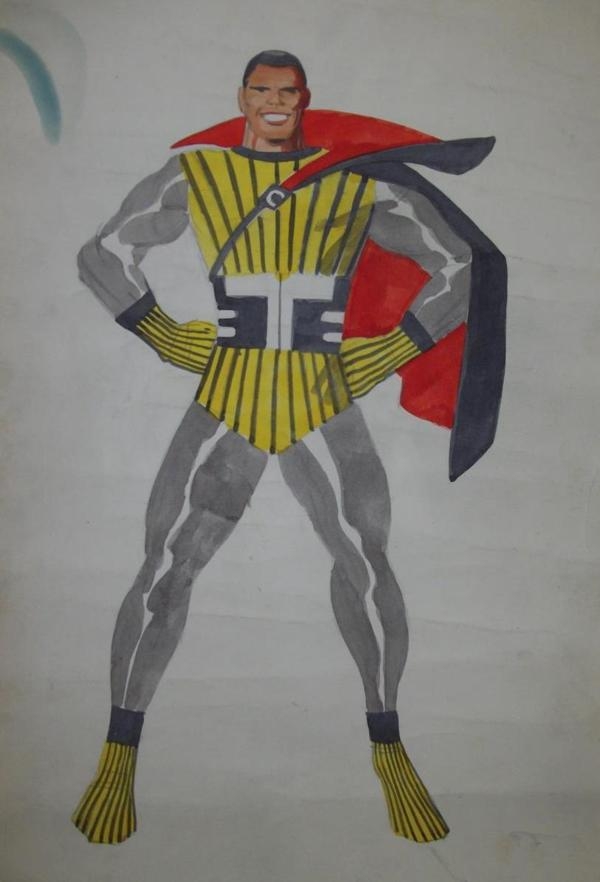
CoalTiger

When printing Arlen Schumer’s visual essay, “The Origin of Jack Kirby’s Black Panther” in Alter Ego #118, Thomas devoted considerable space in his editorial to refuting Schumer’s thesis:

Still, as I’ve told Arlen, I feel obliged to state up front that I have reservations about one of his key assumptions—namely that, because Jack Kirby’s drawing of a Panther-like character called The Coal Tiger (probably) pre-dates FF #51, it can be inferred that the idea of introducing a black super-hero into Marvel’s flagship title was necessarily Jack’s rather than Stan’s. Because Arlen believes that can be inferred, I had little choice but to respond to that assumption.

I strongly maintain that no assumption of Kirby priority can or should be made. For one thing, we know virtually nothing about the Coal Tiger concept except its visual aspect. To presume that Jack rather than Stan was the initiator of The Black Panther ignores the fact that Stan had long been instructing Marvel’s artists to include African-Americans in crowd scenes. I’ve no proof the impetus for a black super-hero came from Stan—but one can’t automatically assume it came from Jack, either. It’s equally possible that Stan came up with the idea, maybe even the name “Black Panther”—and if and when he did, there right in front of him was Jack with his very un-African “Coal Tiger” concept drawing (since there ain’t no tigers in Africa), ready to alter it in an instant into the dark garb of T’Challa, son of T’Chaka.

Chris Tolworthy, the Marvel Method group, 1 August 2018: “As is reasonably well known, Kirby wanted his character to be called the Coal Tiger, and Lee wanted the name changed, hence Black Panther. As anybody can see, the story of Wakanda and its Vibranium is closely modeled on the then-recent news about Katanga and its uranium. Now, once the independence movement was crushed in 1963 the independence army (the Katangan Gendarmes) fled, and planned to return one day to reclaim their uranium mines, much like T’Challa. And what did this Katangan army in exile call itself? ‘The Katangan Tigers.’ ‘No tigers in Africa’, eh? Thomas had better tell the Katangan rebels that. It appears that the only person who understood the source material for the Black Panther was Kirby.”

Patrick Ford (same discussion): “Kurt Busiek has mentioned this connection. There is thought that Patrice Lumumba was the inspiration for the Panther. ‘the US acquired a strategic stake in the enormous natural wealth of the Congo, following its use of the uranium from Congolese mines to manufacture the first atomic weapons, the Hiroshima and Nagasaki bombs.’

“BTW. I don’t know that it is ‘reasonably well known’ that Kirby came up with the name Coal Tiger and Lee came up with Black Panther. It is far more likely that Kirby came up with both names perhaps after Lee rejected the name ‘Coal Tiger’ due to its political implications at a time where Lee may not have been aware of the nascent Black Panther movement. Kirby may have been aware and not told Lee about the budding political implications of the name Black Panther or Kirby may have taken the name from the United States Army 66th Infantry Division which Kirby would have almost certainly have been familiar with due to his WW II service in France.

“For whatever reason people like Roy Thomas tend to think they are smart and that Kirby was some sort of dullard. Time and again evidence turns up that people like Thomas don’t (as Grant Morrison put it) have Kirby’s reading list. Here’s a difference between Roy Thomas and Kirby. Roy Thomas is a man with an obsessive interest in super heroes. In 1965 Thomas was a highly unusual man in his twenties whose main area of fascination was super heroes. He was not only still reading super hero comic books but was so interested in them that he spent a great deal of time writing about and researching the adventures of the Justice Society of America. And Thomas was not interested in comics other than super heroes. He has said in various interviews that he never read Carl Barks or John Stanley because he did not read ‘children’s comics.’ He has also said he didn’t read horror or war comic books. The only sort of comic book he read was super hero comics. On the other hand Jack Kirby had no interest in super heroes what-so-ever aside from the fact it was a genre he could find work in.”

MEMORY

Lee: “As you know, I have the worst memory in the world…” 50

Thomas: Later I saw Stan’s plot for Fantastic Four #1, but even Stan would never claim for sure that he and Jack hadn’t talked the idea over before he wrote this. They may or may not have; he just didn’t recall because he didn’t think it was important at the time… Again, was it an idea Stan had verbally, or was it totally Jack’s idea of doing it? I don’t think anybody knows anymore. I wouldn’t trust either Stan’s memory or Jack’s memory totally in these cases, because people tend to remember things differently over the years. 51

Thomas excuses Lee not remembering who first spoke the idea of the Fantastic Four, because “[Lee] didn’t think it was important at the time.” In reality, it was so important to Lee that his never-having-wavered memory regarding that single detail caused the destruction of his own mythical Happy Bullpen, when first Ditko and then Kirby quit over the lack of credit and accompanying pay. Thomas dismisses Kirby’s recollections, but contrary to his claim here that he doesn’t trust either man’s memory, he stakes his legacy on the account of the man with the self-proclaimed world’s worst memory.

Memory? Steve Ditko had the remedy for the world’s worst memory: stop claiming credit.

Ditko: “Poor memory advocates — too often — want to be given a blank check for what comes out of their mouths. Can a man/mind with a claimed poor memory have any authentic, personal integrity? There are those who make reference to, justifications for, their poor memory but poor memory doesn’t stop them from still claiming facts, truth, credit.” 52

Kirby never claimed a bad memory, and told Mark Borax in 1986 that he and Lee both knew the FF creation story. 53

MARK: Jack, even though each of you, in your own hearts, know who did what —
JACK: We know!
MARK: — do you think that time has obscured some of —
JACK: NO! It hasn’t obscured it. He knows it, I know it.

Roy Thomas serves as a kind of conscience at TwoMorrows, ensuring that Kirby’s legacy is kept in a box defined by Marvel, and Kirby’s “delusions of grandeur” (Thomas, Comic Book Creator #3) are kept in check. “One day, when someone starts a Stan Lee Collector magazine, there’ll be plenty of untapped quotes by Stan they can present…” (Morrow, Stuf’ Said p 5). Until then, we can count on the Kirby Collector to look out for Lee’s reputation.

NEXT: Lieber comes into his own
Back to Contents

Footnotes

back 47 Roy Thomas interviewed by Jim Amash, conducted by phone in September 1997, published The Jack Kirby Collector #18, January 1998.

back 48 Roy Thomas, Robert Kirkman’s “Secret History of Comics” Episode 1, 2017.

back 49 Roy Thomas interviewed by Jim Amash, conducted by phone in September 1997, published The Jack Kirby Collector #18, January 1998.

back 50 “Stan the Man & Roy the Boy,” A Conversation Between Stan Lee and Roy Thomas, Comic Book Artist #2, Summer 1998.

back 51 Roy Thomas interviewed by Jim Amash, conducted by phone in September 1997, published The Jack Kirby Collector #18, January 1998.

back 52 Steve Ditko, “Essay #34: Memory,” The Four-Page Series #5, February 2014. Published and © by Robin Snyder and Steve Ditko.

back 53 Kirby interviewed by Mark Borax, Comics Interview #41, 1986.

Lieber comes into his own

In 1998, Stan Lee was fired, then re-signed by Marvel; it was the same year he began fighting back against Kirby’s TCJ interview. His accomplices were Roy Thomas and Alter Ego/Comic Book Artist. Some new threads were introduced into the narrative, including Larry Lieber.

At current count, Lieber scripting for Kirby on the monster books was first mentioned in 1995: thirty-five years after the fact, the surprise addition of Lieber to the non-existent credits is so compelling that John Morrow will build a narrative out of it (see p 19 under Just Plain Wrong). Lee and Lieber are given the benefit of the doubt.

Stuf’ Said 18: Larry Lieber: “I remember Jack Kirby was usually doing the lead story, and Don Heck was there. Ditko used to do the story at the end of the books, and later he and Stan did Amazing Adult Fantasy. At the time I had a room in Tudor City, and I was writing stories for Jack to draw. Jack was so fast, and I was learning to write.

“I remember that Kirby was so fast he could draw faster than I was writing! Stan would say to me, ‘Jack needs another script!’”

Questions raised by Lieber’s 1999 interview comments:

  • Did the end product benefit from Kirby being supplied Lieber’s scripts?
  • Did Kirby receive the scripts? Did he receive them before or after he pencilled a story?
  • Was Lieber keeping up with Kirby’s output while writing full scripts so soon after learning to write?
  • Was Lee busy enough to have to devise the Marvel Method if his brother was writing full scripts for Kirby? (no… see p 23 under Lee misrepresents.)

Lieber’s 1975 Atlas bio doesn’t mention monster stories.

LieberAtlasBio

Lieber’s 1975 Atlas bio does contain this: “…Stan himself (who taught me that dialogue is more important that captions, and pay vouchers are more important than either).”

22: [Lieber] “When Stan saw that the strips had potential, he started writing them, and he was working with Jack. Then, I think he was doing so much that he found it was better—and also, when you’re working with a guy like Jack—Jack was very creative, and wanted to put a lot of things into it. Jack always welcomed doing it, I’d imagine, to some extent.”

Is there a germ of truth in Lieber’s statement? First the falsehoods or misinformed speculation:

  • “[Lee] was doing so much”;
  • “Jack always welcomed doing it, I’d imagine”.

Here’s the kicker: Lee started “writing” the strips when he saw that they had potential. In May 1961, he found a dent in his income when the Willie Lumpkin newspaper strip was cancelled and Goodman pulled the plug on the comics operation. Kirby proposed his character blitz. Lee saw Kirby’s writing pay and considered the “potential” of making it his own. Before he saw the potential, he hadn’t started “writing them.”

25[26]: Of course, the existence of a full script by Lieber, doesn’t mean Kirby and Lee don’t first have a creative conference, before Stan gives Larry a plot.

The absence of any script by Lieber doesn’t mean he wasn’t writing full scripts for somebody, but Lieber getting a plot from Lee generally indicates Lee recently had a story conference with Kirby.

28[30]: There are no credits listed in Strange Tales #101–102, and #103–105 lists “Plot: Stan Lee • Script: Larry Lieber • Art: Jack Kirby.” Stan is never one to omit his own credit, so the blatant inconsistency probably isn’t his doing. This means either Larry Lieber and/or Jack Kirby plotted and dialogued those first two Strange Tales episodes—and frankly, the lame explanation that appears in #106, which is plotted by Stan and dialogued by Lieber, feels like it is awkwardly shoehorned in at the last minute.

Lee’s best plots are dispensed after a story conference with Kirby. Lieber already admitted he’s not a plotter (see p 19, Lee was not a plotter).

69[75]: [Thomas] “…I saw Stan’s plot for Fantastic Four #1, but even Stan would never claim for sure that he and Jack hadn’t talked the idea over before he wrote this.”

The quote is dated 1997 but was published in early 1998. It was the year Lee signed his new contract, and Thomas and Lee took their fresh remembrances to the pages of Comic Book Artist. Morrow already pointed out that Lee claimed precisely what Thomas said he never would…

155[169]: Based only on [the portrayal of Sue Storm in the plot outline], they must’ve talked out the idea first.

…and he really doesn’t hold with any of Thomas’ FF #1 plot outline nonsense. Morrow wrote on p 22 that [in the presentation art scenario], “the FF synopsis is historically irrelevant in determining who does what in creating the FF.”

149[163]: At a time when most people slow down or retire, Lee’s own journey seems to be just getting started. In 1998, he signs a contract making him Chairman Emeritus of Marvel Comics for life.

TURNING POINT!

This truly does mark a turning point. Thomas’ remark about the FF #1 synopsis, published earlier that year in TJKC (see p 69 above) didn’t go unnoticed, and he was brought on board to help combat the forces of (the now dead) Kirby’s TCJ interview.

Lee was given the space in Alter Ego to rebut the Thomas synopsis statement using the same precise wording, and the pair staged an “interview” to lay out the agreed-upon story. (The “interview” is said to have been recorded in May, while Lee was fired on or about 30 July as part of Marvel’s bankruptcy proceedings.) Coincidentally, Thomas would soon be appointed writer of the Spider-Man newspaper strip, at which point he presumably had to sign the Marvel employment agreement. Herb Trimpe mentioned such an agreement in his NYT article, in which he agreed not to badmouth the company or Lee in exchange for his severance benefits.

At the same time, the decision was made to go public with the fact that Larry Lieber wrote full scripts for the Kirby monster stories which had been problematic for this scenario. From this moment forward, Thomas would never be more certain of the authenticity of a document as he is of any synopsis Lee might turn up.

NEXT: Morrow waffles
Back to Contents

Morrow waffles

Morrow has a number of opportunities to make a decisive call, but waffles to create a false equivalency between Lee’s “truth” and Kirby’s.

Stuf’ Said p 45[49]: By the time work begins on Amazing Spider-Man #25, Lee and Ditko stop speaking to each other, and Ditko deals only with Sol Brodsky when turning in his work.

They “stop speaking to each other”? As Morrow points out below this paragraph, Lee stops speaking to Ditko. Why the equivocation? Even Roy Thomas has portrayed it as one-sided.

Roy Thomas, Robert Kirkman’s “Secret History of Comics” Episode 1, 2017: “By the time I was there, Steve Ditko never came by the office except for a couple of minutes to drop something off, because Stan had decided that there was just no sense in the two of them speaking…”

Roy Thomas, Alter Ego #160, September 2019: “I learned no more, I recall, than that this impasse had come about because Stan and Steve had found they were arguing more and more about stories and the direction of the Spider-Man series. It never occurred to me to ask whose idea the no-speak situation had been; but of course, common sense dictated that it had to have been Stan’s decision. As editor, he was technically Ditko’s superior. Years later, in writings for his friend and partner Robin Snyder’s newsletter The Comics!, the artist confirmed that obvious assumption.”

63[69]: On January 9, the New York Herald Tribune article appears, causing a major rift in the Kirby/Lee relationship. Stan Lee receives an angry phone call this morning from Jack’s wife Roz Kirby, livid about her husband’s portrayal in the article. Every little jab or slight, real or perceived, up to this point could’ve played a role in this reaction.

“Every little jab or slight, real or perceived…” This is an extremely poor choice of words. Is it possible that Roz “perceived” that Lee was signing his name to her husband’s work, or just “imagined” that Lee was stealing his pay? Morrow joins Thomas in minimizing what was an impossible situation for the Kirbys.

126[139]: Kirby feels that there are staffers in the Marvel offices who have been intentionally trying to damage his work and reputation—due to professional jealousy, loyalty to Lee, or resentment over Kirby’s refusal to draw other writers’ scripts.

“Kirby feels”? Why is it necessary to add the qualification? It’s not just an impression Kirby had. Morrow knows, Mark Evanier knows, Robin Snyder knows (and wrote a letter about it). Morrow’s own experience with the malice of the Marvel “staffers” follows on page 127[140] in the book.

Mark Evanier, Kirby-L, the Jack Kirby Internet mailing list, 23 October 1996: Jack’s feelings about this work (and his concern about his letters pages trashing him, which someone else mentioned) will perhaps make more sense if you know that there was at least one editorial staffer at Marvel at the time who was quite vocal in his dislike of Kirby writing, and who felt HE should have the job of doing the dialogue. Jack told me that this guy would phone him up and say, “Well, your new issue of CAPTAIN AMERICA just arrived, Mr. Kirby, and the artwork is breathtaking but everyone here in the office [a gross exaggeration] agrees that the writing is shit. Your books are all bombing, too. The only way you can save your career is to have one of us take over doing the dialogue.” Or words to that effect.

Stephen Bissette, Jack Kirby! group, 10 Sep 2019: I can only imagine how demoralizing this must have been for Jack; I was freelancing at Marvel around this time, and it was heartbreaking to see with one’s own eyes various photocopies of Kirby’s work posted around the offices with “satiric” overdrawings and sarcastic written comments scrawled on them. The utter contempt for and jeering at Kirby’s work for the company was mortifying, and a stern lesson for a budding freelancer working to (maybe) get one’s foot in the door.

127[139]: Stan clearly says here that the writing takes place after the art is in his hands. So as I’ve been demonstrating throughout this book, the term “write” can have many different meanings when pertaining to comics.

Too subtle. There are only two definitions of “write,” the regular one and one you would invent if you were trying to steal someone’s writing pay.

129[141]: Here, Lee is inexplicably equating inkers, colorists, and letterers—who despite their talents, are all basic production people—with the penciler of the strip, who actually contributes to the creation of story and plot. Does this give us insight into his own valuation of anyone who’s not handling the writing end of a comic book?

The words “contributes to” don’t belong in this statement. Lee’s thought processes aren’t worth the scrutiny: he’s stealing.

154[169]: A major portion of Stan’s sworn testimony is kept out of the public record due to a Protective Order that Marvel’s legal team has put in place, and many of the missing pages are frustratingly right where Stan is getting into details about the creation of the Marvel characters that are associated with he and Kirby. Take that as you will.

We have a clear (unredacted) statement from Lee for each of the properties contested that Lee was the sole creator. It’s important to list these to dispense with the idea that he was going to be truthful under oath and back down from any claims mandated by the company. From Stan Lee’s depositions: 54

QUINN: Tell me to the best you can recall, how did the idea for the Fantastic Four come about, and who they were, and what was the back story with regard to the Fantastic Four.

A. Well, as I mentioned, Martin Goodman asked me to create a group of heroes because he found out that National Comics had a group that was selling well. So I went home, and I thought about it, and I – I wanted to make these different than the average comic book heroes.

Q. Let’s talk a little bit about the Spider-Man. How did the idea for Spider-Man come about?

A. Again, I was looking for – Martin said, “We’re doing pretty good. Let’s get some more characters.” So I was trying to think of something different.

Q. And could you tell us how The Incredible Hulk came about? What was your idea for him?

A. Well, same thing. I was trying to – it was my job to come up with new characters and to expand the line as much as I could. So I was trying to think again what can I do that’s different.

Q. Tell us about how Iron Man came about, how he was created, the back story with regard to Iron Man.

A. I will try to make it shorter. It was the same type of thing. I was looking for somebody new.

Q. And how Thor was created and what was your idea behind Thor.

A. Same thing. I was looking for something different and bigger than anything else.

Q. Daredevil. I want to hear about the lawyer.

A. Again I’m trying to think of what can I do that hasn’t been done. And it occurred to me –

Q. Keeping with our discussion, could you tell us about the creation of X-Men? How did that come about?

A. Again, Martin asked me for another team because the Fantastic Four had been doing well. And again I wanted to try something different.

Q. Who created Ant-Man?

A. What could I do that was different?

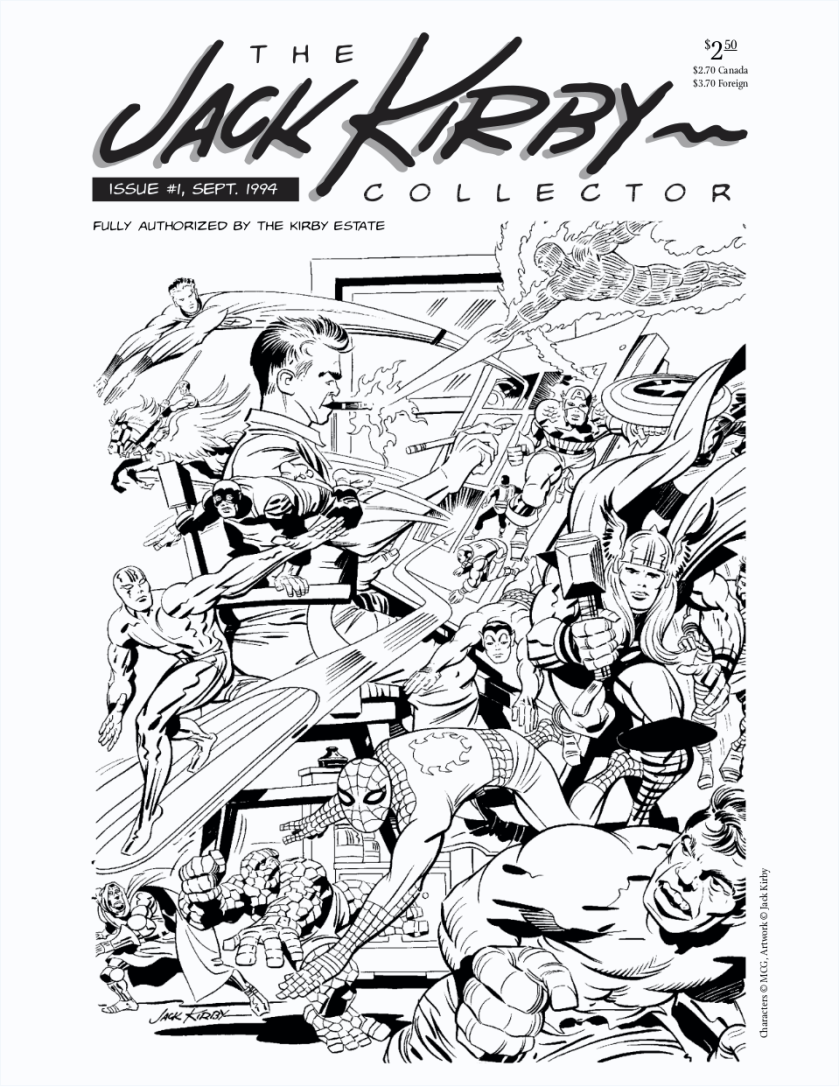
TJKC1cover
We’ve come a long way from this implicit nod to Kirby’s creations on the cover of TJKC #1.

155[169]: After a 186-page missing chunk of testimony, the deposition picks up with Stan discussing what appears to be his text for Origins of Marvel Comics, and possibly other books where he’s discussing the creation of the Marvel characters…

Note that Marvel redacted material that was detrimental to the brand, not testimony that corroborates their version. It’s important to mention that in 1974, possibly based on a company directive, Lee used Origins to take away credit for everything Kirby did but the art. In the 2010 deposition described above by Morrow, Lee clearly stated that when he wrote the book, he was only being magnanimous to suggest Kirby even did that much. It was a disclaimer to establish that any hint of a suggestion of Kirby creation that might be found in the book was an exaggeration based on Lee just being a great guy.

155[170]: So if they talked about the FF first, Jack then did sketches for Goodman to approve, and later Stan wrote the synopsis, nothing about this scenario is at odds with Lee’s answer. And that’s what seems most likely, and most logical, to have happened, at least to me.

Or, if Kirby wasn’t lying to Groth or Pitts or Eisner or Schwartz or Van Hise or Zimmerman or Steve Sherman, Lee was immobilized by his diminishing career prospects and Kirby stepped in to pitch the concepts out of whole cloth to Goodman.

James Van Hise (see also Good things, p 19) incorporating a Kirby interview into his article… 55

For many years, Stan Lee has taken sole credit for the creation of Marvel’s best-known characters. Lee underscored his claims in his book, Origins of Marvel Comics.

“That’s his version of it,” Kirby observes. “If he wants to say that, it’s his book. If I write my book, you’ll get my side of it. But I can tell you that my side of it is the real side–Stan Lee never created a character. In fact, if you look it up in Maurice Horn’s book, he was amazed, too. He was amazed at the kind of things that came out of Marvel after I got there and the fact that Stan Lee had never created a character before that. What has he created since? Nothing. I don’t think that Stan Lee cares about creating characters. That’s my professional opinion. But as far as writing the stories is concerned, he never wrote the stories–not mine anyway.

“I was a penciller and a storyteller and I insisted on doing my own writing. I always wrote my own story, no matter what it was. Nobody ever wrote a story for me. I created my own characters. I always did that. That was the whole point of comics for me. I created my own concepts and I enjoyed doing that.”

Lee rewrote Jack’s captions and word balloons when he brought the artwork into the office.

“Lee wouldn’t let me put the dialogue in. I wrote the story and made up the characters. I had to tell Stan Lee what the story was going to be. He didn’t know. Nobody’s ever seen Stan Lee write a story. I’ve never seen him write a story–not in front of me. Stan was an editor. I argued all the time about doing the word balloons, but I wasn’t allowed to do them. Stan Lee was editor, and his cousin was the publisher and I wasn’t going to argue with that…”

When Goodman gave Kirby a crack at the unused printing capacity pre-shutdown, then Lee got his name on the project (see p 22, under Lieber comes into his own).

158[173]: I may not like this explanation, but I don’t have any evidence to prove it’s wrong. So I have to give Stan a pass, like I gave Jack on his 1989 “Stan never wrote anything” comment.

This is more false equivalence: the red letters in Morrow’s book consistently represent untruth, often baldfaced enough to elicit a physical reaction. Evidence will eventually emerge to show that Kirby’s comment was based in truth; it should at least be given the same benefit of the doubt that’s always given to Lee’s tale about JLA sales. Morrow has shown the example of Glen Gold’s discovery (see p 86 under Lee was not a plotter). There’s also Melvin Shestack’s claim that Magazine Management writers were sometimes paid to dialogue the comics, and a statement by Roy Thomas in his TCJ interview (where Lee called Thomas “some guy”) that Kirby seems to have quoted word for word.

158[173]: I will say that, ignoring a few minor discrepancies, I found both men have been pretty consistent in their accounts over the years. So no, I don’t think either man is a liar by any stretch of the imagination.

“The Verdict” doesn’t follow from the rest of the book. Based on the evidence in Stuf’ Said, surely a judgment could be rendered on the content, not just the consistency, of Lee’s account. It seems like whenever it’s obvious Lee is lying, Morrow is ready to make the determination that Lee isn’t lying.

159[174]: Lee did it, because he genuinely believes he deserves the credit he is claiming, as seen through his own perception of his input being more important than Kirby’s or Ditko’s. Jack is also guilty of taking too much credit, even if it’s only in reaction to Lee’s grandstanding. You can argue what percentage of credit each man deserves, but they both deserve some of it, and neither deserves all of it.

I don’t think Lee genuinely believed it. I think he started by claiming an “innovation in production” that still doesn’t line up with the facts, to cover up his appropriation of the writing rate. Under Perfect Film the stakes grew higher as Lee became their perfect candidate to claim creatorship; on staff, his creations were the property of the company.

“Jack is also guilty of taking too much credit”? This statement is the most deserving in the book of the “egregious” label, but even amidst a relatively comprehensive collection of six decades of Lee’s misdirection, Morrow could only find against Kirby. TJKC is the wrong place to make this claim: Kirby asked for nothing more than recognition for what he’d done, which was create the properties and write the stories. Even Jerry Bails concluded Lee had fed him bogus information in the ‘60s: “Kirby should be advised to sign on the biggest legal guns and fight for the characters he created.” 56

159[174]: So if I have to render a verdict myself, what would it be? To me, the real guilty parties here are Martin Goodman and the “Marvel Method.” Without them, no injustice would’ve existed—and Goodman is the reason the “Marvel Method” started in the first place. Even as the books began selling well in the early 1960s, Goodman didn’t hire anyone to help Lee with the workload, so having artists involved in plotting became a necessity, and muddied the creative waters.

This is ridiculous. “Writing” half of eight monthly publications, Lee wasn’t busy. See Lee misrepresents, p 23.

Lee’s experiments in credits and credit boxes suggest that he was using them to influence Goodman’s cutting of paycheques, and that Goodman either didn’t know about Lee’s sleight-of-hand, or turned a blind eye. Both Kirby and Ditko admitted that they rarely spoke to Goodman; Goodman’s “promises” are another case where Lee’s story has become fact.

159[174]: Once the “Marvel Method” came into play, Kirby was always at someone else’s mercy in seeing his visions realized in the way he thought they should be done.

Kirby described the feeling to Tim Skelly: “you just couldn’t take the character anywhere. You could devote your time to a character, put a lot of insight into it, help it evolve and then lose all connection with it.” 57 The bigger issue, as he told Gary Groth, was the lack of credit and pay: because of Lee’s machinations these were inseparable, no matter how Thomas spins it.

NEXT: Further information
Back to Contents

Footnotes

back 54 Stan Lee deposition, 13 May 2010 and 8 December 2010, Justia, Dockets & Filings, Second Circuit, New York, New York Southern District Court, Marvel Worldwide, Inc. et al v. Kirby et al, Filing 65, Exhibit 1.

back 55 Kirby interviewed by James Van Hise, “A Talk with the King,” Comics Feature #44, May 1986.

back 56 Jerry Bails, “We the Undersigned,” The Comics Journal #105, February 1986.

back 57 Kirby interviewed by Tim Skelly, “The Great Electric Bird” show, WNUR-FM, Northwestern University (Evanston, IL), 14 May 1971; later published in The Nostalgia Journal 27, Aug 1976.

Further information

Stuf’ Said p 5: I’ve never been a major follower of Steve Ditko’s work, or of Spider-Man, for that matter. And Ditko’s distaste for speaking out and appearing publicly puts him at even more of a disadvantage against Lee’s verbosity. So alas, there’s little I can do to rectify that disparity, but I think the few quotes from Ditko presented here speak well of him, and of his involvement at Marvel.

Ditko’s “A Mini-History” beginning in Robin Snyder’s The Comics in 2001 is essential reading and worth the extra effort to track down. For the second edition, Morrow has added quotes from A Mini-History Part 13, “Speculation,” 2003, as well as The 32-Page TSK! TSK! Package (2000), and the 2015 essay, “Why I Quit S-M, Marvel.” Morrow also quotes from The Avenging Mind (2008), Ditko’s 32-page treatise on Lee and Goodman, another must-read.

24: Though it may’ve occurred earlier, by December Jack Kirby submits his presentation for Spiderman, the idea for which is loosely based on Jack Oleck and C.C. Beck’s earlier unused “Silver Spider” strip from Simon & Kirby’s defunct Mainline company. The concept is approved, and Kirby is assigned to draw the origin story.

Kirby said the idea that became Spider-Man was submitted with the concept “blitz” that included the FF, The Hulk, and Iron Man, thus it predates Goodman’s shutdown. Plot points in the concept pages (or conveyed to Lee in a story conference) come from The Fly, Private Strong, and Rawhide Kid (itself echoing Boys’ Ranch and Bullseye origins).

26: Looking closely at the original art, you can see vestiges of Kirby’s handwriting under the final lettering in the balloons from Strange Tales #108 (with Robert Bernstein dialoguing), and Journey into Mystery #88 and Tales to Astonish #40 (both with Larry Lieber dialogue)—which begs the question: Did Jack simply copy Bernstein’s and Lieber’s pre-written script onto the artwork (and if so, why?), or did Kirby have a hand in writing the dialogue for these stories?

The vestiges of Kirby’s handwriting are the only actual proof that exists; no Lieber scripts have survived, even though Kirby kept an older Silver Spider script. It’s easily demonstrated that the credits were manipulated to give Lee plot credit where he didn’t plot (see p 28 below).

Yes, Kirby had a hand in writing the stories.

26[27]: On some of these Torch stories, Kirby’s handwriting can be seen in the word balloons, indicating either he was penciling in his own dialogue, or that of Larry Lieber, directly off his full script.

His own. Also on original art that’s still known to exist of nearly all of the monster stories. (See the IDW book under Just plain wrong, p 19.)
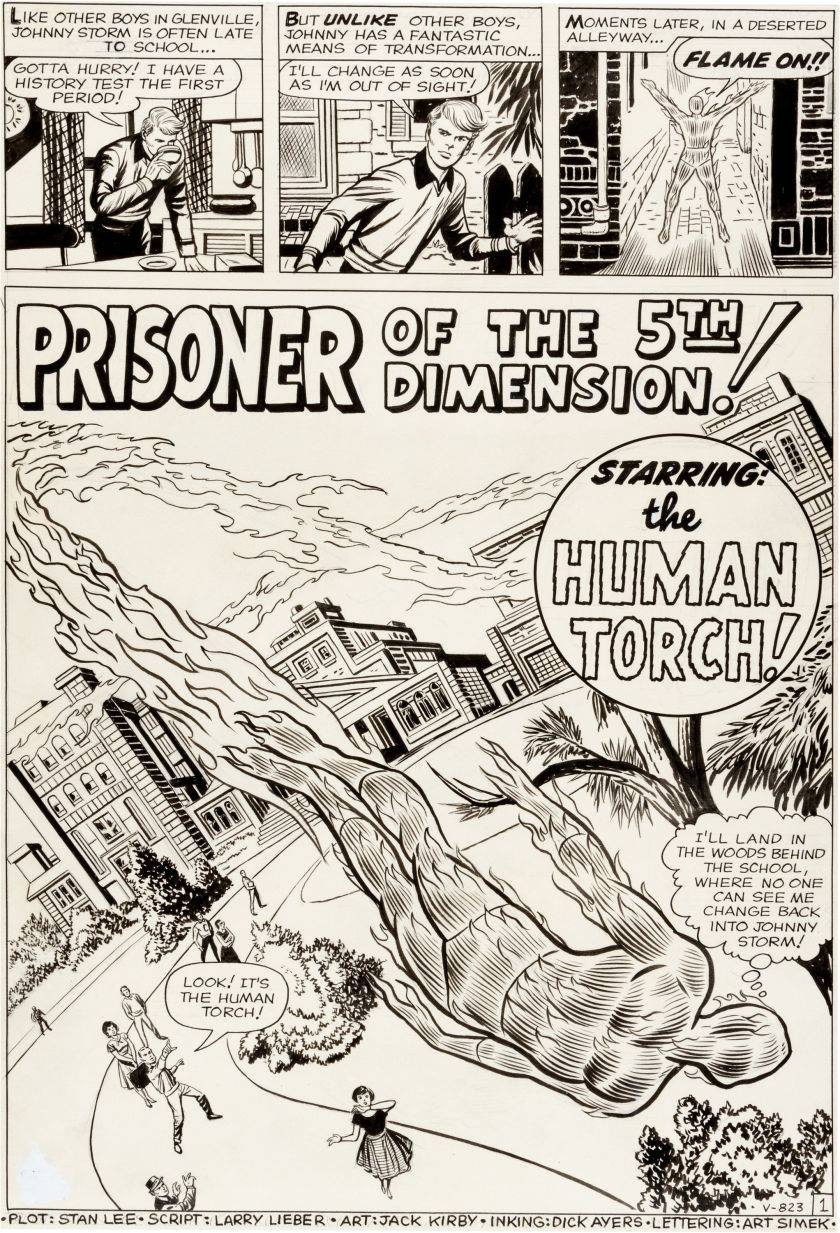
strangetales103

28: Strange Tales #103 splash page, showing the Human Torch maintaining his non-Leelike secret identity.

Lee’s first plot credit. Story plotted by Kirby.

THE ORIGIN OF IRON MAN

28[30]: This month, Jack Kirby designs Iron Man for his debut in Tales of Suspense #39. The cover of ToS #39 is seemingly derived from Kirby’s original concept drawing for the character, before the strip is assigned to Don Heck to illustrate using the Marvel Method.

The credits and publishing sequence of this story bear a closer look. The plot is based on a Kirby Green Arrow story, and #40 contains a Kirby origin story that may have been produced first.

Patrick Ford (Marvel Method group, 6 February 2019): “I don’t know why Lee might have held back Kirby’s origin/introduction story and replace it with one drawn by Don Heck. One thing is sure. Marvel never published another comic book where a character was introduced by someone other than Kirby only to have Kirby come along and do the second issue.”

Chris Tolworthy (same discussion): “One argument for [issue 40] being the origin story is the science. The finally published story is too magical, and that’s why I never cared for Iron Man. You simply cannot make such an advanced device in a cave! But here we see that Stark has the full resources of the military behind him.

“I can easily see Lee saying ‘this is too sciency, I want a more dramatic origin’, but Kirby was too busy to produce another story before the deadline. So Kirby recalled his old Green Arrow story (the jungle is the opposite of science, but it still has the science core) and created quick layouts for somebody else to finish.

“The mistake in the dialog (‘transistor powered’) is highly consistent with Lee not understanding a Kirby plot. It happens all the time in the Fantastic Four. Kirby’s typical method was to read something in a science magazine, then create a story about how the technology might be in thirty years. Lee would then butcher the text, showing that he did not understand the core idea.

“Regarding the scientific source material, I think it’s notable how many of Kirby’s stories come from material that was published circa 1958. Whenever I look for Kirby’s source material that date keeps coming up. So I imagine him seeing more movies and reading more magazines around that time (give or take a couple of years, and allowing for re-runs of earlier movies). In 1963 he was far too busy to do more than minimal reading. 1958 source material is also consistent with Kirby’s claim to have been pushing for superheroes since he arrived: the spark for the radiation heroes, the bomb monster and the transistor hero can all be traced to around 1958. Though of course Kirby would not work out the story details until he got the go-ahead in 1961. Just as he prepared New Gods in his mind and as sketches, but did not fill in the details until he got the deal he needed.”

Patrick Ford (same discussion): “What other comic books does TALES OF SUSPENSE #40 happen to coincide with? One of them is HULK #6 where Kirby was replaced by Ditko.

“One of the most curious things about the first ten Iron Man stories is the plots. When Kirby is the credited penciler we get robots, giant monsters, aliens, inner worlds, Dr. Strange, time travel. The other stories are far more Earth bound.”

Tolworthy made the same observation regarding the Kirby/non-Kirby issues of early Thor during the same period.

28[29]: Kirby also draws Incredible Hulk #5 this month, his final issue. When Jack brings his pages into the office, Stan rejects several of them. In a fit of anger, Kirby tears them in half and tosses them in the trash on his way out. Larry Lieber rescues the unused pages 11–13 of this Hulk story from the garbage. This is the earliest known major disagreement between Kirby and Lee.

…and…

33[35]: This month, Jack Kirby draws X-Men #1 [corrected to Avengers #1 in 2e], while Stan explains to readers why the Hulk was cancelled: [Lee] “We’ve always believed in leveling with our fans. So, for those of you who’ve asked what happened to the Hulk, here’s the scoop: We decided to discontinue the mag because we felt we were spreading ourselves too thin! … We don’t yet know where, when, or how, but be patient—mankind won’t be Hulkless much longer!”

It’s interesting to note that regular assignments on The Hulk and Thor were simultaneously dropped from Kirby’s schedule. He would only return to Thor full time with the addition of Tales of Asgard six months later.

32[34]: [Lee] “We have a new character in the works for Strange Tales (just a 5-page filler named Dr. Strange). Steve Ditko is gonna draw him. Sort of a black magic theme. The first story is nothing great, but perhaps we can make something of him—’twas Steve’s idea, and I figgered we’d give it a chance, although again, we had to rush the first one too much.”

Steve Ditko: What producer tells his customers ‘We have a product based on someone’s bad ideas but I’ve covered the shortcomings, defects, flaws, so the product is not really good but buy it anyway.’ 58

33[35]: This is a pivotal month, as Jack Kirby permanently takes on the main Thor strip, and draws the first installment of “Tales of Asgard” back-ups in Journey into Mystery #97, a project that Lee feels is tailor-made for Kirby…

Speculation: Lee promised Kirby autonomy in the back-up feature to entice him to return to Thor.

Chris Tolworthy made some observations on the lost issues (see the link under p 28 above).

42[46]: After several issues away, Jack is drawing Sgt. Fury #13, featuring a WWII team-up between Fury and Captain America. The credits read “Written and drawn by the titanic two: Stan Lee and Jack Kirby”, and with his WWII experience and association with both characters, I’d assume Kirby was at least partially (if not totally) responsible for the plot.

Totally. The John Severin quote (Stuf’ Said, p 29[31]) is helpful in making this determination.

LAYOUTS

45[49]: By the end of November, Kirby is drawing layouts for the Hulk feature in Tales to Astonish #68. If Jack doesn’t already have growing resentments, no doubt doing layouts for other artists would’ve caused some.

…and…

48[52]: Lee gives readers his rationale for assigning Kirby to layout so many strips…

Layouts are not a difficult concept in the context of the Marvel Method. Kirby was writing; Lee was not. In Romita’s Daredevil example, there wasn’t even a story conference. As for “it’s no wonder his layouts are simple block figures”, why don’t we just define layouts as what Kirby provided? They’re not supposed to be full pencils, they’re supposed to be what (outside of Marvel) would be called a full script with panel breakdowns. The purpose was for the penciller to pay the layout fee in the name of more Kirby-like art, and for Lee to get the full writing rate.

Morrow’s example (ToS #70 layouts) shows that Lee was only the next stop in the production line. Kirby was doing the writing, Kirby was initiating the story.

46[50]: As the year closes out, Jack Kirby creates a presentation for a new spy series, which becomes the debut of “Nick Fury, Agent of S.H.I.E.L.D.” in Strange Tales #135.

It’s critical at this point to contrast Tom Brevoort’s 2015 creation description with that of Lee from 2010:

“Jack Kirby first broached the idea of doing a modern day strip with Nick Fury, and he produced a two-page ‘pilot sequence’ to show to Stan Lee, titled ‘The Man Called D.E.A.T.H.,’” he says. “Stan liked the idea of a modern day Fury strip, but reworked the basic concept with Kirby to create NICK FURY, AGENT OF S.H.I.E.L.D. And that two-page pilot story was never used. In fact, when Jim Steranko turned up at Marvel looking for work, Stan gave it to him as an inking test, which is why those pages are inked by Steranko.” 59 (See pp 46[50] and 51[55] in Stuf’ Said.)

48[52]: Stan apparently forgot about Jack’s story in FF Annual #1, which was originally done for Amazing Fantasy #16 or Spider-Man #1, but redrawn by Ditko when he became the artist on the strip.

Important to note. See Jean Depelley’s reconstruction of events, “Ditko vs. Kirby on Spider-Man,” The Jack Kirby Collector #66, Fall 2015.

STORY CONFERENCES I

61[67]: This month, Lee uncharacteristically invites Kirby to join him to be interviewed for the New York Herald Tribune—no doubt jumping on the media bandwagon started by the National Observer article. In it, Stan comments to interviewer Nat Freeland about Federico Fellini returning “in January.”

Lee also “uncharacteristically” invites Thomas to sit in.

Sean Howe: When Marvel fan Federico Fellini, in New York to promote Juliet of the Spirits, swept into 625 Madison Avenue to meet Stan Lee, Men magazine editor Mel Shestack scoffed that Lee didn’t know who Fellini was; years later, Shestack insisted that the director had quickly lost interest in Lee and cottoned instead to the more colorful magazine editors, who were themselves like “living comic books.” 60

61[67]: So this casts some doubt as to whether this is an accurate representation of a plot conference (if so, Stan skipped an entire issue’s plot, and Kirby stretched a few sentences from Stan into FF #55–60, and tossed in the Klaw issue and subplots himself).

Chris Tolworthy, Marvel Method group, 13 September 2016: “Clearly the meeting was staged, and equally clearly Stan did not know what was in the book. E.g. he said that the Surfer was away in space, yet the whole point of the Surfer was that he was trapped on Earth! Given that they must have had a meeting first, that makes it even clearer that Stan had absolutely no idea what was going on. Stan’s plan interrupted Jack’s flow: issue 55 stands out like a sore thumb, amid a series that otherwise flows from issue to issue. So either Stan ignored what Jack said or he deeply misunderstood it. Almost certainly a combination of the two. And having discussed it first, Jack had every reason to hope that Stan would make this a back and forth performance. But Stan, being Stan, couldn’t stop himself hogging the limelight. So everything about what Stan did was an insult to Jack. The published description of Jack as boring was just icing on the cake, and a natural result of Stan’s behaviour.”

Chris Tolworthy (email to me, 23 June 2018): “Remember, this alleged plotting session must have been for Fantastic Four 55 (based on the content and the date): just five issues after the most famous Fantastic Four story ever, featuring the intro of Stan Lee’s all time favourite character, the one he would not let anybody else write! The story climaxes with the Silver Surfer being EXILED ON EARTH. That is the whole point of the Surfer’s character: he is an alien TRAPPED ON EARTH and must therefore learn about us and be horrified by our madness. But Lee thinks the Surfer spends his time out in space after the battle with Galactus. Lee does not know the first thing about the story he claimed to write, or the first thing about the characters! As soon as Lee opens his mouth he proves he is doing exactly what Thomas denies he is doing: trying to grab credit away from Kirby.”

MONSTER

96[104]: His faster schedule means he can take on additional work at this point, including the story “The Monster” for Chamber of Darkness #4. But Kirby’s original version of the story goes through numerous revisions in the Marvel offices before publication, and he is required to redraw several panels—and to change the original ending, that has Kirby and Lee be the surprise narrators in its final panel. Why this is rejected is still a mystery, as the original story by Kirby is solid, and more remarkable than what finally sees print.

In The Jack Kirby Collector #13, Morrow detailed Lee’s destruction of Kirby’s story:

The differences in the stories were devastating. The sheer inventiveness was diluted out of Jack’s original, its grandiose action reduced to parlor room gunplay, and the finale seemed half-hearted. There was evidence of major revisions, and the final boards showed it. Entire pages were discarded, panels cut and rearranged, and remnants of original pencils could be detected under redrawn panels.
Monsterp3

Chris Tolworthy, The Marvel Method group, 26 September 2016: “How can anybody read both versions and claim that Stan was anything other than a vandal? Given the final panel, and Jack’s comment about the dialog, I wonder if Stan rejected it because he thought it was a personal attack? And if so, Stan did far more to embarrass himself by changing it: he’s like a dictator who orders great art to be destroyed because he does not understand it, but vaguely suspects he is being made fun of. Heck, he’s not acting LIKE that, that is precisely what he was and what he did.

“Even the parts that survive, like the images of the monster leaping from the tower, and the frame with the stairs, are damaged by overly verbose dialog hiding the details.

“This reminds me of one of Stan’s favourite original ideas, one of those things he kept coming back to: publishing photo books (of movie monsters, celebrities, etc) with his own uninspired captions: the ‘You Don’t Say’ series. I think Stan missed his vocation. He was born to be a vandal, finding anything that people liked looking at, anything that somebody else had spent years to develop, and defacing it with his own dumbed down version then writing his name really big with a spray can.”

STORY CONFERENCES II

80[86], 159[174]: [Romita, 2001] “Stan would go off on a tangent and Jack would be talking about what he thought should happen. Jack would go home and do what he thought Stan was expecting. And when Stan got the script, I could hear him saying, ‘Jack forgot everything we were talking about!’”

Morrow attaches significance to this event, as though it were part of the regular workflow. This is a clear example (the Freedland interview being possibly the first and most egregious) of Lee putting on a show for his underlings to maintain the charade that he contributed in advance. What Romita’s story illustrates is that Kirby the writer (like Ditko in Mini-History, Part 12) was usually able to dismiss the more hare-brained of Lee’s suggestions in the pencilling stage. Once Kirby turned in his pages, however, Lee was in full control.

John Romita testified in his 2010 deposition that he was present “at at least two plotting sessions” between Lee and Kirby. After Toberoff’s objection, Romita went on to describe the plotting session after the plotting session, on the drive home after Kirby had taken the train in and met with Lee behind closed doors. As Romita admitted, quoted by Morrow earlier in the book (below), he was never present for a story conference.

55[61]: JOHN ROMITA: [2007] “I never sat in on their meetings. When they had a plotting session, the door was closed. But when Jack would send in, say, the first ten pages of a story—and this is how I knew where things came from—Stan would say to me, ‘Jack completely changed what we wanted the opening to be’… They didn’t always remember what the other had said.”

This admission cancels out Romita’s car ride story as well as his deposition statement.

MARVEL-LOUS

112[124]: On January 5, Stan Lee headlines a critically-panned Carnegie Hall show, “A Marvel-Ous Evening With Stan Lee,” meant to be a celebration of the Marvel brand.

Dean Latimer in The Monster Times: So it was a drag, and a gyp and a Roy-al Rip-off, the Marvellous Evening With Stan Lee. The only element of it that was anywhere near new was Lee’s introduction of Alain Resnais, the famous French culture-groupie, and film-maker and advertising chairman for the Marienbad Wallpaper Company, and who, according to Lee, is making a flick which will incorporate elements of Marvel cartoons.

‘It’s a wierd, lovely, funny, sad flick,’ equivocated Stan, ‘about life and death and love and hate, and — well — everything!’

Chances are, this pencil-pusher speculates, old Stan is letting his editor Roy Thomas or perhaps some far lesser talents ghost who knows the Way-of-the-Con-by-boot-licking, write the script for that one too, and that Smilin Stan doesn’t really know a heck of a lot about the film at all. I mean; Stan’s latest ish of Creatures On The Prowl Where Boogeymen Stumble was ‘wierd, lovely, funny and sad’ — and I can say that, and I didn’t even read it! And I’ll even bet that Where Ghosts Romp or whatever their ‘horror’ comic of reprints from the 1960’s is called, was ‘about life and death and love and hate, and well… everything!’ 61
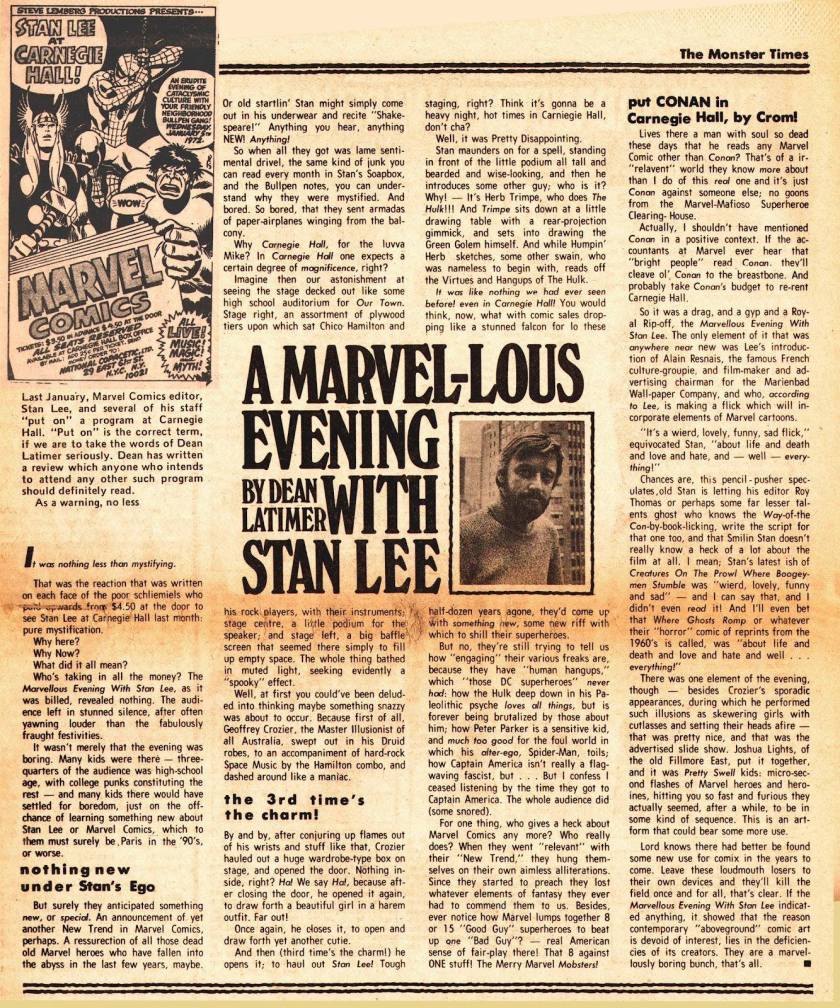
TMT_MarvelousLee

PSYCHOLOGY

159[174]: It’s also tempting to make the psychological conclusion that Stan was passive-aggressive; that whenever a collaborator asserted themselves, he pushed back.

Lee’s “first sayer” doctrine of creation was printed in TCJ. Steve Ditko quoted it in one of his Avenging Mind essays in order to take issue with the idea.

[165][Lee quoted by Ditko]: “It seems to me that the person who says, ‘This is the idea that I want done,’ is the person who created it… I think I’ve been very generous, ‘cause, as I say, anywhere except in the comic book business the artist would not be considered a co-creator, because it’s the guy who says, ‘Let there be a Hulk,’ and lo, there was a Hulk. The guy who says it, he’s the creator.” 62

Lee wasn’t correct from a legal standpoint, nor was he First Sayer in any of the creations. He did, however, apply the Doctrine of First Sayer to his relationship with Kirby. He was the first to get into print that he was the writer of Kirby’s comics, then the initiator of the synopsis. When Kirby came along later in the decade to make the same claims, he’d been set up to look like the liar and accused of sour grapes. Still later Lee became the first to say (outside of fanzine interviews) that he was originator of the ideas.

Early on in the FF letters pages, and to interviewers in later decades, Lee was first to accuse Kirby of his own unsavoury motives. Some examples: greedy, a very evil person, tending toward hyperbole. Only the first one can be said to be partially in jest.

Alan Weiss: I would also like to know what the name of your artist is.

Lee: Considering that our artist signs the name JACK KIRBY on everything he can get his greedy little fingers on, I think we can safely claim that that’s his name!
Stan Lee, Fantastic Four #3 LOC page, cover date March 1962, also Stuf’ Said p 23.

“I think he’s gone beyond of no return,” Lee said [of the TCJ interview]. “Some of the things he said, there is no way he could ever explain that to me. I would have to think he’s either lost his mind or he’s a very evil person.” 63

“Jack tended toward hyperbole…” 64

Greedy? It’s easy to say that Lee’s behaviour begs to be psychoanalyzed (he was a master of projection), but his scapegoating or narcissistic reaction formation was simply covering up his own greed in the theft of the writing pay. Evil? Tending toward hyperbole? Lee was talking about himself.

It’s a measure of the success of Lee’s strategy that one reaches the end of a book like Stuf’ Said to discover that the verdict is inconclusive: the truth is somewhere in the middle. Lee rarely gave anyone cause to believe what he said, but as First Sayer he convinced people that he told the truth about Kirby’s work. Kirby never gave people reason to doubt his word, but for wearers of the Big Boy Pants, his contradiction of Lee’s version of events was sufficient for them to give Lee the benefit of the doubt.

Mark Mayerson (23 September 2012): “It’s important to remember how long Lee was a failure. While he worked for a relative, Lee could never get beyond Martin Goodman’s comic books. While he had the examples of Mickey Spillane graduating to paperbacks and other Goodman writers like Bruce Jay Friedman and Mario Puzo graduating from Goodman’s magazines into novels, plays and screenplays, Lee couldn’t even get promoted to the “men’s sweat” magazines that Goodman published. During the 1950s when comics were being vilified, that must have been particularly painful.

“And there was that incident where Goodman found an entire closet full of unpublished inventory and laid off the comics staff as a result. That was gross mismanagement on Lee’s part, damaging the company’s cash flow. I don’t doubt that if Lee hadn’t been family, he would have been fired too.

“When Marvel finally took off in the ’60s, Lee had 20 years of pent-up hunger for success driving him. He wasn’t about to share credit with anyone. Admitting that Kirby and Ditko were the cause of his success, even partially, would only confirm Martin Goodman’s low opinion of him. And Goodman was right. There are dozens of examples of comics writers and artists who became prose authors, illustrators and fine artists. Lee is still milking the superhero genre even though he hasn’t created any successes in the last 40 years and never did without Kirby and Ditko.”

Patrick Ford (24 September 2012): “Mark, Logic dictates Lee’s original motivation for taking credit for the writing was because he was paid a page rate for writing apart from his salary for editing. If Kirby and Wood, and Ditko, had been credited with writing (or plotting) they would have been paid instead of Lee. Ever notice that Lee was always careful to credit himself with plotting stories which were actually plotted by Jack Kirby?”

138[150] Jack Kirby (to Leonard Pitts Jr, 1985): “Since I’ve matured, since the war itself–I’ve always been a feisty guy, but since the war itself, there are people that I didn’t like, but I saw them suffer and it changed me. I promised myself that I would never tell a lie, never hurt another human being, and I would try to make the world as positive as I could.”
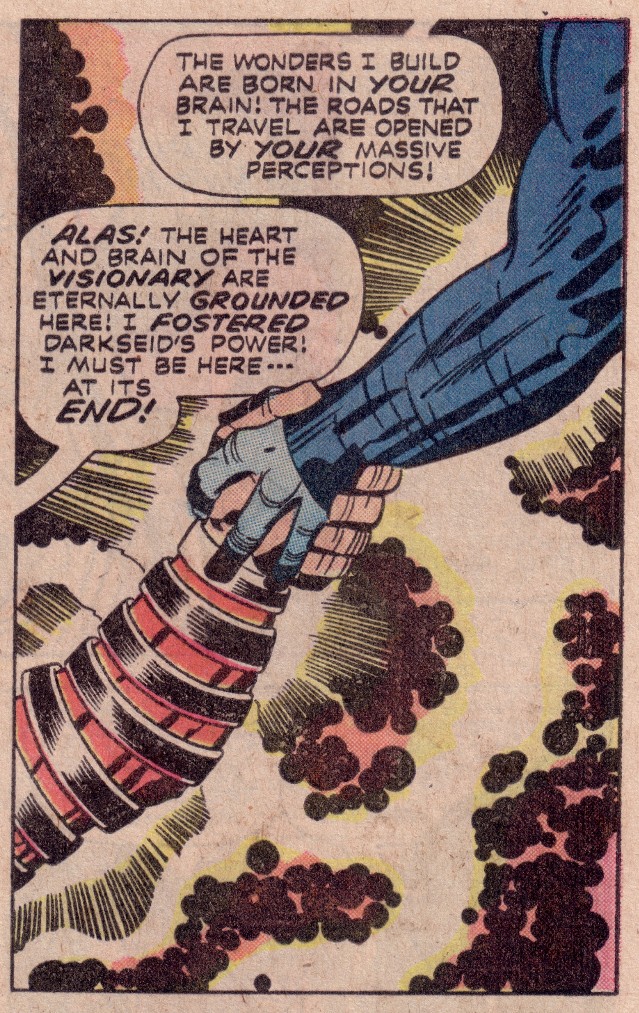
mm9p16panel2l

Back to Contents

Footnotes

back 58 “He Giveth and He Taketh Away,” The Avenging Mind, © 2008 S. Ditko.

back 59 Marvel Executive Editor Tom Brevoort to Tj Dietsch, “C2E2 2015: S.H.I.E.L.D.,” Comics News, Marvel.com, 26 April 2015.

back 60 Sean Howe, Marvel Comics: The Untold Story, 2012.

back 61 Dean Latimer, The Monster Times #3, March 1972.

back 62 “Newswatch,” The Comics Journal #111, September 1986, quoted in Creator or Co-Creator?, Avenging Mind, © 2008 S. Ditko.

back 63 Steve Duin, “The Back Story on Stan Lee vs. Jack Kirby,” The Oregonian/OregonLive, 26 June 2011.

back 64 “Stan the Man & Roy the Boy,” A Conversation Between Stan Lee and Roy Thomas, Comic Book Artist #2, Summer 1998.
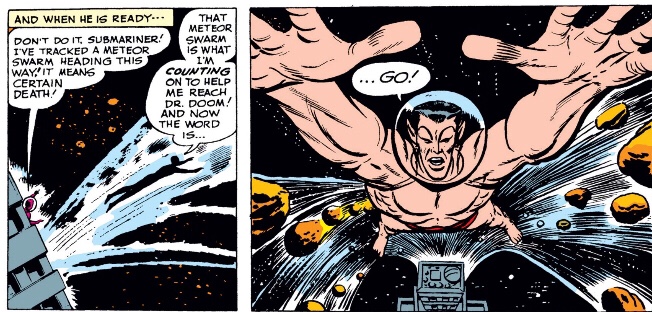
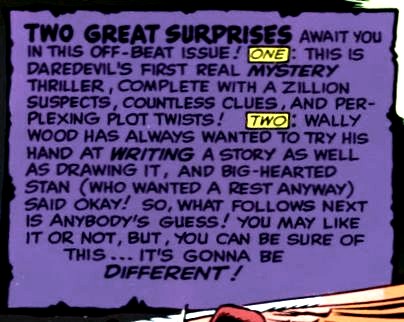
The History of Marvel According to Roy Thomas, Part One

An interview with Roy Thomas appeared in The Jack Kirby Collector 74. Interviewer Matt Herring seems to have a healthy enthusiasm for all things Kirby, but is shot down by Mr Thomas at every attempt to express it.

Thomas is known as an historian, but the history he presents adheres more to the company-scripted storyline than to the events he witnessed beginning in 1965. It’s essentially the Stan Lee story, but with added speculation to fill in the so-called gaps in Lee’s memory; naturally it’s at odds with Kirby’s version. Not only was Thomas not in the room at Marvel’s inception, he was the fan-turned-employee who lived in a bubble: much of his external input was from Lee and people under Lee’s thrall.

For the same reason that Lee’s memory was as sharp as a tack for his 2010 Kirby case depositions, the story told by Thomas has been refined over the years. He accuses Kirby of “delusions of grandeur” for telling his side of the story in the Comics Journal interview and other places, but Thomas himself was never more candid than on the occasion of his own TCJ interview, when he was on the outs with Lee. For example:

“By the early ‘70s [Lee’s] balloon placement, his wording, etc., were generally perfect, but he had substituted form for substance. He’d given up on much of characterization he’d pioneered, as he cut down the number of balloons on a page in the interest of making better time as he had other demands on him. There were no surprises left, not even little ones such as you’d have seen from the early ‘60s through to the late ‘60s… The problem is that a field is no damn good as a long-time profession if you can only stay in it during your best creative period. I mean, does Stan Lee have to be kicked out of the field if you can show his best work was all finished before 1970?”1

Thomas ignores (or chooses to conceal) one of the foundational truths of Marvel history: Stan Lee was not an idea man. Lee’s story ideas came, sometimes under duress, from Ditko, Wood, Goldberg, Ayers, Toth, Orlando, and above all, Kirby. When Kirby was on a title, Lee would assign himself as its writer; when his last writer finally left the building in 1970, not coincidentally “there were no surprises left” in his work, as Thomas put it, and Lee quit “writing” comics.

Here follow some passages from the TJKC interview with comments.

THE HERALD TRIBUNE ARTICLE

THOMAS: And, unfortunately, Stan kind of took the rap for [the tone of the article] from Jack and Roz, who somehow felt that Stan was trying to grab credit away from him, and though Stan could do that, he wasn’t doing that in this instance.

Thomas is wrong: Lee was trying to grab credit. The purpose of staging the Nat Freedland “plotting session” was to present Lee as the originator of the ideas. Thomas knew the story conference was atypical by the very fact that he was invited to attend.

SundayMagCover

Lee in the Herald Tribune article: “The Silver Surfer has been somewhere out in space since he helped the F.F. stop Galactus from destroying Earth… Why don’t we bring him back?”

“Ummh,” says Kirby.

“Suppose Alicia is in some kind of trouble. And the Silver Surfer comes to help her…But the Thing sees them together and he misunderstands. So he starts a big fight with the Silver Surfer. And meanwhile the Fantastic Four is in lots of trouble. Doctor Doom has caught them again and they need the Thing’s help. … The Thing finally beats the Silver Surfer. But then Alicia makes him realize he’s made a terrible mistake. … The Thing is brokenhearted. He wanders off by himself. He’s too ashamed to face Alicia or go back home to the Fantastic Four.”

Chris Tolworthy: Remember, this alleged plotting session must have been for Fantastic Four 55 (based on the content and the date): just five issues after the most famous Fantastic Four story ever, featuring the intro of Stan Lee’s all time favourite character, the one he would not let anybody else write! The story climaxes with the Silver Surfer being EXILED ON EARTH. That is the whole point of the Surfer’s character: he is an alien TRAPPED ON EARTH and must therefore learn about us and be horrified by our madness. But Lee thinks the Surfer spends his time out in space after the battle with Galactus. Lee does not know the first thing about the story he claimed to write, or the first thing about the characters! As soon as Lee opens his mouth he proves he is doing exactly what Thomas denies he is doing: trying to grab credit away from Kirby.2

None of this is new. Alicia was in trouble in issue 16 and elsewhere. The surfer became her friend in issue 49. The Thing misunderstood that friendship in issue 50. Dr Doom captured them in issue 10. The Thing defeated Doom in issue 38. The Thing battled the surfer in issue 50. The Thing wandered off depressed in issues 50-51. Lee is simply putting together elements that already appeared. In contrast, all the other issues around this included brand new characters and brand new situations (or at least situations that had not just happened a few issues earlier). This plotting session is notable for having NO new ideas. Why? Whenever Lee and Kirby work together behind closed doors, ideas are original. But when Lee is definitely working alone, ideas are not original. Yet he acts full of energy and puts on a wonderful show for the interviewer.3

Kirby’s “Ummh” was the point where he was about to interject that the Surfer was Earth-bound. He decided against making Lee look bad by contradicting him in front of the reporter. Lee didn’t return the favour, and Freedland pegged Kirby as a spectator in the process.

The interview was just another straw. Thomas belittles the honest reaction of the Kirbys, requiring him to ignore the (at the time) very recent history of the near office revolt, when Kirby considered following Wood and Ditko out the door. We can file this under Not Thomas’ place to say.

HOW TO QUIT MARVEL

THOMAS: But the trouble is, when Jack came back, Stan didn’t have that kind of direct contact with him anymore. That bond had been broken in 1970, when Jack called him coldly one day just to say, “I’m quitting and I’ve already started working for DC.” You know, that’s not the way you would tell somebody that you’re quitting if you ever think you might want to come back.

Thomas, who speaks from the Lee side of the Marvel Method equation, is the wrong person to be expressing an opinion on Kirby’s interaction with Lee. He doesn’t acknowledge any active part on Lee’s behalf in Kirby’s departure, despite the fact that, in his own words, Lee and Marvel could be vindictive:

The thing that was truest in that article [“Roy Thomas Leaves Marvel,” Journal #56] was the analysis that Marvel has had a tendency in recent years to be very vindictive toward people who leave it to work for the competition. They go far beyond any kind of professional reaction. Stan generally has reasonably good and humane instincts, but once in a while he’ll just decide that if somebody does something, he’s never going to work for Marvel again. He did this with Len, and with Gerry, though to date he’s never said it about me.4

tcj61

As Steve Ditko experienced, there was really nothing that could be said to Lee; Lee wasn’t speaking to Ditko when he quit, so it had to be done through Sol Brodsky. From what we know of the two personalities involved, Kirby handled his departure exactly the way it should have been handled. It goes without saying that the decision had been made much earlier.

PITTS: Why did you leave the F.F. and Marvel that first time?

KIRBY: Because I could see things changing and I could see that Stan Lee was going in directions that I couldn’t. I came in one night and there was Stan Lee talking into a recording machine, sitting in the dark there. It was strange to me and I felt that we were going in different directions.5

GROTH: Did you ever talk to Stan about the application of credit?

KIRBY: You can’t talk to Stan about anything.6

Thomas maintains the fallacy that Lee was taken by surprise by Kirby quitting. Larry Lieber’s deposition contains the story of Kirby tearing up pencilled Hulk pages while storming out of a story conference, probably in late 1962. After the incident, Kirby wasn’t involved with Thor on a regular basis for seven months, and didn’t do another Hulk story for over two years. Lee was forced to come up with unlikely excuses for the Thor personnel shake-up: Al Hartley wanting to work on an adventure strip, or Kirby being late with his FF pages. He didn’t know Kirby was quitting? The working arrangement already showed signs of strain when assignments were either refused or withheld in 1963.

Mike Gartland has described subsequent deal-breaking events in the relationship, in his series, “A Failure to Communicate,” available at the Kirby Museum site. Fast forward to 1970 when, as detailed in TJKC 137, Lee vandalized Kirby’s beautiful story, “The Monster.” He had Kirby redraw it nearly in its entirety, because he could.

Then there’s the contract Kirby was offered.

Mark Evanier: There were other troubling clauses, each more onerous than the previous, so signing [the proffered contract] was out of the question. Jack couldn’t do that to himself, couldn’t do that to his family. He got his attorney involved, but Perfect Film/Marvel still wouldn’t talk to his attorney. Then a lawyer or exec from Perfect Film called Jack directly. This is Kirby’s account as he described it in 1970: The caller asked when they’d be receiving the signed contract. Kirby said he needed changes. The caller said there would be no changes; take it or leave it. Sign it or get out. Jack protested: He was too important to the company to be treated this way. The caller told him he was nuts. Stan Lee created everything at Marvel and they could get any idiot to draw up Stan’s brilliant ideas. At least, that’s how Jack would remember the conversation. Kirby hung up on him, phoned Infantino, and changed companies.8

It’s not Thomas’ place to say that Kirby’s method of quitting was inappropriate, when his own experience would seem to be a primer on how not to quit Stan Lee—his multiple attempts include the time he tried and failed to quit by phone.

GUSTAVESON: But you were saying—by 1974, you and Stan had reached a parting of the ways?

THOMAS: Yes, it seems so in retrospect. It seems inevitable, but I didn’t know it at the time, and neither did Stan. By becoming Publisher, he had gone form being creative force to total company man, which was what he wanted–but I didn’t want to follow him along that path as I had before. As he himself put it once to someone else, “Roy and I no longer see eye to eye.”

I even quit one earlier time, over the phone, and Stan talked me into staying on. But of course in the long run that was an intolerable situation for him, as well as for me.9

HOUSEROY

THOMAS: So I said, “Jack, Stan would really like you back. He obviously never wanted you to leave… The only thing in the way, really— he was kind of hurt and bothered when you did that Funky Flashman stuff in that one title, where you made a character who was a rather vicious—… Now, you had this character called Houseroy.” I said, “I didn’t mind about that because I didn’t feel you were really aiming that at me. I was just Stan’s flunky…” Okay, so I am Stan’s flunky or whatever. And Houseroy is a clever name. I didn’t really mind that much. And I was almost a sympathetic character…”

A couple of points… First, Funky Flashman was undoubtedly the most accurate portrait of Lee we’re ever likely to see, by someone who had worked closely with him but was not beholden to him. Marvel has since outlawed this kind of thing from former employees.

Second, Thomas portraying Lee as the wounded party belies the facts: Lee exited the ‘60s with all of the fruits of the collaboration. Kirby, a freelancer with a good claim on the copyrights and no contract covering the work, was a liability, hence the insulting contract. At best, Lee didn’t lift a finger to see that his longtime collaborator was rewarded or even retained by the company. At worst, he was a willing participant in running him off. (This was not an isolated incident: Lee’s loyalty was to Lee, and he displayed the same lack of respect for the man who’d kept him employed through thick and thin—until it became a life-long job—when he later displaced Goodman’s son as publisher.)

mm6

KIRBY: And my wife was present when I created these damn characters. The only reason I would have any bad feelings against Stan is because my own wife had to suffer through that with me. It takes a guy like Stan, without feeling, to realize a thing like that. If he hurts a guy, he also hurts his family. His wife is going ask questions. His children are going to ask questions.10

HOSTILITY

THOMAS: There was a lot of hostility in him, in general and toward Stan, and before that, toward Simon, all his partners. Toward Carmine Infantino, I think, at a certain stage, too, the guy who brought him over to DC. I loved Jack, but I think he was one of these guys who, whenever he got a partner or was working with somebody, it was inevitable that before long he would just hate them.

Roy Thomas didn’t know Jack Kirby. People who did would tell you he didn’t hate anybody. Kirby was not a hostile, angry guy who hated people, even when others would believe it was justified.

Steve Sherman: Jack was not a hostile guy. His feelings towards Stan go way back. They had different work ethics. He didn’t “hate” Stan. He understood him for who he was and dealt with it as best he could… He was not one to blame others or find fault with people. If anything he could become frustrated because he was in a field that didn’t like to venture far from the status quo. He felt that comics were a legitimate story telling medium that was crippled by a bad business model.11

Jim Amash: The Jack Kirby I knew was not an angry man on the outside but he used the anger he felt to produce art… In an interview somewhere, Jack said something to the effect, “I’m a man who lives with anger.” Jack constructively channeled whatever feelings he had to the comics page and probably felt a great personal release when he did so… Jack was one of nicest, kindest people I ever knew. He was essentially a happy man and maybe he had some bitterness on how certain people treated him.12

KIRBY: Since I’ve matured, since the war itself–I’ve always been a feisty guy, but since the war itself, there are people that I didn’t like, but I saw them suffer and it changed me. I promised myself that I would never tell a lie, never hurt another human being, and I would try to make the world as positive as I could. There’s a lot of guys that might feel (laughter)… My own son feels I’m uncool but my grandson loves me. Being cool or uncool is a generational thing. But as a personal thing, I really love everybody in sight. I’d love to see Stan Lee at peace with himself. I mean, really at peace with himself. Not money-wise, not ambition-wise, not being driven–whatever drives him. But I’d like to see him at peace as a human being.13

CREDIT

In a letter to Comic Book Creator (to be discussed in a later installment), Thomas introduced the phrase “repeatedly over the years” to mean “more than once in the past twenty years.” Repeatedly over the years when he’s spoken about Kirby, Thomas has insisted that credit wasn’t important, and that Kirby didn’t demand it until years after the fact.

“We weren’t worried about the credits, because there wasn’t any money involved.”14

Evidence shows that actually it was the credits that determined who got paid, so this is a misrepresentation.

“For years, Jack Kirby didn’t care that he wasn’t being listed as a writer. Later on when something becomes successful, then everybody starts saying, ‘This percentage of it’s mine!’ ‘That percentage of it’s mine!'”15

“…of course, at that time, it wasn’t occurring either to Stan or to Jack to claim such credit. They were both too busy just getting the stories done and collecting their paychecks.”16

A couple of dissenting opinions were registered in Stuf’ Said, published in 2019:

KIRBY: “…when I began asking for a little more credit, say, a writer credit, he cut the horse up fine and said it was ‘plotting.’ And no matter what I said, he was the publisher’s relative and Goodman was big on family.”17

John Morrow: When asked if this credits change was the result of Kirby actively asking for it, Jack’s wife insisted: “Of course! He used to ask for it all the time…We always asked for a lot of things all the time, and finally they put down ‘Produced by…’ because it’s just ridiculous, you know.”18

Thomas’ insistence that no one was interested in credit at the time contradicts earlier and thus more reliable testimony—from Roy Thomas:

GUSTAVESON: Didn’t Marvel promote art by bringing back the idea of credits in comic books?

THOMAS: Yes, though almost solely, I think, because of Stan Lee’s own well-developed and for the most part deserved ego. Remember, those early credits read “Stan Lee and J. Kirby,” and did you ever know Jack to sign with an initial? It’s just that Stan had obviously decided, after two decades in the field, to make his mark… and there was no sense in hiding his light under a bushel.19

NEXT: 1961

back 1 Roy Thomas, interviewed by Rob Gustaveson, The Comics Journal #61, Winter 1981.
back 2 Personal email from Chris Tolworthy to me, 23 June 2018.
back 3 Personal email from Chris Tolworthy to me, 27 February 2019.
back 4 Roy Thomas, interviewed by Rob Gustaveson, The Comics Journal #61, Winter 1981.
back 5 Jack Kirby interviewed by Leonard Pitts, Jr., conducted in 1986 or 1987 for a book titled “Conversations With The Comic Book Creators”. Posted on The Kirby Effect: The Journal of the Jack Kirby Museum & Research Center.
back 6 Jack Kirby interviewed by Gary Groth, conducted in summer of 1989, The Comics Journal #134, February 1990.
back 7 See the PDF preview at http://twomorrows.com.
back 8 Mark Evanier, Kirby King of Comics, 2008.
back 9 Roy Thomas, interviewed by Rob Gustaveson, The Comics Journal #61, Winter 1981.
back 10 Jack Kirby interviewed by Gary Groth, conducted in summer of 1989, The Comics Journal #134, February 1990.
back 11 Steve Sherman, personal email to me, 28 June 2018.
back 12 Jim Amash, Kirby-L internet mailing list, 18 March 2000.
back 13 Jack Kirby interviewed by Leonard Pitts, Jr., conducted in 1986 or 1987 for a book titled “Conversations With The Comic Book Creators”. Posted on The Kirby Effect: The Journal of the Jack Kirby Museum & Research Center.
back 14 Roy Thomas interviewed by Jim Amash, published in The Jack Kirby Collector #18, September 1997.
back 15 Roy Thomas, Robert Kirkman’s “Secret History of Comics” Episode 1, 2017.
back 16 Roy Thomas, e-mail to John Morrow, September 2018, printed in Stuf’ Said
back 17 Village Voice interview with Jack Kirby, December 8, 1987, quoted in Kirby & Lee: Stuf’ Said! November 2018.
back 18 Roz Kirby interview conducted by John Morrow, December 12, 1995, for Jack Kirby Collector #10, quoted in Kirby & Lee: Stuf’ Said! November 2018.
back 19 Roy Thomas, interviewed by Rob Gustaveson, The Comics Journal #61, Winter 1981.

All other Roy Thomas quotes are from “The Terrific Roy Thomas,” The Jack Kirby Collector #74, Spring 2018.

The History of Marvel According to Roy Thomas, Part Two

1961

THOMAS: In 1961, Stan just stumbled into suddenly having the greatest comic book action artist of all time working for him for cheap wages, simply because he had been in a lawsuit with a DC editor who was so vengeful that he got him blacklisted from DC Comics. With only two or three companies in the field, Jack was forced into coming back to Timely for these cheap rates. Jack was sort of at Stan’s mercy wage-wise and work-wise… you can’t describe it any better than to say it was a “perfect storm” that happened that nobody could control, nobody could have predicted. And that’s why everybody keeps trying to explain it, because some people say it was all Stan Lee—and some people fervently believe it was all Jack Kirby, which is at least equally ridiculous.

Thomas’ account, although it began to develop within a few years of the events it concerns, is inaccurate. Lee’s future was dependent on Kirby taking action to forestall the shutdown of the comics operation, and the introduction of the Marvel Method immediately followed. The key truth in this passage is one that Thomas fails to develop, that Kirby was at Lee’s mercy. Lee didn’t have an eye for talent, he had an eye for writer/artists whose financial position meant that they had no choice but to say yes to the Marvel Method—“having the right people around him,” as Thomas told TCJ:

Stan of course, never operated in a vacuum, at least not in those early days. Jack Kirby in particular was there, and he was just the right artist—no, more than an artist, he was a person with a strongly developed story sense of his own that enabled Jack to add considerably to the material things which Stan himself might not have been equipped to do at that particular stage… Whatever he might say or others might believe, Stan, I think, always knew that he was dependent on having the right people around him.1

Let’s have a look at some actual historical details…

KIRBY: I began to do monster books. The kind of books Goodman wanted. I had to fight for the superheroes. In other words, I was at the stage now where I had to fight for those things and I did. I had to regenerate the entire line. I felt that there was nobody there that was qualified to do it. So I began to do it. Stan Lee was my vehicle to do it. He was my bridge to Martin [Goodman].2

KIRBY: I had to do something different. The monster stories have their limitations — you can just do so many of them. And then it becomes a monster book month after month, so there had to be a switch because the times weren’t exactly conducive to good sales. So I felt the idea was to come up with new stuff all the time — in other words there had to be a blitz. And I came up with this blitz. I came up with The Fantastic Four, I came up with Thor (I knew the Thor legends very well), and the Hulk, the X-Men, and The Avengers. I revived what I could and came up with what I could. I tried to blitz the stands with new stuff. The new stuff seemed to gain momentum.3

Steve Sherman: The thing is, if Joe Maneely hadn’t died, things would have been a lot different. I guess you can call it fate, destiny, random events, but Jack probably would have found something else. Yes it was early ’61 that Goodman was going to pull the plug. Don’t forget, the Marvel offices at the time were pretty small, so it wasn’t a big deal to close the office. I would guess that Goodman had not yet informed the printer or engravers, since that would have been bought ahead of time. I would guess that last issues of the books had been sent out. Jack couldn’t let them close. Jack had always been working on ideas for books. He was pretty well aware of what was being published. He always felt that “superhero” books would make a comeback. Since Goodman already had the pipeline going, it wasn’t too much to give it another shot, especially since it was Jack. He had come through before, so why not. As Jack told me, he came up with all of the titles at once. He called it a “blitzkrieg”. He felt if he put out a bunch of new books at once, it would make a splash. He had “FF”, “Spider-Man”, “The X-Men” and “Thor” and “Hulk”. You can believe it or not, but that’s what he told me.4

Kate Willaert: One thing that really surprised me was October 1961. Marvel shipped an entire month’s worth of books in the last week of September 1961 (including Fantastic Four #2), and then published nothing in October. Four whole weeks of nothing.5

Marvel published comics twice a month in 1961 (and once three times a month), but nothing from September 28th to November 2nd. According to Kirby’s account, Goodman had pulled the plug and then given Kirby’s superheroes a chance, and was convinced enough by what he saw to re-start the operation. Lee insinuated to Thomas that it didn’t happen: “I never remember being there when people were moving out the furniture. [chuckles]… Jack tended toward hyperbole.”6

Steve Ditko wrote about Lee using levity to redirect credit.7 This is another application of the same technique, and Lee combined it with accusing his adversary of that of which he himself was the master—in this case, hyperbole.8

Kirby on convincing Goodman: “It took all day to do that.”9

As a side note, characterizing the discussion as, “it was all Stan Lee” versus “it was all Jack Kirby” makes it easier for Thomas and others to knock down the opposing argument. The reality was that both men contributed more than half: to justify his appropriation of the writing pay, Lee was compelled to make his indelible mark on the work through misdirected meddling; Kirby was the consummate storyteller whose vision was repeatedly corrupted. Kirby turned over pages that contained a fully-written story, and Lee, through added dialogue and forced redraws, made it his own.

SYNOPSES AGAIN (previously addressed here)

Eric Stedman: I have to ask why does everyone keep using the word synopsis to mean outline or plot summary? A synopsis is a summary of a full narrative written after a story is published or a movie is already made, like the articles that appear in Wikipedia, and it confuses things at least to me to suggest that such a thing could be written before a comic book story is drawn — there will always be changes, and a plot summary could be 2 sentences long, or an outline only a skeleton of action with spaces to be filled in.10

Roy Thomas: “The synopsis is printed here. (A retyped version appeared without fanfare in the 30th-anniversary F.F. #358, Nov. 1991, even duplicating typos such as “synopses” for “synopsis”; but, to the best of our knowledge, this is the first time the actual document, including traces of the original words under the crossed-out ones and a few handwritten numbers by Stan, has ever seen print.)”11

AlterEgov2n2

Thomas couldn’t have been more condescending in his letter to Comic Book Creator, taking Jon Cooke to task for not mentioning the synopses in his article “Kirby’s Kingdom”:

Like me, you’ve seen the plot pages done for portions of Fantastic Four #1 and #8. Jack made a lot of changes and additions to the plot of #1’s origin, most notably introducing the heroes dramatically before going into the flashback origin. That action was breathtaking and wonderful… but it didn’t create the characters or the main story, which was the origin. And in #8, as I pointed out while AE was still part of CBA, Stan’s plot even went into more detail about the actions of the Puppet Master and the F.F. than I would have imagined without reading that plot…12

Cooke would have none of it: “Of course I know of the Fantastic Four #1 synopsis, and you’re right to note its existence should have been mentioned in my piece, as well as Larry Lieber’s memories. But given the Kirby-Lee method of collaboration, its presence is an oddity, unusual for a pair who reportedly confabbed verbally in those early years, and it begs for context. Was it and the FF #8 plot written to clarify Lee-Kirby story conferences?”13 He went on to quote Mark Evanier from the Marvel court case against the Kirbys (see below).

The pedigree of the two synopses is so compelling that with a number of verbose explanations they practically stand on their own. Thomas obliged by adding new material to the discussion by email to John Morrow for inclusion in Stuf’ Said. After Cooke’s response, Thomas was back to having to assert the authenticity of the documents:

“Jerry [Bails] told me he had dropped Stan a line to ask for a copy of a Marvel script to go with ones he’d received from Julie Schwartz for Justice League and the like… In 1961 and 1962, Stan was working hard to keep a number of artists busy all at the same time, so it would make perfect sense that he might make up the first part of a story off the top of his head and send it off to Jack, figuring that either (a) he’d send the rest later, (b) he’d relate the last part of the story to Jack in person or over the phone by the time he needed it, or (c) Jack would devise an ending himself. If (b), then that old Black Magic ending might’ve been suggested by Jack when they talked. It’s even possible, though unlikely, that Stan was familiar with the Black Magic story.

“I’m sure other scenarios of what might have happened can be easily devised by any thoughtful reader—none of which need involve the existence of a nefarious plot by Stan Lee to write retroactive synopses for Fantastic Four stories in order to rob Jack Kirby of due credit. Having experienced Stan and the way he worked from mid-1965 on, it’s inconceivable to me that he would have bothered to concoct a ‘retroactive synopsis,’ least of all in the early ’60s.”14

Thomas has given this a lot of thought. As he sees it, many explanations fit the circumstances, and the most obvious or simplest explanation isn’t necessarily the correct one. The thoughtful reader is invited to devise a scenario that absolves Lee of nefarious intent; unthoughtful readers need not apply. (Maybe there’s a No Prize involved.) Rather than making it sound sensible, the over-explanations draw attention to the inconsistencies.

For balance, Stuf’ Said includes another case of contradictory earlier testimony: “…I saw Stan’s plot for Fantastic Four #1, but even Stan would never claim for sure that he and Jack hadn’t talked the idea over before he wrote this.”15

Mark Evanier: [ FF #1] feels an awful lot more like Jack’s earlier work than anything that Stan had done to that date. So I find it very difficult to believe that Jack did not have input into the creation of the characters prior to the – that synopsis, whenever it was composed. And, also, I have the fact that I talked to Stan many times, and he told me – and he said it in print in a few places – that he and Jack had sat down one day and figured out what the Fantastic Four would be.

QUINN. And they discussed the plot before they actually – the drawings were done?

A. They discussed the plot before the alleged synopsis was done also.16

Lee in Origins of Marvel Comics: “After kicking it around with Martin and Jack for a while I decided to call our quaint quartet The Fantastic Four. I wrote a detailed first synopsis for Jack to follow, and the rest is history.”17

Steve Ditko commented on readers ignoring the contradictory claims put in print by Lee: “…someone is lying.”18

The current campaign to institutionalize Lee’s fictitious Origins story incorporating the deceptive interpretation of the document was actually precipitated by Kirby’s TCJ interview. His final word on the subject was in print the year before the “synopsis” appeared in FF 358.

“I’ve never seen it, and of course I would say that’s an outright lie.” –Jack Kirby19

tcj134

THE KIRBY CASE

THOMAS: To tell you the truth, I really don’t know much about it. I did a deposition not for or against Kirby, because, thank heaven, I wasn’t involved in the way I was in matters like Marv Wolfman on Blade, or Steve Gerber on Howard the Duck, or my friend Gary Friedrich on Ghost Rider. With Jack, I was just there as somebody who was around in 1965 and who could report on a few things. So I really don’t know much about how and when… I just don’t know anything about it. I wasn’t involved in it at all. I just went and did my deposition, and I don’t even remember what I said there. [laughter]

Thomas wants to be seen as unbiased by characterizing his deposition as “not for or against.” He was second on Marvel’s witness list after Lee, however, and his allegiance to Lee and Marvel has never been in question. Even when he “went rogue” in 1981 he couldn’t bring himself to actually place unqualified blame on Lee for any of their issues.

Marvel had large swaths of the deposition transcripts redacted, but parts of Thomas’s deposition are visible at the Justia website.20 Let’s have a look at some passages…

STORIES ON SPEC

BY MS. KLEINICK:

Q. In the 1960s — from 1965 to 1970, are you aware of any instance where a writer came in and actually started working on a new series before Stan said: Go ahead and write the series?

A. No.

Q. Are you aware of any instances where an artist began work on a comic book issue before getting the assignment to do the issue from Stan?

A. No.

Q. Did writers or artists have any authority to assign themselves to do an issue without prior approval from Stan or Sol?

A. No. No.

Q. Are you aware of any instances where an artist submitted artwork for an issue that he hadn’t been assigned to, like on spec?

A. Only new artists who were turning in samples, not an established artist, not one that was already — was already doing work for Marvel.

BY MS. KLEINICK:

Q. Are you aware of any instance where Jack Kirby submitted artwork for an issue for a series that Stan or Sol had not already assigned him to?

MR. TOBEROFF: Leading.

THE WITNESS: No.

Thomas’ recollection disregards the physical evidence that still existed in the office while he was there. Kirby used concept sketches to present his characters on spec. As he related separately to Groth and Sherman, this is the way he introduced his Marvel characters to Goodman in 1961.

Even with the rambling Nick Fury creation tale Lee told in his May 2010 deposition online and visible to the public, Marvel Executive Editor Tom Brevoort endorsed Kirby’s MO when interviewed for Marvel’s website in 2015:

“Jack Kirby first broached the idea of doing a modern day strip with Nick Fury, and he produced a two-page ‘pilot sequence’ to show to Stan Lee, titled ‘The Man Called D.E.A.T.H.,’” he says. “Stan liked the idea of a modern day Fury strip, but reworked the basic concept with Kirby to create NICK FURY, AGENT OF S.H.I.E.L.D. And that two-page pilot story was never used. In fact, when Jim Steranko turned up at Marvel looking for work, Stan gave it to him as an inking test, which is why those pages are inked by Steranko.”21

Brevoort’s statement is backed up by the physical pages. Surely Thomas had access to historical artifacts like these or the Spider-Man presentation page Jim Shooter encountered22, yet he fixates on a “synopsis” that can’t definitively be placed in Kirby’s possession before FF #1 was created and written.

fury

NEXT: THE MARVEL METHOD

back 1 Roy Thomas, interviewed by Rob Gustaveson, The Comics Journal #61, Winter 1981.
back 2 Shop Talk, Jack Kirby interviewed by Will Eisner, Will Eisner‘s Spirit Magazine 39, July 1982.
back 3 Jack Kirby interviewed by Gary Groth, conducted in summer of 1989, The Comics Journal #134, February 1990.
back 4 Steve Sherman e-mail to Patrick Ford, February 2018.
back 5 Kate Willaert, Early Days Of Marvel – Release Schedule, Kirby Without Words.
back 6 “Stan the Man & Roy the Boy,” A Conversation Between Stan Lee and Roy Thomas, Comic Book Artist #2, Summer 1998.
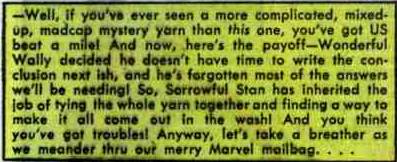
back 7 “He Giveth and He Taketh Away,” The Avenging Mind, © 2008 S. Ditko.
back 8 “The cleverest trick used in propaganda against Germany during the war was to accuse Germany of what our enemies themselves were doing.” Joseph Goebbels, Nuremberg, 1934.
back 9 Ray Wyman, The Art of Jack Kirby, 1992.
back 10 Eric Stedman, Marvel Method group, 27 November 2018.
back 11 Roy Thomas, “A Fantastic First!, Alter Ego v3n2, Summer 1998.
back 12 Roy Thomas, Letter to the editor, Comic Book Creator #3, Fall 2013.
back 13 Jon B. Cooke, response to the Thomas letter to the editor, Comic Book Creator #3, Fall 2013.
back 14 Roy Thomas, e-mail to John Morrow, September 2018, quoted in Kirby & Lee: Stuf’ Said!, November 2018.
back 15 Roy Thomas interviewed by Jim Amash, published in The Jack Kirby Collector #18, September 1997.
back 16 Mark Evanier deposition, 9 November 2010, Justia, Dockets & Filings, Second Circuit, New York, New York Southern District Court, Marvel Worldwide, Inc. et al v. Kirby et al, Filing 65, Exhibit 8.
back 17 Stan Lee, Origins of Marvel Comics, Simon and Schuster, New York, 1974.
back 18 A Mini-History, “Wind-up,” The Comics v14n11 © 2003 S. Ditko.
back 19 Jack Kirby interviewed by Gary Groth, conducted in summer of 1989, The Comics Journal #134, February 1990.
back 20 See declarations by Randi Singer (Filing 65, 18 February 2011) and Marc Toberoff (Filing 77, 25 February 2011), Justia, Dockets & Filings, Second Circuit, New York, New York Southern District Court, Marvel Worldwide, Inc. et al v. Kirby et al.
back 21 Tj Dietsch, “C2E2 2015: S.H.I.E.L.D.,” Comics News blog, Marvel.com, 26 April 2015.
back 22 Jim Shooter, Writer. Creator. Large mammal. blog, Monday, March 21, 2011, and comment on Wednesday, March 30, 2011 post, left August 30, 2011.

All other Roy Thomas quotes are from “The Terrific Roy Thomas,” The Jack Kirby Collector #74, Spring 2018.