Guardian of the Mythology

Roy Thomas (smiling gleefully): When Jerry [Robinson]’s article about what Bill Finger had done on Batman came out of course it made Bob Kane go ballistic the minute that he saw it. So he went to the editor of Batmania, and he wrote half a dozen pages of diatribe. Obviously Bob Kane did not want Bill Finger’s story told and took tremendous offense at it.1

The reaction of Roy Thomas to Bob Kane’s dismay at the exposure of his credit theft is telling. Thomas has made it his life’s work to suppress awareness of the same charges against Stan Lee, and to that end, he continues to discredit the Bill Fingers in Lee’s life. Compared to Lee, Kane was an amateur, because he was actually naïve enough to pay his uncredited collaborators for their work.

In Alter Ego 171, Thomas spells out the current state of the ever-evolving company version of Lee vs Kirby. The framework he uses this time is the expansion of his “rebuttal” of Abraham Riesman’s True Believer: The Rise and Fall of Stan Lee (the original piece appeared in The Hollywood Reporter in February). Thomas shows he has little use for logic, and absolute contempt for the physical evidence. The article reveals the difficulty of maintaining a false narrative in the face of scrutiny from the outside world.
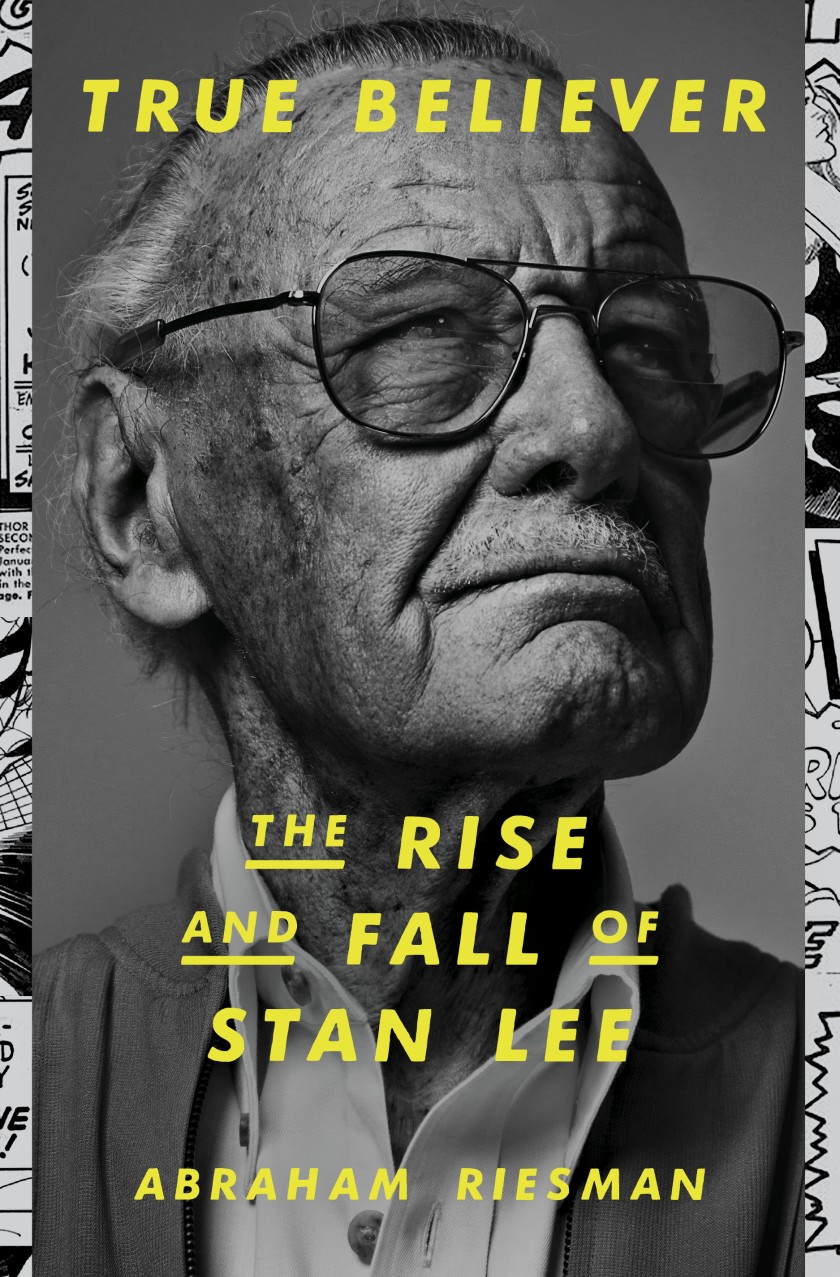
Thomas’ complaints in the “rebuttal” boil down to this:

I feel the chief transgression of this book is how the author goes so far out of his way to undermine much of the received history and biography of Stan Lee.

The “received history” consists of various publicity campaigns in which Thomas was instrumental. These propaganda blitzes served to falsify the events of the ’60s and the late ’50s to give the company clear title to properties created by freelancers.
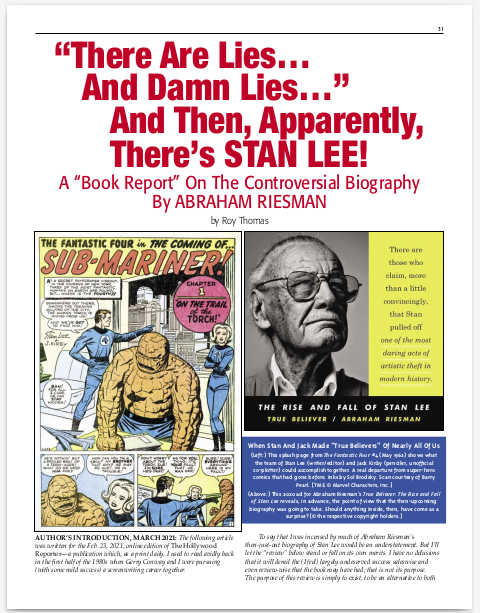
Unless specified with a footnote, the indented passages herein are taken from ‘“There Are Lies… And Damn Lies…” And Then, Apparently, There’s STAN LEE! A “Book Report” On The Controversial Biography By ABRAHAM RIESMAN,’ by Roy Thomas. Quotes within those passages are taken by Thomas from True Believer: The Rise and Fall of Stan Lee, by Abraham Riesman.

In Alter Ego 161, an earlier defense by Thomas of the company line on Kirby consisted wholly of

it’s well known…2

What’s well known? Thomas was suggesting it’s well known that Larry Lieber wrote full scripts for Kirby’s monster comics based on Lee’s plots. This is taken to be “well known” because it appeared in the pages of Alter Ego, 22 years ago. What’s with the fixation of finding some way, any way, to deny Kirby the writing credit he claimed? The answer is simple: if it became known that Kirby was a writer, his “collaborations” with Lee might be subject to more scrutiny.

Jack Kirby always claimed he wrote his own monster stories, but the official line as of 1974 was that Stan Lee wrote them. When that became problematic in 1999, the torch was passed and Larry Lieber was nominated.3

In 1997, Thomas told Jim Amash how he researched his second-hand history for the years that preceded his arrival at Marvel in 1965.

From what little I heard talking to Stan and Sol Brodsky…4

The freelancers might tell a different story, so it was safer not to consult them. By the time Alter Ego 161 was published in 2019, it was clear that Thomas was still ignoring the claims of Kirby and Ditko.

Alas, Mr Riesman is a journalist, and unlike lifelong industry fans like Thomas or hagiographers like Danny Fingeroth, he was compelled to throw out the “received history” and do the research from scratch. Apparently Thomas will need to learn the hard way not to contest Riesman on the grounds of research or documentation.

A chronology of making up history

The “received history” was developed in four stages. In 1961, as Larry Lieber once commented,5 Stan Lee decided to “write” Kirby’s comics; more on this later. Thomas started with the company in 1965, so this is the only stage for which he was not present and has no first-hand knowledge.
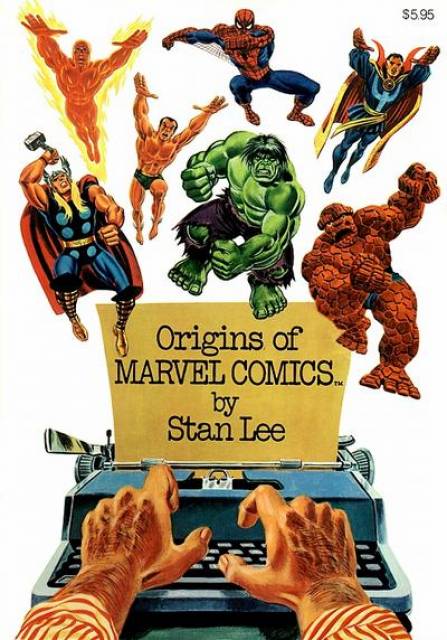
Between 1968 and 1974, Marvel’s new owners had a narrative established for them to consolidate control of the copyrights away from the freelancers who created the properties, culminating in Origins of Marvel Comics under Lee’s byline. In later decades, Lee is known to have had ghostwriters for everything; Origins might be no exception to the pattern. Kirby commented in his TCJ interview that Lee even had ghostwriters for his 1960s dialogue. A look further back in his career shows Lee recycling other people’s scripts under his own name, yet it was Kirby’s remark that drew outrage.

In 1998, in response to two events—Kirby’s death and the interview of Thomas that appeared in the Kirby Collector—Thomas was recruited by Lee and his attorney Arthur Lieberman to join the campaign. (Lieberman had entered the lives of Lee and Thomas in 1970 at the advent of one of Thomas’ greatest creations, Conan the Barbarian.) By the time of the Stan-Roy “interview”  in Comic Book Artist that year, Thomas was directing the effort.

Stan: You know something, Roy? Now that you say it, that’s probably true…6

Finally, in a 2010 deposition in the case in which Marvel sued the Kirby family, with Lieberman at his side, Lee laid claim to sole creatorship of all the contested properties. In addition, that pesky Silver Surfer, not yet a contested property but a counterexample to the idea that Lee created all, was dispensed with by his legal team. Thanks to the presence of Thomas at the unveiling, Kirby had clear title, but in the deposition Lee became co-creator by virtue of making it “a separate character.” Thomas, formerly the only witness against, takes the opportunity in his “rebuttal” to incorporate this new truth in the narrative.

Discerning the truth

Some excerpts from the Thomas “rebuttal,” with Riesman’s work in quotes:

Both men were, I think, wrong… and that’s why Riesman is so ill-advised to use nearly every opportunity he gets to weight things in Jack’s favor and against Stan.

You think I’m exaggerating when I suggest that Riesman finds gratuitous excuses to favor Jack’s vision of things over Stan’s? I’m not.

He simply weighs Stan’s statements against Jack’s, without offering any real evidence that Jack’s memories are any more reliable than Stan’s.

“It’s very possible, maybe even probable, that the characters and plots Stan was famous for all sprang from the brain and pen of [artist writer Jack] Kirby….” “Possible,” yes. Lots of things are “possible.” But—“even probable”? Why? Riesman never really makes a credible case for that. He merely piles up verbiage and quotations: “He said… he said.”

Over and over again in the book—there isn’t room here to list them all—Riesman attempts to undercut Stan’s veracity.

“It was just two men in a room. Kirby relentlessly claimed until his dying day that his discussions were merely a matter of his telling Stan what was going to happen in a given plot, then going home and creating what he’d said he would create….” But hey—guess what: Stan Lee proclaimed to his dying day that he had had the initial idea for most of the 1960s Marvel heroes, with Jack being brought in later to help develop those characters. So why are we supposed to believe one man’s claim and not the other’s, given the lack of hard evidence?

Lee’s veracity can’t be undercut; he seldom told the truth. There is physical evidence, and in denying its existence, Thomas is hoping it will go away. Thomas says Lee was wrong, therefore by the “fine people” principle both men were wrong. No one will remember Thomas admitting Lee was wrong; Thomas won’t even remember for the duration of his article.

Bad memory, aka lying as a default setting

One of the things people have to realize about Stan Lee is that, like many another busy, forward-looking professional… he tended to discard (i.e., forget) events or discussions even in the recent past, once they were over and done with. That aspect of Stan’s personality could be maddening at times, but the fact remains: Stan was, in many ways, almost as forgetful as he generally portrayed himself as being. From the day I met him in 1965, he walked around with 3”x5” note cards in his shirt pocket, on which he’d scribble down things because he didn’t trust his memory. And, while some have argued that his “poor memory” was only a convenient shield against being held responsible for earlier decisions, I feel I spent more than enough time working with him between ’65 and ’74, in particular, to be certain that his notoriously bad memory was way more than just an artful dodge.

[Riesman] simply weighs Stan’s statements against Jack’s, without offering any real evidence that Jack’s memories are any more reliable than Stan’s.

Some people (Steve Ditko in particular) have suggested that poor memory is a reason to not be taken seriously when claiming creator credit. Lee repeatedly claimed “the world’s worst memory” and the like. Kirby never said he had a poor memory, yet propagandists like Thomas insist the unreliability is on both sides before saying their side is telling the truth. In 1986 Kirby said he and Lee both remembered clearly the events of 25 years earlier, and all that was necessary was for Lee to come clean. He expressed confidence that, knowing Lee, that would never happen.

Synopses

And [Riesman] weights things toward Jack’s view point with statements like the foregoing despite the fact, for instance, that partial synopses written by Stan for two of the first eight issues of the crucial Marvel flagship title Fantastic Four (including for #1) have been vouched for as existing since the 1960s.

Synopsis is a misnomer for the items promoted by Thomas as Lee’s documents of creation. Presumably typed by Lee, Chris Tolworthy shows convincingly that they were notes that suggested edits to the stories Kirby had turned in. The representation of the “synopses” as documents of creation, a view Thomas took up only after expressing his skepticism in 1997, is fraudulent.

“…I saw Stan’s plot for Fantastic Four #1, but even Stan would never claim for sure that he and Jack hadn’t talked the idea over before he wrote this.”7

The first “synopsis” to emerge (the one for #8) changed the direction of the Fantastic Four from Kirby’s dark science fiction to Lee’s light and fluffy. (Kirby wrestled control back some 40 issues later.)

If Stan Lee was engaging in an act of ex post facto forgery with that half-synopsis, it was surely the most inept attempt ever seen by man. And Stan was far from inept.

Thomas offers no evidence for this statement, because the “received history” is not about a Stan Lee who was inept. The physical evidence tells a different story.

Mark Evanier: [ FF #1] feels an awful lot more like Jack’s earlier work than anything that Stan had done to that date. So I find it very difficult to believe that Jack did not have input into the creation of the characters prior to the – that synopsis, whenever it was composed. And, also, I have the fact that I talked to Stan many times, and he told me – and he said it in print in a few places – that he and Jack had sat down one day and figured out what the Fantastic Four would be.

QUINN. And they discussed the plot before they actually – the drawings were done?

A. They discussed the plot before the alleged synopsis was done also.8

Amusing bit: Riesman wrote that “a rumor” said the FF #1 synopsis was created after the fact. Thomas refers to Evanier, one source of the rumor, as Kirby’s “one-time teenage assistant.” When Lee made Evanier a Vice President of Stan Lee Media, Thomas was having his loyalty rewarded by being handed the ghostwriting duties on the Spider-Man newspaper strip. Lee was paid $125k a year for having the strip written, but it’s a safe bet Thomas only got a fraction of that. Thomas exacts his revenge on Evanier with the “teenage assistant” crack, not realizing that it might bring to mind Kirby’s first teenage assistant, Stan Lee.

Lieber

Riesman even manages either to misunderstand Stan’s brother Larry Lieber on the way many of the early Marvel stories were written—or else, back in 1999, Larry himself was totally misremembering when he told me in a published interview that, to the best of his recollection, every single story he wrote was done in the script-in-advance format, never by the Marvel Method.

Riesman can’t misunderstand something that is insufficiently documented. Kirby said he wrote his own stories. Lieber has always been very malleable in the hands of his big brother whom, it’s clear in the pages of True Believer, treated him like dirt. Lieber’s name wasn’t mentioned in relation to Kirby’s stories before 1998, and he didn’t claim to have written full scripts for Kirby until after Kirby’s death.
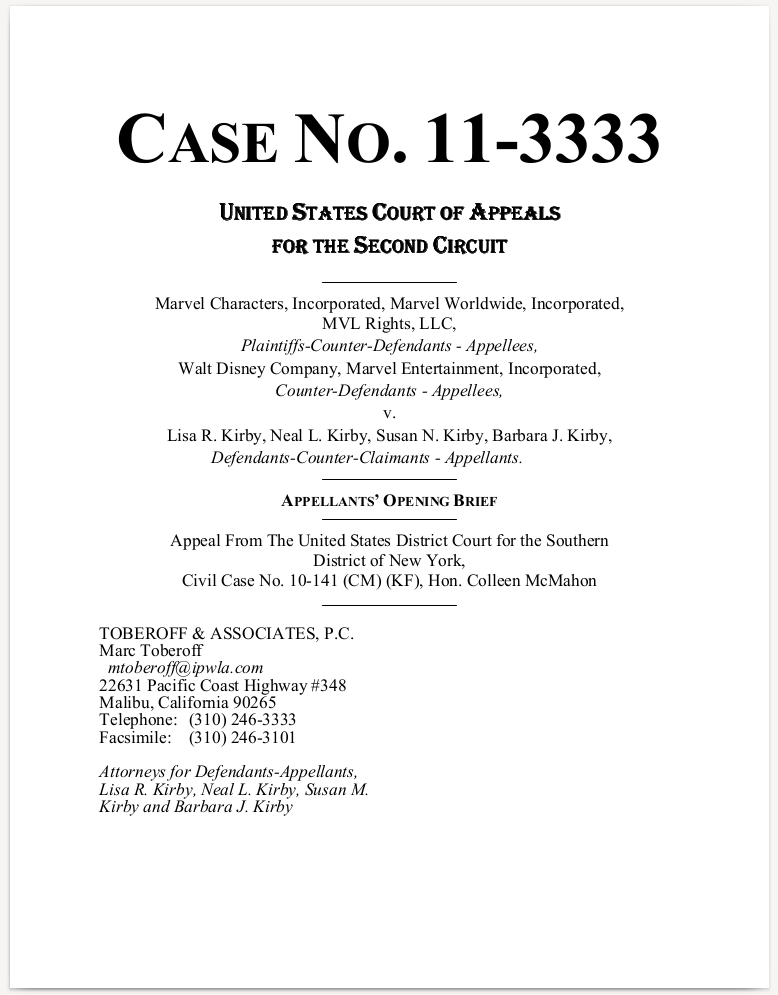
In 2011 Lieber was deposed in the Kirby case, and mentioned that he’d been reluctant to give the deposition. Lee convinced him with the “suggestion” that if he didn’t, he might lose his work on the Spider-Man newspaper strip, work he had at the whim of Lee (see page 30 in the linked PDF).

Case No. 11-3333 Appellants’ Opening Brief

Lieber also described his understanding of what would happen to a script after he turned it in.

MS. SINGER. Do you know what would happen to the script after Stan went over it and made whatever changes?
LIEBER. Yeah. It would be sent to the artist, I would guess.
Q. Okay.
A. Whether it was, you know, the various artists, yeah.
Q. Did you ever — did you have any contact with the story after
you turned it in and made whatever changes?
A. No.9

Thomas notes a couple of points in the book that Lieber later asked to be clarified. Thomas calls it Riesman’s “misinformation.”

Through his friend Frank Lovece, Larry has recently corrected this bit of misinformation on Facebook.

According to Larry in his recent remarks put on Facebook by his friend Frank Lovece, it was his older cousin-by-marriage Martin Goodman who committed that particular verbal vulgarity…

Lovece is a reporter beholden to the Marvel narrative, but Riesman recorded his interviews.

Thomas then expresses disbelief at a few things Lieber said to Riesman.

This is something I’d definitely need to check with Larry himself about before I believed it

…but again, I’d want to hear that description from his own lips.

Again, it’s not that the lead-off pair of statements made by Riesman are necessarily untruths… I wasn’t in the room to hear precisely what Larry told him, and neither were you… but I’d want to hear it from Larry before I didn’t believe that he was, at the very least, misquoted.

Despite his rhetoric, Thomas will never check with Lieber because that kind of poking the actual first-hand accounts is not his style. He’s not a journalist or even an historian. Abraham Riesman not only checked with Lieber, but recorded his lengthy reminiscences. If Thomas were to approach Lieber, the implicit threat of his Marvel affiliation would precede him, and Lieber would alter his story accordingly.

Who was Stan Lee?

“‘When my mother died, our life changed dramatically.’ The change was not born of grief but rather of logistics.”

More of the same as on p. 14, really… this time, a quotation from Stan, followed by a judgment by Riesman. But perhaps, rather than criticize the author, we should all simply marvel at his ability to look inside the mind and heart of Stan Lee and know precisely what he meant by that quote, when the man was known for playing his emotional cards very close to his vest.

Jack Kirby always had the clearest view of his former teenage assistant. In this case he pegged it: Lee was a man with no empathy.

KIRBY: And my wife was present when I created these damn characters. The only reason I would have any bad feelings against Stan is because my own wife had to suffer through that with me. It takes a guy like Stan, without feeling, to realize a thing like that. If he hurts a guy, he also hurts his family. His wife is going ask questions. His children are going to ask questions.10

Freedland

It’s curious that Thomas, who hasn’t hesitated to spin Lee as the injured party in the Herald Tribune debacle, neglects to mention one of the exclusive revelations of True Believer: Riesman interviewed Nat Freedland. Freedland admitted to Riesman that he’d been sucking up to Lee in hopes of getting work with Marvel. This is notable because Thomas has tried to whitewash the incident in the past.
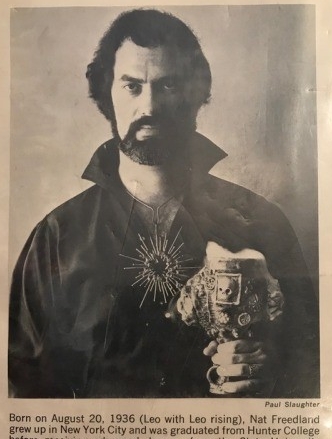
THOMAS: And, unfortunately, Stan kind of took the rap for [the tone of the article] from Jack and Roz, who somehow felt that Stan was trying to grab credit away from him, and though Stan could do that, he wasn’t doing that in this instance.11

Thomas is wrong: Lee was very much trying to grab credit. The purpose of staging the “plotting session” was to present Lee as the originator of the ideas. Thomas knew the story conference was atypical by the very fact that he was invited to attend.

Physical evidence

Stan Taylor: The problem here is not that we don’t have eyewitness testimony, it’s that we have conflicting eyewitness testimony. The people involved disagree. If we can’t rely on first-person testimony, what can we do? Criminal detectives have other words for this: evidence, and modus operandi. We can do what historians, detectives, and scientists have always done: ignore the hearsay, mythology, and personal claims and look at the actual physical evidence, in this case, the original comic books, and contemporaneous documentary evidence from unbiased sources. Human behavior is repetitive, we all have our m.o, — our method of operation. It is this human trait that detectives use to narrow down the lists of suspects in any mystery.12

What comprises the physical evidence? The published comics are the main source, but there’s more. Kirby’s original art from the monster and early superhero period (visible online and in IDW Artist’s Editions) contains his pencilled lettering in the balloons and captions of stories where the writing has been retroactively credited to others. Kirby said in interviews that his documents of creation were a “blitz” of concept sketches that he used to present his characters on spec. Most of these have been absorbed into the published work, as cover figures like Iron Man, or Marvel Masterworks posters like the FF. At least one Spider-Man page and a pair of Nick Fury pages, however, survived long enough to be discussed. Taylor used the physical evidence, mainly the published work attributed to Lee, Kirby, and Ditko, to make a convincing case for Kirby bringing the Spider-Man character and plots to Stan Lee before the first story conference.

Physical evidence of a JLA prototype.

On the other side of the ledger, there are no surviving scripts (although Thomas devotes two pages of the article to a “Marvel Method script” from the ’70s that involved neither Lee nor Kirby). There are two “synopses” that may have been Lee’s attempt to change the direction of what Kirby had already written and drawn. The only physical evidence for writing, including the absence of Lee’s signatures, favours Kirby.
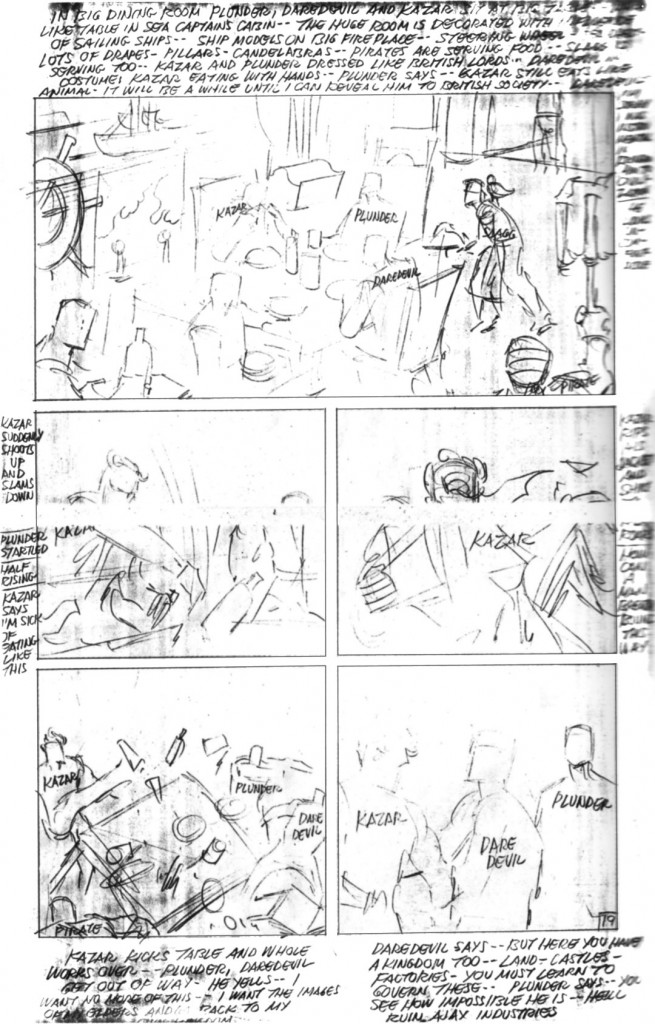
Kirby writing full script with panel breakdowns, writing pay taken by Lee.

Roy Thomas’ attitude toward the physical evidence is troubling. While in the Marvel offices, Jim Shooter encountered a Kirby Spider-Man presentation page, and Jim Steranko was assigned Kirby’s Nick Fury presentation pages to ink. Thomas was closer to that evidence than nearly everyone else for fifteen years. After expressing doubt regarding the timing of the FF #1 “synopsis” in a 1997 interview, he was persuaded the following year to embrace and extend the Lee creation myth.

Some examples of recent Thomas pronouncements that don’t stand up to the physical evidence are detailed here.

Audience

Caption: Frankly, Ye Editor finds it ludicrous that anyone would believe that Stan would’ve bothered to fake such a document [an FF outline] anytime… but especially back in the 1960s!

Thomas mocks the Riesman/Evanier “synopsis” takedown for the benefit of his audience. “Ye Editor” is an inside joke, a fun way for adults to secretly signal each other based on Lee’s cod Shakespeare.
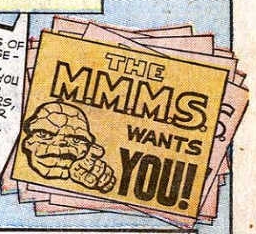
Caption: When Stan and Jack Made “True Believers” Of Nearly All Of Us

It was not Kirby’s goal to make True Believers, it was his goal to tell an entertaining story and sell comics. Lee’s rebirth in the ’60s on the backs of his collaborators came with the realization that if he befriended his readers, he could make them enemies of anyone who called out his managerial abuses.

…in any subsequent edition, Crown Books should change the book’s subtitle. Because he isn’t likely to have convinced anyone who has access to (or interest in) any facts or intelligent observations that lie outside its pages.

“Come to Alter Ego to get all the facts and intelligent observations.” The magazine may run a Jack Kirby tribute issue, but it will never show him respect because he disrespected the flag of Stan Lee. The special brand loyalty to which it caters values the characters above the creators, and their friend in management (Lee) over labour (the freelancers).

But, no matter how well the Random House publicity machine manages to hype this book, as long as it stands as currently published, with Stan all but written off as an inveterate liar whose most important creation was his public persona (when it was actually the concept and direction of the Marvel Universe, an idea that was anathema to Jack Kirby, as per in-book quotes), it will remain undeserving of the high praise heaped upon it by people who, for the most part, don’t really know what the hell they’re talking about.

“People who don’t read Alter Ego don’t really know what the hell they’re talking about.” Thomas sidesteps having to prove Lee is not an inveterate liar with the implication that the “received history” answers all.

Propaganda

Michael J Vassallo: reading Stan Lee: How Marvel Changed the World, by Adrian Mackinder. Another book on Stan, mining the same rubbish. The prologue to the book is not inaccurate as it goes into great length explaining how Stan was positioning himself as a pseudo-military leader of the legion of Marvel fans. Phrases like “face front’” and “True Believer,” makes it obvious the author knows Stan was organizing a cult following. As the author said, “They didn’t just read. They believed.”13

Having served in the US Army Signal Corps during WWII, Lee was aware of the power of propaganda. If it could ever be said that he’d read a book (like Trump and his bedside copy of Mein Kampf), it would be The True Believer: Thoughts on the Nature of Mass Movements.

Mark Seifert commented on a blog post about Jean Shepherd’s trademark use of the word “Excelsior.”

Mark Seifert: I’ve been researching the usage of “Excelsior” word by Marvel Comics legend Stan Lee. There too, there have been widespread claims that it doesn’t really mean much. And some that claim that Stan got it from Shepherd (he didn’t, we’ll get to that in a minute). But it does have specific meaning, as you say. Fwiw, I can give you a little additional context, I believe.

First off: Like Shepherd, Stan Lee was in the Signal Corps during WW2. After the war and their service, I believe they were both engaged in a little Cold War era propaganda as well. I’m not necessarily implying that’s a bad thing (that’s above my pay grade!), but their usage of it was very certainly purposeful and with specific intent.

Keep going. Achieve. Don’t let anything stop you.

In Stan’s case, as you might know, he also uses the terms “True Believer” and “Face Front” frequently. Both of these had gained relatively common usage as terms of propaganda in that era.

“True Believer” a very popular book about the psychology of mass movements by Eric Hoffer in the 1950s, also had a cover on the paperback version which shows a man climbing upward with the classic “Excelsior” banner.

“Face Front” was thrust into usage in that era by syndicated newspaper columnist George Matthew Adams, which a little research shows ran a syndicate that frequently engaged in propaganda. Its meaning is pretty close to the meaning of Excelsior. Basically: stand up, together, and face the enemy.

These are all terms of the trade of mass influence, and in the case of Excelsior, being used regularly by trained Signal Corps veterans who both had access to a mass audience.

In my opinion, there are conclusions to be drawn from that.14

The True Believer: Thoughts on the Nature of Mass Movements, 1951

Some excerpts.
Page numbers are taken from the Harper Perennial Modern Classics edition, 2019.

p 50 A rising mass movement attracts and holds a following not by its doctrine and promises but by the refuge it offers from the anxieties, barrenness and meaninglessness of an individual existence. It cures the poignantly frustrated not by conferring on them an absolute truth or by remedying the difficulties and abuses which made their lives miserable, but by freeing them from their ineffectual selves–and it does this by enfolding and absorbing them into a closely knit and exultant corporate whole.

p 130 Propaganda by itself succeeds mainly with the frustrated. Their throbbing fears, hopes and passions crowd at the portals of their senses and get between them and the outside world. They cannot see but what they have already imagined, and it is the music of their own souls they hear in the impassioned words of the propagandist. Indeed, it it easier for the frustrated to detect their own imaginings and hear the echo of their own musings in impassioned double-talk and sonorous refrains that in precise words joined together with faultless logic.

p 131 [Dr Goebbels] sounds apologetic when he claims that “it cannot be denied that more can be done with good propaganda than by no propaganda at all.”

p 155 …the true believer who is wholly assimilated into a compact collective body has found a new identity and a new life. He is one of the chosen, bolstered and protected by invincible powers, and destined to inherit the earth… The true believer is eternally incomplete, eternally insecure.

p 173 The genuine man of words himself can get along without faith in absolutes. He values the search for truth as much as truth itself. He delights in the clash of thought and in the give-and-take of controversy. If he formulates a philosophy and a doctrine, they are more an exhibition of brilliance and an exercise in dialectics than a program of action and the tenets of a faith. His vanity, it is true, often prompts him to defend his speculations with savagery and even venom; but his appeal is usually to reason and not to faith. The fanatics and the faith-hungry masses, however, are likely to invest such speculations with the certitude of holy writ, and make them the fountainhead of a new faith.

p 175 However, the freedom the masses crave is not freedom of self-expression and self-realization, but freedom from the intolerable burden of an autonomous existence. They want freedom from “the fearful burden of free choice,” freedom from the arduous responsibility of realizing their ineffectual selves and shouldering the blame for the blemished product. They do not want freedom of conscience, but faith–blind, authoritarian faith.

Lee’s True Believers aside, this 70-year-old book has echoes in current events that are alarming.

Lee took to heart a strategy attributed to Goebbels15 in his dealings with Kirby, joking with the True Believers about Kirby’s greed or incompetence, and in a serious moment, accusing him of evil for disputing the creation mythology. Thomas carries on the tradition: his favourite accusation is that Kirby was greedy because of his belief that he wasn’t fairly compensated for his share of the work.

Thomas includes an exercise in the “rebuttal” in which he proves that in today’s dollars, Kirby’s pay was nothing to sneeze at. He fails to mention Lee’s ill-gotten freelance writing pay on over 10,000 pages Kirby produced, or Kirby’s back-breaking 7-day schedule while Lee and Thomas put in a verifiable two to three days in the office. Something else that goes unmentioned is the motivation for Lee’s extortion racket, laid plain in Riesman’s book: the terrible price Lee was paying to keep his wife and daughter in the style to which they were accustomed.
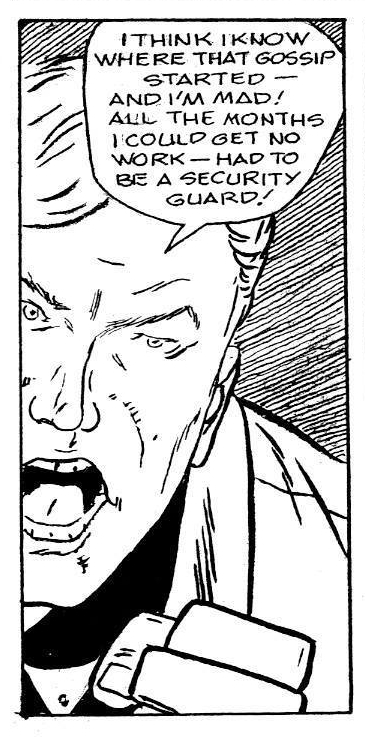
Thomas noted in his 1981 TCJ interview that Marvel was a vindictive company, and that Lee himself could be vindictive on occasion.16 But although his examples of the targets of Lee’s vindictiveness were from the ’70s (Wein and Conway, both writer/editors), he didn’t mention writer/artist Dick Ayers, who sued for reprint fees and lost. Lee stripped Ayers of his assignments and spread the word that he’d had a mental breakdown.

Propaganda in the “rebuttal”

Caption: Fantastic Four #10… Stan Lee and Jack Kirby were shown in their office… trying to come up with a new storyline. In these panels, none other than Dr. Doom waltzes in and takes over… it seems unlikely that Stan would’ve approved such a scene a couple of years later… because it would’ve undermined the reality he was increasingly seeking in the Marvel line.

“The reality [Lee] was increasingly seeking in the Marvel line,” yes, reality in the line of superhero comics is one of those things that needs to be chanted repeatedly, without thinking about what’s being  said.

One of the things people have to realize about Stan Lee is that, like many another busy, forward-looking professional—and Stan was, as my keen-eyed wife Dann put it after a bit of observation, “one of the most future-oriented people” she ever met…

Jack Kirby was a prophet: many accounts (including that of Thomas) talk about his in-person predictions of the future coming true. There are many examples of it in his comic stories. Lee was a follower: Kirby’s account of Marvel’s creation was that Lee was immobilized by his disintegrating career prospects (cancellation of his newspaper strip, shutdown of the comics operation by Goodman), and Kirby stepped in.

“The general public is typically aware of only one narrative of the Marvel revolution: ‘Stan came up with all the characters, plots, and dialogue; Jack just came up with the visuals.’” Actually, if the “general public” knows only the version of events that Riesman paraphrases above, that’s hardly Stan’s fault. First, it’s because the “general public” never read the many, many places in the pages of Marvel’s 1960s comics wherein Stan praised Jack Kirby’s contributions to the skies, often giving him credit for what amounts to co-plotting stories, and on occasion even saying that Jack was likely to come up with a particular story all on his own.

“Not Stan’s fault” is a common theme in Thomas’ retelling, and it’s related to the falsehood that “he never knew why they quit.” It’s “not Stan’s fault” that everyone believes he’s the creator, plotter, writer, and “artist;” if only he hadn’t constantly portrayed himself that way, and had corrected interviewers whenever they got it wrong. It’s “not Stan’s fault” that Kirby and Ditko didn’t make clear their desire to get paid for their work before “stabbing him in the back” and quitting.

At odds with the “not Stan’s fault” line of reasoning are his 1987 interview comment, “the characters’ concepts were mine,”17 and his 2010 deposition,18 wherein he claimed that every creation was his. Lee’s run-of-the-mill propaganda was directed at his readers, but these comments were for general consumption. Thomas, under oath for his own deposition, said Lee misspoke if he ever said “artists” were expected to plot.

Q. Are you aware that Stan Lee, in interviews, has stated that in 1960s, under the Marvel Method, that artists were expected to plot stories?
MS. KLEINICK: Objection; states facts not in evidence.
A. I haven’t any knowledge of that. It would have, you know, surprised me; but if he did, he probably misspoke.19

This leads seamlessly into one of the biggest lies of the “received history”: Lee always praised his collaborators.

[Thomas quotes Lee via Barry Pearl]: “Comicbooks are a collaborative medium. Had I not worked with artists like Jack Kirby, Steve Ditko, John Romita, John Buscema, Gil Kane, all the rest of them, Gene Colan, Syd Shores—yes, Syd Shores, too—Dick Ayers, Joe Sinnott, all those guys… my stories would not have looked as good…. Those guys were writers themselves. But they would write with pictures…. It was a total collaboration affair and sometimes I feel a little guilty, you know: ‘Stan did this, Stan did that.’ I did it, but I did it with them. And they really deserve as much [credit] as I ever get.” You won’t find that quote, in full or in part, in Riesman, either.

Lee often said Kirby was very creative.20 If the actual words are parsed, it can be seen that he never credited him with creating a copyrightable property. Kirby was called a great plotter, but the physical evidence shows that he never received a plot credit. Ditko demanded a plot credit and was stripped of his Hulk assignment (it was given to Kirby so Lee would continue to receive the full writing page rate). Lee didn’t speak to Ditko for over a year, until he finally quit.

It’s important to note that each time Thomas or Lee used the word “artist” to describe Kirby or another one of the writers, it was designed to diminish their contribution and plant the idea that someone else was doing the writing. A better term would be writer/artist, and, in one instance, creator/writer/artist.

Produced by…

…as Riesman’s quotes testify, Stan often—not invariably, but often—gave Jack credit for doing much, even most of the actual plotting. By mid-1966, Stan, eager to accommodate Jack, stopped listing himself as “writer” in the credits and readily agreed to the mutual credit Jack suggested: “Produced by Stan Lee and Jack Kirby.” If Jack wanted still more credit than that, it doesn’t seem he ever made his wishes clearly known to Stan.

The “Produced by” story is one Roy Thomas is fond of telling. Roz Kirby seemed to speak derisively of the wording when she told John Morrow that they asked for credit all the time.21

This time,  Thomas tells the story as fact, but as recently as two years ago, his use of the word “reportedly” reveals that he got it second-hand.

Should Stan perhaps have made some additional accommodation with Jack? The point can be argued—in retrospect, I wish he had—but remember, Stan had reason to believe the matter had been settled to Jack’s satisfaction when the two of them agreed that future stories would be credited as “a Stan Lee & Jack Kirby production,” the phrasing Jack reportedly chose himself.22

Kirby asking for a “Produced by” credit is a Stan Lee story. Mark Evanier contributes to the mythology by relating Lee’s revelation to him that in another magnanimous gesture (the Lee/Thomas version of history is full of them), he offered Kirby and Ditko a plot credit at the same time.23 (It’s not clear from this fairy tale that Ditko was forced to demand it.) In Lee’s telling, Kirby’s response was no, just put “Produced by.”
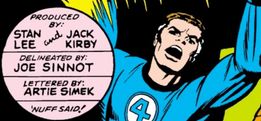

What puts the lie to this one is, again, the physical evidence: it took Lee from April 8, 1965 (Amazing Spider-Man #26, Ditko’s first plot credit) until August 9, 1966 (FF #56, the first “Produced by” credit) for Lee to give Kirby the credit Lee claims Kirby asked for in lieu of a writing credit, a period of 16 months. What Thomas, Evanier, and Lee fail to mention is that Ditko received plotting pay with his credit, taken out of Lee’s writing page rate. A “Produced by” credit didn’t cost Lee a dime, and still didn’t earn Kirby any pay for his writing.

Backstab

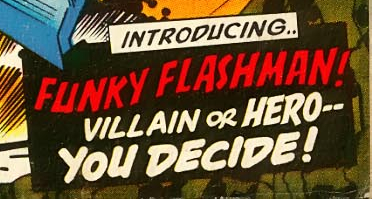
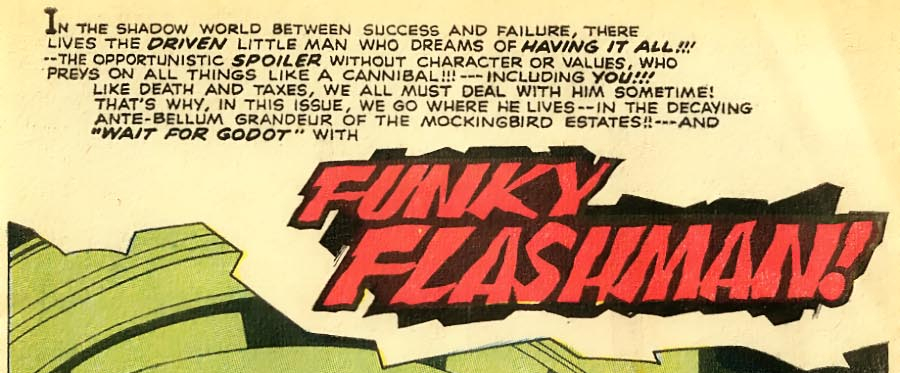
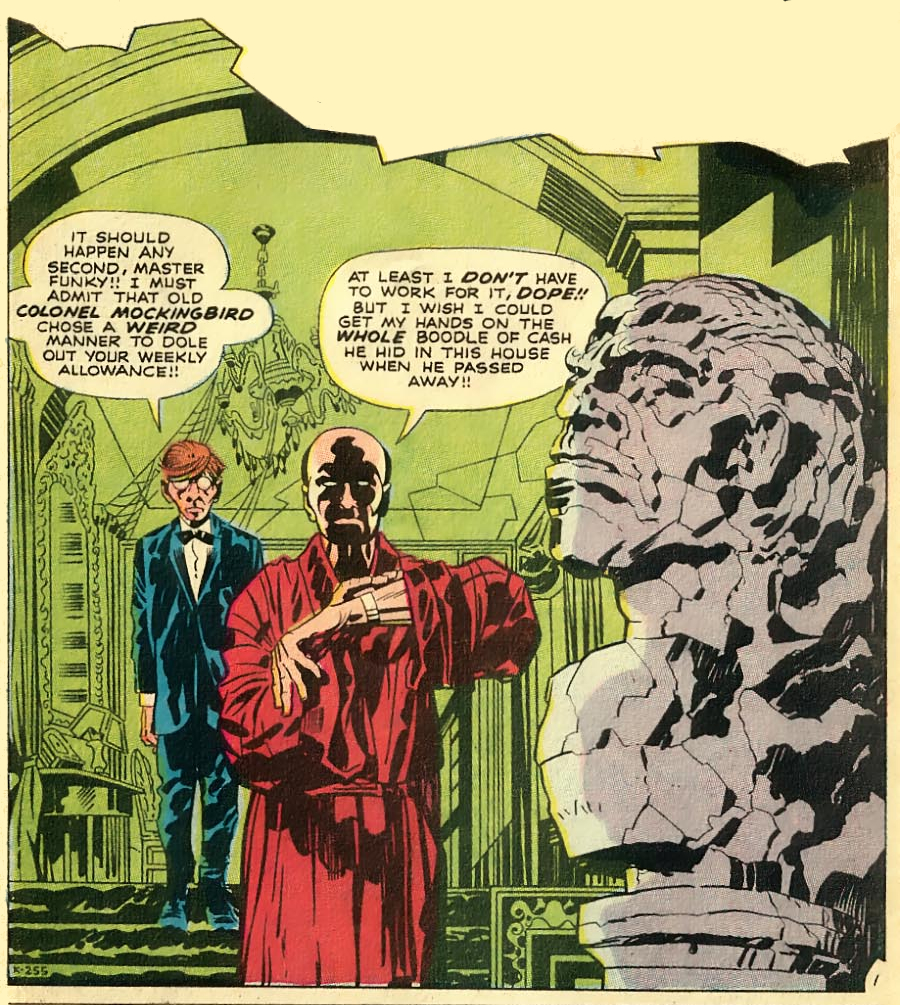
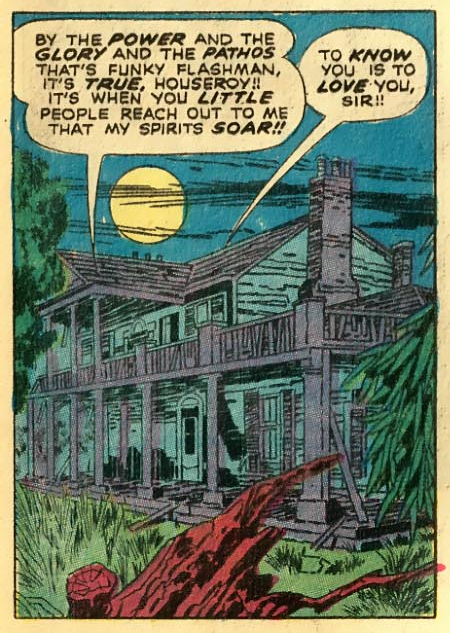
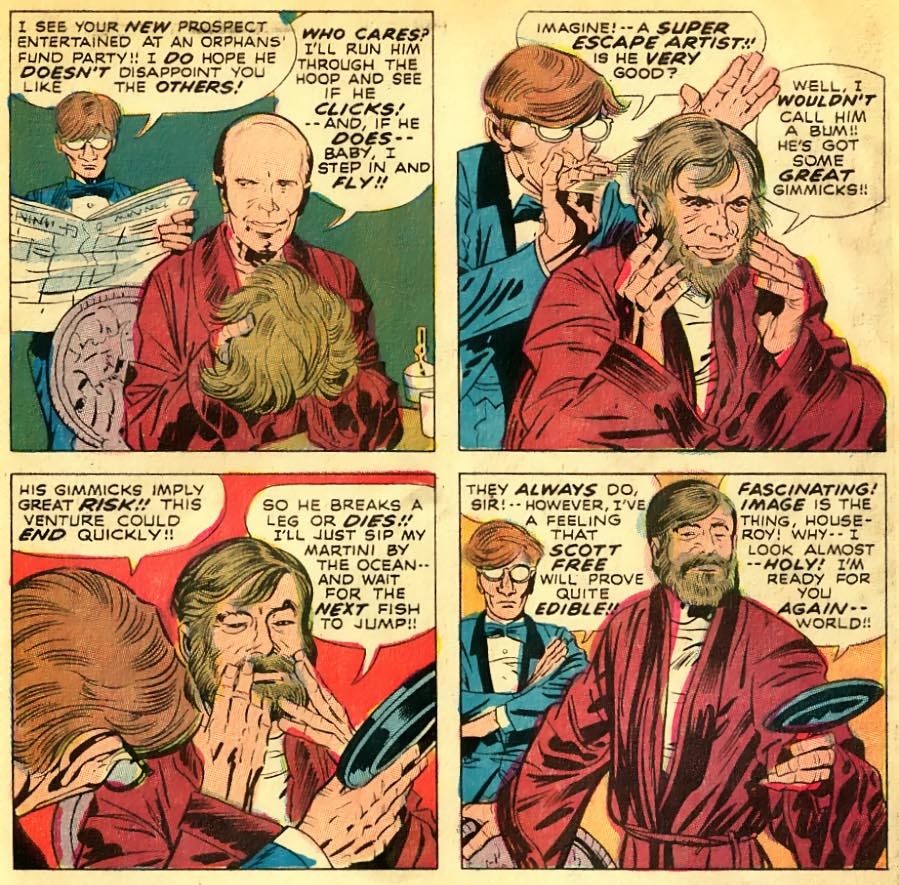
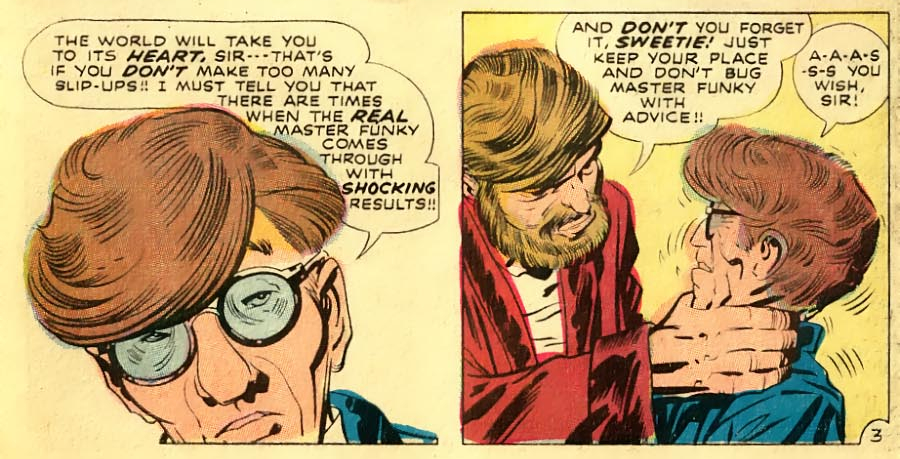
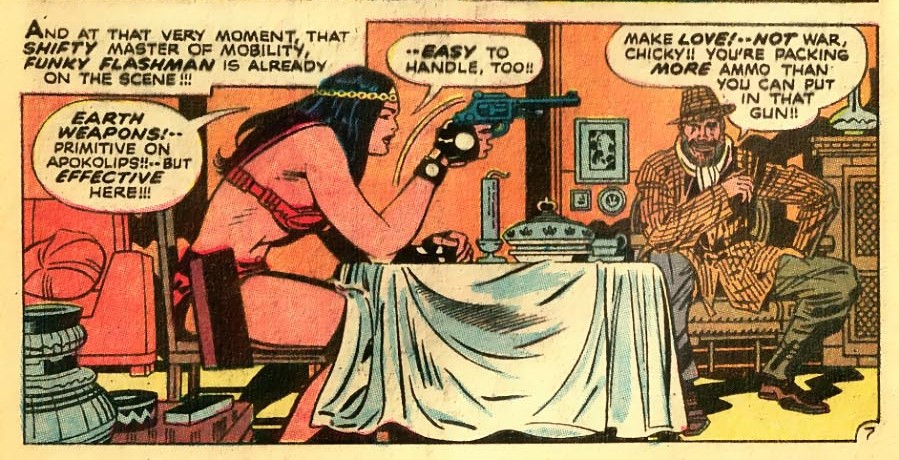
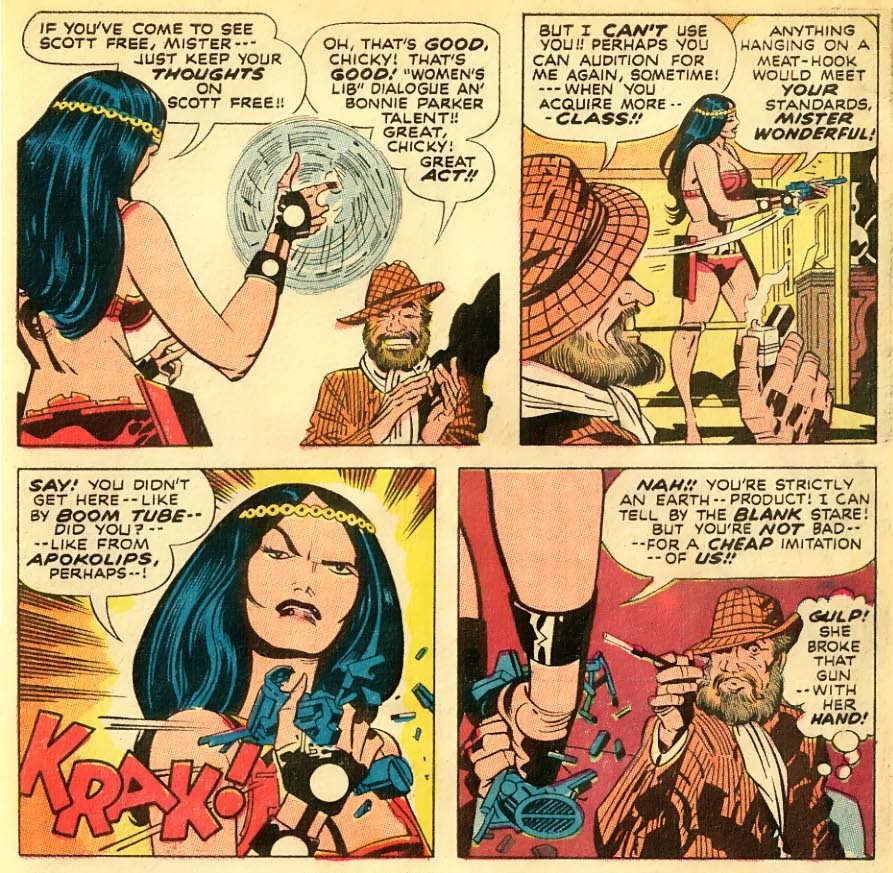
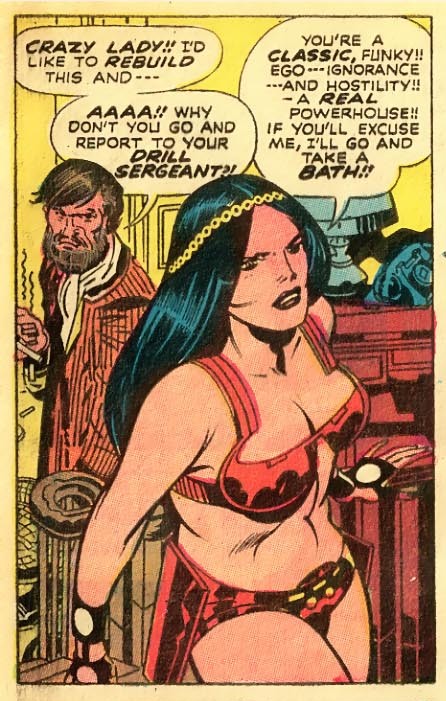
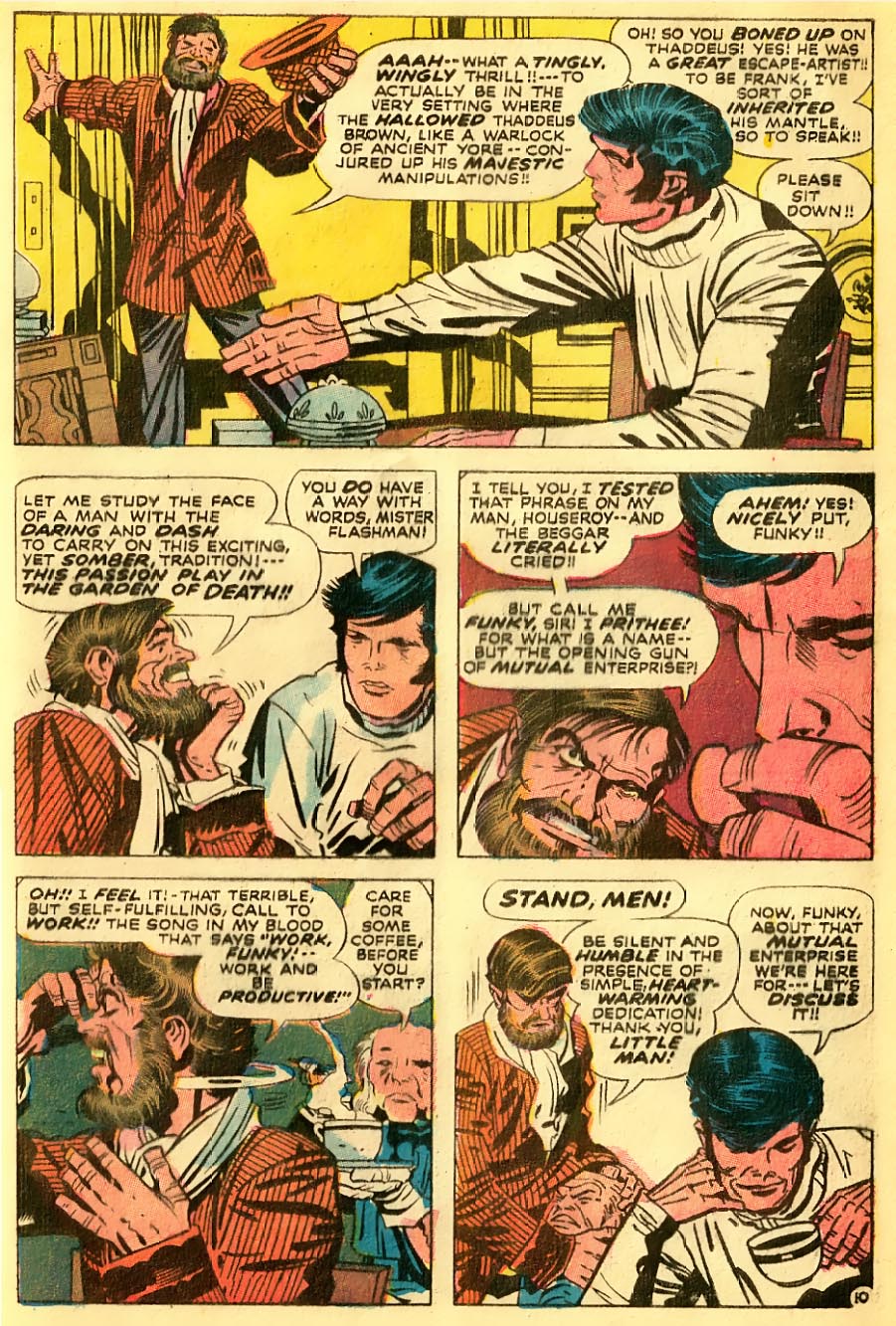
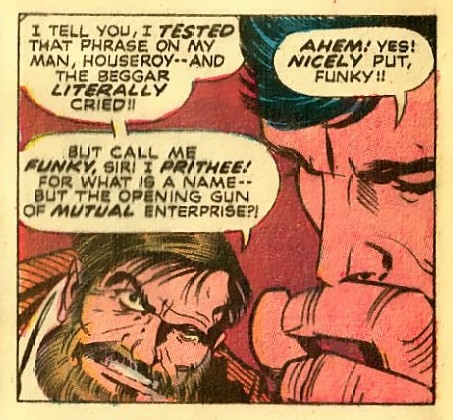
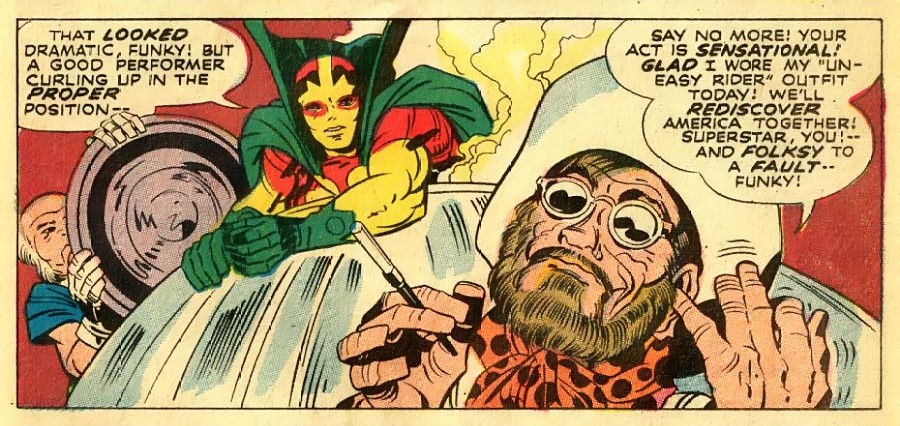
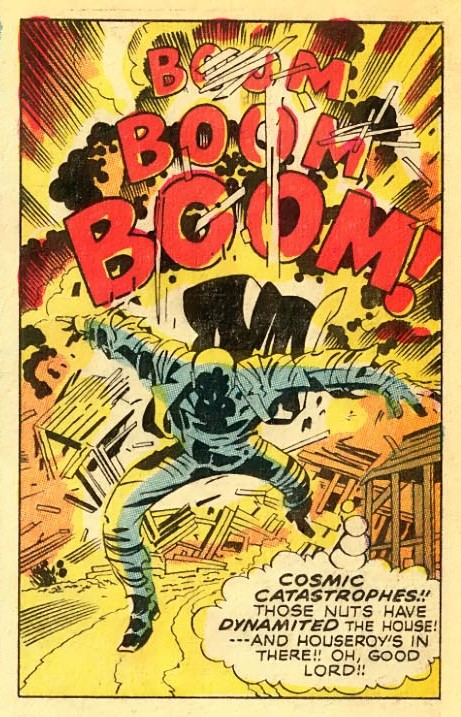
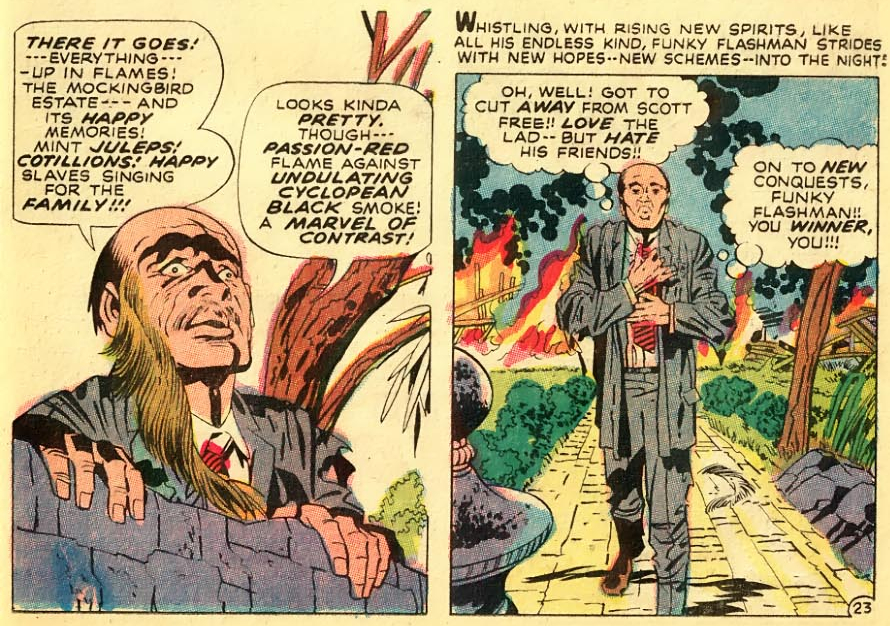
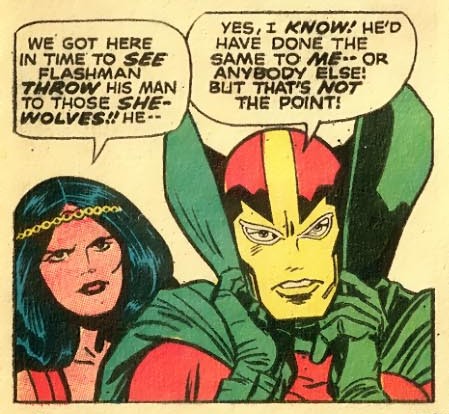
…Stan not only refers to Jack as “one of the greatest artists in the whole world,” but, in the very next sentence, acknowledges that Jack “started most of the characters with me.” Yeah, he’s saying that about the guy who he felt had stabbed him in the back in 1970 when he started working for DC Comics before even bothering to tell him he was quitting, and who had then viciously lampooned him as “Funky Flashman”!

A member of the general public might infer from the circumstances that the matter of stolen writing pay could never have been settled to Kirby’s satisfaction. It’s common knowledge in the outside world that Kirby turned off the tap on new creations after Lee butchered his Cocoon Man story, and began stockpiling concept sketches for his next opportunity. Kirby finally quit after tolerating the Marvel Method for nine years. It’s not a mystery, even though Lee pretended for decades that he didn’t know why. Now Thomas has taken up the mantle.

Vicious? Funky Flashman was undoubtedly the most accurate portrait of Lee we’re ever likely to see, by someone who had worked closely with him but was not beholden to him. Marvel has since outlawed this kind of thing from former employees. Stabbed in the back? Let’s keep in mind that Kirby’s writing pay was extorted for the better part of a decade by the man who, upon Kirby’s departure, immediately began claiming sole creatorship.

Stan Taylor’s approach was to look for patterns. The obvious pattern here is that repetitive Roy Thomas anecdotes concerning Kirby and Lee were designed to conceal something. When a point is belabored in the official version, a little scrutiny should turn up the truth behind it in the form of an accurate Kirby claim.

Conclusion

Abraham Riesman is a journalist. His book is based on new interviews with Lieber, Thomas, Romita, Freedland, O’Neil, and many others. The quotes are accurate because the interviews were recorded. Riesman paid for his own fact checker, publisher Random House paid a separate fact checker, and historian (the real kind, not the Marvel kind) Dr Michael J Vassallo fact checked it. There is no other book about Stan Lee that has been as thoroughly checked against known facts.

Coming back to the “received history,” who is receiving it? The received history is received by the True Believers. Riesman has written a biography for the rest of us, the “general public” who have no use for the company mythology.

I’d like to add a corollary to Stan Taylor’s approach to the first-hand testimony: if the account of one of the people involved is consistently borne out by the evidence, and the other is consistently proven false, it’s appropriate to conclude that the former is a significant contribution to our understanding of the history. That of the latter should be called out at every opportunity.

Footnotes

back 1 The Hulu documentary Batman & Bill, 2017.

back 2 Letters pages, Alter Ego 161, November 2019.

back 3 “A Conversation with Artist-Writer Larry Lieber,” interviewed by Roy Thomas, Alter Ego V3No2, Fall 1999.

back 4 Roy Thomas interviewed by Jim Amash, conducted by phone in September 1997, published in The Jack Kirby Collector #18, January 1998.

back 5 “A Conversation with Artist-Writer Larry Lieber,” interviewed by Roy Thomas, Alter Ego V3No2, Fall 1999.

back 6 “Stan the Man & Roy the Boy,” A Conversation Between Stan Lee and Roy Thomas, Comic Book Artist #2, Summer 1998.

back 7 Roy Thomas interviewed by Jim Amash, conducted by phone in September 1997, published in The Jack Kirby Collector #18, January 1998.

back 8 Mark Evanier deposition, 9 November 2010, Justia, Dockets & Filings, Second Circuit, New York, New York Southern District Court, Marvel Worldwide, Inc. et al v. Kirby et al, Filing 65, Exhibit 8.

back 9 Larry Lieber deposition, 7 January 2011, Justia, Dockets & Filings, Second Circuit, New York, New York Southern District Court, Marvel Worldwide, Inc. et al v. Kirby et al, Filing 65, Exhibit 4.

back 10 Jack Kirby interviewed by Gary Groth, conducted in summer of 1989,  The Comics Journal #134, February 1990.

back 11 “The Terrific Roy Thomas,” panel conducted by Matt Herring, The Jack Kirby Collector #74, Spring 2018.

back 12 Stan Taylor, “Spider-Man: The Case for Kirby,” 2003, available at the Kirby Museum website.

back 13 Michael J Vassallo, Marvel Method group, 10 September 2021.

back 14 Mark Seifert, 10 August 2019 comment on the “Jean Shepherd–Excelsior!!!!!” post at Gene Bergmann’s Jean Shepherd Quest blog.

back 15 Accuse the other side of that of which you are guilty, a misquote, according to Wikiquote.org. It’s possibly based on this actual quote: “The cleverest trick used in propaganda against Germany during the war was to accuse Germany of what our enemies themselves were doing.”

back 16 “The thing that was truest in that article [‘Roy Thomas Leaves Marvel,’ Journal #56] was the analysis that Marvel has had a tendency in recent years to be very vindictive toward people who leave it to work for the competition. They go far beyond any kind of professional reaction. Stan generally has reasonably good and humane instincts, but once in a while he’ll just decide that if somebody does something, he’s never going to work for Marvel again. He did this with Len, and with Gerry, though to date he’s never said it about me.”—Roy Thomas, interviewed by Rob Gustaveson, The Comics Journal #61, Winter 1981.

back 17 Janet Bode, A Comic Book Artist KO’d: Jack Kirby’s Six-Year
Slugfest with Marvel, The Village Voice, 8 December 1987.

back 18 Stan Lee deposition, 13 May 2010, Justia, Dockets & Filings, Second Circuit, New York, New York Southern District Court, Marvel Worldwide, Inc. et al v. Kirby et al, Filing 102, Exhibit 1.

back 19 Roy Thomas deposition, 27 October 2010, Justia, Dockets & Filings, Second Circuit, New York, New York Southern District Court, Marvel Worldwide, Inc. et al v. Kirby et al, Filing 102, Exhibit K.

back 20 “Jack was about the best. He was really the most creative artist of all, because he was more than an artist. I call him a great conceptualizer. He could conceive of stories and follow them through. All I would have to do with Jack is give him a very brief outline on what to do, and he would just do the whole story. After a while when we were rushed, I didn’t even give him an outline, he just did whatever story he wanted and I’d come back and I’d put it in the copy.”—Michael Allen, “Stan ‘The Man’ Lee,” Overstreet’s Comic Book Quarterly Vol 1 #4, April-June 1994.

back 21 When asked if this credits change was the result of Kirby actively asking for it, Jack’s wife insisted: “Of course! He used to ask for it all the time…We always asked for a lot of things all the time, and finally they put down ‘Produced by…’ because it’s just ridiculous, you know.”—Roz Kirby interview conducted 12 December 1995 by John Morrow, The Jack Kirby Collector #10, April 1996.

back 22 Letters pages, Alter Ego 161, November 2019.

back 23 Stan told me something interesting. There was one point in the Spider-Man books when the credits changed from “Art by Steve Ditko” to “plotted and drawn by Steve Ditko…” Stan said that simultaneously he offered the same thing to Kirby— to give him a co-writing credit—and Jack, instead, asked that the credits read “Produced by Stan Lee and Jack Kirby” or some variation of that. If you look at the credits, very rarely after that did it say “Written by Stan Lee.” Jack asked to keep it ambiguous, and Stan went along with it.—Mark Evanier, “Comic Interview,” cited by Barry Pearl in Alter Ego 170, July 2021.
What Kirby wrote


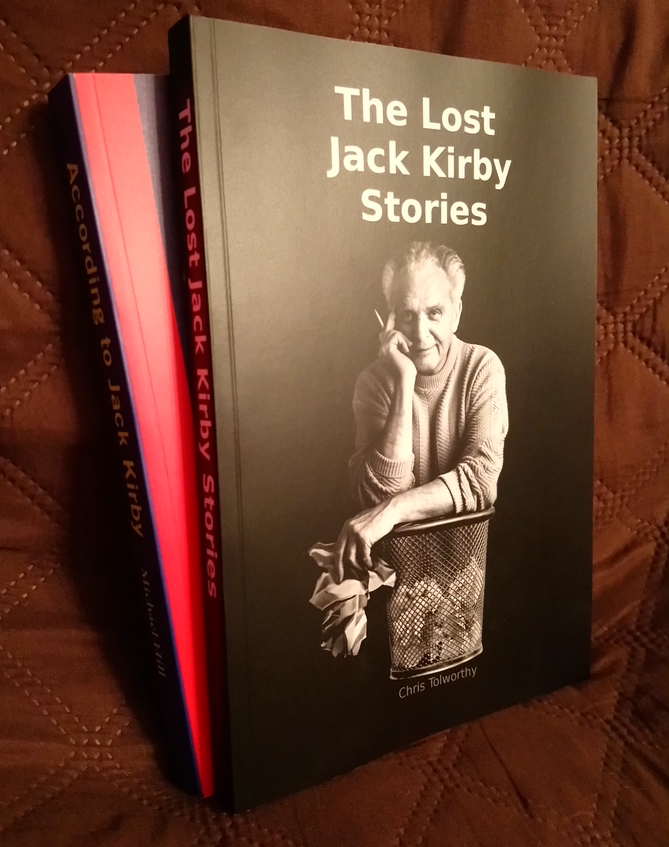
Two years ago, for an audience on social media, Chris Tolworthy dissected “everyone’s favourite” Fantastic Four story, “This Man, This Monster!” His goal was to peel back the layers added by collaborators to Kirby’s finished pages to find the genuine Kirby story underneath. The Facebook post was lengthy and split into several parts, but here’s a taste:

The real monsters are often not the ugly people who see their faults clearly. The real monsters are the handsome people who are either unaware of their faults, or dismiss them for the greater goal. In the FF, Reed frequently hurts his best friend and is not even aware he is doing it. In this story, by seeing two other “monsters” lose everything (one is rejected by his best friend and loses his old life, the other who actually loses his life in Reed’s latest experiment – it was Reed’s faulty cable that broke), Reed finally learns to appreciate Ben: it is the climax of 51 issues.

This was not just a cheap parlour trick. Chris, one of the world’s pre-eminent FF historians, has put together a book of such dissections. From the back cover:

  • The first origin of Dr Doom
  • The lost Hulk #4
  • Who really defeated Galactus?
  • The original Black Widow
  • Ragnarok
  • The first origin of Iron Man
  • Xavier before Cyclops
  • and many more

…and from Chris’ announcement: “This book began as an appendix to my other book (more on that when it’s ready) and that’s how I think of it: a very big appendix. For years people have asked me to put all my crazy Kirby theories into one place. Some of these theories are from my friend James. A few years ago we were contacted by an individual who was able to confirm that at least one of the theories was correct. I cannot guarantee the others, but they are all based on meticulous forensic work, so judge for yourself.”

For those who contend that in the 1960s Marvel Method books, the individual contributions of the collaborators are unknowable, Stan Taylor had this to say:

We can do what historians, detectives, and scientists have always done: ignore the hearsay, mythology, and personal claims and look at the actual physical evidence, in this case, the original comic books, and contemporaneous documentary evidence from unbiased sources. It has been said, “an artist is someone who pounds the same nail over and over again.” All artists, graphic or literary, have patterns. They repeat aspects, concepts, a style of punctuation, a brush stroke, lines of musculature, anything that separates their style from the hundreds of others. When trying to identify an unknown artist, one can compare the piece in question with other contemporaneous works to match up these patterns. This method has been used to research everything from Shakespeare’s writings to the works of the Great Masters.

The nature of Kirby’s collaboration with Stan Lee in most cases allows us to point to a stage in the process that was thoroughly Kirby: when he turned in his pencilled pages on a story. After that, Lee along with the letterer, inker, and other (sometimes accidental) production staff, swung into action and remade the work into the pages that were published. In recent decades, it’s been possible to study Kirby’s notations and pencilled-in dialogue using original art scans that are available online and in the IDW Artist’s Edition volumes. The Lost Jack Kirby Stories provides a new tool for that toolbox.

Jack Kirby was one of the world’s greatest storytellers. Chris spends 170-plus pages proving that some of the stories Kirby intended to tell can be teased out from the noise layered on top. He then teaches the reader to do it for themselves.

Buy it here.

Steve Sherman and Iron Man

I wouldn’t have had a chance to meet Jack Kirby in person. I’ve never been to a convention further from home than the Canadian National Exhibition grounds, and my first trip to California was in 1995, the year after he died. My more recent and more modest ambitions have been to get to a Kirby Museum pop-up in NYC, and to get to a minor convention to see the “History of Jack Kirby” presentation by Mark Badger, Bruce Simon, and Steve Sherman. Sadly, Steve passed away last week.

Steve and Mark Evanier were Jack Kirby’s assistants in the early ’70s, and before the decade was out, Steve was also Kirby’s co-writer on screenplays and the co-creator of Kobra. Steve evidently didn’t have any ambitions to write a book, but if he had, it would have been a book I’d have wanted to read. Steve was humble and always generously forthcoming answering questions, and he was an unflinching advocate for Jack Kirby.

One of Steve’s emails, to Patrick Ford, was quoted in Ferran Delgado’s excellent Sky Masters Sundays book, and was instrumental in the construction of my own book. I reproduce it here:

The thing is, if Joe Maneely hadn’t died, things would have been a lot different. I guess you can call it fate, destiny, random events, but Jack probably would have found something else. Yes it was early ’61 that Goodman was going to pull the plug. Don’t forget, the Marvel offices at the time were pretty small, so it wasn’t a big deal to close the office. I would guess that Goodman had not yet informed the printer or engravers, since that would have been bought ahead of time. I would guess that last issues of the books had been sent out. Jack couldn’t let them close. Jack had always been working on ideas for books. He was pretty well aware of what was being published. He always felt that “superhero” books would make a comeback.

Since Goodman already had the pipeline going, it wasn’t too much to give it another shot, especially since it was Jack. He had come through before, so why not. As Jack told me, he came up with all of the titles at once. He called it a “blitzkrieg”. He felt if he put out a bunch of new books at once, it would make a splash. He had “FF”, “Spider-Man”, “The X-Men” and “Thor” and “Hulk”. You can believe it or not, but that’s what he told me. I think that if you go through all of the interviews with Jack, Stan and countless others, it’s pretty obvious that Stan never came up with a title in his life. It either came from Goodman or someone on staff. I read somewhere that even “Millie the Model” and the other girl comics that Stan takes credit for were thought up by someone else.

Curiously, in the Kirby “tribute” issue of Alter Ego, Will Murray cited Mark Evanier suggesting the same thing. This is curious because it would have had to pass by the editing pen of Roy Thomas (see previous blog posts). Murray’s article is a rework of his Comic Book Marketplace article from 2000, “The Secret Origin of Iron Man.” The Evanier quotes are from the original. Here’s the interesting bit:

The origins of the character are complicated, and many behind-the-scenes details have either never been fully reported or are in dispute. According to Mark Evanier (friend and early-1970s assistant to Jack Kirby), who got the story from the artist himself, Kirby created the character design for Iron Man and brought it to Stan Lee sometime prior to the creation of Thor, Spider-Man, and Ant-Man. If verified, this may date from the period during which he brought in the original version of Spider-Man. Little if any thought was given to who the man inside Iron Man’s bulky armor would be. Kirby’s concept sketch ultimately became the cover to Tales of Suspense #39 (March 1963).

One thing that seems to have escaped Will completely is the source of the plot of the first Iron Man story: it is identical to Kirby’s 1958 Green Arrow story, “The War That Never Ended.” If Murray had to rework a 20-year-old article, why in the world didn’t he cite the Green Arrow plot? In the Alter Ego telling, Kirby’s involvement in the Iron Man origin is restricted to the character design. It becomes clear, however, that if Don Heck got the plot from Lee over the phone, then Lee, as was his MO, was reading said plot straight off of Kirby’s Iron Man concept pages.

Roy Thomas expends a lot of effort in and out of Alter Ego to see to it that Kirby is credited as nothing more than Stan Lee’s artist. It’s fitting that, despite printing an Iron Man creation article that omits the key fact of Iron Man’s creation, Thomas’ tool of Kirby suppression is the source of a 20+-year-old Mark Evanier quote that confirms Steve Sherman’s version of Marvel’s inception.

The Kirby Checklist

Jack Kirby isn’t having a banner decade in TwoMorrows publications. In Jack Kirby Collector 74 in 2018, John Morrow printed an interview with Roy Thomas. I wrote John in response to the preview to say Thomas had his own TwoMorrows magazine, what place did the world’s biggest Kirby denier have in TJKC? He persuaded me to give the interview a chance, resulting in a series of blog posts.

The next issue of TJKC, also in 2018, was Stuf Said, with Thomas as a key witness. Stan Lee cheated Kirby out of nearly a decade of writing pay and misrepresented the nature of their collaboration to the end, but Morrow took the opportunity to find his inner Jury Foreman Mitch, and acquit Lee on all charges.

What could be better than a Roy Thomas interview in the Kirby Collector? How about an entire Alter Ego Kirby tribute issue? As Lee always did, Thomas tends to steal credit from Kirby every time he speaks his name or writes about him. The tribute issue stays true to Thomas’ mission, to confine the TwoMorrows definition of Jack Kirby to “artist.” Thomas expresses the thrust of the issue like this: “Jack was an artist for all eras, and it was high time we made certain that everybody knew that we knew it, too!”

Kirby was a storyteller, and saw himself as primarily a writer. He was a creator/writer/artist, and the writer of the bulk of his own work. That version of Jack Kirby cannot be given credence in Thomas’ world, because it calls into question everything he and the other fans-turned-writers believe they accomplished in their lifetimes. No, Thomas needs to discredit Kirby the writer with every fibre of his being or admit that, in Conan terms, Kirby was Lee’s Robert E Howard and Barry Windsor-Smith combined. Unlike Thomas’ Conan “collaborators,” Kirby worked in a medium that he helped define and repeatedly revolutionized, one for which Lee held nothing but disdain.

By the same token, the tribute issue for that Jack Kirby won’t come from TwoMorrows. Despite having printed the thoughts of people like Grant Morrison, who “get” Kirby’s dialogue, the only Kirby-the-Writer-themed articles in TJKC that will be tolerated by the readership are those that make fun of that dialogue, catering to people who believe Lee’s captions and promotion represented the epitome of literature.

From Thomas’ article in the issue: “Before long, Jack was bad-mouthing Stan again to the fan press, but Stan—at least for the most part—tried not to respond in kind.” This is a lie from the pit of hell: Lee turned on Kirby the way he turned on every other one of his dissatisfied “collaborators”—just ask Ditko, Everett, Wood, or Ayers. (It was also the way many of the fans-turned-writers, Thomas included, turned on their co-workers, in public.) Lee told Salicrup in a 1983 interview for a Marvel publication that Kirby was “beginning to imagine things,” and more specifically to Steve Duin after the TCJ interview, “he’s either lost his mind or he’s a very evil person.” As of the late 1970s, the internal company line from the “serpent’s nest,” somehow leaked to the fans, was that Kirby had dementia.

Thomas, doing his best Minister of Propaganda impression, has accused his detractors of that of which he himself is guilty: he believes Lee contributed something, insinuating that Kirby advocates do not. I’m going to try to make this simple enough for even a Marvel Method writer to understand:

  • No one says “Lee did nothing.” Everyone believes that Lee contributed a great deal; the question is whether it resulted in the greatest thing ever. Thomas is using the accusation to cover up the fact that it’s precisely what he’s doing to Kirby in the guise of praising him, just like Lee always did.
  • “Kirby hater”: Thomas’ own words. (“Lee hater” is the epithet directed at someone who suggests Kirby wrote, a usage potentially initiated by Thomas.) Athough some might see intense hatred as the motive behind a decades-long anti-Kirby campaign in the fan press, I’m going to go with the more descriptive “Kirby denier.”

The question Thomas needs to answer is what it was, beyond the dynamic artwork, that Kirby brought to the equation. Without specifics, it’s far too easy for him to go on “praising” Kirby with generalities.

Anyway, back to 2018… What does a guy have to do to get a writing credit in his own checklist? If he’s Jack Kirby, it may just be too much to ask.

The 2017 two-volume Jack Kirby Monsterbus and this year’s Complete Kirby War & Romance were encumbered with credits dictated by lawyers. Stan Lee and Larry Lieber got top billing as writers, with no evidence that they were involved in the work Kirby was doing in the fantasy/sf titles. (By this time Lee hadn’t yet felt the compulsion to risk Kirby’s wrath and step outside his editor’s salary for occasionally editing the copy on Kirby’s “monster” pages—edits during the  period weren’t signed.)

The 2018 version of the Jack Kirby Checklist from TwoMorrows, called the Centennial Edition, comes with similar issues.

The checklist made its debut in The Art of Jack Kirby by Ray Wyman, Jr and Catherine Hohlfeld, the book that in 1993 set a high bar for Kirby biographies. In the standalone editions of the checklist that followed, Richard Kolkman gets “compiled by” credit in 1998 and 2008, then “compiled and curated by” in 2018. The Final Edition (1998) introduced a Joe Simon inking credit on many stories inked by Kirby, an error repeated in subsequent editions. This misconception on the part of Kolkman appears to have led to more recent, more far-reaching inaccuracies.

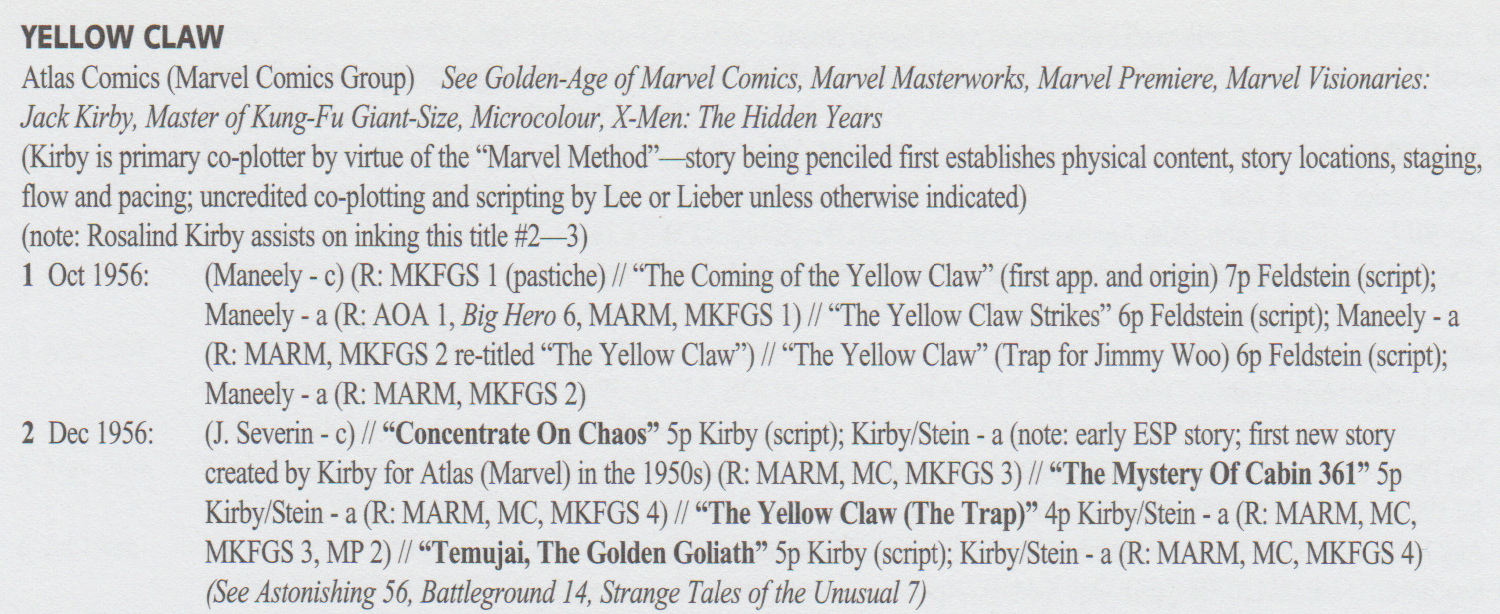
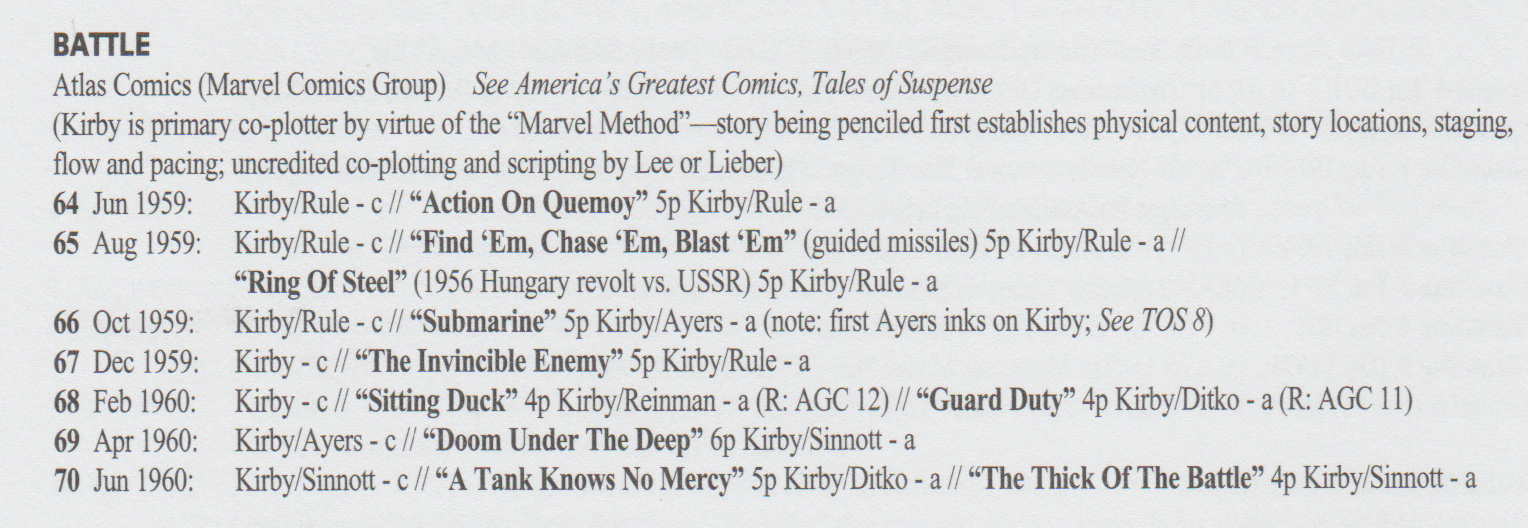
The 1998 version also featured the first appearance of a Marvel Method disclaimer, attributing story flow and pacing to Kirby: “Kirby is a primary co-plotter by virtue of the ‘Marvel method’; story being pencilled first establishes story flow and pacing.” The Centennial Edition expands and reverses the meaning by adding Lee, Lieber, and Bernstein to an already inaccurate blanket credit; now, instead of crediting Kirby for his uncredited plotting, the disclaimer credits others for their nonexistent writing.

The collaborators listed in the Marvel Method note vary: Lee, Lee or Lieber, Lieber, Lieber or Bernstein, and in one instance none specified (perhaps after twenty years in the business Kirby finally got the hang of writing Marvel Method with himself). These titles have been assigned the note:

Yellow Claw (1956)
Gunsmoke Western (1958, starting with pre-implosion inventory not previously credited to Lee)
Battle (1959)
Journey Into Mystery (1959)
Love Romances (1959)
Strange Tales (1959)
Strange Worlds (1958)
Tales of Suspense (1959)
Tales to Astonish (1959)
Two-Gun Kid (1959)
Rawhide Kid (1960)
Amazing Adventures (1961)
Fantastic Four (1961)
Incredible Hulk (1962)
Avengers (1963)
Sgt Fury (1963)
X-Men (1963)
Mighty Thor (1966)
Captain America (1968)
Silver Surfer #18 (1970)

The Marvel Method was Lee’s kickback scheme to extract Kirby’s writing page rate, and the testimony of Larry Lieber and Jack Kirby put the start of the scheme at Fantastic Four #1. The Marvel Method disclaimer should therefore at most apply to the following titles:

Fantastic Four
Incredible Hulk
Avengers
Sgt Fury
X-Men
Mighty Thor
Captain America
Silver Surfer #18

Yellow Claw is Kirby writing, pencilling, and inking (Harry Mendryk covers this in a blog post cited below), and it’s where Kirby introduced the concept of mutants to Atlas. Lieber wasn’t present at the time; Lee wasn’t involved with Kirby’s stories, and was possibly not even the editor on any of Kirby’s books.

Battle doesn’t merit the “Lee or Lieber” credit. The stories were written by Kirby. If this isn’t obvious to the casual reader or crackerjack indexer, Nick Caputo blogged about it.

Michael Vassallo’s rule of thumb for Lee is if he participated in something, he signed it. For the period prior to FF #1, let’s take a look at the first issue of each title to which Lee was willing to sign his name or add a credit box, taking credit and pay on a story of Kirby’s while it was happening (ie not subject to his “recollections” in 1974 or 1998). None are in the 1950s.

Strange Worlds, Amazing Adventures, zero Lee signatures or credit boxes
Two-Gun Kid 54, June 1960, signed
Gunsmoke Western 59, July 1960 signed
Rawhide Kid 17, August 1960, signed
Love Romances 96, November 1961, signed
Journey Into Mystery 86, November 1962, credit box (Thor but not the first)
Tales to Astonish 38, December 1962, credit box
Strange Tales 103, December 1962, credit box
Tales of Suspense 40, April 1963, credit box (Iron Man but not the first)

From Kirby Unleashed: Kirby’s own example of his inking.

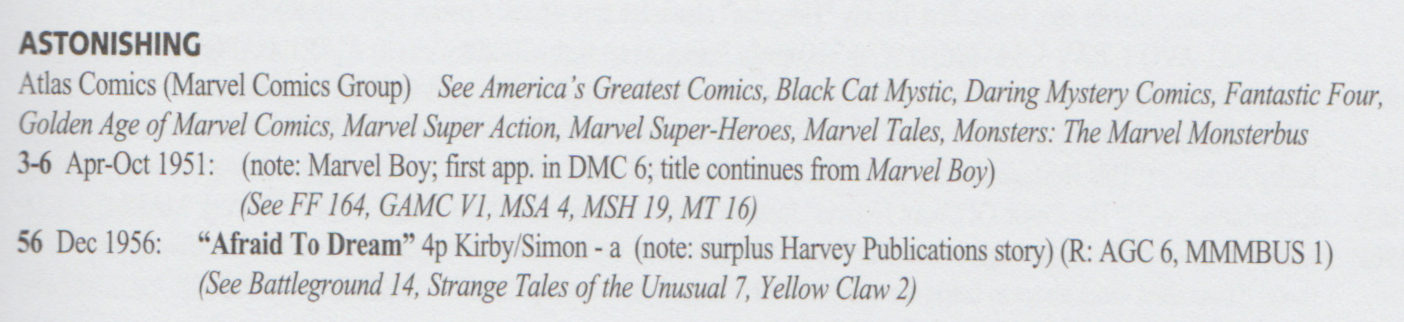
The other note introduced in the Centennial Edition tries to tie Kirby’s 1956 Atlas stories to S&K work for Harvey. Between Simon and the Marvel Method, there’s simply no longer any need to agonize over who wrote Kirby’s stories in the 1950s and reach the unpalatable conclusion that it was actually Kirby. Stories in these titles (all 1956) have been designated “surplus Harvey Publications story”:

Astonishing (explicitly credited as Simon inks),
Battleground
Strange Tales of the Unusual

Each entry refers to the others, and the parenthetical list at the end of the Yellow Claw #2 entry implies guilt by association.

The other 1956 title containing Kirby’s work, Black Rider Rides Again!, somehow escaped the checklist’s Harvey designation. One of the Black Rider stories was printed post-implosion and received the blanket Lee writing credit (see Gunsmoke Western above).

Michael Vassallo contacted Richard Kolkman to find out the reasoning behind the latest Kirby discrediting. Kolkman believes Joe Simon inked “Afraid To Dream,” the Kirby story that was printed in Astonishing, and used that to jump to the Harvey surplus conclusion. He cites Harry Mendryk, but Mendryk is extremely capable in distinguishing Kirby’s inks—it’s unfortunate he wasn’t consulted on the inking credits. Mendryk blogged about Yellow Claw and “Afraid to Dream.”

Kolkman believes Kirby scripted “Afraid To Dream” but didn’t ink it, and inked the “Mine Field” story in Battlefield but worked from someone else’s script. The reality is Kirby wrote and inked both, and nearly every Simon inking credit in the book should be changed to Kirby. Kolkman says he will remove the Marvel Method note on Yellow Claw.

Let’s look at the timeline from the viewpoint of the evidence.

Pre-implosion (1956)
Kirby scripts, Kirby inks (with the exception of Yellow Claw #4, inked by John Severin). Lee was not the writer (he didn’t sign any of the work in question), and he was likely not the editor. Two of the editors at the time were Alan Sulman and Ernie Hart.

Post-implosion (1958-1961)
Kirby was being paid for writing and pencilling. If Lee made changes to the wording in the office, as is visible on the original art at least once (“Fin Fang Foom,” late in the period), he was doing it as the editor. Lee did not sign a single Kirby sf or fantasy story.

Marvel Method (1961-1970)
During this period, a Lieber script credit meant Lieber (or Bernstein where he was credited) was adding dialogue and captions to a finished story. A Lee plot credit was simply fraudulent, since Lee was getting the plots from Kirby’s finished pages. The plot credit/pay was the cut Lee took out of Kirby’s writing pay when he directed it to Lieber. It’s possible that this is the period Lieber remembers as supplying scripts for Kirby based on plots by Lee (which were in turn scraped from Kirby’s pages). Kirby was being defrauded of the writing pay.

The Jack Kirby Checklist, Centennial Edition was a mammoth undertaking and provides an invaluable catalogue of Kirby’s work. When it comes to credits, however, the simplicity of the original Art of Jack Kirby edition, with none added, is simply more respectful of the name on the cover.

Knock Letters again

Here’s a chapter from my book. It’s actually an unnumbered chapter, meant as a sidebar or supplemental information to the chapter before it. It’s my earlier blog post of the same name but updated for the book.

In the chapter that follows, I quoted Jack Kirby’s interview with Howard Zimmerman in Comics Scene #2, famous for Kirby’s characterization of the Marvel offices as a serpent’s nest. Ferran Delgado recently posted the company response, undertaken in the form of letters to the magazine from Roger Stern and John Byrne that had Zimmerman backpedaling on his presentation of Kirby’s views (which were, still, Kirby’s views).1

Byrne wrote that the article “was so full of inaccuracy and muddled re-tellings of events that it was almost unreadable. Example: when I started at Marvel in 1974 they had already established a policy of returning artwork to the artists and writers involved. Kirby makes it sound as if he had to fight for the return of his work after he came back to Marvel in 1976, and this is reported as true… Unfortunately, since Marvel, Jim Shooter, Stan Lee, and probably myself by now, are branded as corporate bad-guys the majority of your readers will probably take every word of the Kirby article as gospel.”

John Byrne is not, and will never be, Jack Kirby. Like Gene Colan, John Romita, John Buscema, or Stan Goldberg, Byrne’s experience with Marvel cannot be used to relate to, or discredit, Kirby’s. Kirby’s treatment at the hands of the company was shameful, and Byrne compounds it by attempting to deny it. While Kirby was getting his 1970s artwork returned, Marvel was not only holding his earlier more valuable work hostage, the company was going to great measures to encourage the theft of what was left of it after certain people were permitted to help themselves to it in the ’60s. In his letter, although he intended it sarcastically, Byrne identified the correct approach: take Kirby’s words in the article “as gospel.” He was also spot on in his enumeration of the “bad guys.”

Stern wrote, “If Mr Kirby has been led to believe that there was some sort of conspiracy to sabotage his books at Marvel in the 1970s, then someone has played a cruel joke on the man. When I started working at Marvel in December of 1975, standard operating procedure was to basically let Jack do whatever he wanted… Hell, the whole office, yours truly included, looked upon Jack as a comics demi-god.” Translation: we were “Jack’s biggest fans,” a euphemism for “We slag Kirby out of our love for him.” (It goes with his conclusion, where he wrote, “I don’t wish to have this sound like I’m down on Jack Kirby. There are few people in the comics industry whom I more admire and respect. I must point out, though, that he is laboring under some misconceptions which can only do him harm.”) Stern went on… “As for the idea that competing writers filled the pages of Jack’s books with overly critical letters—’knock letters’ as Jack called them—well, nothing could be further from the truth… Moreover, I find it hard to believe Mr Kirby’s claim that he wrote all of the early Marvels.”

The transparent strategy of this pair of company men to discredit Kirby closely follows that of their mentor: bluster through the list of “outrageous” claims and conclude, if Kirby hasn’t lost it, then Marvel, Lee, Shooter, and Byrne are the bad guys. Isn’t that ridiculous?

This is the version of the Knock Letters chapter included in the book after the First Edition. It originally started with a quote from a Mike Royer interview, but I removed it at the request of the interviewer. During the resulting reorganization, a casualty of space considerations was Eric Stedman’s concise assessment, but I’ll include it again here:

“All of this is nothing more than vilification of a mature genius by greedy young dumbshits in order to try and justify theft of his creations.”2

Knock Letters

In the midst of Marvel’s lawsuit against the Kirbys, something was bugging Scott Edelman, the letter column editor on a number of issues of Kirby’s Captain America and Black Panther. On his blog, he attempted to demonstrate how fair he’d been, and asked: “Where are those letters columns designed to turn fans into a torch-bearing, pitchfork-wielding mob intent on storming the House of Ideas and demanding Kirby be fired? I just don’t see it. And I’d like those who feel they do see it to back up their claims with some proof. Otherwise, all they’re doing is maligning folks like me who were doing their best to let readers have their say.”3

In an earlier blog post, Edelman proved that it was about more than just letters:4 “I was on staff at Marvel Comics in the mid-’70s when the King returned and tried to pick up where he’d left off… The buzz from us kids in the office wasn’t kind. I’ll admit it. Kirby was a god to us for what he did during the ’60s, but what he was doing at Marvel in the ’70s made us wince, and we didn’t have the tact or maturity to say it appropriately. So we acted like ungrateful punks.”

In The Jack Kirby Collector #72, Shane Foley did an investigative report called “The Great Kirby Kontroversy Letters.” He set out to read all of the letters printed in Jack Kirby’s titles during Kirby’s final years at Marvel, from 1975 to 1978.

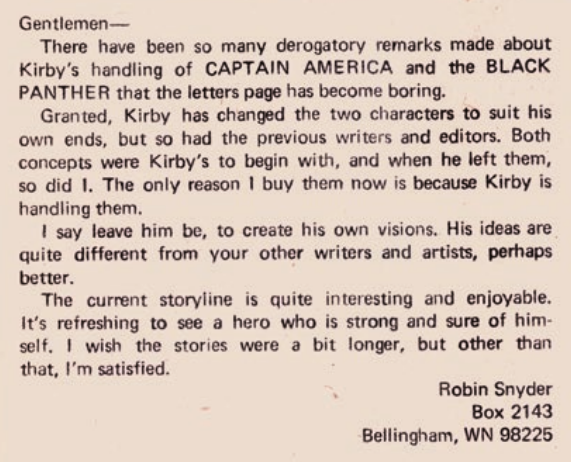
Contrary to the article’s title, the Marvel knock letters are not controversial. To expend so much effort to prove Kirby’s (and Jim Shooter’s) impressions were wrong about them seems misguided. The article should have shown the brutal examples from Captain America and Black Panther, and called the case closed. Ralph Macchio’s letter, printed a month before he joined the staff, portended the demise of the medium with the fanboy call for “continuity and verisimilitude,” and provided the template for many letters to come. Editor/publisher Robin Snyder, in his letter to Black Panther, asked for some respect for Kirby and an end to the knock letters.

This isn’t a question of balance, and a comparison to the LOC pages of other editors proves nothing. What Foley left out of the discussion is that Stan Lee wouldn’t have printed a negative letter. The meaningful comparison would be with ’60s letter columns, with Lee writing and answering letters in FF and signing the names of Stan Goldberg and Sol Brodsky: “Your comics are a cut above!” and “Our readers are more intelligent than most!” (See Chapter 8 in the book.)

The knock letters were the tip of the iceberg of Kirby’s treatment at the hands of the “serpent’s nest.” It was part of a coordinated campaign to discredit him, causing him to take the extreme step of wrestling control of the letters pages away from New York. The campaign was orchestrated by young men of lesser talent without a shred of gratitude (or shame) who wanted to ride Kirby to success the way Lee had. When Kirby declined, they showed a unanimous lack of class and belittled the guy who made their careers possible. His perception of negativity doesn’t bear contesting: it was Kirby’s perception, and calling him overly sensitive is beneath TJKC.

127[140]: [Morrow] I attend my first major comics convention, the Atlanta Fantasy Fair, and pick up the Kirby Masterworks Portfolio from Jim Steranko’s Supergraphics table. I meet Stan Lee, and Jack’s new Silver Surfer Graphic Novel pages are on display. But I overhear some Marvel staffers make disparaging comments about how Jack has “lost it” and can’t produce decent work anymore. I am stunned, to say the least, as I’m still enjoying his work greatly at the time.

Tom Brevoort:5 “It’s been reported that people in the Marvel offices who weren’t enamored with what Kirby was doing on his titles (and who may have preferred it if he had been drawing stories of their design) filled up his letters pages with ‘knock letters.’ In this instance [Captain America #210], they have a point. The whole page is devoted to how divisive Kirby’s return to CAPTAIN AMERICA has been–and while there’s a balance of viewpoints presented, the very fact that the idea of a controversy is acknowledged and given credence plays into the situation. This is a far cry from the typically-laudatory fare that filled most Marvel letters pages. Sure, an occasional knock letter might be printed, but usually those were few and far-between.”

Others’ perceptions aside, what was Kirby’s experience?

Stephen Bissette:6 “I can only imagine how demoralizing this must have been for Jack; I was freelancing at Marvel around this time, and it was heartbreaking to see with one’s own eyes various photocopies of Kirby’s work posted around the offices with ‘satiric’ overdrawings and sarcastic written comments scrawled on them. The utter contempt for and jeering at Kirby’s work for the company was mortifying, and a stern lesson for a budding freelancer working to (maybe) get one’s foot in the door.”

Mark Evanier:7 “Archie Goodwin, whom Jack respected greatly, kept in touch with Jack and did do a little editing on the books, sometimes rewriting (or allowing his assistants to rewrite) a line or a caption. Jack once showed me a splash page to a CAPTAIN AMERICA where someone in New York had rewritten some of his copy. He asked me to explain what this had accomplished and I couldn’t; the rewritten text was not substantially better or different in meaning…it was just different. Some of the other editorial changes were more logical.

“Jack’s feelings about this work (and his concern about his letters pages trashing him, which someone else mentioned) will perhaps make more sense if you know that there was at least one editorial staffer at Marvel at the time who was quite vocal in his dislike of Kirby writing, and who felt HE should have the job of doing the dialogue. Jack told me that this guy would phone him up and say, ‘Well, your new issue of CAPTAIN AMERICA just arrived, Mr. Kirby, and the artwork is breathtaking but everyone here in the office [a gross exaggeration] agrees that the writing is shit. Your books are all bombing, too. The only way you can save your career is to have one of us take over doing the dialogue.’ Or words to that effect.”

Michael Vassallo: “You mean to tell me that some disrespectful moron at Marvel actually said to Jack personally that his writing was ‘shit’? You’d better keep his name a secret Mark. This is one livid Sicilian here!! Even 20 years after the fact I’m appalled.”

Mark Evanier: “It’s true and there were some worse incidents than that.”

Jack Kirby to Howard Zimmerman:8

The health of a comic book can be manipulated by the staff alone. You fill up a book with knock letters [negative criticisms in the letters pages]. The reader who picks up the book and reads all those knock letters knows that the book he’s reading… well, it’s not so hot. And if you do it consistently, it becomes ‘a bad book.’ I haven’t seen anything like a bad book anywhere. I’ve seen a lot of guys trying. I’ve seen a lot of guys who’ll never get the chance to develop. And you can’t develop with two or three issues. You’ve got to give a man a chance to stay in there—either take his beating or succeed. And comics have not done this today.

A guy will create a book, another will fill his book up with knock letters—he’s off in five months, or three months, and the other guy’s got his shot.” Until now Kirby has spoken in even tones. His voice quiet, firm. Now emotion breaks through. There is an anguished look in his eyes and a touch of bitterness in his voice as he says, “I see it as a serpent’s nest. And in a serpent’s nest, nothing can survive. Eventually all the snakes kill each other. Eventually they’ll also kill whatever generated them.

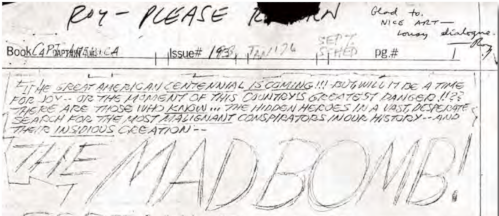
Kirby was attacked out of the gate. When he submitted the pages for his first issue of Captain America, Roy Thomas was permitted to pass judgment by annotating a set of photocopied pencils. On the first page, Thomas wrote, “NICE ART—lousy dialogue.” Someone saw fit to send the set to Kirby (the copies were found in his files). Morrow added it to the Thomas interview in TJKC 74, with this caption: [Morrow]: “Roy doesn’t recall this specifically, but someone at Marvel (Verpoorten, Brodsky, or Stan Lee perhaps) loaned him a set of pencil photocopies of Captain America #193 for feedback. After Roy wrote his honest assessment of the issue (though today he wishes he had used a slightly less opprobrious adjective than ‘lousy’), someone at Marvel mailed these in-house copies to Jack—a thoughtless move at best, and one that helped get Kirby’s 1970s Marvel tenure off to a rocky start.”

Ralph Macchio wrote in the foreword to a recent Kirby reprint volume9 that one of his first assignments at Marvel was “proofreading” Kirby’s work for continuity. “Rarely was there anything jarring enough in that regard to contact the King about.” In other words the defacement of Kirby’s work was done in the office without telling him.

KIRBY (to Leonard Pitts, Jr): The people at Marvel (now) weren’t there at that period. The new kids weren’t there. The new kids didn’t feel that desperation– never felt any desperation. In a way, they don’t care. Why should they? They have their lives ahead of them. Nobody will get involved or go on crusades. “Truth, justice and the American way” is just a childish slogan to a lot of people. But I can tell you that a lot of guys died for it. Superman created an attitude that helped many Americans in a very bad spot.

I can tell you that, besides being a non-person up there, I’ve had adverse personal incidents… which I won’t tell you about. And they’ve hurt me badly. It’s something you don’t like to live with. If I cut off your arm, you’re going to live with that forever. Even if they put a false arm on you, you’re never going to have a right or left arm. And that’s what they’ve done to me. They’ve cut off one of my limbs. Keeping my pages… spreading lies. Blatant lies.

Another one of Kirby’s uninvited junior editors was Scott Edelman. This would seem to be a bad combination, because at the time he was “proofreading” it, he was “offended by the crudeness and incomprehensibility of Kirby’s dialogue…”4 Yet during Kirby’s art battle with Marvel nearly thirty years earlier, Edelman penned what could have been the foreword to this book:10

I look back to the first few Bullpen Bulletins Pages of 1965-1966, and read: […] “Jack ‘King’ Kirby drops in loaded down with a new mess of masterpieces, once a week. Poor Jack! He’s so absent-minded that he usually goes home with someone else’s hat, portfolio, or train ticket! Stan wanted to put a label around his neck reading: ‘if found, please return to the Merry Marvel Bullpen!’ but he couldn’t—Jack had lost the label!”–and I think to myself, if I lied in 1975, what’s to say Stan wasn’t doing the same in 1965? Was it all really as good-natured as it seemed? Or did some of the joshing sting?

Alison Lurie, whose most famous novel is The War Between the Tates, wrote in her earlier novel Real Life (1969): “If nothing will finally survive of life besides what artists report, we have no right to report what we know to be lies.”

The terrible answer is that we are losing our real history. Losing it to people too anxious to collude in the Big Lie for the sake of being inside instead of outside as I once did, not even realizing the enormity of what we were doing. Losing it to those all too willing to say that the Emperor is fully clothed if that will keep them working in comics. Losing it to those for whom the incestuous nature of comics means: Never criticize those who might someday have the power to hire you.

The history of comics should be written by journalists, not by propagandists, and as those who can tell the truth about our past pass on one by one, I’m frightened by the thought that soon it will be too late to undo all the damage done by the propagandists.

Footnotes

back 1 Comics Scene #4.

back 2 Eric Stedman, Marvel Method group, 15 April 2020.

back 31 Scott Edelman, “Three cheers for, and long live, the King!” scottedelman.com, May 28, 2012.

back 42 Scott Edelman, “Shame on you, Captain America!” scottedelman.com, April 21, 2011.

back 53 Tom Brevoort, blog post, 14 March 2020.

back 64 Stephen R. Bissette, Jack Kirby! group, 10 September 2019.

back 75 Mark Evanier and Michael Vassallo, Kirby-L mailing list, October and November 1996.

back 86 Howard Zimmerman, “Kirby Takes on the Comics,” Comics Scene #2, March 1982.

back 97 Ralph Macchio, “The Return of the King,” Kirby Returns!, Marvel, 2019.

back 10 Scott Edelman, “Stan Lee Was My Co-Pilot,” The Comics Journal #99, June 1983.

True Believer

Abraham Riesman has written one of the most important books in comics history.

The field of Stan Lee biographies is not a narrow one. Ronin Ro brought the outsider’s perspective to his Tales to Astonish, but he simply rehashed the Marvel mythology without questioning it, and he refused to cite sources. Jordan Raphael and Tom Spurgeon were on the right track with their 2004 Lee biography: they questioned Lee’s claims, but still portrayed Marvel as a Stan Lee-Martin Goodman operation that somehow benefited from having Kirby around. Danny Fingeroth’s A Marvelous Life is a straight-up hagiography: the Marvel mythology retold from the perspective of an industry insider. Lee was a great guy who was always nice to everybody, and Kirby, Ditko, Wood, and others were just unreasonable.

What sets Riesman’s book apart is that he is foremost a journalist. He is versed in the mythology but able to step outside it and look at it with a skeptic’s eye. The book is compassionate toward its subject, and compelling. It’s impeccably researched with copious endnotes, and incorporates eye-opening interviews with Lieber, Nat Freedland, Denny O’Neil, and Keya Morgan, among many others.

The introductory sequence portraying Celia Solomon’s family in the Old World is captivating. The book begins and ends with Larry Lieber, the little brother Lee barely tolerated for most of his life, and only grudgingly acknowledged while Goodman was still in the picture. Kirby’s death is like a scene from a movie, with his assessment of the relationship from a recent interview done as a voice over.

As Riesman details, Lee’s existence following Kirby’s death was disturbing and devastatingly sad, not something to be wished on anyone. Kirby’s 1972 Funky Flashman ends with Lee inadvertently burning down the House of Ideas and heading for Hollywood. Lee’s final decade bears an eerie resemblance to one of the storylines in another of Kirby’s DC titles, OMAC.

Although necessary, it’s disconcerting that the objective approach requires Kirby’s words to also be treated with skepticism. The propensity to question Kirby’s claims originated with Lee’s decades-long campaign to discredit his creator and story writer (aka his “collaborator”); it was the greatest possible injury he could have inflicted. Riesman says Kirby’s recollections were confusing, citing the Prisoners of Gravity interview where Kirby told Rick Green that The Fantastic Four “were the young people. I love young people.” It’s one of the supposed inconsistencies that requires “Kirby’s defenders” to explain for him. I oblige, here.

It goes without saying that the book’s release mobilized tens, if not dozens of Lee’s followers to discredit the book sight unseen. On the bright side, on February 8th, Kim O’Connor took issue with a line in that day’s review in The New Yorker:

“Like Troy or Rome, every new Marvel story exists on layers of foundations laid by various hands.”


Come on now, lol. This is surely the most bombastic version of “comics aren’t just for kids” in human history. Which is itself remarkable… but whatever, that’s harmless enough. It’s a lot worse to say, ‘Sure Jack Kirby deserves credit. And so do all the colorists who ever worked on that title and the fans who wrote in about plot points, etc.’ That’s not even remotely the same. Come onnnnnn… If we’re talking about assessing Stan Lee’s legacy, it seems to me the central point is that the myth the man created for himself was leveraged by Marvel to whitewash its egregiously exploitative practices. He was the mascot for what remains, in many ways, a shithole industry.

What does it mean that the entire Marvel Universe was built on the ethos of a glorified used car salesman? Among other things, it means someone at the New Yorker can compare Marvel to Troy & Rome (lmao) without ever acknowledging the deep deep human harm this business has done. The “Marvel Method” isn’t about collaboration and teamwork. That is not the takeaway. The Marvel Method is about exploitation. It is a process that has by every indication ruined lives. Can we stop romanticizing this stuff? Stan Lee is dead, and Marvel Comics really, truly deserves your contempt.

Chris Tolworthy, who also loved the book, pointed out that yes, there were no outside witnesses to a Kirby-Lee story conference, but that doesn’t mean, as Riesman suggests, that the distribution of labour is unknowable. The investigation, as Tolworthy does now, and Stan Taylor and Rich Morrissey did before, teases patterns, themes, plots and characters out of the physical product.

Although the examination of the published work is outside the scope of the book, True Believer promises to reach a wide audience outside of comics fandom. Hopefully now that Riesman has done the important part of skewering the mythology, more resources can be directed at the work of knowing the unknowable.

Tom Scioli’s Jack Kirby biography

Comics have had a history problem. Many books that touch on Marvel in the 1960s begin and end with the company version that was developed after Jack Kirby’s 1970 departure. The motivation behind an alternate history was the company’s need to preempt any intellectual property claims on Kirby’s part: he’d operated throughout the ’60s without a contract, and the incoming owners were rightly concerned. The revisionism meshed well with Stan Lee’s portrayal of his Marvel Method as an innovation in comics production, rather than the vehicle for his appropriation of other people’s writing pay, and in 1974 the first installment of the Official Version was published under his name as Origins of Marvel Comics. Compounding the situation, with the passing of labourers and fans of the Golden Age, there’s an increasing belief that comics history begins with Stan Lee creating the Fantastic Four.

The antidote to Marvel’s rewriting of history is the accounts of the freelancers: the writings of Steve Ditko and Wallace Wood, and Jack Kirby’s interviews. Tom Scioli’s Jack Kirby: The Epic Life of the King of Comics starts, not with the inception of the FF, but more than half a century earlier, with the inception of their real creator. Scioli employs a little-seen approach to Kirby’s story: he starts with Kirby’s interviews and treats them as the historical record. In addition to Gary Groth’s 1989 interview in The Comics Journal, he incorporates the 1985 Leonard Pitts, Jr interview, featuring Kirby’s invocation of Budd Schulberg’s What Makes Sammy Run? In Scioli’s telling, Jack Kirby is taken at his word, as he should be.

ScioliSammy

I wouldn’t have chosen the graphic novel format for a Kirby reference book, but Scioli’s book and James Romberger’s For Real have won me over. This is a book that will bring Kirby’s epic life story to a wider audience.

Jack Kirby is a deeply researched labour of love. Scioli’s careful approach is evident in his portrayal of Kirby’s career-derailing confrontation with Jack Schiff, giving voice to Kirby’s words from his court testimony. Schiff’s intentions are obvious when the scene is acted out, but equally obvious is why the judge wasn’t convinced when Kirby expressed those words on the stand. His sense of betrayal when Jack Liebowitz testified against him is palpable.

ScioliSchiff

One weak spot is the Simon and Kirby years, where a dearth of Kirby interview material, or any other supporting accounts, forces Scioli to rely on Joe Simon’s The Comic Book Makers. Kirby himself was reluctant to talk about his time with the famously litigious Simon, other than a somewhat revealing interview with James Van Hise. 1 When Simon’s book came out in 1990, Roz Kirby asked that it be kept from her husband because it would upset him; it has the same passing relationship with the facts as Lee’s Origins. Many details from Simon’s stories, already considered sacrosanct, need to be rigorously fact-checked: these include the circumstances surrounding the team’s departure from Timely, and Kirby’s alleged grudge against the teen-aged Lee for ratting them out (something Kirby never mentioned). Since Simon wasn’t present, his accounts of Kirby’s conversations with Goodman in the ‘60s could only have been imagined.

A technical point: Simon is listed as the inker of Kirby’s stories in Young Romance #1 (and the Kirby Checklist has the same error). With some exceptions of Simon inks that really stand out, Kirby was frequently his own inker until the late ‘50s. Scioli does make a point of showing Kirby in charge creatively throughout the S&K period.

Jack Kirby saw himself as primarily a writer, and from that perspective the physical effects of aging that caused him to reinvent his drawing style had no effect on the grandeur of his writing; the word decline could no more be used to describe Kirby’s later works than it could Picasso’s or Kubrick’s. Fandom’s dinosaurs, Mark Evanier and Charles Hatfield among them, hold that only fanatics can love Kirby’s later efforts. Scioli represents a different generation of Kirby readers, and his enthusiasm for the ‘80s material has always been infectious.

ScioliKyle

Appropriately, the book features a number of familiar scenes showing the recognition Kirby received in his later years. His death is marked by a solid black panel with a small date in the corner, followed by three pages of half-height panels highlighting assorted posthumous events, speeches, and screen credits. Stan Lee is perfectly summed up, without comment, in just three of these panels.

Tom and I joined the Jack Kirby internet mailing list around the same time two decades ago, and at that time, news of the Official Kirby Biography was already a few years old. If that book does someday come to fruition, it will be encumbered in various ways by the Official Company History (if not designed to dovetail with it). Tom Scioli started with a clean slate and produced a Kirby biography with everything I had hoped for. I’m thrilled that he got there first.

Footnotes

back 1 “Jack Kirby in the Golden Age,” Jack Kirby interviewed by James Van Hise, The Jack Kirby Collector #25, August 1999.

Kirby faces

Jack Kirby conveyed volumes with just the posture or facial expression of a character. For a few months in late 1971 and early 1972, his faces exhibited exquisite detail, and Mike Royer’s faithful inks permitted us to see the intricacy of Kirby’s linework.

There is a myth that an abundance of ’60s margin notes signaled an increase in Kirby’s plotting involvement. A similar misconception is that in the early Fourth World books, Kirby was just throwing characters and concepts at the wall, and finally settled in just as Royer got involved. On the contrary, Kirby was playing the long game, and the early issues of the four titles show seeds of things that wouldn’t burst into full flower for a year or more. Before attributing any shortcomings in the books to Kirby, it needs to be acknowledged that his artistic efforts lay concealed under Vince Colletta’s inks. In fact, in the years since Kirby inked his own pencils in the ’50s, very few of the inkers assigned to his work were friendly to his penciled faces, not even Joe Sinnott.

For roughly eight months, Kirby was on top of the world. Aside from the ongoing issues with Jimmy Olsen, he was in complete control of his output in a way that he hadn’t been since the fall of Mainline, and it showed in his work. In the examples that follow, it’s particularly clear in the hair and the eyes.

Mike Royer gets acquainted with the pencils: New Gods #5 and Mister Miracle #5.

Forever People #6, New Gods #6, and Jimmy Olsen #146.

The second issues of the black and white magazines, In the Days of the Mob and Spirit World.

Kirby Draws Real People.

Kirby Draws Real People Again.

Funky Flashman and Murder, Inc. were done during the same two-month cycle. I’m in no way suggesting that Kirby drawing real-life criminals inspired the content of Mister Miracle #6.

The epic achieves biblical proportions with Forever People #7 and New Gods #7..

7FP07p01

7NG07p01

7NG07p05a

Scott and Barda return to Apokolips in Mister Miracle #7.

In Jimmy Olsen, Scrapper and Gabby achieve their own unique detailed style.

“The Power,” Forever People #8.

“The Death Wish of Terrible Turpin,” New Gods #8.

Kanto the Assassin debuted in Mister Miracle #7, but the book was strictly action. Kanto didn’t get his close-up until the following issue.

James Romberger: Kirby’s drawing was based on observation and feeling. Later he became a bit more simplified or one might say he began to almost parody his own style, but a lot of that developed in reaction to the inkers imposed on him. But there is a major rift and drop in the early-mid 70s and I think this came about because he was fucked so terribly—for a few years he had a hard time with it because he had been struck down at a peak of power and grace by the idiot Carmine Infantino at DC cancelling his Fourth World.

To my eye, Jack Kirby’s style experienced a reinvention before the Fourth World books were cancelled. The black and white magazine work came to an end, followed by the eighth issues of the trilogy: by production number, the sequence was Forever People 8, New Gods 8, Jimmy Olsen 148 (the last), Demon 1, Mister Miracle 8, Forever People 9, Demon 2, Kamandi 1, Mister Miracle 10, New Gods 9, Mister Miracle 9. By publication order, the final issue of Jimmy Olsen came first, followed by the eighth and ninth issues of the trilogy titles. The Demon and Kamandi were rolled out during the tenth issue cycle.

As can be seen in the examples above, Kirby was inspired and invested in all of his projects up to this point. Forever People #9, however, was both the cause and beneficiary of his new style. “The Monster in the Morgue” bears Carmine Infantino’s bootprints: Kirby had been instructed to add Deadman, a character that was not his own; he was disheartened, to put it mildly. His make-up compelled him to deliver a good story regardless of the circumstances, but the intensity was gone. Kirby’s reinvented style was more simplified and less detailed: it was on full display in that book, in the new titles, and in “The Mister Miracle to Be” (Mister Miracle #10 and subsequent issues), as well as in the final two issues each of The Forever People and The New Gods.

The other two books in the Issue 9 cycle are interesting. “Himon” in Mister Miracle #9 was the story Kirby couldn’t not tell: he had led up to it with a series of backup stories in earlier issues, and there’s evidence the story was moved up in the schedule. Knowing the implications of Infantino’s intervention, Kirby saw the writing on the wall and got the book out. It has some magnificent panels (particularly on pages 16 and 21), but very few detailed faces (Willik, below, being one close-up). Some of the facial expressions are reduced to slashes.

9MM9Willik

Patrick Ford: There is a bit of a loss of enthusiasm at DC at the time of the cancellation of the Fourth World but in my opinion the material recovered pretty quickly and his stuff for Marvel is often brilliant.

The other casualty was Kirby’s new New Gods storyline, “The Bug,” a potential multi-parter about discrimination in the perfect society. The rooftop scenes featuring Orion, Lightray, and Eve Donner are executed with care while the bug scenes on New Genesis are all action. The final speech could be Kirby’s DC equivalent of the Silver Surfer #18 scream: perhaps this issue had been started when Infantino called with orders to insert Deadman into Forever People. In the following issue, the Bug subplot was simply left hanging.

After Eve’s speech (below), the detail in Kirby’s faces didn’t fully recover until he was reunited with Mike Royer at Marvel (after again having to mess around for nearly a year, sometimes more, with the wrong inkers).

9NG09p22panel

What Jack Kirby left unfinished was the time of peace when he was left alone to do it his way.

What does Funky Flashman tell us about Stan Lee?

Enterprise

In Mister Miracle #6, Kirby unleashed a brilliant send-up of Stan Lee called “Funky Flashman.” It was the most accurate and incisive portrait of Stan Lee ever, by a master caricaturist who knew the inside story. No one was ever better positioned or equipped to give Lee the treatment.

Roy Thomas, as a Marvel staffer, might have gotten to know Lee even better than Kirby did as a freelancer. Thomas didn’t arrive on the scene until 1965, however, and he never broke into the exclusive club of those who addressed Lee by his full given name.

In 1961, with the comics division on the brink of shutdown by Martin Goodman, Kirby presented a stack of concepts to Goodman and was given the green light for the Fantastic Four. Lee’s brother Larry Lieber said “When Stan saw that the strips had potential [ie when they were approved by Goodman], he started writing them.” 1

Kirby had a different take: Lee saw Kirby’s paycheque for the writing and penciling page rates on the “monster” stories, and Kirby was forced to “render unto Caesar.” 2 To achieve this, Lee first added his signature to stories that Kirby wrote. He then added fraudulent plot credits to Kirby stories for which writing credits were given to others (for example “Prisoner of the 5th Dimension!” in Strange Tales #103, Lee’s first “plot credit”). Lee then redefined “writer” for the Marvel Method as “the person who fills in the dialogue,” while at the same time redefining his actual writers as “artists.”

Kirby told Mark Hebert in 1969 that the early superhero work, when Lee inserted himself as Taker of the Writing Page Rate, “was a back-breaking job.” Kirby finally got some relief when he was given a page rate increase for pencilling in the mid ’60s. 3

Stan Taylor: I think that Stan’s singling out and praising the artists actually upset the artists, more than making them happy. Stan was quick to tell everyone how his artists not only pencilled, but plotted also, yet they knew they were only being paid for pencilling, and at a rate less than the competition, and getting nothing for plotting. Stan was getting all the glory, and the big bucks for simply putting the finishing sheen on the artists stories. If it was me, I would get pretty mad about doing the work of one and a half people, while being paid less than the competitor paid just for penciling, and then someone else takes the credit for my stories. 4

For the purposes of this assessment, I’ll use “Funky” and “Stan Lee” interchangeably.

villain

Funky Flashman: “…the opportunistic spoiler without character or values…”

“…he lives… in the decaying ante-bellum grandeur of the Mockingbird Estates!” Martin Goodman built his publishing empire by mimicking, mockingbird-like, his competitors’ successes.

shadow

In the opening sequence, Funky is taking “bread” out of the mouth of a bust that resembles Kirby. Lee was at the mercy of the number of pages Kirby was writing, including layouts. When Kirby received a page rate increase in the mid ’60s, he reduced his output, and stopped doing layouts: Lee was deprived of the writing rate on the pages Kirby was no longer doing. Ditko had a similar effect on Lee’s income when he demanded and received plotting credit on Spider-Man: the plotting page rate was deducted from Lee’s writing rate.

Mr Miracle_06_01

Funky likes it when the Little People hear his words of inspiration, and Houseroy tells him what he wants to hear.

pathos

Houseroy plans to take over when Funky leaves.

valet

Kirby examines Funky’s attitude toward the talent. Officially, the freelancers were interchangeable and expendable. In practice, Kirby provided Lee with something no other collaborator did: thousands of pages of writing pay.

Mr Miracle_06_03top

Roy Thomas once remarked, “Stan is always ‘on’,” 5 meaning Stanley Lieber was always immersed in his Stan Lee persona… except when he wasn’t, occasionally leading to “shocking results.”

shocking

That shifty master of mobility, Funky Flashman, is a bit of a misogynist. Lee repeatedly gutted Kirby’s strong female characters to allow them to demonstrate traditional gender roles to an impressionable audience. Kirby portrays a typical Funky-female interaction.

Mr Miracle_06_07bot

This Kirby woman, like many of Kirby’s female characters based on his wife Roz, isn’t having it.

MM6FunkyBarda

Funky is a classic: ego, ignorance, and hostility! A real powerhouse!

MM6Classic

For panel after panel, Kirby gives us an intimate view of a Kirby-Lee story conference.

Mr Miracle_06_10

“I tell you, I tested that phrase on my man, Houseroy… and the beggar literally cried! But call me Funky, sir! I prithee! For what is a name… but the opening gun of mutual enterprise?!”

MM6Beggar

Folksy to a fault Funky in his “Uneasy Rider” outfit (and cleaning his ear).

UneasyRider

Funky is enamored of recordings of his own voice. In the Pitts interview, 6 Kirby cited the night he found Lee speaking into a recording device as a catalyst for his decision to leave Marvel.

voice

Don’t paw me, Houseroy! I know my words drive people into a frenzy of adoration! I’m preparing for my establishment stage! When the press notices build to fever pitch, I’ll…”

establishment

Throwing Houseroy to the wolves.

Mr Miracle_06_22bot

Funky makes good his escape.

Mr Miracle_06_23b

After causing the estate to go up in flames, Funky heads for Hollywood. Kirby injects another comment regarding the treatment of the talent at the family-run operation.

The colours present a Marvel of Contrast. Cyclopean black is a reference to Robert E. Howard’s short story, “The Black Stone” (Weird Tales, November 1931). 7

cyclopean

Scott is not ignorant of Funky’s devices.

MM6Anybody

Footnotes

back 1 Larry Lieber in conversation with Roy Thomas, Alter Ego v3#2, 1999.

back 2 GROTH: Did you find that fulfilling?

KIRBY: Of course it was fulfilling. It was a happy time of life. But. But, slowly management suddenly realized I was making money. I say “management,” but I mean an individual. I was making more money than he was, OK? It’s an individual. And so he says, “Well, you know…” And the old phrase is born. “Screw you. I get mine.” OK? And so I had to render to Caesar what he considered Caesar’s. And there was a man who never wrote a line in his life — he could hardly spell — you know, taking credit for the writing. I found myself coming up with new angles to keep afloat. I was in a bad spot. I was in a spot that I didn’t want to be in and yet I had to be to make a living.

Jack Kirby interviewed by Gary Groth, conducted in summer of 1989, The Comics Journal #134, February 1990.

back 3 TCJ: How were you able to draw five strips at once during the “Marvel Age’?

KIRBY: I forced myself. It‘s not very easy, especially when you’re in a field that’s picking up momentum and there isn’t too much of a staff to take the burden off you.

TCJ: What do you mean, there wasn’t a staff?

KIRBY: There wasn‘t much of a staff. So I had all that to do and it was a back-breaking job. But, like I said, my generation adjusted to it.

TCJ: Is it smoother-going now?

KIRBY: Yes, it‘s eased off a bit. I’m grateful for that because I can read a newspaper occasionally.

TCJ: Would you like to do another strip, even after all that work?

KIRBY: If they‘re ready, I’m always ready. I never refused a job. I‘ve always been ready to do a job; that’s my bag. I’ll do a job for Stan. I’ll do a job for someone else. I’ll do a job for my family. It‘s the type of person I am. If I have a job to do, I‘ll do it. I‘ve got to do it.

Kirby interviewed by Mark Hebert, conducted early 1969. Appeared in The Nostalgia Journal #30, November 1976, and #31, December 1976.

back 4 Stan Taylor, Kirby-L, the Jack Kirby Internet mailing list, 6 November 1999.

back 5 Roy Thomas interviewed by Jim Amash, conducted by phone in September 1997, published in The Jack Kirby Collector #18, January 1998.

back 6 PITTS: Why did you leave the F.F. and Marvel that first time?

KIRBY: Because I could see things changing and I could see that Stan Lee was going in directions that I couldn’t. I came in one night and there was Stan Lee talking into a recording machine, sitting in the dark there. It was strange to me and I felt that we were going in different directions.

Leonard Pitts, Jr., conducted in 1986 or 1987 for a book titled “Conversations With The Comic Book Creators”. Posted on The Kirby Effect: The Journal of the Jack Kirby Museum & Research Center.

back 7 What’s Cyclopean: For a prototypically pulp writer, Howard at first keeps his adjectives thoroughly under control. Probably not accidentally, the prose gets purpler in proximity to the monolith (“lurid tongues of flame,” etc.). And in the midsummer moonlight, the cliffs around it appear like “cyclopean and Titan-reared battlements jutting from the mountain-slope.” Then later, the stone is “like a spire on a cyclopean black castle.” —review of “The Black Stone” by Ruthanna Emrys and Anne M. Pillsworth.