Fact check: A Marvelous Life

Danny Fingeroth’s Lee biography is an ambitious work, and adds some new information to the discussion. Since it’s a hagiography that pleases its target audience, it’s unreasonable to expect an impartial telling of history.

Marvelous

Fundamental omissions (their absence taints the history the book pretends to tell):

1 It was about the money. Kirby was not then, nor ever, allowed to be perceived as a writer, because Lee was taking the writing pay. Lee cultivated his following by convincing them that not only were they not weird for reading comics, they were smarter than readers of other comics. They were easily convinced that Lee’s teen humour dialogue was the ultimate in writing, and that Kirby wasn’t a writer. Now this belief is repeated without the need to verify it, and millions upon millions of people take it for fact without ever having read a comic dialogued by Lee.

2 Ditko and Kirby were witnesses to history. While Lee was writing the credit boxes, and when he started living up to his Cadence contract, Ditko and Kirby needed to be de-credited as well as discredited. Lee repeatedly said he didn’t know why they left (“I never did know why they left,” should always be read as, “I’m not at liberty to tell you why they left”). He responded to Kirby’s interview claims by suggesting Kirby was out of his mind. In the book and in general, contradictory statements of the two witnesses compared with the official version need to be explained away in terms of the witnesses’ own motivations.

For contesting Lee’s story, Kirby got to be labeled a heretic. People who bring up the fact that other stories exist are called “haters” (see the back cover). Kirby’s take on various events is acknowledged in the book with the admonition that he wasn’t consistent in what he said; his key testimony on critical points is simply ignored, while the credibility of Lee, Lee’s brother, and people who weren’t even there, remains unquestioned. Thus, as Lee would have wanted, some key Kirby and Ditko insights are simply absent. Roy Thomas said in his 1981 TCJ #61 interview, “I think Stan has pretty accurately outlined things, even though in hyperbolic terms, in books like the first Origins of Marvel Comics.” I would submit that Kirby’s interviews, along with Ditko’s Mini-History, tell a more accurate history of ‘60s Marvel.

Just a nice guy

Page 52: “affable, propeller-beanie-wearing… Perhaps Lee/Lieber hadn’t yet learned how to charm reporters.”
78: “Lee’s natural inclination to be friendly and welcoming”

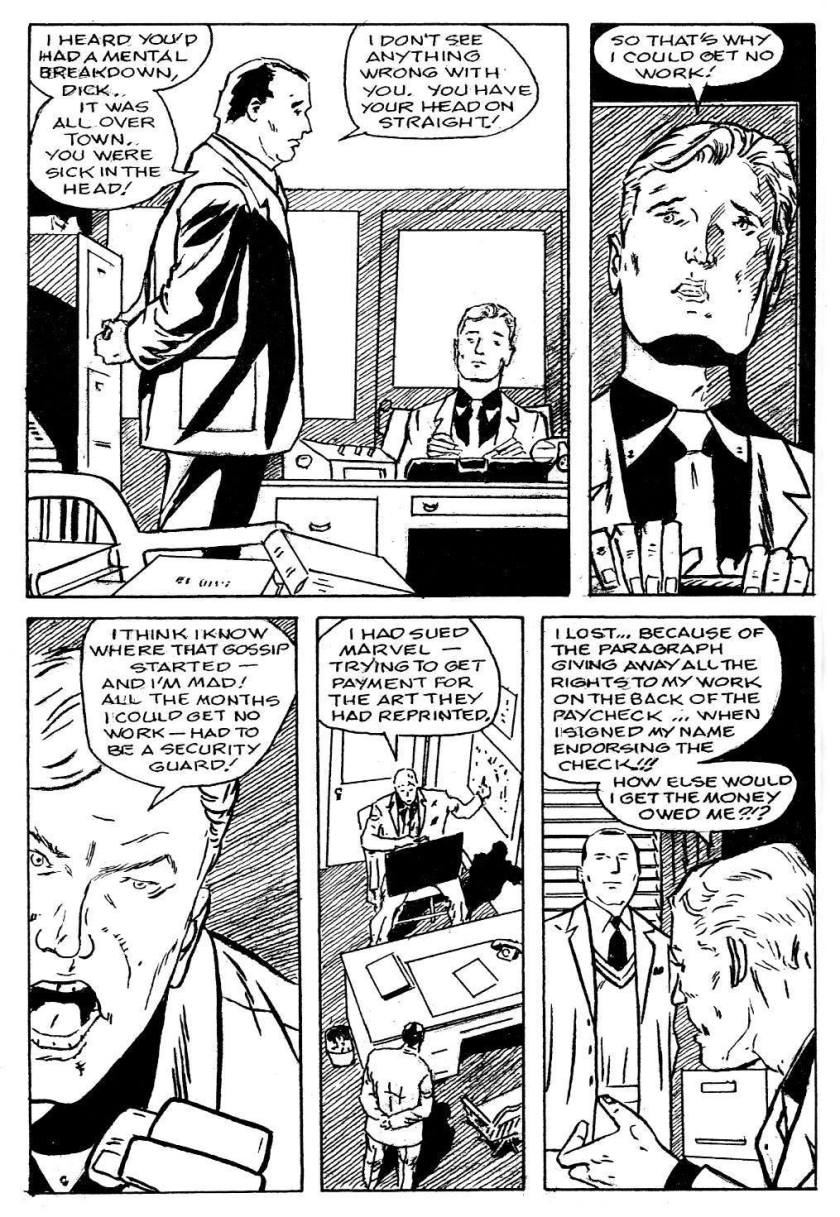
Lee is portrayed as the man who got along with everyone, and Kirby and Ditko are the difficult ones. Fingeroth details the tragedy of Carl Burgos’ destruction of his life’s work in comics at his own hand (pp 165-6); Burgos blamed Lee. Wallace Wood and his “angry departure” are mentioned (155), but not Alex Toth, or Joe Orlando. Dick Ayers, in his graphical autobiography, revealed being smeared to the competition by the rumour of a nervous breakdown; Ayers blamed Lee. Herb Trimpe told us that when he was unceremoniously terminated by Marvel, he needed to sign away his right to badmouth Lee or the company in order to receive retirement benefits.

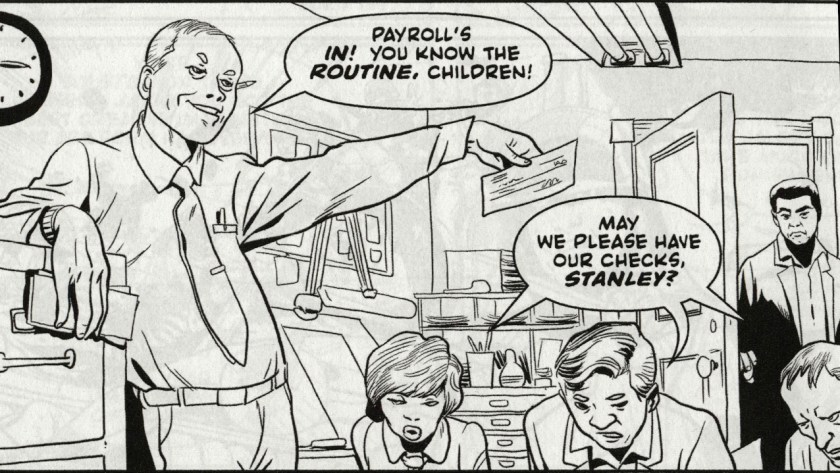
What is lost in Marvelous Life is the experience of Harvey and Adele Kurtzman (42), who in the ’40s and ‘50s knew Lee lorded it over his employees. Lost are the assessments of Al Jaffee and Gerry Conway, that Lee, although the master at being a pal to his readers, was socially awkward with, even (unintentionally?) cruel to his employees. Heart-warming Al Jaffee stories are included, but the circumstances of Jaffee’s departure are omitted. Mentioned is Joe Simon’s 1966 “The New Age of Comics” (161), but left out is a Joe Orlando-edited Angel and the Ape story (1968): they both portrayed Lee as the one who signed his name to other people’s work. The Dean Latimer review of the 1971 Carnegie Hall show is quoted, but not its portrayal of Lee as someone who spoke in superlatives while saying nothing.

Wood’s experience distills Kirby’s Marvel Method decade, and Ditko’s half decade, to a matter of months. On the cover of his first Marvel book he was touted like no other talent; he was plotting from the start, and made it clear to Lee that he wasn’t going to continue doing the writing while Lee took the writing pay. After finally being credited for writing, Wood was demoted to inker, and quit. In the credits and letters pages, he was then taunted like no other (except maybe Ditko, whom Lee called “the genius of the world” and “eccentric” after his departure). On 5 September 1978, John Hitchcock received a postcard from Wood that said, “I want the credit (and the money) for everything I do! And I resent guys like Stan Lee more than I can say! He’s my one reason for living… I want to see that no-talent bum get his…”

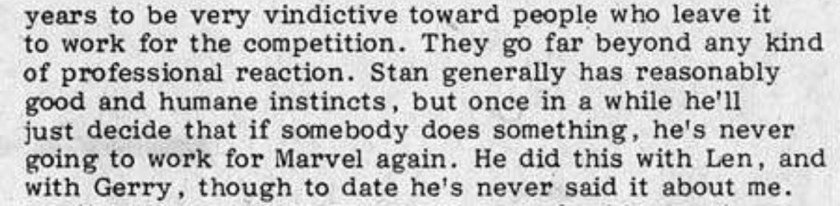
Roy Thomas: The thing that was truest in that (earlier TCJ) article was the analysis that Marvel has had a tendency in recent years to be very vindictive toward people who leave it to work for the competition. They go far beyond any kind of professional reaction. Stan generally has reasonably good and humane instincts, but once in a while he’ll just decide that if somebody does something, he’s never going to work for Marvel again. He did this with Len, and with Gerry, though to date he’s never said it about me.
Roy Thomas, interviewed by Rob Gustaveson, The Comics Journal #61, Winter Special 1981.

263: “Unlike Kirby and Ditko, [Romita and Buscema] seemed to enjoy their association with Lee and to admire and respect him…”
Romita and Buscema knew what they were getting into because the Marvel Method was already established by the time they were first subjected to it. Neither was a creator/writer like Ditko and Kirby, thus they weren’t submitting their creations and writing to have Lee to appropriate the credit.

BUSCEMA: Did I work at Marvel? I mean, I’m hearing stories I never heard. I don’t recall Stan jumping or dancing because we worked over the phone.
ROMITA: And you used to love the plots right?
BUSCEMA: I hated it.

Marvel Bullpen Reunion 2001, SDCC interview by Mark Evanier, Alter Ego #16, June 2002.

77: “There were rumors of ‘pay-to-play’ editorial kickbacks [at National] and elsewhere.”
90: “Before he’d burned his bridges at DC and returned to Timely, Kirby…”

The second statement needs elaboration. Kirby’s “falling out” at DC was over editor Schiff extorting an increased percentage on Sky Masters by threatening to withhold DC assignments. (Schiff’s eloquent gestures might be characterized these days as a “perfect” discussion.) Make no mistake, the Marvel Method was a kickback of the writing pay, which Lee’s “artists” relinquished after writing the story in order to receive further assignments. The book portrays Kirby as the difficult one because he chose to leave abusive relationships with people who were stealing from him. The men who paid Lee’s kickback did so, not because he was such an affable, welcoming guy or a great accumulator of talent, but because their options were limited. Even Romita, who’d once told wife Virginia to tell Lee to go to hell (65), didn’t return to Marvel until he was “let go” by DC (according to his 2010 deposition). The book words it that he was “left without steady work” (155).

Creation of the FF

Back in the real world, falsehoods were introduced into the Marvel narrative at the beginning of the Cadence era… the Justice League, Joan Lee, the “synopsis.” The book reports on all of them.

72: “Joan Lee would be instrumental in the legend… several years later”
By page 88, the tale has graduated from legend to fact.

The 1960’s Marvel hero era was championed by Jack Kirby pushing Martin Goodman to try heroes again since the moment he arrived in 1958. That it took 4 years is due to the resistance he was up against. The silly story about Stan’s wife being the impetus is creative history hogwash.
Michael J Vassallo, Marvel Method group, 27 December 2019.

Michael Vassallo: Does Stan, on his wife’s advice, finally do comic book stories like he wants to? (Having done a thousand Millie the Model, My Friend Irma, My Girl Pearl, Rusty, Lana, Tessie, Mitzi, Little Lenny, Little Lizzie, Nellie, Kathy, Ginch, Imp, Mrs. Lyons’ Cubs, Willie Lumpkin, et al stories, a smattering of recent westerns, and not a single superhero since 1942).
Does Stan (and Goodman), after constant pushing by Kirby, relent and see what he proposes? (Having already done the most visually exciting superheroes hits of the golden-age, co-invented the romance comics genre, produced some of the most respected genre comics of the genre age, Sky Masters, Challengers of the Unknown for DC, The Fly at Archie, bug powers via an “extract” for Harvey, two different previous Thors, untold powerful monsters, and a score of “ancient gods walking among men” stories).

Stan Lee (1922-2018) – The Timely Years, Timely-Atlas-Comics blog post.

Steve Sherman: The thing is, if Joe Maneely hadn’t died, things would have been a lot different. I guess you can call it fate, destiny, random events, but Jack probably would have found something else. Yes it was early ’61 that Goodman was going to pull the plug. Don’t forget, the Marvel offices at the time were pretty small, so it wasn’t a big deal to close the office. I would guess that Goodman had not yet informed the printer or engravers, since that would have been bought ahead of time. I would guess that last issues of the books had been sent out. Jack couldn’t let them close. Jack had always been working on ideas for books. He was pretty well aware of what was being published. He always felt that “superhero” books would make a comeback. Since Goodman already had the pipeline going, it wasn’t too much to give it another shot, especially since it was Jack. He had come through before, so why not. As Jack told me, he came up with all of the titles at once. He called it a “blitzkrieg”. He felt if he put out a bunch of new books at once, it would make a splash. He had “FF”, “Spider-Man”, “The X-Men” and “Thor” and “Hulk”. You can believe it or not, but that’s what he told me.
By email to Patrick Ford, 2018.

Kirby related the same experience to Gary Groth in 1989.

87: “Lee was about to resign…”
Let’s get real. Goodman was about to, and did, pull the plug. (No new Marvel product hit the stands during the month of October 1961. An even longer shutdown saw no comic books published from 27 October until 29 December the previous year.) Furniture was being moved, tears were spilled. Kirby presented his concepts to Goodman, Goodman approved one off the pile. At that point, as Larry Lieber himself once characterized it, Lee entered the picture. “When Stan saw that the strips had potential, he started writing them…”

Lieber in conversation with Thomas, Alter Ego #2 (1999).

94: “Assuming that Lee’s plot outline… was the template Kirby used… the synopsis”
Roy Thomas has thrown his reputation behind the so-called document, but Kirby called it “an outright lie.” This is one of the cases where Kirby’s statement on a subject has been omitted.

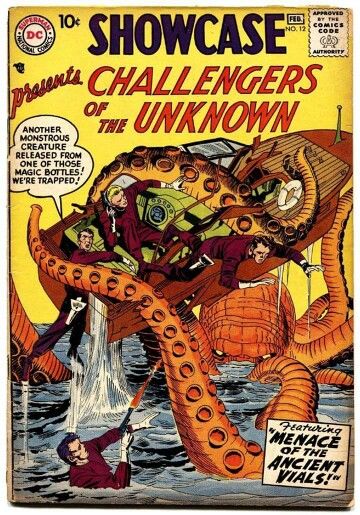
Like Fantastic Four, Challengers of the Unknown depicted the adventures of four people who form a team after surviving an air crash. The members of the Challengers had personality traits similar to the Fantastic Four. Pilot “Ace” Morgan, like the Fantastic Four’s Reed Richards, was the decisive leader of his group. “Rocky” Ryan, like Benjamin Grimm, aka “The Thing,” was the group’s strongman. Daredevil “Red” Ryan was the resident firebrand, much like Johnny Storm. “Prof” Haley was, like Sue Storm, the bland and nondescript member of the group. The Challengers team, like the Fantastic Four, confronted science fiction enemies in a wide variety of fantastic settings.
Furthermore, in light of how important the new Fantastic Four comic was to the firm’s line, it seems implausible to me that Lee would suddenly change this working relationship and not first consult with Kirby on this new book, especially given Kirby’s decades of experience in the superhero genre (e.g. Captain America) and renowned ability to spontaneously and quickly generate so many publishable creations.
After Fantastic Four had been published and was a success, Lee produced a synopsis for the first story which he said was what he gave Kirby to work from. Kirby, however, consistently asserted that he never saw any kind of typed synopsis or treatment for the Fantastic Four.

Expert Report of Mark Evanier, expert witness on behalf of the defendants, Marvel Worldwide, Inc. et al v. Kirby et al, submitted 4 November 2010.

90: Challengers is mentioned as an afterthought, as something with which people noticed similarities. Let’s put it in its historical context, a few pages earlier as part of the “slow but steady superhero revival.” Kirby’s Challengers was given its own title, escaping its Showcase tryout in fewer months than The Flash did. Kirby’s Challengers predated the JLA in the superhero revival by three years, and even without Kirby, was outselling JLA’s Brave and the Bold in 1960, when the JLA would have been around for Goodman to notice. The first JLA cover “paid homage” to Kirby’s Showcase #12 Challengers cover before the similarity was noticed between Kirby’s FF #1 cover and the first JLA cover.

Fingeroth states as fact the speculation that Challengers was co-created by Joe Simon: the Lee saga comes with the need to always portray Kirby as someone who didn’t write and didn’t create. Evanier wrote, “The first SHOWCASE issue of CHALLENGERS was produced out of the Simon-Kirby studio, before it had a publisher, and as with many Joe/Jack projects, it’s a little hard to tell where Simon leaves off and Kirby begins, at least with regard to the writing. Joe says he wrote it. Jack said he wrote it. My guess is they both wrote it. If you buy that, then it’s a question of whether you think co-writing the issue is enough to entitle Simon to co-creator credit. I would think so but it’s not as clear-cut as some other projects.” (Kirby-L, 19 Nov 1996.)

Rich Morrissey responded to Evanier at length. “As for the Challengers of the Unknown, Jack Schiff’s records show that Dave Wood came up with the idea and was paid for scripting the story. I can well believe, and writing style expert Martin O’Hearn has backed this up, that Jack Kirby completely rescripted the story when he drew it, and apparently DC has as well—to the point where they give Kirby sole credit for creating the Challengers, exclusive of Wood…
“But what, in that case, was Joe Simon’s involvement? I’ve never known it to be mentioned by any of the people involved with the title during Kirby’s lifetime, and Ben Oda’s lettering is only a natural result of his work with Kirby, just as Simon and Kirby’s letterer at Marvel on Captain America (Ferguson) came to DC with them when they changed employers in 1942.
“Martin’s comments on the script are telling: “‘What’s his name?’ ‘I’ll bet it’s a corker!’ And: ‘Exactly, sir! Witchcraft! Black magic! Sorcery! Some practiced it. Many feared it. But nobody ever laughed at it!’ Or: ‘Shades of Uncle Zeke’s chicken roost!’ You tell me: did those lines from SHOWCASE #6, the first Challengers story, come from the writer of The Demon or the writer of The Green Team? I guess Mark Evanier, figuring that it originated in the Simon/Kirby office, is working from a false conclusion: that Simon rather than Kirby was the writer there.” (Kirby-L, 24 Dec 1996.)

Goodman was probably aware of the success of Challengers, and had seen DC themselves imitate Challengers with Suicide Squad, Sea Devils, and the JLA. He was nudged into action by Kirby’s presentation, after he’d actually pulled the plug on the comics division; his renowned knowledge of the market may have determined which of Kirby’s concepts to audition first. The idea that Goodman would say, “I’ve taken measures to kill the comics division, let’s have a team of superheroes” is on par with Lee sneaking a hated spider character into a cancelled title, or Lee betting Goodman he could make a success of a war comic with a ridiculous name.

TNJ: After 10 issues of Captain America you left, didn’t you?
KIRBY: Yes, Joe and I went to work with DC. We did the Sandman and The Boy Commandos. We had one thing called the Newsboy Legion which was a pretty nice little strip. Before I left I created the Young Allies for Atlas which was a patriotic strip and actually was the first team strip – in other words four boys. Following that there was four anything. Four boys, four girls, four super villains or super heroes. It became kind of a team thing and it might have been a kind of primitive predecessor to The Fantastic Four. Even before I created the FF I created the Challengers, which…
TNJ: …is the same thing.
KIRBY: And if you notice the uniforms, they’re the same.

Kirby interviewed in 1969 by Mark Hebert, conducted early 1969, appeared in The Nostalgia Journal #30, November 1976, and #31, December 1976.

91: An attempt is made to put the discussion to rest using Mark Evanier’s words from King of Comics: “Among those who worked around them at the time, there was a unanimous view: Fantastic Four was created by Stan and Jack. No further division of credit seemed appropriate.”
By Chapter 21, Evanier is dismayed that Lee didn’t follow this in his deposition, instead doubling down and backtracking on any sharing of credit that may have slipped through in Origins. Evanier “felt that Lee had a responsibility to at least reiterate what he’d said in the past regarding Kirby having been instrumental in creating characters.” Mark’s alternate reality has room for a benevolent Lee but not Disney lawyers.

Consistency

75: “In later years, Kirby would claim…”
89: Kirby’s version… “inconsistent across various tellings”
222: “…Kirby, who, like Lee, would change his reported recollections and feelings about events over the years…”

Kirby would also make these claims in earlier years. Fingeroth has taken someone else’s word that Kirby’s account was inconsistent. Except for guarding his words when Marvel was the source of his paycheque (late ’60s, 1975-8) Kirby was remarkably consistent because he didn’t need to remember an alternate story that had been concocted for him. See these Kirby Museum links, Interviews and Chronology.

Lee began demonizing Kirby in the 1980s, questioning how he could say the things he’d said in interviews, whether he’d lost his mind.
“I think Jack is really—I don’t know what to say. I don’t want to say anything against him. I think he is beginning to imagine things.”
Stan Lee interviewed by Jim Salicrup and David Anthony Kraft in Comics Interview #5, July 1983.

“I think he’s gone beyond of no return,” Lee said. “Some of the things he said, there is no way he could ever explain that to me. I would have to think he’s either lost his mind or he’s a very evil person.”
Steve Duin, “The Back Story on Stan Lee vs. Jack Kirby,” The Oregonian/OregonLive, 26 June 2011.

In 1998, in discussion with Thomas, Lee laughed off some of Kirby’s claims. This particular book about Stan Lee is governed by Lee’s stated disdain for Kirby’s truthfulness, avoiding some direct quotes from Kirby’s version, and stating multiple times without examples that it was inconsistent.

Credit

215: Lee “loudly blew the horn for everyone in his circle… Month after month of Lee telling Marvel’s readers how great Jack was… While Stan Lee had not given Jack Kirby his talent, and while Kirby had a wide and deep professional track record going back to the 1930s, the fact was that his current high-profile, living-legend status was the product of tireless and ceaseless promotion by the man who had been Stanley Martin Lieber.”

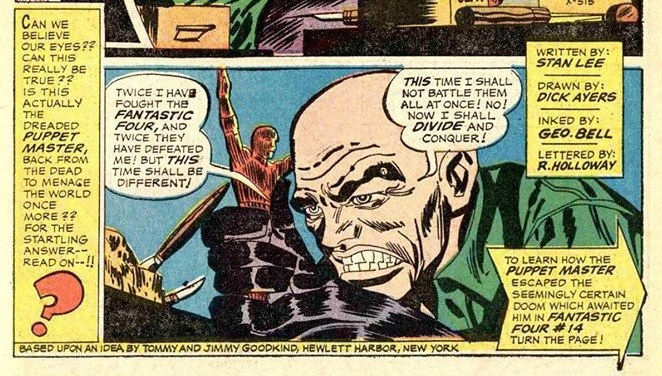
This is exactly backwards. It was Stan Lee the persona that would have ceased to exist in 1961 had Kirby not been given a crack at realizing his creations. Kirby would have continued in the industry, telling solid stories wherever he could find work, maybe not with a company of such a low calibre as Goodman’s comics operation. While parsing Lee’s horn-blowing and status giving, it’s important to note how often Lee referred to Kirby as anything other than an artist, or when Lee’s praise of Kirby’s creativity and plotting ability could be monetized by Kirby. The answer is… never. Jack Kirby was never given a plotting credit at Marvel from the time credits were instituted in 1962 until his departure in 1970. Lee credited himself as plotter on the first story with such a credit, one that was so obviously a Kirby plot. There were assorted other plot credits during that time, including Tommy and Jimmy Goodkind, apparently Lee’s neighbour’s kids, in Strange Tales #116. This despite the fact that Kirby was the primary plotter during those years, for his own stories as well as the stories he laid out for others.

Ditko’s Avenging Mind is given a fair amount of coverage in the book, but is dismissed for the wrong reason (discussed later). Ditko’s assessment of Lee’s crediting is explored in “Creative Crediting”: “All of these combinations of Stan’s credits of ‘Scripted by’, ‘Script and editing by’ and ‘Written by’, etc. are all claiming, implying, a full script by Lee. In using such terms and phrases as ‘Illustrated by’, ‘Art by’, ‘Artwork by’ and ‘Illustrations’ (in crediting me), all of which are factually, truthfully, incorrect identifications, Lee is claiming my artwork was done from his full script… Yet Lee never wrote a full script for me.”
This is followed by “He Giveth and He Taketh Away”: “Stan Lee started early with his self-serving, self-crediting writing and speaking style…”

244: Origins. “Lee was, to be sure, effusive in his compliments for Kirby and Ditko, but the narrative made it clear that it was Stan Lee who was the major creative force behind Marvel and its characters… not surprising given that his two most important collaborators had abandoned him and the company.”

Abandoned? Lee’s two most important collaborators had walked away from the man who, in this era of not calling a lie a lie, was appropriating their writing pay. He was effusive in his compliments for his artists, and Kirby and Ditko refused to be constrained by his demeaning terminology; his followers were and are taken in, but his unpaid writers saw through it.

323: Lee’s deposition… “While giving Kirby great praise… Lee” in his deposition!

Q. And this is — you talked about it before that artists were expected as part of their job to populate the story with characters?
STAN LEE: Oh. You see, if there’s a story where the hero goes, let’s say, to a nightclub, so I would say or whoever the writer is would say the hero goes to a nightclub, and he talks to this person, and then there’s a gun fight. Well, when the artist draws it, the artist has to draw other people in the nightclub. So the artist is always creating new characters. I mean, the artist might decide to have the character standing at the bar and draw a sexy-looking bartender, a female or an interesting looking bartender.

Videotaped Deposition of Stan Lee, 13 May 2010 (the first of two)

Lee credited his “artists” with “creating” a sexy-looking bartender character. As was his way, he “effusively” and with “great praise,” credited Kirby with nothing.

4 (Preface): And to a small group of comics fans and professionals, he was the most dastardly of villains, exploiting victimized artists who did all the real creative work, while he was just a lucky, slimy manipulator who was in the right place at the right time.

Was Lee in the right place at the right time? Absolutely. He was the promoter who made a connection with his readers. As the Sherman/Groth account indicates, Kirby was the predominant creator and plotter (and Ditko did the rest). Kirby, Ditko, and Wood were the early 1960s writers, with Lee adding the teen humour-style dialogue and restructuring stories to make them less literate (Kirby being the reader on the team). Despite the fact that so many of Lee’s pre-1961 characters had been female (Patsy, Linda, Millie, Kathy, et al), he used his power of dialogue to remove or re-interpret any agency or acts of heroism from women in Kirby’s stories.

Fingeroth reduces detractors of The Official Stan Lee Story (called “haters” on the back cover) to objects of amusement, unsurprising given the target audience. My objection is to the term “victimized artists.” Artist was the term used by Lee to remove credit from his writers and creator/writers. It’s time to put that lie to rest.

Further observations

28: “according to Simon, Kirby always believed” Lee ratted them out.
Simon’s account of Kirby’s beliefs is not to be trusted. Simon always gave himself the starring creative role in his historical fiction.

29: “Lee was writing many of these stories as well as numerous superhero tales, in addition to editing the titles. At that point, energetic young man didn’t seem to have much if any editorial assistance.”
Nonsense. Not only was Lee not the only editor at the time, but Goodman was listed as the editor.

45: “Lee had amassed an enormous quantity of inventoried stories… Supposedly, when Goodman one day discovered all these pages in a closet… he was so infuriated he decided to fire everybody and burn off the excess.”
Patrick Ford, Marvel Method, 1 January 2020: The book does cast doubt of the “art in the closet” reason for firing the staff. However it fails to mention that Martin Goodman never said that was the reason. Stan Lee claims Martin Goodman said that. The fact is that Goodman would logically have been thrilled that the staff was producing so well that he had a large inventory built up. He should only have been annoyed if the staff was not producing enough rather than more than enough.
The more logical reason for getting rid of the staff was given by Al Jaffee who said it had to do with taxes and medical insurance.
The way Lee tells the story makes Lee appear to be the victim of his own largess. Good ol’ Stan buying even stuff that wasn’t good enough to print. Where in reality he wasn’t buying anything. The staff was punching a time clock. They were paid by the hour not by the page.

59: “While writing some superhero stories that year…”
Purposefully misleading: this follows a description of the failed superhero revival… Lee wrote none of them, and no other superhero stories that year.

64: Lieber… “was drawing—and possibly writing—romance comics”
It stands to reason that if Lieber was to be credited as the writer on Kirby’s stories, there’s no limit to the writing that can be attributed to him, even before he started writing.

76: “Though Larry started out writing romance scripts, eventually Lee would delegate the scripting of many of the Kirby-drawn monster stories to his brother to write.”
Many? In the absence of signatures, the word of the Lieber brothers is the only thing this claim has going for it. Not only did they not make the claim before 1995, neither of them even mentioned Lieber in that context, given a number of opportunities.

78: “So Lee kept working on other projects.”
Patrick Ford, Marvel Method, 27 December 2019: What is interesting to me is just about everything Lee tried was either a comic strip or something closely related to comics or panel cartoons. And yet a staple of Lee biographies is Lee contending for decades that he was ashamed of comics and yearned to escape the field.
If , as he says, Lee really aspired to write the great American novel why didn’t he make attempts to sell fiction to Goodman’s magazines or to other publishers ?
The bottom line is Jack Kirby, who also proposed loads of comic strips, wrote more fiction (at least three teleplays and a novel) than Stan Lee is known to have written.

Mark Mayerson, Marvel Method, 27 December 2019: The other thing about Lee’s outside projects is that they were all humorous. He wasn’t writing adventure or drama. He obviously felt that his strongest potential for outside sales was comedy. Yet, he’s celebrated for “creating” heroes and adventures when it was obviously not his strength.
Kirby, on the other hand, had done very little humor in his career. His work was all about heroes and adventure. Yet, somehow, Lee is the “creator” of the Marvel universe and Kirby was only the artist who drew up Lee’s ideas.
The truth is so obvious for anyone who bothers to look.

82: “Many of the stories were created in what would come to be called the “Marvel Method” of short plot discussion, followed by pencil art, followed by dialogue, and then inks and colors. That method would come to be the source of much controversy in Lee’s life.”
According to Mark Evanier’s description, it’s the way Kirby worked solo. To work with Lee, he wrote margin notes instead of balloons and captions.

83: “the Lee-Kirby team would try their hand at a new superhero—inked by Ditko—the magic-themed Dr. Droom.”
The story has no Lee signature. Judging by the finished work, Kirby and Ditko are the only ones we can be certain actually worked on it.

112: Spider-Man–”The closest to truth we have… either before or after Lee had decided to come up with an insect-derived, teenage superhero…”
Ditko ultimately wrote that he didn’t know who originated the ideas in Kirby’s 5-page story. Kirby and Ditko were in agreement, but Lee’s version denies that Ditko told him that Kirby’s story was similar to The Fly (also a Kirby story).

114: “Are we to infer from this that Ditko felt, that, while he and Stan might have cocreated the character, that Steve deserved the lion’s share of the credit?”
We are to infer nothing more than that Ditko wanted cocreator credit, and that Lee wasn’t going to give it to him without taking it away in the next breath.

116: “Interestingly, and mostly unnoticed by the general public, in his introduction to 2013’s The Art of Ditko…”
Lee credited Ditko as cocreator when no one was paying attention, why? It was a meaningless gesture, and given all the attention it deserved by Ditko.

116: The Avenging Mind: “Ditko seemed to simply believe that Lee was not credible, apparently because he did not share Ditko’s philosophical principles.”
This is utter nonsense: Ditko didn’t hold anyone up to his own principles. Lee was not credible because he had a history of making stuff up to steal credit from his creator/writers. Ditko had his number.

116, 117: “Ditko gave little, if any, weight to Stan’s contributions as scripter, editor, art director, and, yes, co-plotter for many of the Spider-Man stories they did together, before Lee agreed to give Ditko full plotting credit.” and “the early issues were most likely true collaborations…”
Stan Taylor proves convincingly that plots for the early issues came from combining plot elements from recent Kirby stories, so it’s safe to assume that they were contained in Kirby’s concept pages. Ditko’s description of a story conference with Lee mentions the need to repeatedly steer Lee away from hare-brained ideas. If Kirby plotted the early issues, and Ditko was sole plotter from about #14 onward, which are the issues for which Lee should get plot credit?

118: “It’s here that Lee’s life story really assumes a key part in the Spider-Man mythos“
Jameson grew out of Lee’s experience of menial jobs? Jameson is Ditko’s jab at Lee, in the same way that Lee was the inspiration for Kirby creations Ego, Maximus, Infant Terrible, …

125: “Thor… was birthed by Lee (plot), Lieber (script), and Kirby (pencils and probably plot input)”
The first Thor story was clearly a Kirby plot, containing recurring Kirby science fiction characters.

125: Ant Man—”Jewish creators Lee, Lieber, and Kirby?”
The origin story bears no Lee signature, so we can only be certain Kirby and Ayers were there at the time. Another explanation from the House of Lies holds that, for some reason, Lee didn’t sign all of his stories, but we know better.

126: Tales of Suspense #39. “The [Iron Man] origin story was by Lee, Lieber, and Don Heck.”
Kirby plot (recycled from his Green Arrow story), concept sketch-turned-cover, and possibly layouts. Kirby’s own origin story appears in the following issue, which suggests it was delayed for some reason.

126: “The words twas Steve’s idea leave unclear if Lee was referring to the character, the character’s origin, the series’ mystical motif, the plot to the first story, or some combination of those elements.”
Let’s see how we can re-interpret ’twas Steve’s idea. Ditko brought the character, and story, to Lee on spec.

127: Stupid origin stories you know aren’t true… “According to Lee, to prove that the Marvel ‘formula’ could work in any genre, he and Kirby came up with the World War II-set battle comic Sgt Fury and His Howling Commandos, whose eponymous first issue was dated May 1963.”
Oops. John Severin (Kirby Collector #25) told of Kirby pitching the concept to him as a newspaper strip, pre-Marvel, near Columbus Circle. Creative input by Lee? Zero. Can we apply the credibility of Lee’s claim here to his other claims?

127: X-Men
Created by Kirby, who at least knew what a mutant was (see Yellow Claw), and what a transistor wasn’t.

128: “…with the exception of Dr Strange and Spider-Man, all the characters emerged from some combination of the talents of Stan Lee and Jack Kirby, with Larry Lieber contributing, although Larry has never claimed to have conceived or designed any of the characters.”
I see where this is going. Lieber never claimed to have written any of Kirby’s sf/fantasy stories before the ‘90s. He’s being held in reserve in case more evidence emerges that Kirby did any of the creating (such as when a page of original art surfaces with Kirby’s penciled dialogue in the balloons).

161: Herald Tribune article… “Lee felt terrible about it.”
Did Lee have it in him to feel terrible about it?

161: Herald Tribune article… “at least partly staged…”
A little knowledge of Nat Freedland might indicate that it was more than partly staged. Note that in January 1966, Lee was concealing from Freedland the fact, by criticizing him in the present tense, that Ditko had been gone for a month and a half.

166: Simon’s version of the 1966 lawsuit…
Taken from My Life in Comics, a work of historical fiction on par with Origins of Marvel Comics or Mair’s Excelsior! Simon should not be permitted to speak for Kirby’s motivation, because he was not present in any discussion between Kirby and Goodman, and it was Simon who was cutting Kirby out of the suit.

167: typo… “Lee and Kirby” should be “Simon and Kirby”

199: “it does seem that not getting to do the Surfer series was perceived as a significant slight by Kirby…”
It may be baffling, but it does seem that way,
Kirby interviewed on the Tim Skelly Show, WNUR radio, 14 May 1971.
What do you think the advantages are over at National?
The advantages? Well, I have a lot more leeway. I can think things out and do them my way, and know I get credit for the things I do. There were times at Marvel when I couldn’t say anything because it would be taken from me and put in another context, and it would be lost—all my connection with it would be severed. For instance, I created the Silver Surfer and Galactus and an army of other characters and my connection with them is lost. Therefore I just kept all the new ideas to myself.
This sounds like a problem…
You get to feel like a ghost.

204: PF&C purchase. “According to Lee, Goodman made him verbal promises…”
Earlier in the decade, also according to Lee, Goodman made promises to Kirby and Ditko that needed to be relayed by Lee, because Kirby and Ditko didn’t usually talk to Goodman. Did Goodman ever actually make verbal promises?

226: “Along with the intensity of his visuals and concepts, Kirby also provided idiosyncratic scripting in a style seemingly designed to be the opposite of Lee’s reader-friendly, narrative-clarifying, naturalistic word usage.”
A good book would compare examples of Kirby’s “idiosyncratic scripting” with examples of “Lee’s reader-friendly, narrative-clarifying, naturalistic word usage,” instead of just pretending this statement is true.

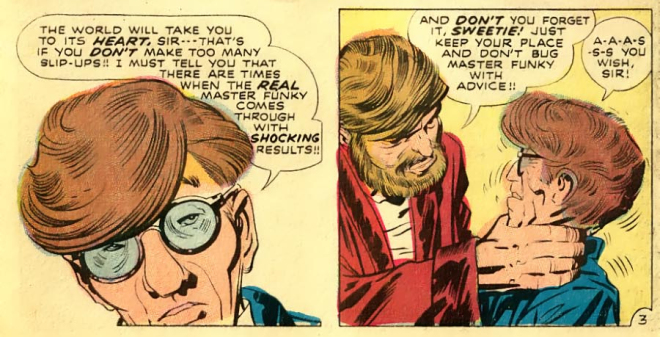
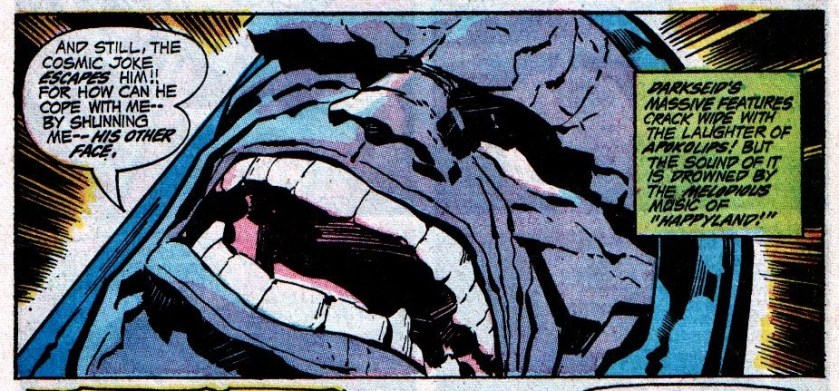
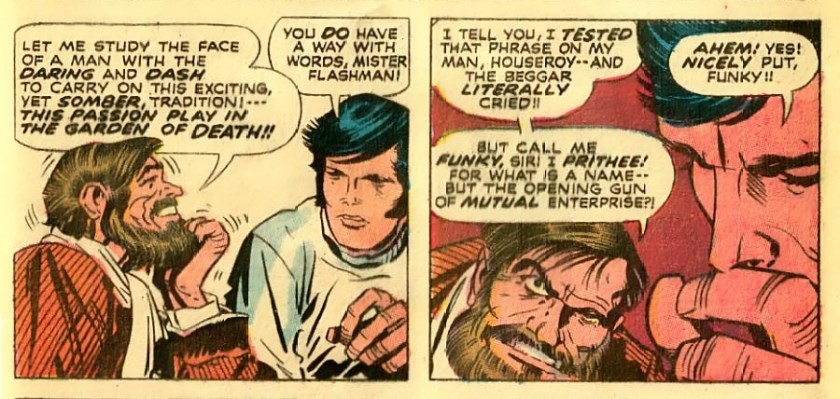
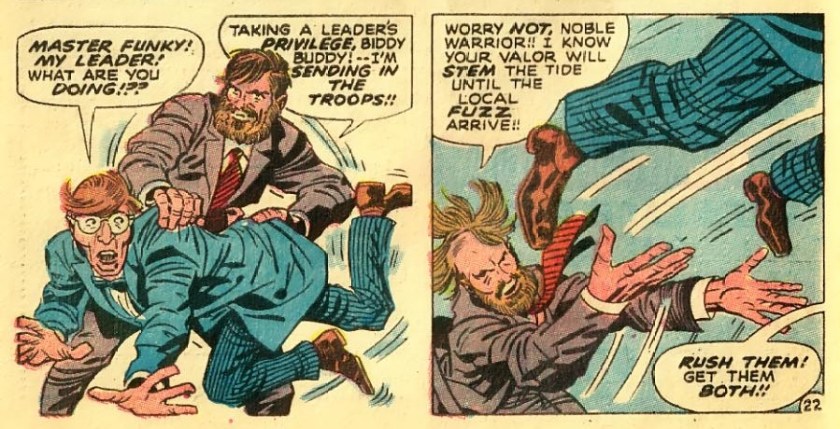
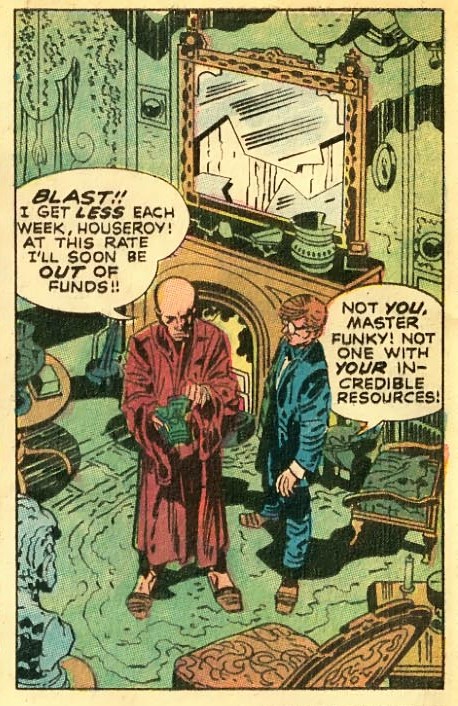
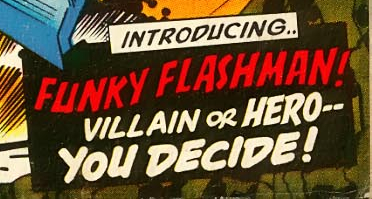
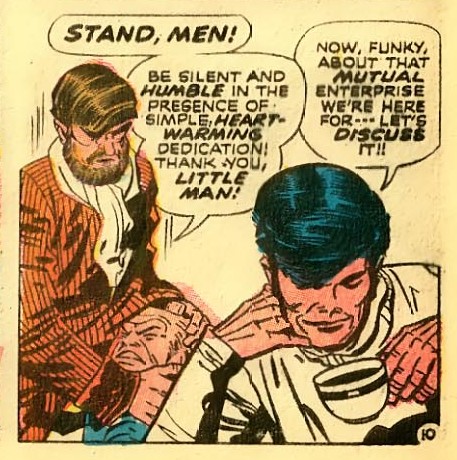
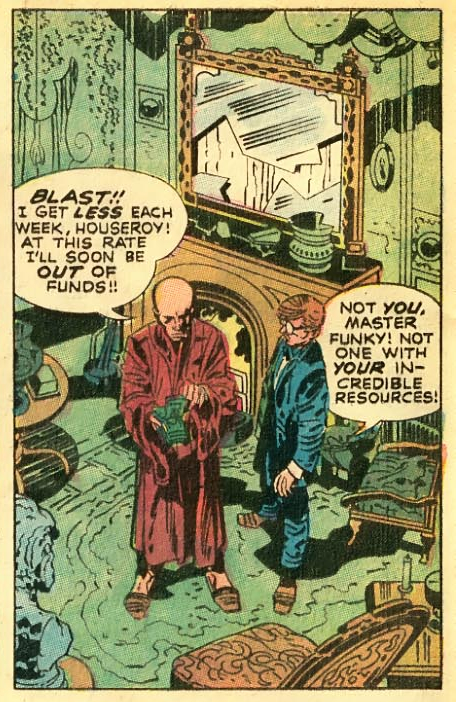
233: “A self-involved hustler and promoter, Flashman—once his toupee and fake beard were in place—looked exactly like Stan Lee of the era. Funky was a pathetic character, self-involved, leeching off a relative, willing to sell anyone out in service to himself and to the primary villain of Kirby’s Fourth World, Darkseid.”
Was this portrayal way off the mark, or incisive? Is it maybe the most accurate picture we’re ever likely to get of Lee from someone who knew him better than most other people in that context?

253: “If all he’d wanted was to pump out work for hire comics, he could have stayed at Marvel, where Stan Lee was, near the end of Kirby’s time there, pretty much giving him autonomy—and credit—anyway.”
This must be one of the stupidest things I’ve ever read. See abusive situation above.

260: “There were rumors that staffers were deliberately printing a higher proportion of negative letters about Kirby’s titles than were actually received and were making fun of his output with nasty annotated pages of his comics pinned up on the office walls.”
Rumours? Stephen Bissette, John Morrow, and Mark Evanier are spreading those rumours as first-hand experience.

261: “Kirby had no intention of plotting stories for someone else to dialogue.”
Fingeroth understands something that seems to perpetually mystify Thomas.

290: TCJ interview: “Even staunch supporters of Kirby thought the interview was over the top, Kirby reviling Lee to a degree that he had never before publicly done.”
I suspect Fingeroth has been speaking to the wrong staunch Kirby supporters.

Neal Kirby: Though my opinion may be viewed by some as non-objective, I can say that my father spoke the truth in this (Gary Groth) interview. Stan Lee has the advantage since my father’s death in 1993 of being the last man standing.
He has been able to say, claim, invent whatever he wants without fear of rebuttal! Is it conceivable that Stan Lee, with little knowledge of mythology, much less Norse mythology could come up with the premise of Thor as a super hero? Isn’t it much more likely that my father, whose studio on Long Island was filled with books on history and mythology, of which his favorite was Norse mythology, would be much more likely to have created such a character? I could go on as such concerning almost all the Marvel characters. What bothers me the most, however, is that Stan Lee is rewriting history in his favor, and young people now are starting to view him as the lone creator of the Marvel characters. There have been many injustices in the 80+ years of comic book history; this without question is one of the greatest.

Comments section, “TCJ Archive: Jack Kirby Interview,” The Comics Journal website, 2 June 2011.

295-7: Ditko and Lee… “When they saw each other, both their faces lit up…”
DeFalco: Then Steve walked away, and I had one of those surreal moments where, as I’m walking down the hall with Stan, Stan says to me, “You know, Tommy, I’ve always been curious about this. Do you know why Steve quit?”
Mark Mayerson, Marvel Method, 30 December 2019: As editor and later publisher, Lee could have called Ditko at any time and asked Ditko directly. The fact that he didn’t means that either he knew or didn’t care enough to bother. His asking others why Ditko quit is nothing more than a cover-up, making Lee seem to be the injured party and not the cause.

309, 310: “Something had changed for Ditko. No longer was he the person who seven years earlier had exchanged hugs with Stan Lee. ”
Well, he was the same person, but like Kirby at the convention, his upbringing told him how to behave when meeting the boss who had refused to speak to him for over a year in a previous decade.

305: bankruptcy
Lee was fired by Marvel on 30 July 1998. He was signed to a new contract in November.

308: “Lee’s friend, Batman cocreator Bob Kane”
Another credit thief, but at least Kane paid his uncredited creator/writers.

311, 324: Arthur Lieberman
Not much is mentioned about Lieberman, but it would be interesting to explore his involvement in Origins of Marvel Comics and the recruiting of Roy Thomas 24 years later.

311, 317: syndicated Spider-Man strip?
At the time of Lee’s death, Thomas said he’d been writing it for “17, 18 years.” Coupled with Jim Shooter’s claim that it was him who was writing it earlier, it’s not hard to conclude that Lee got paid for it ($125k per year according to one superseded contract) without actually writing it.

312: Uslan doesn’t have the remotest concept of how Kirby and Lee “collaborated.”

322: “the estate of Jack Kirby, through lawyer Marc Toberoff, filed suit against Disney”
Legal specifics are important, and presumably Disney’s legal proofreaders should have caught this egregious misstatement of fact. The Kirbys, through lawyer Marc Toberoff, filed for reassignment of the copyrights; they did not file suit against Disney. Disney filed suit against the Kirbys.

322: Lee’s testimony: “more or less, the history of the characters’ creation as recounted by him in his 1974 book, Origins of Marvel Comics.”
Much, much less, or the book wouldn’t be quoting Fingeroth’s interview with Mark Evanier.

352: “There was one key insight, though, that Stan Lee had that Kirby and Ditko did not. Lee came to see that, in the early 1960s, there was an audience of adult fans who had read comics as children and were still interested in them… maybe there was some way to reclaim those older readers, now in college or in the work world, to get them to help spread the idea that comics were cool or even relevant…”
Chris Tolworthy, Marvel Method, 31 December 2019: Lee’s insight was that he could turn adults into children: Tell them they are clever and brave and cool if they join the treehouse club. Kirby and Ditko were busy turning children into adults: teaching them values that would help them recognise funky flashmen and the harm they cause.

353: Lee: “I always wrote for myself.”
One only needs to look at a Kirby story restructured by Lee to know that Lee’s understanding of storytelling was dwarfed by Kirby’s; consequently Lee writing for himself meant dumbing down.

353: “Lee had the authority of an owner but the insecurity of a freelancer. He was still at the boss’s mercy—even though most of his colleagues saw him as the boss.”
Lee was always the boss to his “colleagues,” even if he needed to invoke Goodman’s name without Goodman’s knowledge.

A Few Things You May Not Know About Jack Kirby


A Response to Stuf’ Said

For nearly sixty years until his death, Stan Lee represented himself as the driving creative force behind Marvel Comics, as well as its primary plotter and writer. For the last quarter of a century of his own life, Jack Kirby pushed back against Lee’s misappropriation of the credit due Kirby. With Stuf’ Said, John Morrow has done a great service by putting the two men’s claims in front of his target audience.

My issues with Stuf’ Said (and I must admit, I’m not a member of that target audience) stem from Morrow’s editorial interpretation of the material, coupled with a disproportionate representation of Lee’s point of view. I’m going to use these issues as a framework to introduce some of the material that was left out.

Morrow set the stage for Stuf’ Said in his editorial in The Jack Kirby Collector 73:

Are you a “Type A” kind of fan, who thinks Kirby deserves all the credit, Stan cheated Jack out of it, and this magazine doesn’t beat that drum loudly enough?

Or are you a “Type B” fan, who thinks Stan gets unfairly maligned by all the “Type A” fans, and this publication is unfairly skewed toward Jack?

Let me toss this out. How about we all be “Type C” fans—the kind that can put on our Big Boy (and Girl) Pants, consider others’ viewpoints, and admit that the reality might just lie somewhere between the two extremes?

Stan Lee will have turned 95 by the time you read this (on December 28, 2017), and TwoMorrows celebrated with a special 150th issue of Roy Thomas’ mag Alter Ego devoted to Stan. He toiled in the thankless business of comics for a lot of years, and God-willing, he’ll be with us many more. We gain nothing by denigrating The Man, and we don’t have to tear him down to build Jack up. Marvel Comics, through Disney, finally gets that. So should we. The battle’s over, folks, and we all won—both Kirby and Lee fans (not that those two groups are mutually exclusive)!

Just a few notes: no serious observer says Kirby deserves all the credit, or that Lee did nothing. These are imaginary arguments designed to be easily refuted. Lee had a massive impact on the work, through dialogue and forced redraws. There’s no compelling evidence, however, outside of his own account, that his contribution came before Kirby pencilled a given story.

Secondly, Lee did not toil unthanked in the thankless business of comics for a lot of years. The thanks and rewards he reaped far exceeded those afforded anyone else in comics (and many other fields), ever, in an industry infamous for its poor treatment of its contributors. His rewards were nominally for his own work, but were mostly for the work of others.

Thirdly, when the “battle” was over, no one told Lee or Roy Thomas: they both doubled down on their claims of the mythical Marvel creation saga. Never one to see straight where Kirby is concerned, Thomas is the custodian and often the author of the Lee version of events. He’s not required to participate in the Big Boy Pants exercise and look at things from the freelancers’ point of view, and indeed admits that the secret to being a Marvel historian is knowing that no one but Lee ever needed to be consulted. In Stuf’ Said, Morrow gives carte blanche to an individual intent on removing Kirby’s contribution from Marvel history.

We don’t have to tear down Lee to build up Kirby; we do need to tear down Lee’s false legacy. The discussion is decades old, and always begins with Stan Lee’s comments being taken as the truth; his Marvel narrative is treated as “common knowledge.” The alternate stories of Kirby or other Lee collaborators then appear to be challenging “the truth”: proof is demanded when it’s politely suggested that their accounts differed from Lee’s. Kirby’s own story is contested mercilessly, and requires a different degree of proof because Lee often preempted it with claims to the contrary. Lee put himself in the fan news from the beginning, and had a quarter of a century unanswered after Kirby’s death to press his advantage.

Stephen Bissette: Why, oh why, continue to favor Stan Lee’s account, with so much self-evident conflict-of-interest as a benchmark of his entire comics and media career; so many conflicting self-accounts from Stan himself; and such a clear, public record of Stan’s profiting and profiteering for much of his life from sustaining and spinning his own self-aggrandizing accounts? 1

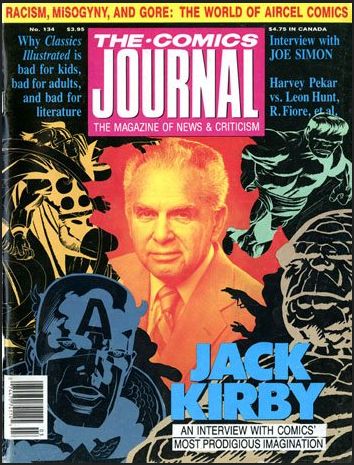
tcj134

Morrow from the last chapter, “The Verdict”:

One thing that tripped me up previously was Jack’s 1989 Comics Journal #134 interview, since back in the day, Kirby came across to me as a little nutty-sounding with some of the bitter recollections he brought to light. The most egregious is when he said, “Stan Lee and I never collaborated on anything! I’ve never seen Stan Lee write anything. I used to write the stories just like I always did.”

A few pages earlier, Morrow had provided a “but” to this statement, but it was wiped away in the conclusion. We’ll parse Kirby’s claim later, and I’ll be exploring the applicability of Morrow’s word egregious. For now I’ll just say that being “tripped up” by a 1989 Kirby interview suggests that Morrow hadn’t been paying attention to the previous 20 years of Kirby’s interviews, which all told the same story. TJKC is undoubtedly the best source of those interviews, obscure and otherwise, but they’re tossed out the window with this one concluding statement.

CONCLUSION

Because I began this as an email to John Morrow addressing the issues point-by-point as I read through the book, the volume of supplemental information below is daunting. With that I’ll come to the point and give my verdict. Please grab a copy of the book (available from Amazon or in PDF from twomorrows.com) and follow along to see the references in context.

Stuf’ Said puts an unprecedented amount of little-known Kirby material in front of a wider audience than it’s had before, an admirable achievement. The benefit, however, is outweighed by an uncritical treatment of the Stan Lee mythology, putting it on par with Kirby’s version, and further entrenching it by giving it the TwoMorrows stamp of approval. Morrow also rehashes a number of discredited myths about Kirby: the art directorship myth, the Kirby needed reining-in myth, the Kirby should have stood up for himself myth. In the name of appearing impartial, Kirby’s account is treated overly critically.

Despite a verifiable record of untruths dating back to the advent of his new career as “creator,” Lee is accepted as a reliable witness to the events of history. Morrow has taken a position that’s similar to the mainstream media stance: the Lee version, the accepted wisdom, is part of what goes uncontested in Stuf’ Said. The sheer volume of Lee material, first-hand and from the supplemental witnesses, overwhelms Kirby’s.

The witness list is hierarchical: Roy Thomas is at the top of this hierarchy, as is Joe Simon. With a few notable exceptions, their words are passed along uncontested, despite that in both cases they’re advancing agendas that can’t allow Kirby to be taken seriously. Lee comes next: Morrow directly challenges a number of Lee’s statements and even dismisses some outright, but many of Lee’s abundant myths (and stories from others that could only have originated with Lee) are simply read into the record.

With the exception of Steve Ditko and Wallace Wood, both of whom quit Lee over the same grievances voiced by Kirby, most of the other witnesses quoted in the book tell a variation of Lee’s false history; they’re not testifying to what happened, they’re testifying to what they were told by Lee. This is a difficult situation arising from the fact that for the most part there were two eyewitnesses (and Thomas wasn’t one of them).

At the bottom of the hierarchy is Kirby, and Stuf’ Said actually bolsters the case against him. Thomas and the rest of Lee’s attestors, plus Simon, grace the pages of this issue of The Jack Kirby Collector for the express purpose of discrediting Kirby’s words so we can wear our Big Boy Pants and agree the truth was somewhere in the middle. Kirby’s quotes (like the one where he called the idea of working from Lee’s FF #1 plot “an outright lie”), go unremarked, do not factor into “The Verdict,” or are absent altogether.

Big Boy Pants aside, intellectual honesty requires a decision at this point. The accounts of the two men provide no option for both to be telling the truth, even truth according to their own definition of the word “writing.” Lee did not simply seek to be credited as the writer: he declared, “the characters’ concepts were mine.” 2 As Steve Ditko wrote, “someone is lying.” 3

The correct approach in Stuf’ Said would be to let Kirby and Lee speak for themselves without any analysis. Alternatively, after assembling this impressive collection of information, Morrow simply should have endeavored to indiscriminately QUESTION EVERYTHING.

CONTENTS

Good things: what Stuf’ Said gets right

Assumes facts not in evidence

Just Plain Wrong

Kirby was rarely, if ever, late with the FF pages

Lee was not a plotter

Simon says

Lee misrepresents

Thomas explains

Lieber comes into his own

Morrow waffles

Further Information

Quotes that follow from Stuf’ Said are specified by page number, with the name of the speaker in square brackets. A second page number in square brackets refers to Stuf’ Said: The Expanded Second Edition. Quotes from the book not explicitly identified are John Morrow’s.

NEXT: Good things: what Stuf’ Said gets right

Footnotes

back 1 Stephen Bissette, “Digging Ditko, Part 3,” SRBissette.com, September 14th, 2012.

back 2 Janet Bode, A Comic Book Artist KO’d: Jack Kirby’s Six-Year Slugfest with Marvel, The Village Voice, December 8, 1987.

back 3 Steve Ditko, A Mini-History: “Wind-up,” The Comics v14 n11, © 2003 S. Ditko.

Good things: what Stuf’ Said gets right

The book is full of great examples of John Morrow’s insight into Kirby’s side of the story. It’s unfortunate that it all gets tossed when a conclusion is deemed necessary.

Stuf’ Said p 17: There’s something Stan fails to mention in his 1998 response, which would lend credence to Jack’s account: That around this time, Marvel is closing its doors, exactly as Kirby states.

Although there was another imminent shutdown coinciding with Kirby’s 1958 arrival, Steve Sherman says Kirby told him this was 1961 (see p 19, below).

Kate Willaert: “One thing that really surprised me was October 1961. Marvel shipped an entire month’s worth of books in the last week of September 1961 (including Fantastic Four #2), and then published nothing in October. Four whole weeks of nothing.” 4

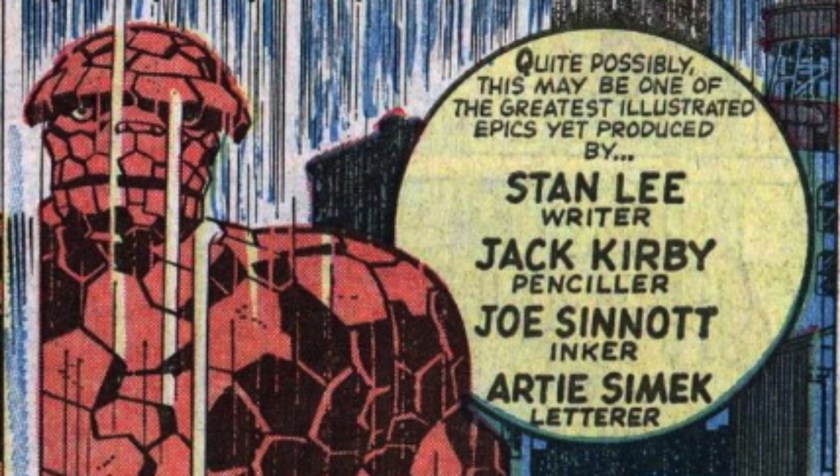
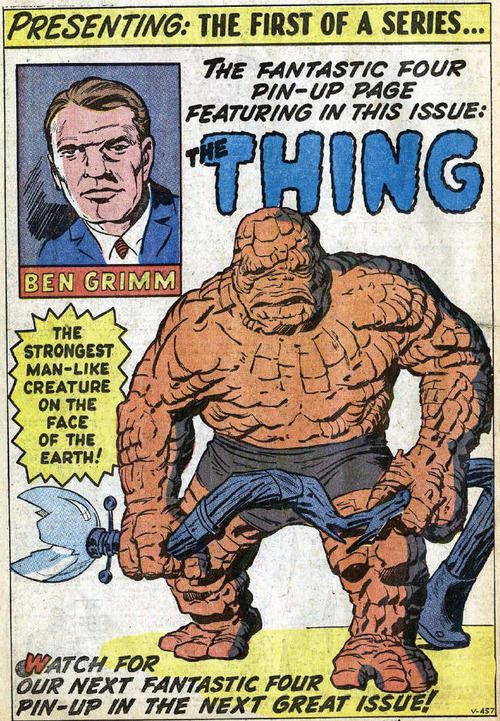
TheThingMasterworksPinup

20-22: (presentation art)

…and…

[Kirby] “I came in with presentations. I’m not gonna wait around for conferences. I said, ‘This is what you have to do.’ I came in with Spiderman, the Hulk, and the Fantastic Four. I didn’t fool around. I said, ‘You’ve got to do super-heroes.’ I took Spiderman from the Silver Spider—a script by Jack Oleck that we hadn’t used in Mainline. That’s what gave me the idea for Spiderman. I’ve still got that script .”

Very well described. Steve Sherman also mentioned the fact that Goodman was shutting down in 1961, borne out by the lack of product in October (after FF #2 was published).

Steve Sherman: ‘The thing is, if Joe Maneely hadn’t died, things would have been a lot different. I guess you can call it fate, destiny, random events, but Jack probably would have found something else. Yes it was early ’61 that Goodman was going to pull the plug. Don’t forget, the Marvel offices at the time were pretty small, so it wasn’t a big deal to close the office. I would guess that Goodman had not yet informed the printer or engravers, since that would have been bought ahead of time. I would guess that last issues of the books had been sent out. Jack couldn’t let them close. Jack had always been working on ideas for books. He was pretty well aware of what was being published. He always felt that “superhero” books would make a comeback. Since Goodman already had the pipeline going, it wasn’t too much to give it another shot, especially since it was Jack. He had come through before, so why not. As Jack told me, he came up with all of the titles at once. He called it a “blitzkrieg”. He felt if he put out a bunch of new books at once, it would make a splash. He had “FF”, “Spider-Man”, “The X-Men” and “Thor” and “Hulk”. You can believe it or not, but that’s what he told me.’ 5

34[36]: Does the omission, after Stan making sure he is credited for all those previous issues’ plots, indicate that Kirby is the uncredited plotter of #114? For that matter, knowing that Lee was always diligent about including his own credit line, does the lack of a specific “Plotted by” credit in a comic mean the plot was either only partially by Stan, or had no involvement by him at all?

38[41]: Kirby may’ve already been drawing Avengers #6 when Stan writes this, which would indicate Jack is handling the lion’s share of plotting.

Kirby was drawing his story for Strange Worlds #1 in 1958 when he resumed the lion’s share of the plotting. Prior to that he was simply assumed to be the writer of his work.

42[46]: Stan apparently has Don Heck plot Avengers #11, and then redraw the ending after he sees the pencils—because if Stan plotted it, wouldn’t he know ahead of time that it isn’t the real Spider-Man?

Yes.

43[47]: The first couple have credits for “Stan Lee, writer” and “Jack Kirby, illustrator”, but these are identical plots to the 1940s stories, for which Stan had no involvement—yet by default, he’s getting credit for plotting, due to the omission of any mention of the source material.

Captain America is not the exception.

95[103]: Examine this last comment by Lee, and compare it to any other occupation’s real-life workplace. What Stan’s saying here is, instead of hiring (and paying) another employee when he is too busy to do the work himself, he shifts part of his workload to other existing employees (i.e., the artists), but doesn’t pay them additionally for it. So effectively, Martin Goodman is getting extra employees for free, rather than having to hire new ones. This is a great deal for management, but lousy for the workers—it’s no wonder many of the artists come to resent this division of labor.

Nearly correct. Now give Lee the page rate for the writing he’s not doing, which was the motivation for starting the whole process. Effectively, Goodman is paying the same money, but the writing rate is going to the wrong person.

99[109]: Salt shaker: I’d assume, instead of being talked into it, Kirby insisted on dialoguing “The Inhumans,” so any plans he had for them wouldn’t be usurped, like his ideas for the Silver Surfer, Him, and Galactus had been.

Good call.

less

109[119]: Funky Flashman.

Nice exercise, followed by some nice detective work in the second edition to determine what might have been the trigger. It goes without saying that the underlying reason is still treated in Stuf’ Said as the elephant in the room. With Mister Miracle #6, Kirby was the model of restraint after ten years subject to the Marvel Method.

116[128]: It makes for great promo copy, but historically, this is simply impossible. The idea that Stan is doing radio interviews about Marvel, prior to Journey into Mystery #83, seems rather far-fetched.

Good call. I think “impossible” outdoes “seems far-fetched.”

116[128]: Was the [Fourth World] series ended for financial reasons as they’ve said?
[Kirby] “No. No financial reasons involved. I can’t make a statement unless I make it in concert with those who make policy.”

This would be a good place to mention the changing market conditions, and Robert Beerbohm’s assertion (in TwoMorrows’ own Comic Book Artist) that The New Gods and The Forever People were targets of affidavit return fraud. This type of speculation involved independent distributors selling comics out the “back door” in “large lots” while being reported as destroyed. Not being a target, Mister Miracle was missed by Carmine Infantino’s hatchet. 6

120[132]: Lee continues to recount the early days of Marvel for the press, and hones his message…

Accurate description.

122[134]: This must be a bogus anecdote, since in 1960, Stan hadn’t been working on any super-heroes for some time. And the “Atlas Monsters” wouldn’t be what he is referring to, as they don’t have “superhuman powers.”

It’s good to point this out, but it’s not done nearly enough in Stuf’ Said.

138[151]: I’m objecting again here, as Lee isn’t fully addressing the issue. He’s completely avoiding any discussion of whether Marvel was about to close when Kirby arrived, and only focusing on the “crying” comment.

Lee’s response is rendered irrelevant by the fact that Kirby’s “blitz” in early 1961 was followed by a lapse in publication for the month of October.

144[158]: After re-reading it in chronological context with all I’ve documented up to this point, much of what Kirby says makes more sense to me now than it did when this was published in 1990, but some sections still seem exaggerated, and understandably bitter…

This is the “but” that vanishes in the last chapter: more needs to be said here. Morrow should have a better appreciation that more of the interview is simply the truth. Kirby is not a bitter or hateful man (see p 5 below, under Just Plain Wrong). The same standard of scrutiny should be applied to Lee’s words.

151[166]: And am I the only one who thinks this idea [Thor using his hammer for transport] is more likely to originate from Kirby than Lee?

No.

151[166]: So, is Lee a credit-hog, who takes any credit that isn’t nailed down, and will stop at nothing to keep others from getting any? He certainly was effusive in his praise for Kirby over the years:
[Lee] “Jack was one of the best artists in the business; one of the best artists I ever worked with.”
152[166]: But giving Kirby a compliment, and giving him equal credit for creating, are two very different things—and this is something that Lee often can’t often bring himself to do, especially in this later era.

This says it all: effusive in his praise, calling Kirby “one of the best artists,” “Lee always gave Kirby credit.” Yet as Ditko wrote in 2008 7, Lee was removing credit for the writing being done by “his artists” (for which he was also removing the page rate). Just to be clear, Lee was removing the writing pay for the work that was already done by his writer/artists, and then publicly providing them with a label that categorized them as artists who executed his ideas. Morrow’s “often” is spectacularly understated; he meant “ever.”

153[168]: I think it’s clear from the evidence presented in this book, that Kirby first developed a “Silver Spider”-based idea for a “Spiderman.” Kirby produced a presentation board with notes about the character. And Ditko’s certain that Stan showed him the first five pages of Jack’s original Spiderman story, which feature a different looking hero on the splash page than the one we know today. So let’s imagine how a similar interview with Kirby, being asked these same questions and adopting Lee’s attitude, might’ve gone…
Here’s a key factor: Kirby didn’t have the same attitude as Lee about it. He repeatedly gave Ditko credit in his comments over the years. It looks to me that Stan views any involvement after an initial idea in someone’s head, as superfluous to the “creation”—and if you take that reasoning to its logical conclusion, Lee would be superfluous in Spider-Man’s creation.

A nice touch. There’s a better case that Spider-Man was a Kirby-Ditko co-creation, and that Lee was the Baldo Smudge-like go-between.

Tuk made a similar observation regarding creation claims: “Both Lee and Kirby have described their version of how the Fantastic Four came about. We could examine their particular claims (see appendix 2) but we don’t even need to go that far. Whenever Lee talks about the origin of the Fantastic Four… [he] talks about himself for half the time. Then he talks about the surface details: these characters have superpowers. He then talks about what made them different in the most abstract way: they had real emotions and problems, but which emotions? Which problems? Why should a reader care? Now compare how Kirby describes what happened… note how Kirby talks about the underlying motivations, the feelings, what made each individual character different. Kirby knows what drives the characters as individuals, and hence where conflicts would arise. So who is more likely to have written these conflicts? Lee or Kirby?” 8

154[169]: Here’s my problem with this: If Lee wrote this synopsis before ever even mentioning the concept for the Fantastic Four to Jack as he’s claimed, how can he not be sure whose idea it was to originally keep Sue permanently invisible? It’s right there in Stan’s synopsis, so it has to be his idea if he hadn’t talked to Jack about it prior to writing it.

Exactly. Unfortunately Morrow’s skepticism doesn’t come across in other places in the book.

NEXT: Assumes facts not in evidence
Back to Contents

Footnotes

back 4 Kate Willaert, “Early Days of Marvel – Release Schedule,” kirbywithoutwords blog, 21 February 2016.

back 5 Steve Sherman by email to Patrick Ford, 2018.

back 6 Robert L. Beerbohm, “Secret Origins of the Direct Market,” Part One, Comic Book Artist #6, Fall 1999, and Part Two, Comic Book Artist #7, February 2000.

back 7 Steve Ditko, “He Giveth and He Taketh Away,” The Avenging Mind, © 2008 S. Ditko.

back 8 Tuk, The Case for Kirby, zak-site.com.

Assumes facts not in evidence

Stuf’ Said p 4: Lee’s m.o. was giving characters “hang-ups,” like Iron Man’s weak heart, Daredevil’s blindness, Spider-Man’s—well, acne, heartburn, post-nasal drip, allergies, chronic halitosis, and a dozen other maladies, depending on what Stan Lee interview you were reading.

“Lee’s m.o.”: this statement assumes facts not supported by the evidence. In this case, Lee says it’s his m.o.: Kirby had squabbling teammates in The Newsboy Legion, Boy Commandos, Boys’ Ranch, The Three Rocketeers, and Challengers of the Unknown; the science involved tells us Iron Man’s weak heart was undoubtedly built into Kirby’s concept pages/origin story; Daredevil’s blindness was introduced by Bill Everett; and it’s easily proven that the emphasis on non-action scenes in Amazing Spider-Man was supplied by Steve Ditko.

Ditko wrote that Lee wanted more costumed fighting and less interaction of Peter Parker at school: “Stan Lee did not like my playing up the school context, of using panels with Peter Parker (PP) being involved with his classmates. He wanted Spider-man (S-m) to get into action as fast and as often as possible. Stan rightly believed that the costumed hero is what the comic book is all about–a costumed hero in action. But PP/S-m, a teenage hero, should be seen, understood, in his teenage context, environment. His normal (non-hero) life can’t just be shown in some brief transitional sequences between a number of hero/villain clashes.” 9

Much like Susan Kirby’s “Sue Storm” story covered by Morrow (Stuf’ Said p 21), Wendy Everett told Blake Bell that her dad added Daredevil’s blindness because his daughter was legally blind. After the claim was brought to his attention, Morrow seemingly grudgingly included it as a possibility in the second edition [37]: “although in real life, the daughter of the new strip’s artist Bill Everett is legally blind, so it may’ve evolved from that.” (Blindness remains on Lee’s list of creations at the start of the book.)

Lee further made it known to and through his readers that he was the one who instilled humanity in the characters and made them individuals with his dialogue, but this is laughable. Lee was the great homogenizer: his male hero dialogue is interchangeable between titles. You can verify this by reading it aloud.

KIRBY’S CONTRIBUTION

4: As the 1960s wore on, Jack was doing more of the work, via the “Marvel Method,” where the “artist” was responsible for much/most/all of the plotting and pacing of the stories, while the “writer” concentrated on the words in the caption boxes and balloons, after the drawn pages were completed and the story totally fleshed out.

Kirby maintained that he worked this way from the start; what evolved was his method of conveying his written story to Lee. Prior to margin notes, Kirby wrote in the balloons or explained the pages in detail to Lee in person (necessitating Lee’s margin notes). He instituted margin notes to avoid face-to-face story conferences when the situation became intolerable. Lee encouraged the idea that margin notes marked his decision to give Kirby “free rein” because it gave Lee unlimited credit for the writing up to that point.

LEE’S PERSONALITY

5: From the start of his career, Lee’s personality won people over. Co-workers mostly adored him while he spent two decades cranking out unremarkable stories for Marvel, beginning in 1941. But until Kirby and Ditko arrived in the late 1950s, there were no notable characters created by him, super-hero or otherwise.

“Lee’s personality won people over”: Morrow has given us the Disnified version of Lee. Contrary to this depiction, Lee’s personality did not win him any friends at work.

Paul Wardle: “Harvey Kurtzman claimed that Lee would return his original art to him (strips such as Hey! Look! that Timely published in the 1940s) only after drawing a big ‘X’ through them with a black grease pencil. He also said Lee would sit on top of a filing cabinet and force the employees to bow to him on their way to work. Stan was reportedly an ‘enfant terrible’ in those days, having been promoted when still a teenager by publisher Martin Goodman after the departure of Simon and Kirby.” 10 Rick Veitch accurately captured this side of Lee with his Funky-like portrayal of the team Stanley Burr and Jack Curtis in Boy Maximortal #1.

Boy Maximortal
Stanley Burr in Rick Veitch’s Boy Maximortal #1.

Wallace Wood (years with Lee: 1964-65): I enjoyed working with Stan on DAREDEVIL but for one thing. I had to make up the whole story. He was being paid for writing and I was being paid for drawing but he didn’t have any ideas. I’d go in for a plotting session and we’d just stare at each other until I came up with a storyline. 11

52[56] Wallace Wood: “I want the credit (and the money) for everything I do! And I resent guys like Stan Lee more than I can say! He’s my reason for living… I want to see that no-talent bum get his…” (Sometime between 1976–1981: Wallace Wood’s letter to John Hitchcock)

Gerry Conway: Stan has always had that quality of kindly insensitivity. I think he’s basically a nice guy, he wants to be a nice guy, he does want to be nice to his employees, but I don’t think he’s terribly sensitive. If he is made aware of you as an individual, he’ll probably be very nice, but making him aware of you as an individual is the problem. He’s kind of self-centered in that regard… 12

John Romita: Around 1957 was when Stan and I were at our lowest ebb in our relationship. In the last year, he cut my rate every time I turned in a story. He was not even talking to me then… 13

Roy Thomas (1965- ): “By the time I was there, Steve Ditko never came by the office except for a couple of minutes to drop something off, because Stan had decided that there was just no sense in the two of them speaking…” 14

Wood, Romita, and Ditko all cited Lee’s silent treatment. Ditko wrote 50 years after the fact that it’s what drove him away.

John Romita: So I called up Zena Brody, the romance editor at DC—she was a nice girl and a pretty good editor, too—and told her I couldn’t do any more for her, and she was very upset. She said, “Gee, I was counting on you.” She was talking about doing a steady series with me. I told her, “I’m sorry, but Stan Lee is giving me the bulk of my work.” She said, “We’ll try to get you more work.” But I said, “I have to decide now because I can’t gamble. If you can’t give me the work Stan is giving me, then I’ll be out.” And then, six months later, he let me go through his secretary… when it came time that he ran out of money and had to shut down, or cut down to the bone, I had done two or three days’ work, ruling up the pages, lettering the balloons, and blocking in the figures on a story—and here comes a call from his assistant… and she says, “John, I have to tell you that Stan says to stop work on the Western book because we’re going to cut down on a lot of titles.” I said to her, “Well, I spent three days on it. I’d like to get $100 for the work, to tide me over.” She said, “Okay, I’ll mention it to Stan.” I never heard another word about the money, and I told Virginia, “If Stan Lee ever calls, tell him to go to hell.” [laughs] And that was the last work I did for him until 1965… 13

Michael J Vassallo, Snyder-Ditko Appreciation Society (group), 22 September 2018: I’ve probably spoken to as many ex-creative staff from the 1940’s and 1950’s than anyone has. The preponderance of the attitudes was that Stan was a lord-it-over type boss. That’s not my opinion, it’s what I got from others. Sure some say “Stan was great”, but more said he was not. Numerous accounts exist of Stan pretending to fire people in the 1940’s and then saying he was only joking. Read Cal Massey’s interview where he relates how Stan would sing “massas in the cold, cold ground” when he (an African American) would come up to pick up a script. There’s Stan telling Jaffee to watch his ass because some new artist was possibly going to replace him (Jaffee quit on the spot). It goes on and on. Things like that. They far outweigh the better stories about Stan. Things like that are black and white. No opinions or guessing or interpolation is needed.

Jim Amash interviewed Cal Massey (1951-57) for Alter Ego #105, October 2011.

MASSEY: I walked into the room and Stan Lee said, “Massey’s in the cold, cold ground.” I sat down, and he said, “Messy Massey.” Then I got up and started to leave, when Stan asked me where I was going. I said, “I thought New York had grown past this sort of thing. Have a nice day.” Then, Stan said, “Massey, get your ass back here. How many stories can you turn out a month?” Of course, after that, he could say anything to me. [mutual laughter]

JA: Explain to me the “Massey’s in the cold, cold ground” reference.

MASSEY: Stan was making a play on the lyrics of a song from the South that was written during slavery times, and I didn’t like it. He explained that to me, saying, “I just wanted to see what kind of character you had.”

Jim Amash interviewing Al Jaffee (1942-56). 15

JA: Stan Goldberg told me he was let go at the end of 1949, too. This is the way I understand it: every week, somebody was let go, and eventually everyone was let go. It was building up to a mass firing. Rudy Lapick is sure of the date because he got married in May 1948, and when he came back from his honeymoon, he discovered he was out of a job… What made it tough for Rudy is that he said Stan used to come up to him and, as a joke, say, “You’re fired.” He didn’t like being teased like that.

JAFFEE: Oh, Stan teased people like that all the time. I liked Stan and we got along pretty well, but it’s like a marriage. You like certain things about the person you’re with, and you’re not crazy about other things. Stan toyed with people, including me, without realizing that underlings get very scared when someone they depend on for their living is joking about things that may affect the way they make their living. But I would have to put it in a certain context. I don’t think Stan ever did anything to be cruel. It was just his sense of humor; he wanted to get a rise out of you, that’s all. If Stan were apprised of the fact that the person’s feelings were hurt, he would instantly say, “Oh, gee, I’m sorry. I didn’t mean that.”

JA: I’m sure of that. But it’s one thing if the staffers tease you, and another if the boss does…

JAFFEE: […] Stan was always half-joking, but sometimes people would take it the wrong way and think he was making fun of them, or shaking them up, or trying to get them to worry about shaping up, because he would make a joke. In this instance, his joke was, “Al, you’d better look to your laurels. Look what someone just did as a sample.” Someone had just done a sample for Patsy Walker, and he showed it to me. It was a beautiful piece of work. Stan continued in that vein, “Well, you know, you’re going to have to measure up to this stuff.” The guy he was talking about eventually ended up being one of his top artists. I said, “Stan, I don’t want this to sound bad or anything, but I think you ought to give one of my books to this guy.” I was dead-tired and a little bit angry. Then I said, “Why don’t you give this guy the book I just brought in? I have to go now. I’m very tired.” I gave Stan the pages and drove home. When I got home, my wife said that Stan called, and was sorry and didn’t mean what he’d said—that it was just sort-of a joke that went wrong. I called Stan and said, “I think I’ve had it with doing Patsy Walker anyway. I’m finished with Patsy Walker.” [Jaffee quit.]

Daniel Keyes (1952-55): “Well, Stan was tall, skinny. And the shyest person I had ever met up until that time. He would not talk to anyone. He’d hole up in his back office… That shyness. He was very supercilious. He was way above all of us. I think Martin Goodman looked down on him. I intuited that. So I think, in a sense, Stan kicked people below him.” 16

Jim Amash interviewing Jack Katz (1953-55). 17

JA: What was Stan like?

KATZ: Extremely efficient, cold, indifferent, and unmoving.

JA: That’s very unlike the image we all have of Stan.

KATZ: He had a serious attitude, almost arrogant.

Roy Thomas: The thing that was truest in that article was the analysis that Marvel has had a tendency in recent years to be very vindictive toward people who leave it to work for the competition. They go far beyond any kind of professional reaction. Stan generally has reasonably good and humane instincts, but once in a while he’ll just decide that if somebody does something, he’s never going to work for Marvel again. He did this with Len, and with Gerry, though to date he’s never said it about me. 18

65[71]: After this sees print, that summer, Burgos’ daughter sees her father destroy everything he has pertaining to his comic book career.

Susan Burgos: “I never saw his collection until the day he threw it all out… there was a whole pile of stuff in the yard… I got the impression that he either lost the case or something else had happened pertaining to it… I grew up believing that he came up with this fabulous idea, and that Stan Lee took it from him.”

Stan Lee to Nat Freedland, New York Herald Tribune, 9 January 1966: “Ditko thinks he’s the genius of the world,” and, “He just drops off the finished pages with notes at the margins and I fill in the dialogue.” [Ditko didn’t use margin notes, and he was already gone at the time of this interview.]

Stan Lee, speech, Princeton University, March 1966: Now we just lost the artist that does “Doc Strange,” Steve Ditko, who also does Spider-Man. [audience gasps and hisses] I feel as badly about it as you do. He’s a very… peculiar guy. [audience laughs] He’s a great talent, but he’s a little eccentric. Anyway, I haven’t spoken to this guy for over a year. He mails in the work, and I write the stories, and that’s the way he liked to work it. One day he just phoned and he said “That’ll be it.”

Note that Lee had altered the story in just two months: Ditko, having quit before the January interview, was getting increasingly difficult to work with, despite no longer being there. Lee then deputized Romita, who’d never spoken to Ditko, to spread the message that Ditko had been difficult. By 1975, Ditko would go from “peculiar and eccentric” (rich coming from Lee but endearing to his fans), to being Hitler to Lee’s Chamberlain (see p 118 under Lee misrepresents).

Dick Ayers received similar treatment. 19

Ayers

From the ‘40s until the early ‘70s, people had Lee’s number. See the Dean Latimer review (p 112 under Further Information).

TURNING POINT!

5: Then suddenly, groundbreaking new series and characters started appearing from 1961–1965, due to an epiphany he had (brought on by the urging of his wife).

“the urging of his wife” leading to “groundbreaking new series and characters”: The Cadence Industries propaganda machine swung into action with Lee as its front man. The FF creation stories began shortly after the acquisition of Marvel, designed to deflect attention from the inconvenient presence of the FF precursor at DC, Challengers of the Unknown.

Lee: Personally, I was bored. I had 20 years of writing and editing comics behind me. Twenty years of “Take that, you rat!” and “So, you wanna play, huh?” Twenty years of worrying whether a sentence or phrase might be over the head of an eight-year-old reader. Twenty years of trying to think like a child. And then an off-hand remark by my wife caused a revolution in comics tantamount to the invention of the wheel. Eighteen simple words, electrifying in their eloquence and their portent for the future. Each momentous syllable is engraved in my memory:

“When are you going to stop writing for kids and write stories that you yourself would enjoy reading?”

It was a casual question, posed in a casual way, but it really rocked me. It made me suddenly realize that I had never actually written anything for myself. For two unsatisfying decades I’d been selling myself short, sublimating any literary ability I might have in a painful effort to write down to the level of drooling juveniles and semicretins.

“Nevermore!” I shouted. “Nevermore will I fashion my tales for the nameless, faceless ‘them’ out there. Henceforth, I will write for an audience of one; an audience I should have no trouble pleasing, for I certainly know what turns me on.” 20

Lee: “The top sellers varied from month to month, in cycles. Romance books, mystery books. We followed the trend. When war books were big, we put out war books. Then one day my wife came to me and said, ‘You’ve got to stop kidding yourself. This is your work. You’ve got to put yourself into it.’ So I did.” 21

Citing the latter quote, Morrow himself revealed the key to the timing of these stories:

108[118]: This [1971] article also contains the first instance I’ve found of Stan giving credit to his wife Joan for pushing him to put more of himself into his comics work.

Jason Goodman framed the story differently…

“Stan Lee said he was gonna quit. This one is easiest to disprove with evidence and even Stans own words. In the early 70s Stan’s story was that Miss Joan said ‘when will you realize this is permanent’ not ‘do it your own way’.” 22

After noting the problem with the timing of the Joan Lee story, Morrow admitted it as evidence.

Lee: Be that as it may, Martin mentioned that he had noticed one of the titles published by National Comics seemed to be selling better than most. It was a book called The Justice League of America and was composed of a team of superheroes. Well, we didn’t need a house to fall on us. “If The Justice League is selling,” spake he, “why don’t we put out a comic book that features a team of superheroes?” 23

124[136]: [Lee] “He said to me, ‘You know, Stan, I found out that DC Comics has a book called the Justice League, and it’s selling pretty well. Maybe we ought to do a book with a lot of superheroes.’”

As with the Joan Lee item, it’s instructive to look for a mention of the JLA story predating the early ‘70s when Lee and his ghostwriters were preparing Origins of Marvel Comics: there are none. The TwoMorrows book, The Stan Lee Universe, collects a number of Lee interviews, but has only a single mention of the JLA story: the Jay Maeder interview, purportedly from Comics Feature in 1974 (also printed in Alter Ego #74), the same year the tale appeared in Origins. It is perhaps a strange circumstance that the Maeder interview also contains a version of the Joan Lee story, one much closer to the way Jason Goodman would relate it decades later:

Lee: …my wife said to me one day, Stan, when are you gonna realize this is permanent? And instead of looking to do something sensational in some other field, why don’t you make something sensational about what you’re doing? I mean, you’re writing, you are creating…do something really good.

Back on p 19 in the second edition, Morrow has prefaced the section on Kirby’s “blitz” story with yet another Lee JLA quote. In both editions, he cleverly displayed the cover of The Brave and the Bold #28 (first appearance of the JLA) on the same page as that of FF #1. Morrow is slyly suggesting, as early ‘70s Marvel re-historians would have you believe, that one was the inspiration for the other. Left out is the one that predates both by more than two years, the one that those historians were trying to suppress: the obvious inspiration for the B&B cover, and the direct antecedent to the Fantastic Four.

Showcase12Challs

The more obvious reality is that the inspiration for the Fantastic Four was the Challengers of the Unknown rather than the JLA, and Lee’s mid-career revival was inspired, not by his wife, but by Jack Kirby.

SCRIPTS

15: JOE SINNOTT: “…He did full scripts for every story he wrote during the 1950s until the Comics Code Authority pushed the comic book industry into near bankruptcy and oblivion. He really is a prodigious, tireless worker.”

Sinnott’s statement is at odds with the evidence which suggests Lee trafficked in the scripts of others but didn’t write them himself. The Atlas Tales website lists credits for Lee, signed and/or speculative, and Michael Vassallo has extensively catalogued Lee’s writing.

Michael J. Vassallo, The Marvel Method group, 7 May 2019: “My discussion with Joe [Sinnott] this weekend included me telling him that all the stories Stan Lee gave him from the pile of scripts on Lee’s desk were written by other writers, not Stan himself. Joe didn’t even realize this, as didn’t Bernie Krigstein, who assumed those tepid post-code fantasy stories he drew, were Stan’s, just because Stan handed them out.”

KEYES: At first I just edited them. Writers would come in. I would bring the synopses in to Stan. He would choose a number of them, but I was the front man. I would sit up front. I would deal with the script writers, the artists. They would bring the stuff to me. I would bring them back to Stan. I was a go-between. Eventually, I started writing them. And I was pretty good at it… We worked our asses off. I’d get the synopses. I’d read them, and select a number, bring them to Stan. He would then weed them out again. He had a regular stable, so we gave preference to those. Usually, they were all written by the same writers…

WM: Stan Lee is today considered one of the great comic book writers. Was he writing many comics in those days?

KEYES: Not to my knowledge. He edited, I guess. He was a businessman, as far as I was concerned. And a shy businessman is almost an oxymoron. I’ve never thought of Stan as a writer at all. So that surprises me. Of course, he might have been turning in comics for a few extra bucks, doing it under pen names so that Martin Goodman wouldn’t know about it. I never thought of Stan as a writer. He says that he created Spider-Man. I never thought of him as a creative person. It could be that one of the writers created it and sent in a synopsis. And it got picked up. But of course he’s become a multi-millionaire for that stuff. 24

Steve Ditko: “Lee never wrote a full script for any work I did at Marvel.” 25

BlackMagic4p11

PLOT OUTLINES

27[28]: Kirby draws Fantastic Four #8 this month, working from a partial synopsis for the first 13 pages which is known to exist; Lee sends it to fan Jerry Bails in late 1963, and it appears in his fanzine Capa Alpha #2. But the Puppet Master ending is an almost exact copy of a 1951 Black Magic #4 story Kirby drew titled “Voodoo on Tenth Avenue.” So Kirby is heavily involved in at least the plotting of #8’s final chapter, if not the entire book.

Assumes facts not in evidence. Late 1963 puts it over a year after the fact. Kirby cannot be determined to have “worked from a partial plot outline” simply because one is known to exist: why give it a free pass? The FF #8 “synopsis” is an even bigger fraud than that for FF #1 (see p 69 below): the one for the origin may have been re-purposed in the ‘90s but this one, whether written immediately after the story conference or immediately before mailing, was used to misrepresent the writing process to Bails. Yes, Kirby plotted the entire book because Lee was not someone who plotted stories for Kirby.

37[40]: Over the November 28 Thanksgiving holiday, Roy Thomas sees the partial plot synopsis for Fantastic Four #8 (typed circa April 1962) at Jerry Bails’ home. Stan Lee had recently sent it to him (probably on November 18, as a handwritten cover letter from that date exists saying, “Jerry, so where’s our trophy? The FF”). This is the issue that features an ending nearly identical to a 1954 Kirby Black Magic story.

“typed circa April 1962” assumes facts not in evidence. “Roy Thomas sees the partial plot synopsis for Fantastic Four #8 at Jerry Bails’ home.” Where, when, and with whom Thomas encountered the item is undoubtedly cemented in his memory because of other events that week, but what does it prove?

Thomas having seen the “partial plot synopsis” in person proves:

  • it was typed before it was mailed to Bails, and presumably on or before the 18th.
  • it was mailed over a year after FF #8’s publication date (9th August 1962).
  • it was typed no later than 28th November 1963, when Thomas saw it.

Thomas having seen the “partial plot synopsis” in person does not prove:

  • Lee typed it before Bails requested it.
  • Lee typed it before a story conference with Kirby. *
  • Lee typed it.
  • Kirby ever saw it.

* the recurring event where Kirby maintained he typically imparted a story to Lee.

The existence of the plot outlines doesn’t automatically indicate proof of creation, or pre-pencilling plotting. They’re only seen or found in Lee’s desk or office rather than in Kirby’s possession (where they’d be expected given their stated purpose), but location aside, there’s still nothing to indicate that Lee typed anything before Kirby gave him the plot. Like any of the typed notes ever mentioned by Lee, Thomas, or Flo Steinberg, they are at best the record of story conferences (see also p 66 below). At worst they’re after-the-fact fabrications.

The end of the story is missing from #8’s outline, which is convenient because as Morrow noted, the ending is verifiably all Kirby. Thomas offers abundant explanations for this. He later suggests (p 69[75]) that Stuf’ Said readers can play at home by filling in their own explanation for the #1 outline’s logical deficiencies. He cautions against falling for the obvious and most likely answer.

64[70]: Stan Lee goes on his first-ever vacation (likely needing a break after the loss of Ditko, and the stress with Kirby over the New York Herald Tribune article), and leaves Kirby to both draw and dialogue the S.H.I.E.L.D. story for Strange Tales #148 after plotting the story together. Lee noted in an interview: [Lee] “I [did] a little editing later, but it was [Kirby’s] story.”

81[87]: Discussing the 1966 Strange Tales #148 story Kirby dialogued: [Lee] “We had both plotted that out before I left, but he put the copy in on that one…”

“after plotting the story together” assumes facts not in evidence. Lee wasn’t a plotter. “We had both plotted that out before I left” means they had a story conference, which means the plotting was done by the usual plotter.

Richard Kyle: “By the way, in discussing just what Jack did and what Stan did, no one seems to refer to that SHIELD story in Strange Tales #148, mentioned by the San Diego panel in another connection. In an editorial, Lee mentions specifically that Jack was going to write the story while Stan took a vacation. I recall turning to the story, wondering if it would be different from the regular SHIELD yarns, and being a little surprised that it read the same as the others—which I had believed Lee wrote… By that time, I realized that Lee was simply a dialogue writer, not a story writer…” 26

69[75]: [Roy Thomas] “…I saw Stan’s plot for Fantastic Four #1, but even Stan would never claim for sure that he and Jack hadn’t talked the idea over before he wrote this.”

On this page Morrow gives Thomas carte blanche to defend the FF #1 plot; he also lays out a couple of issues he has with the document, here and on p 156[169]. The year after the above interview, even before Lee signed his new contract, Thomas was persuaded to walk back his cynicism. Neither Lee nor Thomas is known to have addressed the issue of chapter breaks in plot outlines.

FF PLOT TIMELINE

1963: Lee sends plot outline of #8 to Bails, and leads Bails to believe he “writes a one-page synopsis of an entire FF story.” 27

“Late-1960s”: in 1998, Thomas says this is when he saw the FF #1 outline in Lee’s office (he has since revised it to 1966, the date Morrow cites). Coincidentally, PF&C acquired Marvel in 1968 and needed proof of ownership of the properties; on p 69[75] Morrow calls this coincidence a conspiracy theory.

1974: Lee writes that he wrote a “detailed first synopsis” to present his revolutionary creation to Kirby.

1991: in FF #358, Marvel prints what’s later described as the retyped version of the #1 outline, in response to Kirby’s TCJ interview that was published the previous year.

1998 (see Lieber comes into his own, below): the #1 “actual document” is reproduced in Alter Ego v2#2, provided as a photocopy by Lee, by mail.

Steve Webb, Snyder-Ditko Appreciation Society (group), 12 September 2019: If the document had existed when Goodman sold the company, it would have been introduced then. If it had existed when Kirby was presented with the special waiver to get his art back in 1985, it would have been produced then. If it had existed when Kirby gave the most blunt of his TCJ interviews in the early 90s, it would have been introduced then.

69[75]: [Mark Evanier] “[FF #1] feels an awful lot more like Jack’s earlier work than anything that Stan had done to that date. So I find it very difficult to believe…”

If not Evanier’s, then Kirby’s should be the last word on the subject:

GROTH: Stan says he conceptualized virtually everything in The Fantastic Four – that he came up with all the characters. And then he said that he wrote a detailed synopsis for Jack to follow.

ROZ KIRBY: I’ve never seen anything.

KIRBY: I’ve never seen it, and of course I would say that’s an outright lie. 28

Strangely the TCJ quote (above) doesn’t appear in Stuf’ Said.

66[72]: Above is Stan Lee’s plot synopsis for stories Kirby would’ve been starting around March 1966… You have to assume this was given to Jack, prior to him beginning work on any of these stories, and it’s fascinating to see how he took these basic ideas, and built multi-issue arcs out of them—great stories, but they aren’t regarded as his most pivotal work.

Or, and there’s just as much evidence to support this hypothesis, you could “have to assume” that Lee took notes of Kirby plots and had someone type them. (More circumstantial evidence even, because multiple witnesses—including Lee—describe notes being taken, by Thomas and Steinberg, for example, during non-Kirby story conferences.)

Morrow takes a page out of Thomas’ book: the proof that Lee’s “synopsis” came first is in describing what Kirby did with it. Clearly Lee did the synopsis “prior to [Kirby] beginning work on any of these stories” (a phrase that looks like it was shoehorned into the sentence by a lawyer), but oh, look at the wonderful things Kirby did with Lee’s basic ideas, only proving that Lee’s ideas came first. With no evidence to support Morrow’s sequence of events, “you have to assume.”

95[103]: Gene Colan: “Stan had taken on a huge writing load because the company had, a few years earlier, been having financial problems, and he decided to write most of his scripts. But he didn’t have time to sit down and type out a full-blown script, so he would dictate it to me over the telephone, and I would record it with a tape recorder or a wire recorder.”

Lee was provably less busy than before the financial problems. In addition, Gene Colan is not Jack Kirby and is thus disqualified from having his recollection applied to Kirby’s experience with Lee.

ART DIRECTOR

102[112]: Romita will eventually assume the role of Marvel’s art director, but Lee at this time has someone else in mind…

Assumes facts not in evidence. The most accurate statement that could be made here is that decades later Lee claimed he had Kirby in mind. Romita says it’s an honorary title rather than a paid position (see below). Is it necessary even to say anything else to put this fantasy to rest?

102[112]: [Lee] “The one thing I remember and felt bad about when Jack left, was that I had been thinking about—and maybe I even talked to him about it—that I wanted to make Jack my partner in a sense; I wanted him to be the art director and I thought that he could serve in that function and I would serve as the editor.”

Aside from the litany of reasons Kirby could never be art director, this quote needs to be accompanied by the immediate rebuttal from Thomas:

Roy: Also, with Jack being in California, there would have been a geographical problem. 29

Morrow’s mild suggestion that Kirby wouldn’t have been interested treats the alleged incident as though it actually happened. The story should have been dismissed for what it was, a fabrication.

SPURGEON: Another thing that’s unclear to me when I’m tracking your career: at what point did you officially become an art director?

ROMITA: [laughs] It was never official. It was a handshake. It was so unofficial that Stan used to be paid as art director. I never got a penny for being art director.

SPURGEON: That’s not a very good arrangement at all.

ROMITA: I used to say that Stan would give titles instead of salary increases. He would call a person an assistant editor, but not give them a raise. He used to give us nicknames instead of raises. [laughter] That’s why I got so many nicknames. 30

116[128]: On the creation of the Fantastic Four, Origins of Marvel Comics gives what could be Stan’s most accurate, concise account ever of the sequence of events: [Lee] “After kicking it around with Martin and Jack for a while, I decided to call our quaint quartet The Fantastic Four. I wrote a detailed first synopsis for Jack to follow, and the rest is history.”

“most accurate”? Assumes facts not in evidence. While Roy Thomas seems to forget the existence of this quote (see Lieber comes into his own, p 69), Lee is denying the existence of Kirby’s concept sketches. Morrow has been definite up to this point about the concept art, so why not call Lee out at this point for revising history?

LEE’S CONTRIBUTION

159[174]: At the very least, without Lee’s input and sometimes reining in Kirby’s most outlandish ideas, the Marvel books wouldn’t have sold, Jack would have been looking for work elsewhere, and we’d have never gotten far enough along to see a “Galactus Trilogy” or Black Panther debut to argue about.

Morrow is repeating a myth here. The most that can be said about Lee’s contribution is that things might not have been as successful without his “voice” in the comics and his promotion in the text pages. As Tuk shows repeatedly, Lee’s “reining in” amounted to the destruction of solid storytelling by someone who didn’t understand it. He also shows that Lee “collaborating” with Kirby yielded sales numbers to match Kirby’s immediate pre-Marvel figures, and surmises Kirby would have had respectable sales numbers in the ’60s with or without Lee’s involvement. Kirby saw it as his job to make sales, and he knew how to do it using his storytelling skills; as he proved by clumsily dismantling a lot of those stories, Lee was just throwing stuff against the wall.

RoadBlock

“Lee’s input.”

Darrell Epp, The Marvel Method group, 20 May 2019: “ONE gene colan draws a road block. TWO lee forcibly inserts a caption box that says, “That is a road block!” THREE lee tricks millions he’s a writer, and not just a writer, but america’s own mythmaker, what a sweet scam.”

Patrick Ford, same discussion: “Not only, ‘It’s a roadblock (sic).’ Also, ‘A barricade thrown across the road.’ Lee does this constantly. More often than any writer I can think of. This was described in the early ’60s by Jerry Bails who wrote that Lee’s Marvel Method writing consisted of Lee describing the action which was already evident to the reader, and making wisecracks. Perhaps the most succinct description of Lee’s writing ever. And done prior to Lee being canonized.

Jerry Bails: Captions must be limited largely to describing the action in the box, and dialogue must consist mainly of wisecracks, both of which can be added directly to the pencilled drawings. 31

In TJKC #66, John Morrow and Shane Foley showed Kirby’s script and Lee’s resulting dialogue for a page of the 1978 Silver Surfer graphic novel. Here’s page 20, panel 5.

SSGNP20p5KirbyScript
Kirby’s script.
SSGNP20p5LeeScript
Lee’s script.

Michael J Vassallo, Marvel Method group, 2 September 2019: This pretty much in a nutshell sums up the “Marvel Method” that can be extrapolated backwards to the vast majority of silver age Marvel. The advantage here is we have both Jack’s original art with notes, Jack’s typed detailed notes accompanying the art, and Stan’s minimal contribution. All three for the world to see.

Patrick Ford, same discussion: Note how Lee undercuts Kirby’s intent. Kirby says the Surfer’s eye blazes with a steady flame. Lee writes that the spark begins to die.

Dave Rawlins, Marvel Method group, 10 September 2019: Stan Lee’s attitude displayed in his description of what set Marvel Comics apart reveals a serious disconnect with the intentions and goals of Ditko and Kirby. While they were creating comics aimed at young readers they strove to tell serious adventure tales. Lee would have us believe it was all a put on, a pop-art production, if you will. I suppose it WAS a put on for him.

NEXT: Just Plain Wrong
Back to Contents

Footnotes

back 9 Steve Ditko, A Mini-History, Part 11, The Comics, v14 n6, © 2003 S. Ditko.

back 10 Paul Wardle, “The Two Faces of Stan Lee,” The Comics Journal #181, October 1995.

back 11 Mark Evanier’s interview with Wallace Wood as posted to Kirby-L, the Jack Kirby Internet mailing list, 5 July 1997.

back 12 Gerry Conway interviewed by Rob Gustaveson, The Comics Journal #69, December 1981.

back 13 John Romita interviewed by Roy Thomas, “John Romita and All That Jazz,” Alter Ego #9, July 2001.

back 14 Roy Thomas, Robert Kirkman’s “Secret History of Comics” Episode 1, 2017

back 15 Al Jaffee, interview with Jim Amash, published in Alter Ego #35, April 2004.

back 16 Daniel Keyes interviewed by Will Murray, Alter Ego #13, March 2002.

back 17 Jack Katz, interviewed by Jim Amash, Alter Ego #92, March 2010.

back 18 Roy Thomas, interviewed by Rob Gustaveson, The Comics Journal #61, Winter Special 1981.

back 19 Dick Ayers, The Dick Ayers Story, Volume 2, 2005.

back 20 Stan Lee, “How I Invented Spider-Man,” Quest Magazine, July/August 1977.

back 21 Saul Braun, “Shazam! Here Comes Captain Relevant,” The New York Times, 2 May 1971.

back 22 Jason Goodman, grandson, 27 December 2018, tcj.com comments.

back 23 Stan Lee, Origins of Marvel Comics, Simon and Schuster, New York, 1974.

back 24 Daniel Keyes interviewed by Will Murray, Alter Ego #13, March 2002.

back 25 Steve Ditko, “He Giveth and He Taketh Away,” The Avenging Mind, © 2008 S. Ditko.

back 26 Richard Kyle, letter to the editor, The Jack Kirby Collector #13, December 1996.

back 27 Jerry Bails, K-a CAPA alpha #2, November 1964.

back 28 Jack Kirby interviewed by Gary Groth, conducted in the summer of 1989, The Comics Journal #134, February 1990.h

back 29 “Stan the Man & Roy the Boy,” A Conversation Between Stan Lee and Roy Thomas, Comic Book Artist #2, Summer 1998.

back 30 John Romita interviewed by Tom Spurgeon, 2002, posted at comicsreporter.com, 10 August 2012.

back 31 Jerry Bails, K-a CAPA alpha #2, November 1964.

Just plain wrong

Stuf’ Said p 5: But his greatest commercial success was always when working in conjunction with a level-headed, business-oriented personality like Joe Simon or Stan Lee to guide him.

Not so. Lee and Simon both took inordinate credit for, and misdirected the proceeds from, Kirby’s talents. They are taken at their word that Kirby needed guiding.

“greatest commercial success”? With the uncertainty in the sales numbers for the Fourth World books dictated by common sense and Robert Beerbohm’s research (see Good things, p 116), this is at best speculation. Worse, Kirby saw it as his job to make sales: attributing the success of his handiwork to Simon and Lee takes away one of the things for which he most wanted to be remembered. They are simply the victors in Kirby’s history; even TJKC endorses their version while Kirby’s words on the subject are ignored.

KIRBY: My monsters were lovable monsters. [Laughter.] I gave them names — some were evil and some were good. They made sales, and that’s always been my prime object in comics. I had to make sales in order to keep myself working. And so I put all the ingredients in that would pull in sales. It’s always been that way.

ROZ KIRBY: I was downstairs with him in the basement when he was figuring out what the (Sgt Fury) logo should be. If Stan Lee wants to know who created him, he can ask me. I was with him.

KIRBY: I didn’t have to take anybody else’s strip to make sales, and my purpose was just to make sales.

KIRBY: Marvel was on its ass, literally, and when I came around, they were practically hauling out the furniture. They were literally moving out the furniture. They were beginning to move, and Stan Lee was sitting there crying. I told them to hold everything, and I pledged that I would give them the kind of books that would up their sales and keep them in business, and that was my big mistake.

GROTH: Did your page rate increase substantially in the ’60s as the work became more popular?

KIRBY: Yes, it did. My object was to help the publisher to make sales. That was my job. It wasn’t a job of being a Rembrandt. 32

BITTERNESS?

5: By the time his original art battle became public in 1985, he was livid over his treatment by the company. In his 1989 Comics Journal interview, he was bitter after having spent the last part of his life waging that war.

Bitterness did not define Kirby, and shouldn’t be used to paint his claims as outlandish.

Patrick Ford (May 2011 comment on the interview at tcj.com): “The interview is a conversation. In conversation there is almost always use of hyperbole, comments which are exaggerated for humor (even if it’s an insulting humor), and comments which might be understood by the participants but might not be understood by the reader. Far from being angry Kirby was about as even tempered and sweet as any person in the history of the form. In no way does he have a reputation for being bitter or angry. There are numerous video clips of the man anyone can look at and he comes across as soft spoken, controlled, whimsical, anything but angry.”

Dan Nadel (same comments section): “Gary Groth published a note saying that some of the claims were possibly exaggerated (Groth never said they were not true)…”

Patrick Ford, 2015: “Let’s not pretend mean old Gary Groth manipulated Kirby, or that Kirby said things out of anger. Kirby always said he created the characters and stories. Is that so hard to believe? Harder to believe than Lee being the creator? Lee is under no pressure to get his story straight. He can say anything he wants comfortable in the knowledge that the comics press and the mainstream press (PBS, WSJ, Taschen, etc.) will support him completely. The trick Lee began and which all Lee’s fans have followed, is to call Kirby ‘an immortal’ ‘the King’ ‘incredibly creative’ ‘like a father to me’ ‘a legend,’ and then turn around and call him a liar by claiming that Lee came up with all the ideas and assigned them to Kirby who ‘co-created’ by creating the artwork. As we know Lee decided to completely turn over Spider-Man to Ditko. And SPIDER-MAN was Marvel’s best selling book… So we are supposed to believe that Kirby who was producing on average three times as many story pages as Ditko, was meeting all the time with Lee so that Lee could give him plots?”

RUMOURS

16: These quotes are at the center of why people will question Kirby’s mental acuity in the late 1980s. Most had never heard this version of events previously, and taken out of context, it does sound like Jack—bitter from the battle with Marvel Comics you’ll read about later in this book—is going overboard and making things up.

[Lee] “I never remember being there when people were moving out the furniture. If they ever moved the furniture, they did it during the weekend when everybody was home. Jack tended toward hyperbole, just like the time he was quoted as saying that he came in and I was crying and I said, ‘Please save the company!’ I’m not a crier and I would never have said that. I was very happy that Jack was there and I loved working with him, but I never cried to him.”

Kirby loyalists have tried to explain away Kirby’s comments. At the end of Bud Schulberg’s novel What Makes Sammy Run?, the character Sammy Glick (who Kirby is known to identify Stan Lee with) is sobbing because his bombshell fiancée cheated on him—can this be where Jack gets the mental image of Stan crying at his desk?

The questioning of Kirby’s “mental acuity” doesn’t belong in TJKC. The ultimate source of such a rumour about Kirby, or about any of Stan Lee’s collaborators, was Lee; just ask Ayers or Everett or Ditko or Wood. In the case of Kirby, Lee didn’t just let it be known through the grapevine as with Ditko and Ayers; he told an interviewer: “I think he’s gone beyond of no return,” Lee said [of the TCJ interview]. “Some of the things he said, there is no way he could ever explain that to me. I would have to think he’s either lost his mind or he’s a very evil person.” 33

In the second edition, Morrow produces, unremarked, quotes from a 1983 Lee interview with Jim Salicrup, wherein Lee essentially suggests that everything Kirby has said is a lie, and that he has “taken leave of his senses.”

[145]: [Lee] “I think Jack is really—I don’t know what to say. I don’t want to say anything against him. I think he is beginning to imagine things.”

Steve Sherman once addressed the question like this: “I knew Jack from about late 1968 to 1994 and I can tell you he did not suffer from dementia.” 34

“Most had never heard this version of events previously…” John Morrow has spent a good deal of time with the entire body of Kirby’s interviews, yet by the conclusion of the book he is still “tripped up” by the “egregiousness” of Kirby’s TCJ interview.

“Crying.” Steve Sherman again: “Yes it was early ’61 that Goodman was going to pull the plug.” (See the full quote under p 19 in section Good things.)

The Sammy Glick reference here is a non sequitur: Morrow misses the point of the comparison. Sammy Glick is Stan Lee. Lee didn’t need to be married to Kirby for us to compare him to Walter Keane. Kirby didn’t need to get the mental image from a book, because he was present when the events took place.

Kirby loyalists? I am one, and it’s simple: Kirby’s comments don’t need to be explained away if he’s taken at his word. As Roy Thomas has learned just from this exercise, Lee’s story requires a great deal of explanation.

MONSTERS

19: Around April, Kirby draws Strange Tales #89, featuring Fin Fang Foom. Stan Lee’s signature isn’t to be found on any of the pages, so it’s likely this issue is dialogued by Larry Lieber or someone else in the Bullpen—although the alliterative name screams Lee’s involvement on some level, at least in plotting.

[18]: On any Atlas monster stories where Lee’s signature isn’t to be found, it’s likely the story is dialogued by Larry Lieber or someone else in the Bullpen—although the alliterative names of creatures like Fin Fang Foom screams Lee’s involvement on some level, at least in plotting.

In IDW’s Jack Kirby Heroes and Monsters Artist’s Edition, shot from the original art, Kirby’s lettering can be seen in the balloons on the Fin Fang Foom pages, with Lee’s corrections (see also Further Information, p 26). How likely is it that Lieber scripts were involved? Let’s base this on the evidence before 1995, the year Lieber was first presented as writer of the monster stories. The most likely scenario is the obvious: that Kirby wrote, drew, and dialogued the story, and Lee made corrections in the office.

Morrow suggests that the absence of Lee’s signature indicates Lieber dialogue, and that alliteration signifies Lee plotting. This is simply fabricating details to support a false version of events.

“MONSTER” STORY WRITING CREDIT TIMELINE

1974: Lee lays claim to writing Kirby’s monster stories. 35

1989: Kirby explicitly corrects him. 36

1994: Kirby dies.

1995: Lieber says no, it was him. 37

1998: Lee and Thomas go all in with Lieber’s story. 38

1999: Michael Vassallo disproves Lee’s claim based on the absence of his signature on any of Kirby’s post-code sf/fantasy stories. 39

Morrow was aware of the determination by Vassallo and chose to side with Thomas’ “he forgot to sign them” defence. Lee didn’t “write” a monster book before 1961 when he signed one of Ditko’s, and he never signed one of Kirby’s. Lieber isn’t confirmed to have scripted one before 1960; 40 he didn’t claim he scripted one of Kirby’s until after Kirby’s death.

Patrick Ford, The Marvel Method, 18 October 2016: “Kirby says he wrote them. Kirby’s name is on them. Lee says he wrote them. Lee’s name is not on them. Lee signed everything he claims to have written. So why is Lee’s word taken over Kirby’s? There are a lot of possibilities. Given the nature of the plots and Kirby’s writing on pages my guess is Kirby may have sold completely written and penciled stories to Lee. Lee then would give his brother a plot based on the Kirby story. Larry Lieber would then write a full script which Lee would place in a circular file and then Lee would edit Kirby’s dialogue.”

Mark Mayerson (same discussion): “Here’s some complete speculation on my part with no evidence to back it up. Kirby works at home and writes and draws the monster stories. He delivers them, invoices and gets paid. He doesn’t look at the finished comics because he’s too busy working on what’s on his board. The pay stinks, but Kirby knows that Marvel is a shoestring operation, so he just keeps grinding out the pages. Meanwhile, Stan Lee types up a plot based on Kirby’s story and tells his brother to take the story and type up a script from it. Then they both invoice and get paid fees for the plot and script of Kirby stories without Kirby ever knowing about it.”

ASSORTED INACCURACIES

19[20]: More likely, Kirby broaches the idea of doing pitches with Lee first, to see if his conduit to Goodman is even willing to do it, before he spends time preparing them. In such an instance, Lee will likely take part in a preliminary conversation with Kirby, to determine what would appeal to Martin.

“More likely?” Or, and this requires even fewer contortions, Kirby creates concepts out of whole cloth the way he has always done.

23: On the back of this page of original art for Fantastic Four #5 [sic: the “Lee layouts” are in FF #3, corrected in 2e], Stan Lee is clearly giving Kirby layout suggestions. The question is, why? Did he lack confidence that a 20-year veteran of comics like Jack could do it himself? Or was this done prior to the “Marvel Method”? More examples of FF #5 layouts are on the next page.

These are not Lee layouts; consider the logistics that would be required. These are demands by Lee for redraws: they were done in the story conference when Kirby brought in the pages to describe the story for Lee to dialogue. This has the same explanation as Lee’s margin notes (see Lee misrepresents, p 38).

27[28]: So I’m proposing that Lee never finished #8’s synopsis, realizing Kirby didn’t need such extensive guides to crank out a story he could dialogue—and that this new method of story production would soon spill over to other artists as Lee got busier with his editorial duties.

So I’m proposing that over a year after the issue was published, Jerry Bails asked Lee for a synopsis and Lee had the story conference notes (or even just a copy of the comic) lying around. He knew the ending was problematic so he just left it off. We’ll leave “Lee got busier” for another time.

153[168]: Comics is a collaborative medium between writer and artist, and to discount either’s participation, at least up till the first published appearance of a character, seems nonsensical to me.

Morrow’s definition was designed to suit the discussion. Comics are sometimes a collaborative medium; some of the best comics have a single writer/artist. Like the best cartoonists, Kirby did his greatest work outside of the artificial collaboration of the Marvel Method. Even at Marvel he collaborated with himself, then turned the pages over to Lee. Lee either collaborated with or fought against what was already written.

155[170]: And Lee’s correct: The idea for Spider-Man didn’t come from Kirby’s previous work on The Fly—it originated from the earlier “Silver Spider,” which wasn’t asked about in the public testimony.

Lee wasn’t correct enough for the point to have merited a correction. The idea may have come from the Silver Spider by way of the Spiderman logo, but as Stan Taylor showed in “The Case for Kirby” (and as Ditko told Lee at the time), Kirby borrowed from his own works: The Fly, Private Strong, and Rawhide Kid provided plot points and plot devices for more than just one Spider-Man story. This suggests Kirby’s plots were written on the pitch pages (as we’ve seen with other Kirby concepts); once they were in Lee’s office they became his plots to dispense to Ditko, Heck, or Lieber.

155[170]: In February 2012, things get ugly, as the Kirbys’ attorney files for appeal. He accuses Disney of paying Stan Lee for his testimony on their behalf, and claims that Lee pressured his brother Larry Lieber to testify against his will, under the implication that he might lose his job as artist on the Spider-Man newspaper strip, which is his only source of income.

Kirby attorney Marc Toberoff did not accuse Disney of paying Lee for his testimony. His January 2012 Appellants’ Opening Brief for the Kirbys’ appeal to the Second Circuit Court of Appeals says this: “The evidence also showed that shortly after receiving the Terminations regarding Marvel’s biggest characters, Disney gratuitously paid Lee significant additional monies. CA(I) 39-46, 59-71.” The page numbers cited refer to a Confidential Appendix that would be accessible to the Court. The paragraph containing that information starts like this: “The record evidence demonstrated that Lee’s deep financial ties to both Marvel and Disney, coupled with the contradictions between Lee’s testimony, his prior authenticated statements, and much of the record evidence, raised very serious concerns about Lee’s credibility.”

70-Brief_Page_01

The “allegation” of the threat to Lieber’s income is also documented in the Appellants’ Opening Brief (link, above). Toberoff cites page numbers in Lieber’s deposition (meaning Lieber originated the “allegation”), but Marvel has redacted those pages.

I have to take issue with Morrow’s contention that “things get ugly” when the Kirbys appeal: things got ugly when Marvel sued the Kirby family, over a year earlier. This perspective on the Kirbys’ appeal from someone who was on their witness list is quite bizarre.

159[174]: You don’t hear of Kirby having any creatorship disputes with Joe Simon, Jack Oleck, Larry Lieber, Denny O’Neil, or Steve Gerber.

“creatorship disputes”? This minimizes the fact that Kirby was denied credit for his part in creating the Marvel Universe, and dismisses his reaction to having his writing credit and pay taken. Somehow the expectation is that Kirby should have shown nothing but gratitude when he knew his pocket was being picked. His livelihood wasn’t being compromised in any of the other collaborations (and he may not even have been aware he was collaborating with Lieber).

STANDING UP

159[174]: Kirby should’ve asserted himself more, rather than sitting back and hoping things would right themselves. I hesitate to psychoanalyze Jack, who he was a tough street fighter as a kid, never shrinking from a scuffle. But after experiencing the horrors of World War II, he tended to avoid confrontation, and let Joe Simon handle the business battles for him. When Joe wasn’t there any longer, if Kirby was expecting Stan to watch his back, he’d end up disappointed. Lee looked out for Number One, and there’s no crime in that. Jack should’ve done the same[—but the realities of the time didn’t afford him that opportunity (added for 2e)].

Nobody is entitled to the opinion that “Kirby should have stood up for himself” until they’re ready to admit:

  • that the Marvel Method was a kickback scheme;
  • that Kirby had recently had a bad experience going to court (i.e. standing up for himself) over such an arrangement;
  • that the recipient of the current kickback was withholding assignments from others over the kickback;
  • that Kirby believed DC was his only alternative, an option that wasn’t available to him before 1968 because he had once chosen to stand up for himself.

Why is it considered acceptable, in the publication that bears his name, to question the resolve of a combat vet in his business relationships with those who sought to take advantage of him? The copy writer, who hadn’t seen combat, saw fit to pull rank over the creator/writer who had, even in the credit boxes:

SgtFury6Credits

Kirby’s priority was always to provide for his family.

Patrick Ford, the Marvel Method group, 29 May 2019: A look at publishing records shows that nearly all of 1955 and through the end of 1956 must have been an incredibly difficult time for the Kirby family. Kirby had been paid a lump sum for the Mainline inventory and nothing after that. Aside from that records show that Kirby had almost nothing published for nearly two years.

Mark Mayerson (same discussion): I would suggest that the two years of little to no work were a big reason that Kirby didn’t stand up for himself more at Marvel during the ’60s. Unemployment, especially if you’re supporting a family, is a traumatic experience a person doesn’t forget. A period that long makes a man question his self-worth and whether his career is over. Tolerating a bad working situation is preferable to being unemployed. It’s only when Schiff retired and Kirby had a secure contract with DC that he left. Without that contract, he was risking unemployment again.

The conclusion of Stuf’ Said would seem to be the place to be honest about the criteria set forth here by Morrow: whether or not Lee committed a crime looking out for Number One, or whether Simon ever had Kirby’s back.

NEXT: Kirby was rarely, if ever, late with the FF pages
Back to Contents

Footnotes

back 32 Jack Kirby interviewed by Gary Groth, conducted in the summer of 1989, The Comics Journal #134, February 1990.

back 33 Steve Duin, “The Back Story on Stan Lee vs. Jack Kirby,” The Oregonian/OregonLive, 26 June 2011.

back 35 Steve Sherman, Kirby-L Google Group, 2 September 2011.

back 35 Stan Lee, Origins of Marvel Comics, Simon and Schuster, New York, 1974.

back 36 Jack Kirby interviewed by Gary Groth, conducted in the summer of 1989, The Comics Journal #134, February 1990.

back 37 In TJKC #77, Will Murray updated his 1984 article, “I remember… Vandoom, Master of Marvel Monsters.” The original article didn’t mention Larry Lieber, but the new version incorporates Murray’s 1995 Comics Scene article on Lieber, “Monster Master,” with quotes.

back 38 “Stan the Man & Roy the Boy,” A Conversation Between Stan Lee and Roy Thomas, Comic Book Artist #2, Summer 1998.

back 39 Michael Vassallo, Kirby-L, the Jack Kirby Internet mailing list, 17 November 1999.

back 40 Script credit tentatively confirmed, Official Index to the Marvel Universe #14, per Lieber’s Wikipedia page.

Kirby was rarely, if ever, late with the FF pages

Stuf’ Said p 27: This is very telling. The book is running late, and Stan hasn’t finished dialoguing it, but the pencil art is in by now. Yet Stan has no idea what it is about, which leads me to believe Kirby has plotted it without Stan’s involvement. Either way, it’s definite that the duo is using some form of the “Marvel Method” at this point.
One reason it would be running so late: FF #7 is when the mag goes from bi-monthly to monthly publication. So the change from their old production schedule means making up a month on the schedule to get it to press on time. Thus, it makes sense Stan might turn Jack loose as the deadlines tighten, and let Kirby plot issues around this period by himself. This lends more credence to the idea that Kirby writes the dialogue on FF #6. Jack is an accomplished pro who’s done countless books before. So Stan can feel confident turning it over to him if he is running late and needs help on it.

Correction: Lee “turned Jack loose” in general because he felt confident in Kirby doing the writing without pay. Lee doesn’t know the plot until Kirby turns in the pages.

FF6_Namor

“definite that the duo is using some form of the ‘Marvel Method’ at this point”? The practical application of the Marvel Method from its inception (FF #1, see previous definition), was that Kirby would plot, write, and pencil a story; he would relate the story to Lee in the story conference when he turned over the pages; then Lee would add the dialogue.

31[33]: Stan continues to correspond with Jerry Bails, one of the prominent names in fandom: [Lee] “You’re right about Al Hartley’s art work not being right for Thor. Actually, Al specializes in teen-age strips (he does the Patsy Walker mag for us) and simply pinch-hit Jrny. Into Mystery because it was an emergency—Jack was busy with an FF ish that was late, Joe Sinnott was tied up with another job, etc.”
The “emergency” Lee refers to is actually more involved than he lets on. While Kirby skips drawing the Thor feature in Journey into Mystery #90–92, he spends this time course-correcting the Human Torch feature in Strange Tales #108 and 109, and giving a creative push to the new Iron Man strip in Tales of Suspense #40 and 41—which would easily account for an issue of Fantastic Four running late.

Might I suggest that despite multiple such accusations by Lee to third parties and on letters pages, Kirby was rarely, if ever, late with FF pages? Again, Morrow should question everything.

“Al Hartley wanted to work on an adventure strip, so I took Thor away from Kirby.” See how silly that sounds?

Kirby’s creative push on Iron Man included the design of the character, and likely included the first story drawn. Why Heck’s story with Kirby’s plot appeared first is the puzzle. (See Further information, p 28.)

36[38]: Lee goes on to reveal more about how frantic things are at Marvel: [Lee] “Can we level with you? We can’t tell you what the next FF will be because we haven’t decided on a plot yet. So we won’t say ‘Don’t miss the greatest, most thrilling, etc. etc.’ All we’ll say is—we’ve got to dream up a story in the next couple of days, and have it drawn pronto if we wanna make our deadline!”

“Can we level with you?” We’re about to do anything but level with you. It’s what we say before we don’t level with you.

Lee hasn’t decided on the plot because he hasn’t yet seen the plot in Kirby’s pencilled pages. When Kirby’s pages arrive, I predict Lee will have a revelation.

40[43]: Plans are afoot for the summer, but it’s still a bit early to finalize them, as Stan eludes: [Lee] “We are definitely going to publish a Spiderman annual!… We don’t know the exact content yet because we haven’t written it yet! In fact, we don’t know when we’ll get the time to write it.”

“We.” Ditko hasn’t submitted his pages yet.

40[43]: The two main stories are mentioned by title, though it says some of the other features are “still top secret”, likely meaning they haven’t been decided upon yet at the time of this writing.

“decided upon”? Lee hasn’t received Kirby’s pages yet.

41[44]: Meanwhile, as Lee composes the letter column for Sgt. Fury #11—a title Jack hasn’t been involved with beyond covers for four issues—Kirby is name-dropped by Stan: [Lee] “Hey Kirby—FF’s a week late!”

The odds are against it.

41[44]: Is Kirby ever late, unless Stan has overloaded him with too much work?

Not even then.

NEXT: Lee was not a plotter
Back to Contents

Lee was not a plotter

Stuf’ Said p 19[18]: Larry Lieber: “Stan made up the plot, and then he’d give it to me, and I’d write the script … I would follow from Stan’s plots.”

Like Thomas, Lieber was only repeating what he’d been told by Lee. There’s no evidence that Lee “made up” plots even if he was dispensing plots.

34[36]: Barry Pearl recounts what Ayers has to say in 2009 about plotting with Stan: “Dick told us how Stan called him one day [in early 1965] and said, ‘I can’t think of a story for Sgt. Fury #23. We won’t have an issue unless you think of something!’ …”

…and…

34[36]: Another Marvel regular [Goldberg] recounted his own plotting experiences with Lee… “One time I was in Stan’s office and told him, ‘I haven’t got another plot.’ Stan got out of his chair, walked over to me, looked me in the face, and said very seriously, ‘I don’t ever want to hear you say you can’t think of another plot.’ Then he walked back and sat in his chair. He didn’t think he needed to tell me anything more. After that, I could think of a plot in two seconds.”

The question that needs to be asked is if Lee was leaning on Ayers and Goldberg for plots, how in the world could anyone believe he was providing plots to Kirby?

54[60]: [WALLACE WOOD]: “I enjoyed working with Stan on Daredevil but for one thing. I had to make up the whole story. He was being paid for writing and I was being paid for drawing but he didn’t have any ideas. I’d go in for a plotting session and we’d just stare at each other until I came up with a storyline. I felt that I was writing the book but not being paid for writing.

“But remember that issue of Daredevil I wrote? Stan said it was hopeless and that he’d have to rewrite the whole thing. Then I saw it when it came out and he’d changed five words, less than an editor usually changes. I think that was the last straw.”

As Morrow has noted here, Wood wasn’t given writing credit, even begrudgingly, without ridicule in the letters and text pages.

Daredevil10caption

Wood1

Wood2

48[52]: Lee gives readers his rationale for assigning Kirby to layout so many strips:
[Lee] “Jack needs another pair of hands for all the strips we’d like him to do, but instead of giving him a break by taking a strip away completely, we try to have him make rough layouts for the next penciler, so that the strip will still have that ol’ Kirby magic no matter who does it!”

Lee meant to say “no matter who adds the dialogue, me or some guy in the office.” “Kirby magic” means a story written by Kirby (see Further information, p 45).

86[92]: This month, Kirby’s drawing Thor #155, but as Glen Gold discovered on the original art from the issue, Stan is making very direct comments in the margins to someone, that the dialogue isn’t working, and he suggests fixes. This leads to the supposition that someone in the office may well’ve been ghost-writing on this, or Lee is at least having someone else in the office fix things that, in hindsight, he doesn’t feel worked well on his own dialogue.

And yet Kirby suggesting this in 1989 remains “egregious” as this book goes to print.

88[94]: [Lee] “[Ego, the Living Planet] was Jack’s idea, too. I remember I said, ‘You’ve got to be kidding.’ He said, ‘No, let’s get a living planet, a bioverse.’ Well, I didn’t want him to think I was chicken. I said, ‘All right, you draw it, I’ll write it.’”

Lee inadvertently reveals his m.o. for working with Kirby, the one that’s been in place from the start: Kirby idea, Kirby-drawn story, Lee overwriting. To get an idea of the calibre of Lee “plotting” without Kirby, Chris Tolworthy suggests looking at specific titles when Kirby was absent, like FF after 102, or the six Thor stories in Journey Into Mystery during Kirby’s hiatus.

NEXT: Simon says
Back to Contents

Simon says

Stuf’ Said p 6: Always the consummate businessman, Simon was more renowned for his deals than his creative work, although he was a very adept artist in his own right. But Kirby tended to get the lion’s share of the creativity credit in their relationship, while Simon steered the duo’s financial boat with a steady hand from one company to another. He had a flair for coming up with concepts and gimmicks that would stand out from the crowd, and he always looked out for Kirby’s best interests as well as his own.

“adept artist”? No. A perhaps competent artist who employed ghosts and whose credited work is so varied in style that it is impossible to know whether the work is by Simon or one of his hired hands. Like someone else we know, he “had a flair” for putting his name on Kirby’s work.

Simon “looked out” for his own interests. The failure of Mainline left him in substantially better straits than the Kirbys (see p 12, below).

ComicBookMakers1990

Jim Amash, Kirby-L, 29 January 2000: “You’re right about Roz not wanting to show Jack the Simon book. As a matter of fact, Roz even told me not to tell Jack I had read or even knew about it. That book really upset her.

“Another thought. Dan Barry and Charles Paris both told me that they remembered Jack sitting in the DC bullpen writing and drawing stories at the same time. In fact, Dan’s comment was (censored for language), ‘I don’t know how Kirby could write and draw 5 pages a day but I used to see him do it.’

“I think we have to give weight to the fact that Kirby sat down alone in Thousand Oaks and wrote and drew his own stories without Simon or Lee. So there’s little doubt that Jack could do it. The question how often did he do it when he worked with Joe Simon. It seems to me that there was more than one way Jack did stories back then and that we’ve about mentioned them all by now.

“Joe Simon has been known to embellish facts also. He claimed he laid out and had lettered the 1970’s Sandman story by Simon-Kirby. When I pointed out to him that Royer did the lettering and that penciled pages showed Jack’s drawing and handwriting and nothing of Simon’s, he backed off that claim. Until his next interview.”

Rodrigo Baeza, 2013: Steranko had the following to say about Joe Simon yesterday on Twitter…
‘I had to fight to get paid for characters I created & wrote for him. He kept my presentation art without paying me, and later sold the material and kept the $$$. I once offered to pencil a series starring one of my characters and, in his infinite wisdom, he said, “YOU CAN’T DRAW!” Bottom line: swindler. Don’t believe me? Ask Kirby’s wife Roz!’

9: “We created Captain America… Jack and I turned out so much stuff that we had many work methods. At the beginning, I would write the story right on the art board, making very rough layouts. Then Jack would tighten up the drawing, and if he had to, help with the story. We were both prolific writers. Then I would ink it. That was the true Simon and Kirby stuff.”

This interview was recorded in 1990, the year of publication of the first edition of The Comic Book Makers, the book that had upset Roz Kirby. Simon couldn’t keep his story straight. Here’s one of his embellishments, told to Jim Amash, printed in 2008. 41

JA: Did Jack occasionally write his own stories?

SIMON: I didn’t let him write a story when I was with him, but he worked with the scripts. He was a good editor. He’d put some nice phrases in there, but his stories were all fragmented.

On closer examination it can be seen that stories pencilled and inked by Kirby since his return from the war were also written by Kirby, and many of the books produced by the studio feature a solo Kirby lead story (writing, pencils, inks). In TJKC #25, Morrow reprinted what he introduced as a “revealing interview with the King” by James Van Hise… 42

VAN HISE: How much of your own writing were you doing then?

KIRBY: All of it. I’ve always done my own writing. When I got into comic books I began needing people like Joe Simon, and finally Joe and I got together to do Captain America. We were both professionals, and we were both capable of writing the stuff, but Joe did most of the business. He was a big guy, six foot three, very impressive, and he had college experience which I didn’t have—but I had a unique storytelling ability, so although he was quite capable of doing so, he never had to write the stories. I’d write the stories on Captain America or whatever we’d be working on and Joe did business with the publisher because he could meet the publisher on an equal footing. I was younger and I was the kid with the turtleneck sweater who was always working.

VAN HISE: What was the actual breakdown of work between you and Joe Simon on Captain America as far as penciling, inking, etc.?

KIRBY: Well, I did most of it because I had the time. I was constantly working. Joe had duties as an editor and he might be an editor in the publishing house and he’d be having contacts with the publisher that I didn’t.

Kirby’s answers call to mind the reflections of Jack Katz on working in the S&K studio a number of years later… 43

KATZ: Jack would work at his own desk there, and Joe would come in during the morning, and subtly stare at us. Then Jack would go to lunch, and when he came back, Joe would leave for the day. I think he was looking for financing, I’m not sure…

JA: How many hours a day do you figure Kirby was working?

KATZ: I left late. He would get in early. He was always there before I came in. I used to come in at nine. Joe was there quite often. But then he’d take off, and he would take some pages with him.

S&K studio writers Kim Aamodt and Walter Geier spoke to Amash for Alter Ego #30 (November 2003)…

AAMODT: Well Simon and Kirby wrote the plots. They sat there and wrote them, and that’s what we followed… Jack did more of the plotting than Joe. Jack’s face looked so energized when he was plotting that it seemed as if sparks were flying from him… Joe was good, but not as creative as Jack was… I remember Jack Kirby was very good about making up titles. I remember giving him a lame title, and Jack said, “No. We’re going to call it ‘Under the Knife.’” It was a surgical story. I was impressed that Jack came up with titles so quickly… I really sweated out plots, unlike Jack Kirby. Jack just ignited and came out with ideas, and Joe’d just kind of nod his head in agreement.

JA: Do you think Joe did much writing?

AAMODT: I really don’t know. I always just thought of him as being a counterpart to Kirby. I just saw him handle the business end. I always said, “Joe was on the ground and Jack was on cloud nine.” Jack was more the artist type; he had great instincts.

GEIER: Every time I went up there, I saw both of them [Simon and Kirby]. And they always gave the writers the plots. Jack Kirby was great about that; he always came up with the plots…

JA: What did you think of Simon and Kirby?

GEIER: I liked them. They were real characters. They were kind of like street guys. Joe Simon was not what I’d call “Ivy league.” Joe used to sit there when the writers came in for conferences. They sat there and made up the plots for the writers. Jack did most of that. Joe would say something once in a while, but Jack was the idea man.

10: Before completing their work on Captain America Comics #10, Timely’s accountant reveals to Kirby and Simon that they are being cheated out of promised profits from the title as originally negotiated with Goodman.

Simon’s explanation may be “commonly known” but requires confirmation independent of Simon.

12: Simon & Kirby’s own comics company Mainline goes out of business, resulting in lean times and the pair parting ways. Kirby goes looking for other work, mainly from DC Comics. Why exactly do Simon and Kirby stop working together? Kirby is hesitant to share too many details about it…

It was “lean times” for the Kirbys (see p 159 under Just Plain Wrong). Simon seems to have done well, moving into an oceanfront mansion, and in possession of what would eventually prove to be a small fortune in original art (from inside and outside the studio).

Kirby’s reticence is not unlike how one would act under threat of legal action by, say, the famously litigious Simon.

13: The remaining finished Mainline material goes to Charlton Comics to be published.

Simon also used the material, and the intellectual property, to make deals behind Kirby’s back.

Mark Evanier, EC Yahoo Group (8 March 2004): “My understanding is that the Charlton deal was a partnership. Simon and Kirby had finished most of two issues of each of their existing Mainline comics (IN LOVE, FOXHOLE, POLICE TRAP and BULLSEYE) and two issues of two new books (WIN-A-PRIZE and a new, as yet unnamed humor comic). They had a lot of money and time invested in the leftover material and wanted to get it into print quickly to recoup their money.

“George Dougherty suggested Charlton. They made a deal where Simon and Kirby would supply the contents and Charlton printed and distributed. The gross was to be split on some sort of formula and the idea was that once they had some idea of how the books were selling, they might negotiate an ongoing relationship to keep doing them. Simon and Kirby retained ownership of the material and magazines. (The material for their humor comic wound up in Charlton’s FROM HERE TO INSANITY on some sort of separate deal.)

“Even before they got any sales reports, Joe and Jack had soured on Charlton and gone off looking for other venues in which to work. Then the hurricane hit Charlton and Joe and Jack never got any sales figures, and Jack thought they never even received any money beyond a modest advance Charlton had given them. There was no further talk of Simon and Kirby doing stuff with Charlton.

“I am at a loss to explain why there was a FOXHOLE #7 done by Charlton writers and artists. When I asked Jack about it, he said there was no such comic; that Charlton would have had no right to do that. Then I showed it to him and he was baffled how it could have come about. Simon didn’t recall, either, but said that maybe (because the company was in dire straits due to the flood) they gave permission to use the title…or something.”

Similarly, Kirby was not consulted when a deal was made with Skywald for reprinting his Bullseye material (Sundance Kid #s 1 and 2), as noted by Bruce Hamilton. 44

97[105]: Martin Goodman had, in 1966, convinced Kirby that he’s being left out by Simon, and to sign a deposition describing the creation of Captain America in terms favorable to Marvel, with the understanding that Kirby will receive a payment equal to whatever Simon receives. As Joe would reveal decades later in his book The Comic Book Makers, Goodman paid most of Simon’s settlement directly to Simon’s attorney to shortchange Kirby, by paying him only the same smaller $3750 amount that Simon directly received.

Simon’s book definitely needs to be experienced, but the book and his interviews should not be taken as a recounting of facts. This is a good place to mention Simon’s dealings with Goodman in the 1960s…

Patrick Ford, Marvel Method group, 1 February 2019: “It’s sad how common it is to see people say that Kirby sided with Marvel against Simon. Kirby’s story, the one he always told, was that he and Simon were on staff at Timely and were charged with creating super heroes to populate Goodman’s publications.

“Simon’s story completely cuts Kirby out of the creation of the character Captain America and also marginalizes Kirby’s contribution to the ten issues of CAPTAIN AMERICA COMICS. As Simon describes it Kirby was nothing more than a penciler who tightened up Simon’s layouts. As there were at least ten creators who wrote, penciled, inked and lettered CAPTAIN AMERICA COMICS #’s 1-10 Kirby was just one of them.

“Why would Kirby have sided with Simon? In his book Simon claims that Kirby ‘bristled’ in 1965 when Goodman told Kirby that Simon was ‘trying to cut Kirby out.’ Aside from the obvious fact that Simon would not have been present in any meeting between Goodman and Kirby in 1965 the fact is that Simon WAS cutting Kirby out.”

104[114]: Kirby pushes for the payment due him from Marvel, equal to what Joe Simon received in November 1969 for settling the Captain America suit. On June 29, Marvel sends a letter confirming Kirby will sign a release form like the one Simon signed, and in return Kirby will receive $2535 (the same $3750 amount Simon received directly, less the $1000 balance that remains on his 1968 loan, plus interest). But Kirby doesn’t sign the release and get his payment, for a full two years.

This story may originate with Simon. The part about the secret payment through his lawyer needs to be independently confirmed. See p 97 above.

145[161]: [Chronological recap.]

A nice summary. Again, watch out for Simon statements taken literally.

NEXT: Lee misrepresents
Back to Contents

Footnotes

back 41 Joe Simon interviewed by Jim Amash, Alter Ego #76, 2008.

back 42 “Jack Kirby in the Golden Age,” originally published in Golden Age of Comics #6, November 1983, and reprinted in The Jack Kirby Collector #25.

back 43 Jack Katz interviewed by Jim Amash, Alter Ego #92, March 2010.

back 44 Kirby interviewed by Bruce Hamilton in Rocket’s Blast Comicollector #81, April 1971, reprinted in TJKC #18, January 1998.

Lee misrepresents

Stuf’ Said p 23[22]: [Lee] “…I stumbled onto [the Marvel Method]. I’d be writing all the stories, and I’d be working on a Fantastic Four and the artist who’s doing Dr. Strange would come and say, ‘Stan, I’ve finished my script . I need another’. But I’ve got the typewriter going for F.F. and I couldn’t stop. And I couldn’t let him sit around doing nothing.”

Lee wasn’t keeping “artists” busy. His page count at this point was lower than it was before the implosion. He was not too busy to write eight publications per month (and indeed was not even responsible for writing all of them). There is no evidence that he wrote a script (see Sinnott, p 15 under Assumes facts not in evidence).

Here are the titles containing Lee-signed stories in the two-month period leading up to FF #1:

Rawhide Kid
Patsy Walker
Kathy
Life with Millie
Gunsmoke Western
Kid Colt Outlaw
Love Romances
Linda Carter Student Nurse
Millie the Model

Lee’s first signed fantasy story is one of Ditko’s, the month before the cover date of FF #1. He signed three of Ditko’s that month; he didn’t sign any of Kirby’s, that month or any other. (See links under Assumes facts not in evidence, p 15.)

Patrick Ford, the Marvel Method group, 15 April 2019: “A fact which contradicts Lee’s claim that the Marvel Method came about because Lee was so busy he no longer had time to write full scripts is Lee wasn’t writing anything close to ‘the whole line.’ He was writing about half the line. And curiously even after the hero books began replacing the monster-fantasy titles Lee continued to have his brother and other writers assigned to hero titles while Lee seemed to prefer MILLIE, PATSY and Westerns to costumed heroes. Once the super hero titles were in, more or less, full swing Lee chose not to write: Thor, Iron Man, Ant-Man, the Human Torch.”

34[36]: [Lee] “…90% of the ‘Tales of Asgard’ stories were Jack’s plots, and they were great! He knew more about Norse mythology than I ever did (or at least he enjoyed making it up!). I was busy enough just putting in the copy after he drew it.”

I’m going to go with 100%.

38[41]: TURNING POINT!
[Lee] “I wrote it… this is my writing, to remind me [what] to say… to let me know that that’s what I wanted to put in. It’s funny; historians always write about Jack’s notes. They never write about the notes that I put in, because I always erased them, once the script was done.”

Not a turning point. Lee was simply making notes to himself during the kind of story conference Kirby maintained was the usual procedure: Kirby described the story he’d pencilled to Lee when he delivered the pages. See Kirby’s description in the Pitts interview, Stuf’ Said p 137[150].

117[129]: Lee discusses the departure of Kirby, and whether he could’ve done his New Gods books at Marvel: [Lee] “He could have. I don’t really know why he left. I think it was a personal thing. Jack never told me.”

This repeated lie calls for a translation: “I was stealing from him and he finally got tired of it. When the new owners decided who was to be appointed creator, I threw Jack under the bus… I did the same later with Chip and the position of Publisher.”

118: [Lee] “…with Ditko I have less of an understanding. Steve was a very mysterious character.”

More of the interview…

[Charles] Murray: Could you tell me what happened to Steve Ditko, and why he’s wasting his time with poor mystery titles for a small company?

Lee: It’s the same thing as with Kirby—only with Ditko I have less of an understanding. Steve was a very mysterious character… But, little by little, he became tougher and tougher to work with… it was like Chamberlain giving in to Hitler, the more I appeased him, the harder he got to work with. Finally, it reached the point where he didn’t even come up to the office with his artwork—he’d just mail it in. Then one day he said he was leaving. (see Stuf’ Said p 118[130]) 45

Chamberlain appeasing Hitler? Lee is concealing his decision to stop speaking to Ditko. Thomas, and by extension, Brodsky, corroborate Ditko’s version of events that he brought his artwork to the office in person up until the last day.

Translation: “Steve demanded plotting pay, and that cut into the page rate I was stealing from him. I couldn’t let him think I was going to tolerate that.” (My putting words in Lee’s mouth should give Morrow an idea why it’s problematic to add Kirby’s colour code to the things Lee says Kirby said.) Ditko’s writings should be presented to counter this nonsense, particularly his letter to Comic Book Marketplace (Stuf’ Said p 150[164]).

In your Comic Book Marketplace #61, July 1998, page 45, Stan Lee talks about “…a very famous scene…” of the trapped Spider-man lifting heavy machinery over his head.
The drama of that sequence was first commented on and popularized by Gil Kane.
Stan says “I just mentioned the idea…I hadn’t thought of devoting that many pages to it…”
I was publicly credited as plotter only starting with issue #26. The lifting sequence is in issue #33.
The fact is we had no story or idea discussion about some Spider-man books even before issue #26 up to when I left the book.
Stan never knew what was in my plotted stories until I took in the penciled story, the cover, my script and Sol Brodsky took the material from me and took it all into Stan’s office, so I had to leave without seeing or talking to Stan.
Steve Ditko, New York 46

It’s a lie that Lee didn’t know why Ditko left. Indeed, he was making contingency plans with Romita.

124[136]: [Lee] “This is how Jack Kirby and I created the Silver Surfer, one of our most popular characters…”

Will this statement be allowed to stand uncontested?

133[145]: Lee has specifically claimed credit for Thor’s buddies: [1998] [Lee] “I made [the Warriors Three] up. I specifically remember that I did them because I wanted a Falstaff-type guy, a guy like Errol Flynn, and then I wanted a guy like Charles Bronson who was dire and gloomy, riddled with angst. Those three were mine.”

The defensive language is interesting, but as with many “historical” statements from this “interview” (the timing of which is critical… see Lieber comes into his own), it’s a lie.

AF15p10s

135[148]: At this late stage, it’s hard to know for sure what happened to all the Kirby art that wasn’t on Irene Vartanoff’s 1980 inventory count, but an interesting piece of history recently appeared online that adds to the discussion.

…and…

147[160]: Lee gives his account of what happened to the original art in the early days at Marvel Comics: [Lee] “Back then… we actually tore up and threw away all the pages of artwork… whatever didn’t get destroyed was simply given away to anybody who’d take it.”

“At this late stage” (Lee having handed the reins to his daughter), things are going to become more and more clear. Stories like the “loyalty test” (p 141[155]) need to be considered in light of how they would benefit or assuage the conscience of someone who had “rescued” that art.

Kevin Melrose regarding “Hollywood Treasure” (Comic Book Resources, November 2010): ‘Second, and by far the most interesting, is the suggestion that Lee’s garage could be the mother lode of Silver Age original art. Toward the end of the video, after Lee has gone, host Joe Maddalena tells his associates: “This is a great start to a great relationship. His guy was telling me — I said, ‘Does he have any artwork?’ He goes, ‘Boxes and boxes in the garage.’ I said, ‘What do you mean, garage?’ He goes, ‘Storage units full.’ I said, ‘Well, supposedly I’ve heard him say he doesn’t have anything.’ The guy said, ‘Storage units full of artwork.’ He goes, ‘He has no idea what he has. He’s never looked at it’.” Maddalena, owner of Profiles in History auction house, hopes (naturally) to gain access to the art for appraisal. Watch the video after the break. Hollywood Treasure airs Wednesdays on Syfy.’

144[150]: [Lee] “That was when I called the lawyer, and I said, ‘Should we sue him?’”

This was nothing more than posturing. Marvel would never have let Lee near a courtroom given the actual evidence for his claims.

NEXT: Thomas explains
Back to Contents

Footnotes

back 45 Stan Lee interviewed by Charles Murray, Fantasy Advertiser v3 n55, April 1975.

back 46 Steve Ditko, letter to the editor, Comic Book Marketplace #63, October 1998.

Thomas explains

Stuf’ Said p 37[40]: Roy Thomas: “Jerry told me he had dropped Stan a line to ask for a copy of a Marvel script to go with ones he’d received from Julie Schwartz for Justice League and the like… In 1961 and 1962, Stan was working hard to keep a number of artists busy all at the same time, so it would make perfect sense that he might make up the first part of a story off the top of his head and send it off to Jack, figuring that either (a) he’d send the rest later, (b) he’d relate the last part of the story to Jack in person or over the phone by the time he needed it, or (c) Jack would devise an ending himself.”

…and…

69[75]: Roy Thomas offered me more thoughts on its lineage…

Sometimes the truth lies in the most verbose and convoluted explanation. Sometimes that explanation just shows the lengths required to cover up the original deception. Thomas is given free rein to do this in Stuf’ Said, his remarks uncontested. In a couple of instances, Morrow provides contradictory evidence, but not in the same place, and not tied to Thomas’ declarations.

101[111]: Roy Thomas: “You can see where almost anybody would be upset in that kind of circumstance… [Stan] knew there were some difficulties, but he certainly didn’t see it coming that Jack was quitting, or I never got any indication of it… with Jack, he sort of bottled it up, and Stan knew there were problems, but he didn’t know how deep they ran.”

On the contrary, treating Kirby like just another freelancer was clearly in the best interests of PF&C, and Lee embraced the role he was given. To suggest that the con man is oblivious to the feelings of his mark is one thing; to portray the thief as the victim is outrageous.

Morrow does the same thing…

36[147]: At the beginning of August, Stan Lee and Jack Kirby have an encounter at the Marvel Comics 25th Anniversary party being held at this year’s San Diego Comic-Con. Marvel’s editor-in-chief, Jim Shooter, is witness to the meeting, and later recounts, “I’m watching history here. They’re really getting friendly again. They really seemed to be becoming friends. Then Stan says, ‘Ya know, Jack, I don’t care who owns [the Marvel character copyrights]. I don’t care who gets the credit. You can own it, you can have the credit. I’d just like to work with you once more’.” Kirby allegedly nods and says, “Well, that will be fine,” but Roz Kirby, pulling her husband away from the conversation, says, “Over my dead body.” As I’d expect in such a situation, Lee is offended.

Although Lee continued stealing Kirby’s accomplishments every time he opened his mouth, even at Marvel’s 25th Anniversary, the Kirbys were expected to “get over it” so Lee could be the offended party.

Thomas’ 1981 TCJ interview is a clinic on quitting Lee.

HOUSEROY

115[127]: [Thomas] “And all I could say to Jack was, ‘The only thing between you really is that Stan was a little hurt about the way you left, but that’s not a big deal. And the Funky Flashman stuff bothered him a little bit, because it seemed, to Stan at least, somewhat mean-spirited.’ I said to Jack, ‘I don’t take the Houseroy stuff that personally, because you don’t know me. My relationship to Stan was somewhat like what you said, and partly it’s just a caricature because I was there. And the name ‘Houseroy’ is clever as hell, and I kinda like it.’ I’m even a sympathetic character because I got tossed to the wolves. But I said, ‘We can get past that. Stan would love to have you back; he never wanted you to leave’.”

This is very magnanimous of Thomas who denies that he took offense at Kirby’s Houseroy but behaves otherwise. Despite having personal experience taking advantage of others through the Marvel Method, he dismisses Kirby’s valid grievances against Lee. Thomas seems oblivious to the irony in his recent demands for proper credit from DC Comics when he’s been on the credit misdirection side for over fifty years.

“I don’t take the Houseroy stuff that personally, because you don’t know me.” It turns out that Kirby knew Thomas very well, because in 1972 he accurately predicted Thomas’ inescapable legacy as valet to the Lee myth (see “Funky Flashman,” Mister Miracle #6).

SCHOOLED BY KIRBY ON THE MARVEL METHOD

121[133]: [Thomas] “Jack agreed to do it—under one condition. He insisted that I plot out the stories, panel by panel, and send him that to pencil from. And I balked at that. I could see that Jack was determined that he wasn’t going to add one incident, one thought, to the story that I hadn’t given him. And if I was going to have to do that, I really didn’t see any special value in having Jack pencil the FF at that point. I’d prefer to work with Rich Buckler or someone else Kirby-influenced. So that was the end of my attempt to get Jack to do Fantastic Four.”

Translation: “Jack really didn’t see any special value in having me get paid the writing page rate if he was going to be doing the writing.” You’d think the reality of Kirby’s situation might have occurred to Thomas when he was asking him to work Marvel Method.

DISCIPLINES OF THE ENDURING MARVEL HISTORIAN

6: …[Roy Thomas] remains a fan at heart, relentless in his pursuit of documenting comic book history. While admittedly loyal to Stan Lee for helping his creative career blossom, Roy also has one of the sharpest memories I’ve ever encountered, and in working with him since 1997, I’ve never found him to be anything less than 100% fair, professional, and honest.

It bears mentioning that if it weren’t for Thomas being present when Lee opened the package from Kirby, Lee would be known as the creator of the Silver Surfer.

Thomas explained the secret of his “relentless” approach to being an historian to Jim Amash…

Amash: In that period when Marvel introduced The Inhumans, Galactus, and the Black Panther, would you say those were all co-creations, or did Jack come in like he did with the Silver Surfer and say, “Stan, I have these characters”?

Thomas: From what little I heard from talking to Stan and Sol Brodsky, the Silver Surfer was kind of an exception, although there may have been a few villains that were created by Jack. [emphasis mine] 47

Thomas may have had the title of historian thrust upon him, but for the period of time he was not an eyewitness, his idea of research is “what little I heard from talking to Stan and Sol Brodsky.” He documented a discussion he once had with Kirby (see p 115 above), but other than that there’s no evidence he ever sought out the other side of the Marvel story from Kirby or Ditko.

69[75]: [Thomas] “But of course, at that time, it wasn’t occurring either to Stan or to Jack to claim such credit. They were both too busy just getting the stories done and collecting their paychecks.”

Thomas was not present at Marvel’s inception, and all of his knowledge of the motivations of Kirby and Ditko come from Lee. What keeps him awake at night is the outrageous idea that Kirby would later try to claim credit. Because Thomas wasn’t there to hear Kirby claim credit at the time, any claim of credit after the fact should quite obviously be given to Lee.

CREDIT

[Thomas] “For years, Jack Kirby didn’t care that he wasn’t being listed as a writer. Later on when something becomes successful, then everybody starts saying, ‘This percentage of it’s mine!’ ‘That percentage of it’s mine!’” 48

[Thomas]: “We weren’t worried about the credits, because there wasn’t any money involved.” 49

Thomas is being deliberately misleading: there was money in the credits for the person writing them. Even though Lee didn’t sign any of Kirby’s monster stories, he later instituted credit boxes for the express purpose of adding his name to things he didn’t write (see p 28 under Further Information).

Morrow has provided two quotes that diminish Thomas’ credit crusade:

65[71]: [Kirby] “…when I began asking for a little more credit, say, a writer credit, he cut the horse up fine and said it was ‘plotting.’ And no matter what I said, he was the publisher’s relative and Goodman was big on family.”

When asked if this credits change was the result of Kirby actively asking for it, Jack’s wife insisted:
“Of course! He used to ask for it all the time…We always asked for a lot of things all the time, and finally they put down ‘Produced by…’ because it’s just ridiculous, you know. I don’t think Jack would’ve fought if I didn’t kick him in the pants. I think I was more angry than he was.”

TIGERS IN AFRICA?

CoalTiger

When printing Arlen Schumer’s visual essay, “The Origin of Jack Kirby’s Black Panther” in Alter Ego #118, Thomas devoted considerable space in his editorial to refuting Schumer’s thesis:

Still, as I’ve told Arlen, I feel obliged to state up front that I have reservations about one of his key assumptions—namely that, because Jack Kirby’s drawing of a Panther-like character called The Coal Tiger (probably) pre-dates FF #51, it can be inferred that the idea of introducing a black super-hero into Marvel’s flagship title was necessarily Jack’s rather than Stan’s. Because Arlen believes that can be inferred, I had little choice but to respond to that assumption.

I strongly maintain that no assumption of Kirby priority can or should be made. For one thing, we know virtually nothing about the Coal Tiger concept except its visual aspect. To presume that Jack rather than Stan was the initiator of The Black Panther ignores the fact that Stan had long been instructing Marvel’s artists to include African-Americans in crowd scenes. I’ve no proof the impetus for a black super-hero came from Stan—but one can’t automatically assume it came from Jack, either. It’s equally possible that Stan came up with the idea, maybe even the name “Black Panther”—and if and when he did, there right in front of him was Jack with his very un-African “Coal Tiger” concept drawing (since there ain’t no tigers in Africa), ready to alter it in an instant into the dark garb of T’Challa, son of T’Chaka.

Chris Tolworthy, the Marvel Method group, 1 August 2018: “As is reasonably well known, Kirby wanted his character to be called the Coal Tiger, and Lee wanted the name changed, hence Black Panther. As anybody can see, the story of Wakanda and its Vibranium is closely modeled on the then-recent news about Katanga and its uranium. Now, once the independence movement was crushed in 1963 the independence army (the Katangan Gendarmes) fled, and planned to return one day to reclaim their uranium mines, much like T’Challa. And what did this Katangan army in exile call itself? ‘The Katangan Tigers.’ ‘No tigers in Africa’, eh? Thomas had better tell the Katangan rebels that. It appears that the only person who understood the source material for the Black Panther was Kirby.”

Patrick Ford (same discussion): “Kurt Busiek has mentioned this connection. There is thought that Patrice Lumumba was the inspiration for the Panther. ‘the US acquired a strategic stake in the enormous natural wealth of the Congo, following its use of the uranium from Congolese mines to manufacture the first atomic weapons, the Hiroshima and Nagasaki bombs.’

“BTW. I don’t know that it is ‘reasonably well known’ that Kirby came up with the name Coal Tiger and Lee came up with Black Panther. It is far more likely that Kirby came up with both names perhaps after Lee rejected the name ‘Coal Tiger’ due to its political implications at a time where Lee may not have been aware of the nascent Black Panther movement. Kirby may have been aware and not told Lee about the budding political implications of the name Black Panther or Kirby may have taken the name from the United States Army 66th Infantry Division which Kirby would have almost certainly have been familiar with due to his WW II service in France.

“For whatever reason people like Roy Thomas tend to think they are smart and that Kirby was some sort of dullard. Time and again evidence turns up that people like Thomas don’t (as Grant Morrison put it) have Kirby’s reading list. Here’s a difference between Roy Thomas and Kirby. Roy Thomas is a man with an obsessive interest in super heroes. In 1965 Thomas was a highly unusual man in his twenties whose main area of fascination was super heroes. He was not only still reading super hero comic books but was so interested in them that he spent a great deal of time writing about and researching the adventures of the Justice Society of America. And Thomas was not interested in comics other than super heroes. He has said in various interviews that he never read Carl Barks or John Stanley because he did not read ‘children’s comics.’ He has also said he didn’t read horror or war comic books. The only sort of comic book he read was super hero comics. On the other hand Jack Kirby had no interest in super heroes what-so-ever aside from the fact it was a genre he could find work in.”

MEMORY

Lee: “As you know, I have the worst memory in the world…” 50

Thomas: Later I saw Stan’s plot for Fantastic Four #1, but even Stan would never claim for sure that he and Jack hadn’t talked the idea over before he wrote this. They may or may not have; he just didn’t recall because he didn’t think it was important at the time… Again, was it an idea Stan had verbally, or was it totally Jack’s idea of doing it? I don’t think anybody knows anymore. I wouldn’t trust either Stan’s memory or Jack’s memory totally in these cases, because people tend to remember things differently over the years. 51

Thomas excuses Lee not remembering who first spoke the idea of the Fantastic Four, because “[Lee] didn’t think it was important at the time.” In reality, it was so important to Lee that his never-having-wavered memory regarding that single detail caused the destruction of his own mythical Happy Bullpen, when first Ditko and then Kirby quit over the lack of credit and accompanying pay. Thomas dismisses Kirby’s recollections, but contrary to his claim here that he doesn’t trust either man’s memory, he stakes his legacy on the account of the man with the self-proclaimed world’s worst memory.

Memory? Steve Ditko had the remedy for the world’s worst memory: stop claiming credit.

Ditko: “Poor memory advocates — too often — want to be given a blank check for what comes out of their mouths. Can a man/mind with a claimed poor memory have any authentic, personal integrity? There are those who make reference to, justifications for, their poor memory but poor memory doesn’t stop them from still claiming facts, truth, credit.” 52

Kirby never claimed a bad memory, and told Mark Borax in 1986 that he and Lee both knew the FF creation story. 53

MARK: Jack, even though each of you, in your own hearts, know who did what —
JACK: We know!
MARK: — do you think that time has obscured some of —
JACK: NO! It hasn’t obscured it. He knows it, I know it.

Roy Thomas serves as a kind of conscience at TwoMorrows, ensuring that Kirby’s legacy is kept in a box defined by Marvel, and Kirby’s “delusions of grandeur” (Thomas, Comic Book Creator #3) are kept in check. “One day, when someone starts a Stan Lee Collector magazine, there’ll be plenty of untapped quotes by Stan they can present…” (Morrow, Stuf’ Said p 5). Until then, we can count on the Kirby Collector to look out for Lee’s reputation.

NEXT: Lieber comes into his own
Back to Contents

Footnotes

back 47 Roy Thomas interviewed by Jim Amash, conducted by phone in September 1997, published The Jack Kirby Collector #18, January 1998.

back 48 Roy Thomas, Robert Kirkman’s “Secret History of Comics” Episode 1, 2017.
back 49 Roy Thomas interviewed by Jim Amash, conducted by phone in September 1997, published The Jack Kirby Collector #18, January 1998.
back 50 “Stan the Man & Roy the Boy,” A Conversation Between Stan Lee and Roy Thomas, Comic Book Artist #2, Summer 1998.

back 51 Roy Thomas interviewed by Jim Amash, conducted by phone in September 1997, published The Jack Kirby Collector #18, January 1998.

back 52 Steve Ditko, “Essay #34: Memory,” The Four-Page Series #5, February 2014. Published and © by Robin Snyder and Steve Ditko.

back 53 Kirby interviewed by Mark Borax, Comics Interview #41, 1986.