Lieber comes into his own

In 1998, Stan Lee was fired, then re-signed by Marvel; it was the same year he began fighting back against Kirby’s TCJ interview. His accomplices were Roy Thomas and Alter Ego/Comic Book Artist. Some new threads were introduced into the narrative, including Larry Lieber.

At current count, Lieber scripting for Kirby on the monster books was first mentioned in 1995: thirty-five years after the fact, the surprise addition of Lieber to the non-existent credits is so compelling that John Morrow will build a narrative out of it (see p 19 under Just Plain Wrong). Lee and Lieber are given the benefit of the doubt.

Stuf’ Said 18: Larry Lieber: “I remember Jack Kirby was usually doing the lead story, and Don Heck was there. Ditko used to do the story at the end of the books, and later he and Stan did Amazing Adult Fantasy. At the time I had a room in Tudor City, and I was writing stories for Jack to draw. Jack was so fast, and I was learning to write.

“I remember that Kirby was so fast he could draw faster than I was writing! Stan would say to me, ‘Jack needs another script!’”

Questions raised by Lieber’s 1999 interview comments:

  • Did the end product benefit from Kirby being supplied Lieber’s scripts?
  • Did Kirby receive the scripts? Did he receive them before or after he pencilled a story?
  • Was Lieber keeping up with Kirby’s output while writing full scripts so soon after learning to write?
  • Was Lee busy enough to have to devise the Marvel Method if his brother was writing full scripts for Kirby? (no… see p 23 under Lee misrepresents.)

Lieber’s 1975 Atlas bio doesn’t mention monster stories.

LieberAtlasBio

Lieber’s 1975 Atlas bio does contain this: “…Stan himself (who taught me that dialogue is more important that captions, and pay vouchers are more important than either).”

22: [Lieber] “When Stan saw that the strips had potential, he started writing them, and he was working with Jack. Then, I think he was doing so much that he found it was better—and also, when you’re working with a guy like Jack—Jack was very creative, and wanted to put a lot of things into it. Jack always welcomed doing it, I’d imagine, to some extent.”

Is there a germ of truth in Lieber’s statement? First the falsehoods or misinformed speculation:

  • “[Lee] was doing so much”;
  • “Jack always welcomed doing it, I’d imagine”.

Here’s the kicker: Lee started “writing” the strips when he saw that they had potential. In May 1961, he found a dent in his income when the Willie Lumpkin newspaper strip was cancelled and Goodman pulled the plug on the comics operation. Kirby proposed his character blitz. Lee saw Kirby’s writing pay and considered the “potential” of making it his own. Before he saw the potential, he hadn’t started “writing them.”

25[26]: Of course, the existence of a full script by Lieber, doesn’t mean Kirby and Lee don’t first have a creative conference, before Stan gives Larry a plot.

The absence of any script by Lieber doesn’t mean he wasn’t writing full scripts for somebody, but Lieber getting a plot from Lee generally indicates Lee recently had a story conference with Kirby.

28[30]: There are no credits listed in Strange Tales #101–102, and #103–105 lists “Plot: Stan Lee • Script: Larry Lieber • Art: Jack Kirby.” Stan is never one to omit his own credit, so the blatant inconsistency probably isn’t his doing. This means either Larry Lieber and/or Jack Kirby plotted and dialogued those first two Strange Tales episodes—and frankly, the lame explanation that appears in #106, which is plotted by Stan and dialogued by Lieber, feels like it is awkwardly shoehorned in at the last minute.

Lee’s best plots are dispensed after a story conference with Kirby. Lieber already admitted he’s not a plotter (see p 19, Lee was not a plotter).

69[75]: [Thomas] “…I saw Stan’s plot for Fantastic Four #1, but even Stan would never claim for sure that he and Jack hadn’t talked the idea over before he wrote this.”

The quote is dated 1997 but was published in early 1998. It was the year Lee signed his new contract, and Thomas and Lee took their fresh remembrances to the pages of Comic Book Artist. Morrow already pointed out that Lee claimed precisely what Thomas said he never would…

155[169]: Based only on [the portrayal of Sue Storm in the plot outline], they must’ve talked out the idea first.

…and he really doesn’t hold with any of Thomas’ FF #1 plot outline nonsense. Morrow wrote on p 22 that [in the presentation art scenario], “the FF synopsis is historically irrelevant in determining who does what in creating the FF.”

149[163]: At a time when most people slow down or retire, Lee’s own journey seems to be just getting started. In 1998, he signs a contract making him Chairman Emeritus of Marvel Comics for life.

TURNING POINT!

This truly does mark a turning point. Thomas’ remark about the FF #1 synopsis, published earlier that year in TJKC (see p 69 above) didn’t go unnoticed, and he was brought on board to help combat the forces of (the now dead) Kirby’s TCJ interview.

Lee was given the space in Alter Ego to rebut the Thomas synopsis statement using the same precise wording, and the pair staged an “interview” to lay out the agreed-upon story. (The “interview” is said to have been recorded in May, while Lee was fired on or about 30 July as part of Marvel’s bankruptcy proceedings.) Coincidentally, Thomas would soon be appointed writer of the Spider-Man newspaper strip, at which point he presumably had to sign the Marvel employment agreement. Herb Trimpe mentioned such an agreement in his NYT article, in which he agreed not to badmouth the company or Lee in exchange for his severance benefits.

At the same time, the decision was made to go public with the fact that Larry Lieber wrote full scripts for the Kirby monster stories which had been problematic for this scenario. From this moment forward, Thomas would never be more certain of the authenticity of a document as he is of any synopsis Lee might turn up.

NEXT: Morrow waffles
Back to Contents

Morrow waffles

Morrow has a number of opportunities to make a decisive call, but waffles to create a false equivalency between Lee’s “truth” and Kirby’s.

Stuf’ Said p 45[49]: By the time work begins on Amazing Spider-Man #25, Lee and Ditko stop speaking to each other, and Ditko deals only with Sol Brodsky when turning in his work.

They “stop speaking to each other”? As Morrow points out below this paragraph, Lee stops speaking to Ditko. Why the equivocation? Even Roy Thomas has portrayed it as one-sided.

Roy Thomas, Robert Kirkman’s “Secret History of Comics” Episode 1, 2017: “By the time I was there, Steve Ditko never came by the office except for a couple of minutes to drop something off, because Stan had decided that there was just no sense in the two of them speaking…”

Roy Thomas, Alter Ego #160, September 2019: “I learned no more, I recall, than that this impasse had come about because Stan and Steve had found they were arguing more and more about stories and the direction of the Spider-Man series. It never occurred to me to ask whose idea the no-speak situation had been; but of course, common sense dictated that it had to have been Stan’s decision. As editor, he was technically Ditko’s superior. Years later, in writings for his friend and partner Robin Snyder’s newsletter The Comics!, the artist confirmed that obvious assumption.”

63[69]: On January 9, the New York Herald Tribune article appears, causing a major rift in the Kirby/Lee relationship. Stan Lee receives an angry phone call this morning from Jack’s wife Roz Kirby, livid about her husband’s portrayal in the article. Every little jab or slight, real or perceived, up to this point could’ve played a role in this reaction.

“Every little jab or slight, real or perceived…” This is an extremely poor choice of words. Is it possible that Roz “perceived” that Lee was signing his name to her husband’s work, or just “imagined” that Lee was stealing his pay? Morrow joins Thomas in minimizing what was an impossible situation for the Kirbys.

126[139]: Kirby feels that there are staffers in the Marvel offices who have been intentionally trying to damage his work and reputation—due to professional jealousy, loyalty to Lee, or resentment over Kirby’s refusal to draw other writers’ scripts.

“Kirby feels”? Why is it necessary to add the qualification? It’s not just an impression Kirby had. Morrow knows, Mark Evanier knows, Robin Snyder knows (and wrote a letter about it). Morrow’s own experience with the malice of the Marvel “staffers” follows on page 127[140] in the book.

Mark Evanier, Kirby-L, the Jack Kirby Internet mailing list, 23 October 1996: Jack’s feelings about this work (and his concern about his letters pages trashing him, which someone else mentioned) will perhaps make more sense if you know that there was at least one editorial staffer at Marvel at the time who was quite vocal in his dislike of Kirby writing, and who felt HE should have the job of doing the dialogue. Jack told me that this guy would phone him up and say, “Well, your new issue of CAPTAIN AMERICA just arrived, Mr. Kirby, and the artwork is breathtaking but everyone here in the office [a gross exaggeration] agrees that the writing is shit. Your books are all bombing, too. The only way you can save your career is to have one of us take over doing the dialogue.” Or words to that effect.

Stephen Bissette, Jack Kirby! group, 10 Sep 2019: I can only imagine how demoralizing this must have been for Jack; I was freelancing at Marvel around this time, and it was heartbreaking to see with one’s own eyes various photocopies of Kirby’s work posted around the offices with “satiric” overdrawings and sarcastic written comments scrawled on them. The utter contempt for and jeering at Kirby’s work for the company was mortifying, and a stern lesson for a budding freelancer working to (maybe) get one’s foot in the door.

127[139]: Stan clearly says here that the writing takes place after the art is in his hands. So as I’ve been demonstrating throughout this book, the term “write” can have many different meanings when pertaining to comics.

Too subtle. There are only two definitions of “write,” the regular one and one you would invent if you were trying to steal someone’s writing pay.

129[141]: Here, Lee is inexplicably equating inkers, colorists, and letterers—who despite their talents, are all basic production people—with the penciler of the strip, who actually contributes to the creation of story and plot. Does this give us insight into his own valuation of anyone who’s not handling the writing end of a comic book?

The words “contributes to” don’t belong in this statement. Lee’s thought processes aren’t worth the scrutiny: he’s stealing.

154[169]: A major portion of Stan’s sworn testimony is kept out of the public record due to a Protective Order that Marvel’s legal team has put in place, and many of the missing pages are frustratingly right where Stan is getting into details about the creation of the Marvel characters that are associated with he and Kirby. Take that as you will.

We have a clear (unredacted) statement from Lee for each of the properties contested that Lee was the sole creator. It’s important to list these to dispense with the idea that he was going to be truthful under oath and back down from any claims mandated by the company. From Stan Lee’s depositions: 54

QUINN: Tell me to the best you can recall, how did the idea for the Fantastic Four come about, and who they were, and what was the back story with regard to the Fantastic Four.

A. Well, as I mentioned, Martin Goodman asked me to create a group of heroes because he found out that National Comics had a group that was selling well. So I went home, and I thought about it, and I – I wanted to make these different than the average comic book heroes.

Q. Let’s talk a little bit about the Spider-Man. How did the idea for Spider-Man come about?

A. Again, I was looking for – Martin said, “We’re doing pretty good. Let’s get some more characters.” So I was trying to think of something different.

Q. And could you tell us how The Incredible Hulk came about? What was your idea for him?

A. Well, same thing. I was trying to – it was my job to come up with new characters and to expand the line as much as I could. So I was trying to think again what can I do that’s different.

Q. Tell us about how Iron Man came about, how he was created, the back story with regard to Iron Man.

A. I will try to make it shorter. It was the same type of thing. I was looking for somebody new.

Q. And how Thor was created and what was your idea behind Thor.

A. Same thing. I was looking for something different and bigger than anything else.

Q. Daredevil. I want to hear about the lawyer.

A. Again I’m trying to think of what can I do that hasn’t been done. And it occurred to me –

Q. Keeping with our discussion, could you tell us about the creation of X-Men? How did that come about?

A. Again, Martin asked me for another team because the Fantastic Four had been doing well. And again I wanted to try something different.

Q. Who created Ant-Man?

A. What could I do that was different?

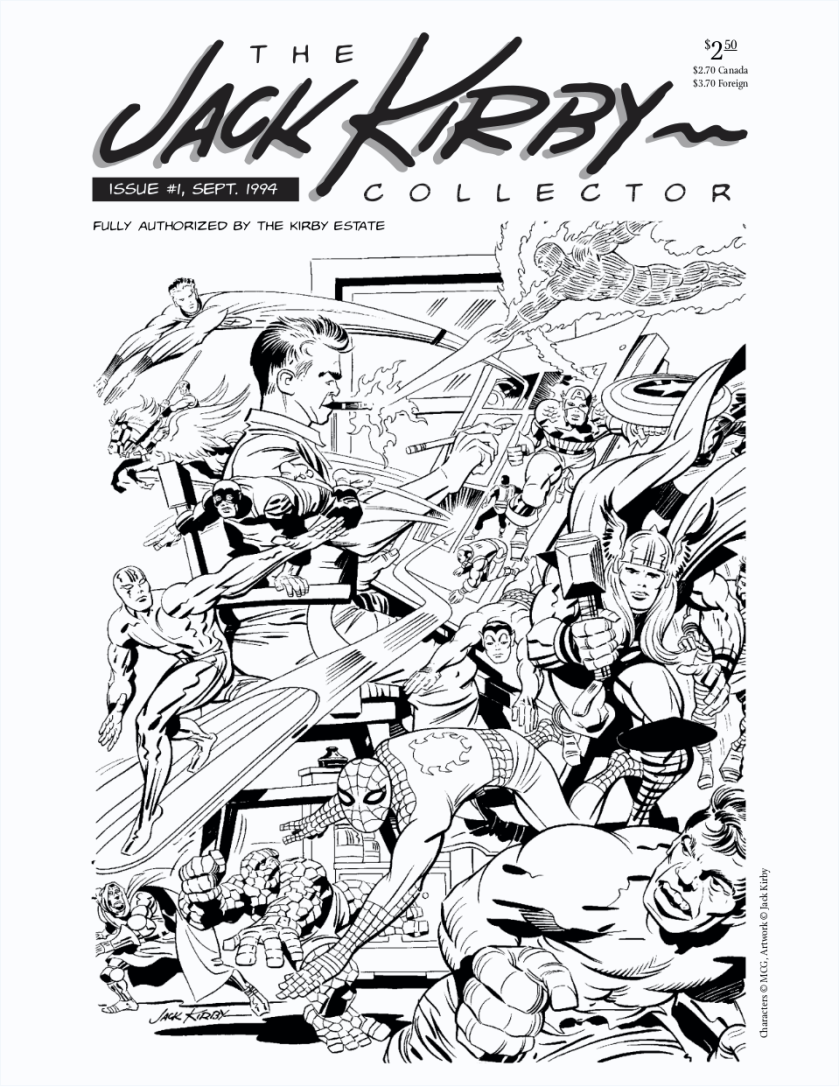
TJKC1cover
We’ve come a long way from this implicit nod to Kirby’s creations on the cover of TJKC #1.

155[169]: After a 186-page missing chunk of testimony, the deposition picks up with Stan discussing what appears to be his text for Origins of Marvel Comics, and possibly other books where he’s discussing the creation of the Marvel characters…

Note that Marvel redacted material that was detrimental to the brand, not testimony that corroborates their version. It’s important to mention that in 1974, possibly based on a company directive, Lee used Origins to take away credit for everything Kirby did but the art. In the 2010 deposition described above by Morrow, Lee clearly stated that when he wrote the book, he was only being magnanimous to suggest Kirby even did that much. It was a disclaimer to establish that any hint of a suggestion of Kirby creation that might be found in the book was an exaggeration based on Lee just being a great guy.

155[170]: So if they talked about the FF first, Jack then did sketches for Goodman to approve, and later Stan wrote the synopsis, nothing about this scenario is at odds with Lee’s answer. And that’s what seems most likely, and most logical, to have happened, at least to me.

Or, if Kirby wasn’t lying to Groth or Pitts or Eisner or Schwartz or Van Hise or Zimmerman or Steve Sherman, Lee was immobilized by his diminishing career prospects and Kirby stepped in to pitch the concepts out of whole cloth to Goodman.

James Van Hise (see also Good things, p 19) incorporating a Kirby interview into his article… 55

For many years, Stan Lee has taken sole credit for the creation of Marvel’s best-known characters. Lee underscored his claims in his book, Origins of Marvel Comics.

“That’s his version of it,” Kirby observes. “If he wants to say that, it’s his book. If I write my book, you’ll get my side of it. But I can tell you that my side of it is the real side–Stan Lee never created a character. In fact, if you look it up in Maurice Horn’s book, he was amazed, too. He was amazed at the kind of things that came out of Marvel after I got there and the fact that Stan Lee had never created a character before that. What has he created since? Nothing. I don’t think that Stan Lee cares about creating characters. That’s my professional opinion. But as far as writing the stories is concerned, he never wrote the stories–not mine anyway.

“I was a penciller and a storyteller and I insisted on doing my own writing. I always wrote my own story, no matter what it was. Nobody ever wrote a story for me. I created my own characters. I always did that. That was the whole point of comics for me. I created my own concepts and I enjoyed doing that.”

Lee rewrote Jack’s captions and word balloons when he brought the artwork into the office.

“Lee wouldn’t let me put the dialogue in. I wrote the story and made up the characters. I had to tell Stan Lee what the story was going to be. He didn’t know. Nobody’s ever seen Stan Lee write a story. I’ve never seen him write a story–not in front of me. Stan was an editor. I argued all the time about doing the word balloons, but I wasn’t allowed to do them. Stan Lee was editor, and his cousin was the publisher and I wasn’t going to argue with that…”

When Goodman gave Kirby a crack at the unused printing capacity pre-shutdown, then Lee got his name on the project (see p 22, under Lieber comes into his own).

158[173]: I may not like this explanation, but I don’t have any evidence to prove it’s wrong. So I have to give Stan a pass, like I gave Jack on his 1989 “Stan never wrote anything” comment.

This is more false equivalence: the red letters in Morrow’s book consistently represent untruth, often baldfaced enough to elicit a physical reaction. Evidence will eventually emerge to show that Kirby’s comment was based in truth; it should at least be given the same benefit of the doubt that’s always given to Lee’s tale about JLA sales. Morrow has shown the example of Glen Gold’s discovery (see p 86 under Lee was not a plotter). There’s also Melvin Shestack’s claim that Magazine Management writers were sometimes paid to dialogue the comics, and a statement by Roy Thomas in his TCJ interview (where Lee called Thomas “some guy”) that Kirby seems to have quoted word for word.

158[173]: I will say that, ignoring a few minor discrepancies, I found both men have been pretty consistent in their accounts over the years. So no, I don’t think either man is a liar by any stretch of the imagination.

“The Verdict” doesn’t follow from the rest of the book. Based on the evidence in Stuf’ Said, surely a judgment could be rendered on the content, not just the consistency, of Lee’s account. It seems like whenever it’s obvious Lee is lying, Morrow is ready to make the determination that Lee isn’t lying.

159[174]: Lee did it, because he genuinely believes he deserves the credit he is claiming, as seen through his own perception of his input being more important than Kirby’s or Ditko’s. Jack is also guilty of taking too much credit, even if it’s only in reaction to Lee’s grandstanding. You can argue what percentage of credit each man deserves, but they both deserve some of it, and neither deserves all of it.

I don’t think Lee genuinely believed it. I think he started by claiming an “innovation in production” that still doesn’t line up with the facts, to cover up his appropriation of the writing rate. Under Perfect Film the stakes grew higher as Lee became their perfect candidate to claim creatorship; on staff, his creations were the property of the company.

“Jack is also guilty of taking too much credit”? This statement is the most deserving in the book of the “egregious” label, but even amidst a relatively comprehensive collection of six decades of Lee’s misdirection, Morrow could only find against Kirby. TJKC is the wrong place to make this claim: Kirby asked for nothing more than recognition for what he’d done, which was create the properties and write the stories. Even Jerry Bails concluded Lee had fed him bogus information in the ‘60s: “Kirby should be advised to sign on the biggest legal guns and fight for the characters he created.” 56

159[174]: So if I have to render a verdict myself, what would it be? To me, the real guilty parties here are Martin Goodman and the “Marvel Method.” Without them, no injustice would’ve existed—and Goodman is the reason the “Marvel Method” started in the first place. Even as the books began selling well in the early 1960s, Goodman didn’t hire anyone to help Lee with the workload, so having artists involved in plotting became a necessity, and muddied the creative waters.

This is ridiculous. “Writing” half of eight monthly publications, Lee wasn’t busy. See Lee misrepresents, p 23.

Lee’s experiments in credits and credit boxes suggest that he was using them to influence Goodman’s cutting of paycheques, and that Goodman either didn’t know about Lee’s sleight-of-hand, or turned a blind eye. Both Kirby and Ditko admitted that they rarely spoke to Goodman; Goodman’s “promises” are another case where Lee’s story has become fact.

159[174]: Once the “Marvel Method” came into play, Kirby was always at someone else’s mercy in seeing his visions realized in the way he thought they should be done.

Kirby described the feeling to Tim Skelly: “you just couldn’t take the character anywhere. You could devote your time to a character, put a lot of insight into it, help it evolve and then lose all connection with it.” 57 The bigger issue, as he told Gary Groth, was the lack of credit and pay: because of Lee’s machinations these were inseparable, no matter how Thomas spins it.

NEXT: Further information
Back to Contents

Footnotes

back 54 Stan Lee deposition, 13 May 2010 and 8 December 2010, Justia, Dockets & Filings, Second Circuit, New York, New York Southern District Court, Marvel Worldwide, Inc. et al v. Kirby et al, Filing 65, Exhibit 1.

back 55 Kirby interviewed by James Van Hise, “A Talk with the King,” Comics Feature #44, May 1986.

back 56 Jerry Bails, “We the Undersigned,” The Comics Journal #105, February 1986.

back 57 Kirby interviewed by Tim Skelly, “The Great Electric Bird” show, WNUR-FM, Northwestern University (Evanston, IL), 14 May 1971; later published in The Nostalgia Journal 27, Aug 1976.

Further information

Stuf’ Said p 5: I’ve never been a major follower of Steve Ditko’s work, or of Spider-Man, for that matter. And Ditko’s distaste for speaking out and appearing publicly puts him at even more of a disadvantage against Lee’s verbosity. So alas, there’s little I can do to rectify that disparity, but I think the few quotes from Ditko presented here speak well of him, and of his involvement at Marvel.

Ditko’s “A Mini-History” beginning in Robin Snyder’s The Comics in 2001 is essential reading and worth the extra effort to track down. For the second edition, Morrow has added quotes from A Mini-History Part 13, “Speculation,” 2003, as well as The 32-Page TSK! TSK! Package (2000), and the 2015 essay, “Why I Quit S-M, Marvel.” Morrow also quotes from The Avenging Mind (2008), Ditko’s 32-page treatise on Lee and Goodman, another must-read.

24: Though it may’ve occurred earlier, by December Jack Kirby submits his presentation for Spiderman, the idea for which is loosely based on Jack Oleck and C.C. Beck’s earlier unused “Silver Spider” strip from Simon & Kirby’s defunct Mainline company. The concept is approved, and Kirby is assigned to draw the origin story.

Kirby said the idea that became Spider-Man was submitted with the concept “blitz” that included the FF, The Hulk, and Iron Man, thus it predates Goodman’s shutdown. Plot points in the concept pages (or conveyed to Lee in a story conference) come from The Fly, Private Strong, and Rawhide Kid (itself echoing Boys’ Ranch and Bullseye origins).

26: Looking closely at the original art, you can see vestiges of Kirby’s handwriting under the final lettering in the balloons from Strange Tales #108 (with Robert Bernstein dialoguing), and Journey into Mystery #88 and Tales to Astonish #40 (both with Larry Lieber dialogue)—which begs the question: Did Jack simply copy Bernstein’s and Lieber’s pre-written script onto the artwork (and if so, why?), or did Kirby have a hand in writing the dialogue for these stories?

The vestiges of Kirby’s handwriting are the only actual proof that exists; no Lieber scripts have survived, even though Kirby kept an older Silver Spider script. It’s easily demonstrated that the credits were manipulated to give Lee plot credit where he didn’t plot (see p 28 below).

Yes, Kirby had a hand in writing the stories.

26[27]: On some of these Torch stories, Kirby’s handwriting can be seen in the word balloons, indicating either he was penciling in his own dialogue, or that of Larry Lieber, directly off his full script.

His own. Also on original art that’s still known to exist of nearly all of the monster stories. (See the IDW book under Just plain wrong, p 19.)

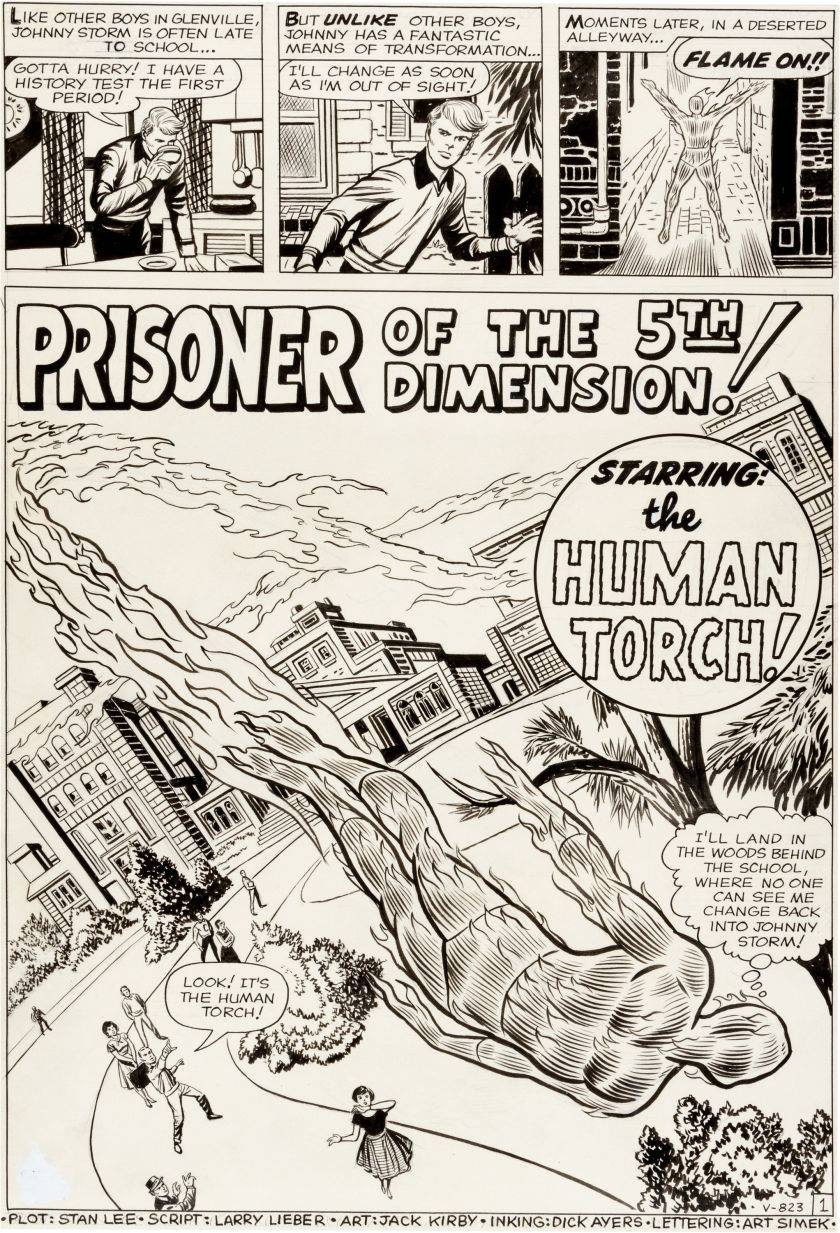
strangetales103

28: Strange Tales #103 splash page, showing the Human Torch maintaining his non-Leelike secret identity.

Lee’s first plot credit. Story plotted by Kirby.

THE ORIGIN OF IRON MAN

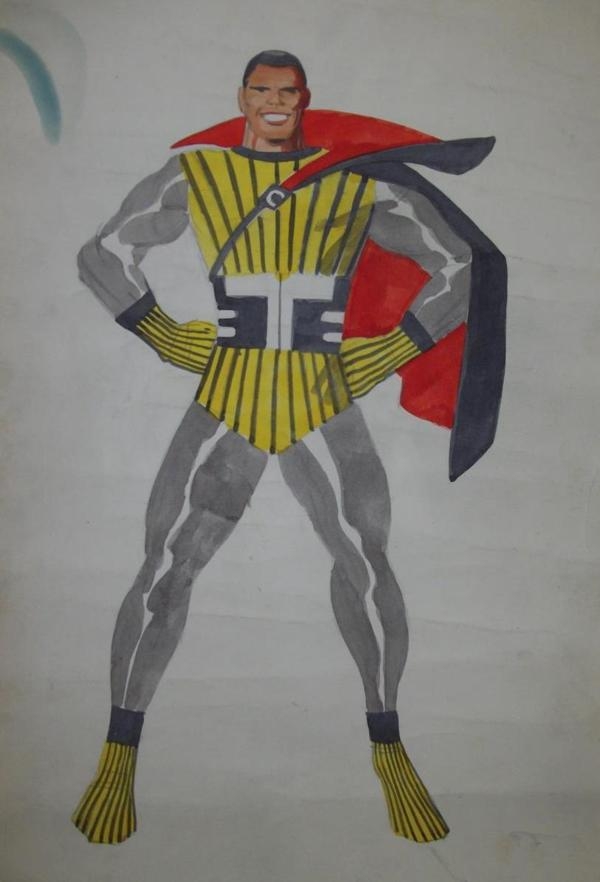
28[30]: This month, Jack Kirby designs Iron Man for his debut in Tales of Suspense #39. The cover of ToS #39 is seemingly derived from Kirby’s original concept drawing for the character, before the strip is assigned to Don Heck to illustrate using the Marvel Method.

The credits and publishing sequence of this story bear a closer look. The plot is based on a Kirby Green Arrow story, and #40 contains a Kirby origin story that may have been produced first.

Patrick Ford (Marvel Method group, 6 February 2019): “I don’t know why Lee might have held back Kirby’s origin/introduction story and replace it with one drawn by Don Heck. One thing is sure. Marvel never published another comic book where a character was introduced by someone other than Kirby only to have Kirby come along and do the second issue.”

Chris Tolworthy (same discussion): “One argument for [issue 40] being the origin story is the science. The finally published story is too magical, and that’s why I never cared for Iron Man. You simply cannot make such an advanced device in a cave! But here we see that Stark has the full resources of the military behind him.

“I can easily see Lee saying ‘this is too sciency, I want a more dramatic origin’, but Kirby was too busy to produce another story before the deadline. So Kirby recalled his old Green Arrow story (the jungle is the opposite of science, but it still has the science core) and created quick layouts for somebody else to finish.

“The mistake in the dialog (‘transistor powered’) is highly consistent with Lee not understanding a Kirby plot. It happens all the time in the Fantastic Four. Kirby’s typical method was to read something in a science magazine, then create a story about how the technology might be in thirty years. Lee would then butcher the text, showing that he did not understand the core idea.

“Regarding the scientific source material, I think it’s notable how many of Kirby’s stories come from material that was published circa 1958. Whenever I look for Kirby’s source material that date keeps coming up. So I imagine him seeing more movies and reading more magazines around that time (give or take a couple of years, and allowing for re-runs of earlier movies). In 1963 he was far too busy to do more than minimal reading. 1958 source material is also consistent with Kirby’s claim to have been pushing for superheroes since he arrived: the spark for the radiation heroes, the bomb monster and the transistor hero can all be traced to around 1958. Though of course Kirby would not work out the story details until he got the go-ahead in 1961. Just as he prepared New Gods in his mind and as sketches, but did not fill in the details until he got the deal he needed.”

Patrick Ford (same discussion): “What other comic books does TALES OF SUSPENSE #40 happen to coincide with? One of them is HULK #6 where Kirby was replaced by Ditko.

“One of the most curious things about the first ten Iron Man stories is the plots. When Kirby is the credited penciler we get robots, giant monsters, aliens, inner worlds, Dr. Strange, time travel. The other stories are far more Earth bound.”

Tolworthy made the same observation regarding the Kirby/non-Kirby issues of early Thor during the same period.

28[29]: Kirby also draws Incredible Hulk #5 this month, his final issue. When Jack brings his pages into the office, Stan rejects several of them. In a fit of anger, Kirby tears them in half and tosses them in the trash on his way out. Larry Lieber rescues the unused pages 11–13 of this Hulk story from the garbage. This is the earliest known major disagreement between Kirby and Lee.

…and…

33[35]: This month, Jack Kirby draws X-Men #1 [corrected to Avengers #1 in 2e], while Stan explains to readers why the Hulk was cancelled: [Lee] “We’ve always believed in leveling with our fans. So, for those of you who’ve asked what happened to the Hulk, here’s the scoop: We decided to discontinue the mag because we felt we were spreading ourselves too thin! … We don’t yet know where, when, or how, but be patient—mankind won’t be Hulkless much longer!”

It’s interesting to note that regular assignments on The Hulk and Thor were simultaneously dropped from Kirby’s schedule. He would only return to Thor full time with the addition of Tales of Asgard six months later.

32[34]: [Lee] “We have a new character in the works for Strange Tales (just a 5-page filler named Dr. Strange). Steve Ditko is gonna draw him. Sort of a black magic theme. The first story is nothing great, but perhaps we can make something of him—’twas Steve’s idea, and I figgered we’d give it a chance, although again, we had to rush the first one too much.”

Steve Ditko: What producer tells his customers ‘We have a product based on someone’s bad ideas but I’ve covered the shortcomings, defects, flaws, so the product is not really good but buy it anyway.’ 58

33[35]: This is a pivotal month, as Jack Kirby permanently takes on the main Thor strip, and draws the first installment of “Tales of Asgard” back-ups in Journey into Mystery #97, a project that Lee feels is tailor-made for Kirby…

Speculation: Lee promised Kirby autonomy in the back-up feature to entice him to return to Thor.

Chris Tolworthy made some observations on the lost issues (see the link under p 28 above).

42[46]: After several issues away, Jack is drawing Sgt. Fury #13, featuring a WWII team-up between Fury and Captain America. The credits read “Written and drawn by the titanic two: Stan Lee and Jack Kirby”, and with his WWII experience and association with both characters, I’d assume Kirby was at least partially (if not totally) responsible for the plot.

Totally. The John Severin quote (Stuf’ Said, p 29[31]) is helpful in making this determination.

LAYOUTS

45[49]: By the end of November, Kirby is drawing layouts for the Hulk feature in Tales to Astonish #68. If Jack doesn’t already have growing resentments, no doubt doing layouts for other artists would’ve caused some.

…and…

48[52]: Lee gives readers his rationale for assigning Kirby to layout so many strips…

Layouts are not a difficult concept in the context of the Marvel Method. Kirby was writing; Lee was not. In Romita’s Daredevil example, there wasn’t even a story conference. As for “it’s no wonder his layouts are simple block figures”, why don’t we just define layouts as what Kirby provided? They’re not supposed to be full pencils, they’re supposed to be what (outside of Marvel) would be called a full script with panel breakdowns. The purpose was for the penciller to pay the layout fee in the name of more Kirby-like art, and for Lee to get the full writing rate.

Morrow’s example (ToS #70 layouts) shows that Lee was only the next stop in the production line. Kirby was doing the writing, Kirby was initiating the story.

46[50]: As the year closes out, Jack Kirby creates a presentation for a new spy series, which becomes the debut of “Nick Fury, Agent of S.H.I.E.L.D.” in Strange Tales #135.

It’s critical at this point to contrast Tom Brevoort’s 2015 creation description with that of Lee from 2010:

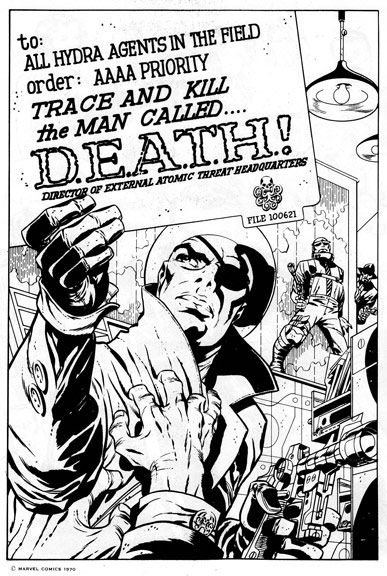
“Jack Kirby first broached the idea of doing a modern day strip with Nick Fury, and he produced a two-page ‘pilot sequence’ to show to Stan Lee, titled ‘The Man Called D.E.A.T.H.,’” he says. “Stan liked the idea of a modern day Fury strip, but reworked the basic concept with Kirby to create NICK FURY, AGENT OF S.H.I.E.L.D. And that two-page pilot story was never used. In fact, when Jim Steranko turned up at Marvel looking for work, Stan gave it to him as an inking test, which is why those pages are inked by Steranko.” 59 (See pp 46[50] and 51[55] in Stuf’ Said.)

48[52]: Stan apparently forgot about Jack’s story in FF Annual #1, which was originally done for Amazing Fantasy #16 or Spider-Man #1, but redrawn by Ditko when he became the artist on the strip.

Important to note. See Jean Depelley’s reconstruction of events, “Ditko vs. Kirby on Spider-Man,” The Jack Kirby Collector #66, Fall 2015.

STORY CONFERENCES I

61[67]: This month, Lee uncharacteristically invites Kirby to join him to be interviewed for the New York Herald Tribune—no doubt jumping on the media bandwagon started by the National Observer article. In it, Stan comments to interviewer Nat Freeland about Federico Fellini returning “in January.”

Lee also “uncharacteristically” invites Thomas to sit in.

Sean Howe: When Marvel fan Federico Fellini, in New York to promote Juliet of the Spirits, swept into 625 Madison Avenue to meet Stan Lee, Men magazine editor Mel Shestack scoffed that Lee didn’t know who Fellini was; years later, Shestack insisted that the director had quickly lost interest in Lee and cottoned instead to the more colorful magazine editors, who were themselves like “living comic books.” 60

61[67]: So this casts some doubt as to whether this is an accurate representation of a plot conference (if so, Stan skipped an entire issue’s plot, and Kirby stretched a few sentences from Stan into FF #55–60, and tossed in the Klaw issue and subplots himself).

Chris Tolworthy, Marvel Method group, 13 September 2016: “Clearly the meeting was staged, and equally clearly Stan did not know what was in the book. E.g. he said that the Surfer was away in space, yet the whole point of the Surfer was that he was trapped on Earth! Given that they must have had a meeting first, that makes it even clearer that Stan had absolutely no idea what was going on. Stan’s plan interrupted Jack’s flow: issue 55 stands out like a sore thumb, amid a series that otherwise flows from issue to issue. So either Stan ignored what Jack said or he deeply misunderstood it. Almost certainly a combination of the two. And having discussed it first, Jack had every reason to hope that Stan would make this a back and forth performance. But Stan, being Stan, couldn’t stop himself hogging the limelight. So everything about what Stan did was an insult to Jack. The published description of Jack as boring was just icing on the cake, and a natural result of Stan’s behaviour.”

Chris Tolworthy (email to me, 23 June 2018): “Remember, this alleged plotting session must have been for Fantastic Four 55 (based on the content and the date): just five issues after the most famous Fantastic Four story ever, featuring the intro of Stan Lee’s all time favourite character, the one he would not let anybody else write! The story climaxes with the Silver Surfer being EXILED ON EARTH. That is the whole point of the Surfer’s character: he is an alien TRAPPED ON EARTH and must therefore learn about us and be horrified by our madness. But Lee thinks the Surfer spends his time out in space after the battle with Galactus. Lee does not know the first thing about the story he claimed to write, or the first thing about the characters! As soon as Lee opens his mouth he proves he is doing exactly what Thomas denies he is doing: trying to grab credit away from Kirby.”

MONSTER

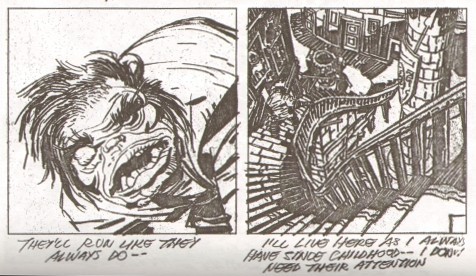
96[104]: His faster schedule means he can take on additional work at this point, including the story “The Monster” for Chamber of Darkness #4. But Kirby’s original version of the story goes through numerous revisions in the Marvel offices before publication, and he is required to redraw several panels—and to change the original ending, that has Kirby and Lee be the surprise narrators in its final panel. Why this is rejected is still a mystery, as the original story by Kirby is solid, and more remarkable than what finally sees print.

In The Jack Kirby Collector #13, Morrow detailed Lee’s destruction of Kirby’s story:

The differences in the stories were devastating. The sheer inventiveness was diluted out of Jack’s original, its grandiose action reduced to parlor room gunplay, and the finale seemed half-hearted. There was evidence of major revisions, and the final boards showed it. Entire pages were discarded, panels cut and rearranged, and remnants of original pencils could be detected under redrawn panels.

Monsterp3

Chris Tolworthy, The Marvel Method group, 26 September 2016: “How can anybody read both versions and claim that Stan was anything other than a vandal? Given the final panel, and Jack’s comment about the dialog, I wonder if Stan rejected it because he thought it was a personal attack? And if so, Stan did far more to embarrass himself by changing it: he’s like a dictator who orders great art to be destroyed because he does not understand it, but vaguely suspects he is being made fun of. Heck, he’s not acting LIKE that, that is precisely what he was and what he did.

“Even the parts that survive, like the images of the monster leaping from the tower, and the frame with the stairs, are damaged by overly verbose dialog hiding the details.

“This reminds me of one of Stan’s favourite original ideas, one of those things he kept coming back to: publishing photo books (of movie monsters, celebrities, etc) with his own uninspired captions: the ‘You Don’t Say’ series. I think Stan missed his vocation. He was born to be a vandal, finding anything that people liked looking at, anything that somebody else had spent years to develop, and defacing it with his own dumbed down version then writing his name really big with a spray can.”

STORY CONFERENCES II

80[86], 159[174]: [Romita, 2001] “Stan would go off on a tangent and Jack would be talking about what he thought should happen. Jack would go home and do what he thought Stan was expecting. And when Stan got the script, I could hear him saying, ‘Jack forgot everything we were talking about!’”

Morrow attaches significance to this event, as though it were part of the regular workflow. This is a clear example (the Freedland interview being possibly the first and most egregious) of Lee putting on a show for his underlings to maintain the charade that he contributed in advance. What Romita’s story illustrates is that Kirby the writer (like Ditko in Mini-History, Part 12) was usually able to dismiss the more hare-brained of Lee’s suggestions in the pencilling stage. Once Kirby turned in his pages, however, Lee was in full control.

John Romita testified in his 2010 deposition that he was present “at at least two plotting sessions” between Lee and Kirby. After Toberoff’s objection, Romita went on to describe the plotting session after the plotting session, on the drive home after Kirby had taken the train in and met with Lee behind closed doors. As Romita admitted, quoted by Morrow earlier in the book (below), he was never present for a story conference.

55[61]: JOHN ROMITA: [2007] “I never sat in on their meetings. When they had a plotting session, the door was closed. But when Jack would send in, say, the first ten pages of a story—and this is how I knew where things came from—Stan would say to me, ‘Jack completely changed what we wanted the opening to be’… They didn’t always remember what the other had said.”

This admission cancels out Romita’s car ride story as well as his deposition statement.

MARVEL-LOUS

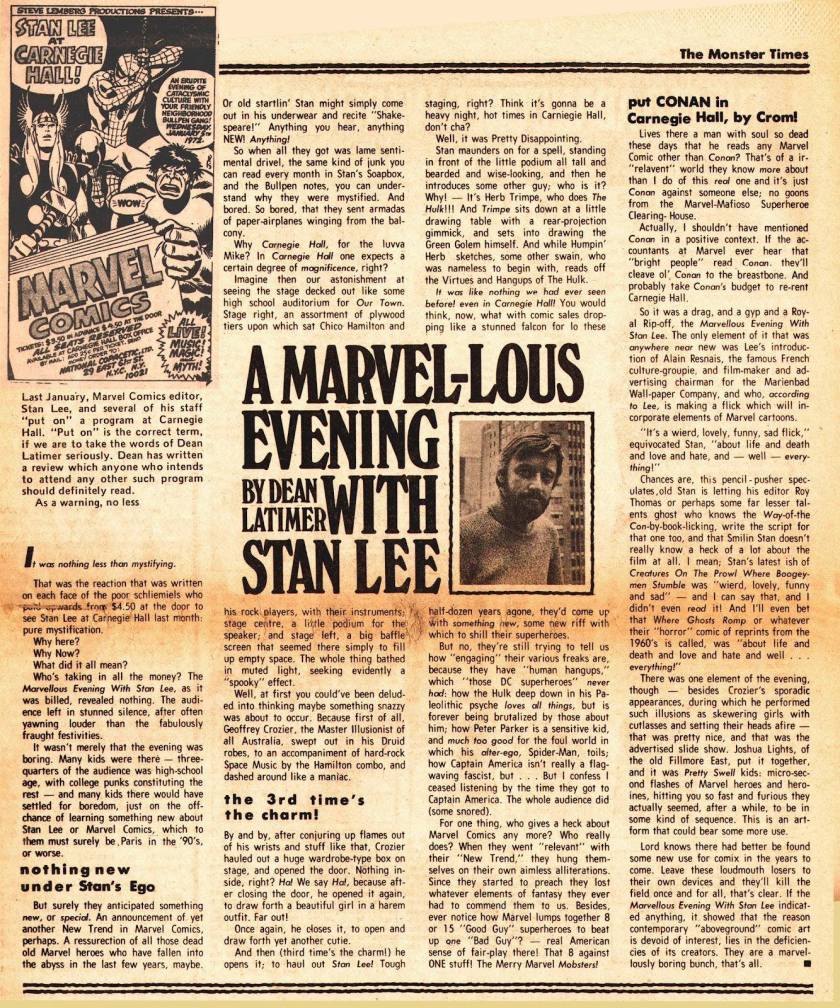
112[124]: On January 5, Stan Lee headlines a critically-panned Carnegie Hall show, “A Marvel-Ous Evening With Stan Lee,” meant to be a celebration of the Marvel brand.

Dean Latimer in The Monster Times: So it was a drag, and a gyp and a Roy-al Rip-off, the Marvellous Evening With Stan Lee. The only element of it that was anywhere near new was Lee’s introduction of Alain Resnais, the famous French culture-groupie, and film-maker and advertising chairman for the Marienbad Wallpaper Company, and who, according to Lee, is making a flick which will incorporate elements of Marvel cartoons.

‘It’s a wierd, lovely, funny, sad flick,’ equivocated Stan, ‘about life and death and love and hate, and — well — everything!’

Chances are, this pencil-pusher speculates, old Stan is letting his editor Roy Thomas or perhaps some far lesser talents ghost who knows the Way-of-the-Con-by-boot-licking, write the script for that one too, and that Smilin Stan doesn’t really know a heck of a lot about the film at all. I mean; Stan’s latest ish of Creatures On The Prowl Where Boogeymen Stumble was ‘wierd, lovely, funny and sad’ — and I can say that, and I didn’t even read it! And I’ll even bet that Where Ghosts Romp or whatever their ‘horror’ comic of reprints from the 1960’s is called, was ‘about life and death and love and hate, and well… everything!’ 61

TMT_MarvelousLee

PSYCHOLOGY

159[174]: It’s also tempting to make the psychological conclusion that Stan was passive-aggressive; that whenever a collaborator asserted themselves, he pushed back.

Lee’s “first sayer” doctrine of creation was printed in TCJ. Steve Ditko quoted it in one of his Avenging Mind essays in order to take issue with the idea.

[165][Lee quoted by Ditko]: “It seems to me that the person who says, ‘This is the idea that I want done,’ is the person who created it… I think I’ve been very generous, ‘cause, as I say, anywhere except in the comic book business the artist would not be considered a co-creator, because it’s the guy who says, ‘Let there be a Hulk,’ and lo, there was a Hulk. The guy who says it, he’s the creator.” 62

Lee wasn’t correct from a legal standpoint, nor was he First Sayer in any of the creations. He did, however, apply the Doctrine of First Sayer to his relationship with Kirby. He was the first to get into print that he was the writer of Kirby’s comics, then the initiator of the synopsis. When Kirby came along later in the decade to make the same claims, he’d been set up to look like the liar and accused of sour grapes. Still later Lee became the first to say (outside of fanzine interviews) that he was originator of the ideas.

Early on in the FF letters pages, and to interviewers in later decades, Lee was first to accuse Kirby of his own unsavoury motives. Some examples: greedy, a very evil person, tending toward hyperbole. Only the first one can be said to be partially in jest.

Alan Weiss: I would also like to know what the name of your artist is.

Lee: Considering that our artist signs the name JACK KIRBY on everything he can get his greedy little fingers on, I think we can safely claim that that’s his name!
Stan Lee, Fantastic Four #3 LOC page, cover date March 1962, also Stuf’ Said p 23.

“I think he’s gone beyond of no return,” Lee said [of the TCJ interview]. “Some of the things he said, there is no way he could ever explain that to me. I would have to think he’s either lost his mind or he’s a very evil person.” 63

“Jack tended toward hyperbole…” 64

Greedy? It’s easy to say that Lee’s behaviour begs to be psychoanalyzed (he was a master of projection), but his scapegoating or narcissistic reaction formation was simply covering up his own greed in the theft of the writing pay. Evil? Tending toward hyperbole? Lee was talking about himself.

It’s a measure of the success of Lee’s strategy that one reaches the end of a book like Stuf’ Said to discover that the verdict is inconclusive: the truth is somewhere in the middle. Lee rarely gave anyone cause to believe what he said, but as First Sayer he convinced people that he told the truth about Kirby’s work. Kirby never gave people reason to doubt his word, but for wearers of the Big Boy Pants, his contradiction of Lee’s version of events was sufficient for them to give Lee the benefit of the doubt.

Mark Mayerson (23 September 2012): “It’s important to remember how long Lee was a failure. While he worked for a relative, Lee could never get beyond Martin Goodman’s comic books. While he had the examples of Mickey Spillane graduating to paperbacks and other Goodman writers like Bruce Jay Friedman and Mario Puzo graduating from Goodman’s magazines into novels, plays and screenplays, Lee couldn’t even get promoted to the “men’s sweat” magazines that Goodman published. During the 1950s when comics were being vilified, that must have been particularly painful.

“And there was that incident where Goodman found an entire closet full of unpublished inventory and laid off the comics staff as a result. That was gross mismanagement on Lee’s part, damaging the company’s cash flow. I don’t doubt that if Lee hadn’t been family, he would have been fired too.

“When Marvel finally took off in the ’60s, Lee had 20 years of pent-up hunger for success driving him. He wasn’t about to share credit with anyone. Admitting that Kirby and Ditko were the cause of his success, even partially, would only confirm Martin Goodman’s low opinion of him. And Goodman was right. There are dozens of examples of comics writers and artists who became prose authors, illustrators and fine artists. Lee is still milking the superhero genre even though he hasn’t created any successes in the last 40 years and never did without Kirby and Ditko.”

Patrick Ford (24 September 2012): “Mark, Logic dictates Lee’s original motivation for taking credit for the writing was because he was paid a page rate for writing apart from his salary for editing. If Kirby and Wood, and Ditko, had been credited with writing (or plotting) they would have been paid instead of Lee. Ever notice that Lee was always careful to credit himself with plotting stories which were actually plotted by Jack Kirby?”

138[150] Jack Kirby (to Leonard Pitts Jr, 1985): “Since I’ve matured, since the war itself–I’ve always been a feisty guy, but since the war itself, there are people that I didn’t like, but I saw them suffer and it changed me. I promised myself that I would never tell a lie, never hurt another human being, and I would try to make the world as positive as I could.”

mm9p16panel2l

Back to Contents

Footnotes

back 58 “He Giveth and He Taketh Away,” The Avenging Mind, © 2008 S. Ditko.

back 59 Marvel Executive Editor Tom Brevoort to Tj Dietsch, “C2E2 2015: S.H.I.E.L.D.,” Comics News, Marvel.com, 26 April 2015.

back 60 Sean Howe, Marvel Comics: The Untold Story, 2012.

back 61 Dean Latimer, The Monster Times #3, March 1972.

back 62 “Newswatch,” The Comics Journal #111, September 1986, quoted in Creator or Co-Creator?, Avenging Mind, © 2008 S. Ditko.

back 63 Steve Duin, “The Back Story on Stan Lee vs. Jack Kirby,” The Oregonian/OregonLive, 26 June 2011.

back 64 “Stan the Man & Roy the Boy,” A Conversation Between Stan Lee and Roy Thomas, Comic Book Artist #2, Summer 1998.

The History of Marvel According to Roy Thomas, Part One

An interview with Roy Thomas appeared in The Jack Kirby Collector 74. Interviewer Matt Herring seems to have a healthy enthusiasm for all things Kirby, but is shot down by Mr Thomas at every attempt to express it.

Thomas is known as an historian, but the history he presents adheres more to the company-scripted storyline than to the events he witnessed beginning in 1965. It’s essentially the Stan Lee story, but with added speculation to fill in the so-called gaps in Lee’s memory; naturally it’s at odds with Kirby’s version. Not only was Thomas not in the room at Marvel’s inception, he was the fan-turned-employee who lived in a bubble: much of his external input was from Lee and people under Lee’s thrall.

For the same reason that Lee’s memory was as sharp as a tack for his 2010 Kirby case depositions, the story told by Thomas has been refined over the years. He accuses Kirby of “delusions of grandeur” for telling his side of the story in the Comics Journal interview and other places, but Thomas himself was never more candid than on the occasion of his own TCJ interview, when he was on the outs with Lee. For example:

“By the early ‘70s [Lee’s] balloon placement, his wording, etc., were generally perfect, but he had substituted form for substance. He’d given up on much of characterization he’d pioneered, as he cut down the number of balloons on a page in the interest of making better time as he had other demands on him. There were no surprises left, not even little ones such as you’d have seen from the early ‘60s through to the late ‘60s… The problem is that a field is no damn good as a long-time profession if you can only stay in it during your best creative period. I mean, does Stan Lee have to be kicked out of the field if you can show his best work was all finished before 1970?”1

Thomas ignores (or chooses to conceal) one of the foundational truths of Marvel history: Stan Lee was not an idea man. Lee’s story ideas came, sometimes under duress, from Ditko, Wood, Goldberg, Ayers, Toth, Orlando, and above all, Kirby. When Kirby was on a title, Lee would assign himself as its writer; when his last writer finally left the building in 1970, not coincidentally “there were no surprises left” in his work, as Thomas put it, and Lee quit “writing” comics.

Here follow some passages from the TJKC interview with comments.

THE HERALD TRIBUNE ARTICLE

THOMAS: And, unfortunately, Stan kind of took the rap for [the tone of the article] from Jack and Roz, who somehow felt that Stan was trying to grab credit away from him, and though Stan could do that, he wasn’t doing that in this instance.

Thomas is wrong: Lee was trying to grab credit. The purpose of staging the Nat Freedland “plotting session” was to present Lee as the originator of the ideas. Thomas knew the story conference was atypical by the very fact that he was invited to attend.

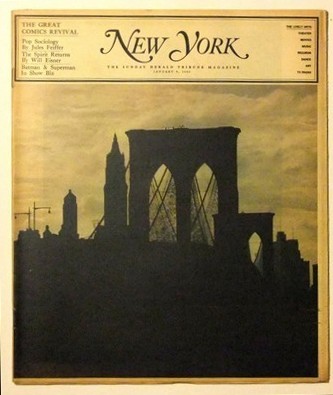
SundayMagCover

Lee in the Herald Tribune article: “The Silver Surfer has been somewhere out in space since he helped the F.F. stop Galactus from destroying Earth… Why don’t we bring him back?”

“Ummh,” says Kirby.

“Suppose Alicia is in some kind of trouble. And the Silver Surfer comes to help her…But the Thing sees them together and he misunderstands. So he starts a big fight with the Silver Surfer. And meanwhile the Fantastic Four is in lots of trouble. Doctor Doom has caught them again and they need the Thing’s help. … The Thing finally beats the Silver Surfer. But then Alicia makes him realize he’s made a terrible mistake. … The Thing is brokenhearted. He wanders off by himself. He’s too ashamed to face Alicia or go back home to the Fantastic Four.”

Chris Tolworthy: Remember, this alleged plotting session must have been for Fantastic Four 55 (based on the content and the date): just five issues after the most famous Fantastic Four story ever, featuring the intro of Stan Lee’s all time favourite character, the one he would not let anybody else write! The story climaxes with the Silver Surfer being EXILED ON EARTH. That is the whole point of the Surfer’s character: he is an alien TRAPPED ON EARTH and must therefore learn about us and be horrified by our madness. But Lee thinks the Surfer spends his time out in space after the battle with Galactus. Lee does not know the first thing about the story he claimed to write, or the first thing about the characters! As soon as Lee opens his mouth he proves he is doing exactly what Thomas denies he is doing: trying to grab credit away from Kirby.2

None of this is new. Alicia was in trouble in issue 16 and elsewhere. The surfer became her friend in issue 49. The Thing misunderstood that friendship in issue 50. Dr Doom captured them in issue 10. The Thing defeated Doom in issue 38. The Thing battled the surfer in issue 50. The Thing wandered off depressed in issues 50-51. Lee is simply putting together elements that already appeared. In contrast, all the other issues around this included brand new characters and brand new situations (or at least situations that had not just happened a few issues earlier). This plotting session is notable for having NO new ideas. Why? Whenever Lee and Kirby work together behind closed doors, ideas are original. But when Lee is definitely working alone, ideas are not original. Yet he acts full of energy and puts on a wonderful show for the interviewer.3

Kirby’s “Ummh” was the point where he was about to interject that the Surfer was Earth-bound. He decided against making Lee look bad by contradicting him in front of the reporter. Lee didn’t return the favour, and Freedland pegged Kirby as a spectator in the process.

The interview was just another straw. Thomas belittles the honest reaction of the Kirbys, requiring him to ignore the (at the time) very recent history of the near office revolt, when Kirby considered following Wood and Ditko out the door. We can file this under Not Thomas’ place to say.

HOW TO QUIT MARVEL

THOMAS: But the trouble is, when Jack came back, Stan didn’t have that kind of direct contact with him anymore. That bond had been broken in 1970, when Jack called him coldly one day just to say, “I’m quitting and I’ve already started working for DC.” You know, that’s not the way you would tell somebody that you’re quitting if you ever think you might want to come back.

Thomas, who speaks from the Lee side of the Marvel Method equation, is the wrong person to be expressing an opinion on Kirby’s interaction with Lee. He doesn’t acknowledge any active part on Lee’s behalf in Kirby’s departure, despite the fact that, in his own words, Lee and Marvel could be vindictive:

The thing that was truest in that article [“Roy Thomas Leaves Marvel,” Journal #56] was the analysis that Marvel has had a tendency in recent years to be very vindictive toward people who leave it to work for the competition. They go far beyond any kind of professional reaction. Stan generally has reasonably good and humane instincts, but once in a while he’ll just decide that if somebody does something, he’s never going to work for Marvel again. He did this with Len, and with Gerry, though to date he’s never said it about me.4

tcj61

As Steve Ditko experienced, there was really nothing that could be said to Lee; Lee wasn’t speaking to Ditko when he quit, so it had to be done through Sol Brodsky. From what we know of the two personalities involved, Kirby handled his departure exactly the way it should have been handled. It goes without saying that the decision had been made much earlier.

PITTS: Why did you leave the F.F. and Marvel that first time?

KIRBY: Because I could see things changing and I could see that Stan Lee was going in directions that I couldn’t. I came in one night and there was Stan Lee talking into a recording machine, sitting in the dark there. It was strange to me and I felt that we were going in different directions.5

GROTH: Did you ever talk to Stan about the application of credit?

KIRBY: You can’t talk to Stan about anything.6

Thomas maintains the fallacy that Lee was taken by surprise by Kirby quitting. Larry Lieber’s deposition contains the story of Kirby tearing up pencilled Hulk pages while storming out of a story conference, probably in late 1962. After the incident, Kirby wasn’t involved with Thor on a regular basis for seven months, and didn’t do another Hulk story for over two years. Lee was forced to come up with unlikely excuses for the Thor personnel shake-up: Al Hartley wanting to work on an adventure strip, or Kirby being late with his FF pages. He didn’t know Kirby was quitting? The working arrangement already showed signs of strain when assignments were either refused or withheld in 1963.

Mike Gartland has described subsequent deal-breaking events in the relationship, in his series, “A Failure to Communicate,” available at the Kirby Museum site. Fast forward to 1970 when, as detailed in TJKC 137, Lee vandalized Kirby’s beautiful story, “The Monster.” He had Kirby redraw it nearly in its entirety, because he could.

Then there’s the contract Kirby was offered.

Mark Evanier: There were other troubling clauses, each more onerous than the previous, so signing [the proffered contract] was out of the question. Jack couldn’t do that to himself, couldn’t do that to his family. He got his attorney involved, but Perfect Film/Marvel still wouldn’t talk to his attorney. Then a lawyer or exec from Perfect Film called Jack directly. This is Kirby’s account as he described it in 1970: The caller asked when they’d be receiving the signed contract. Kirby said he needed changes. The caller said there would be no changes; take it or leave it. Sign it or get out. Jack protested: He was too important to the company to be treated this way. The caller told him he was nuts. Stan Lee created everything at Marvel and they could get any idiot to draw up Stan’s brilliant ideas. At least, that’s how Jack would remember the conversation. Kirby hung up on him, phoned Infantino, and changed companies.8

It’s not Thomas’ place to say that Kirby’s method of quitting was inappropriate, when his own experience would seem to be a primer on how not to quit Stan Lee—his multiple attempts include the time he tried and failed to quit by phone.

GUSTAVESON: But you were saying—by 1974, you and Stan had reached a parting of the ways?

THOMAS: Yes, it seems so in retrospect. It seems inevitable, but I didn’t know it at the time, and neither did Stan. By becoming Publisher, he had gone form being creative force to total company man, which was what he wanted–but I didn’t want to follow him along that path as I had before. As he himself put it once to someone else, “Roy and I no longer see eye to eye.”

I even quit one earlier time, over the phone, and Stan talked me into staying on. But of course in the long run that was an intolerable situation for him, as well as for me.9

HOUSEROY

THOMAS: So I said, “Jack, Stan would really like you back. He obviously never wanted you to leave… The only thing in the way, really— he was kind of hurt and bothered when you did that Funky Flashman stuff in that one title, where you made a character who was a rather vicious—… Now, you had this character called Houseroy.” I said, “I didn’t mind about that because I didn’t feel you were really aiming that at me. I was just Stan’s flunky…” Okay, so I am Stan’s flunky or whatever. And Houseroy is a clever name. I didn’t really mind that much. And I was almost a sympathetic character…”

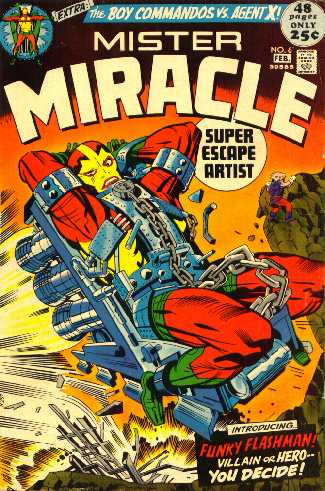
A couple of points… First, Funky Flashman was undoubtedly the most accurate portrait of Lee we’re ever likely to see, by someone who had worked closely with him but was not beholden to him. Marvel has since outlawed this kind of thing from former employees.

Second, Thomas portraying Lee as the wounded party belies the facts: Lee exited the ‘60s with all of the fruits of the collaboration. Kirby, a freelancer with a good claim on the copyrights and no contract covering the work, was a liability, hence the insulting contract. At best, Lee didn’t lift a finger to see that his longtime collaborator was rewarded or even retained by the company. At worst, he was a willing participant in running him off. (This was not an isolated incident: Lee’s loyalty was to Lee, and he displayed the same lack of respect for the man who’d kept him employed through thick and thin—until it became a life-long job—when he later displaced Goodman’s son as publisher.)

mm6

KIRBY: And my wife was present when I created these damn characters. The only reason I would have any bad feelings against Stan is because my own wife had to suffer through that with me. It takes a guy like Stan, without feeling, to realize a thing like that. If he hurts a guy, he also hurts his family. His wife is going ask questions. His children are going to ask questions.10

HOSTILITY

THOMAS: There was a lot of hostility in him, in general and toward Stan, and before that, toward Simon, all his partners. Toward Carmine Infantino, I think, at a certain stage, too, the guy who brought him over to DC. I loved Jack, but I think he was one of these guys who, whenever he got a partner or was working with somebody, it was inevitable that before long he would just hate them.

Roy Thomas didn’t know Jack Kirby. People who did would tell you he didn’t hate anybody. Kirby was not a hostile, angry guy who hated people, even when others would believe it was justified.

Steve Sherman: Jack was not a hostile guy. His feelings towards Stan go way back. They had different work ethics. He didn’t “hate” Stan. He understood him for who he was and dealt with it as best he could… He was not one to blame others or find fault with people. If anything he could become frustrated because he was in a field that didn’t like to venture far from the status quo. He felt that comics were a legitimate story telling medium that was crippled by a bad business model.11

Jim Amash: The Jack Kirby I knew was not an angry man on the outside but he used the anger he felt to produce art… In an interview somewhere, Jack said something to the effect, “I’m a man who lives with anger.” Jack constructively channeled whatever feelings he had to the comics page and probably felt a great personal release when he did so… Jack was one of nicest, kindest people I ever knew. He was essentially a happy man and maybe he had some bitterness on how certain people treated him.12

KIRBY: Since I’ve matured, since the war itself–I’ve always been a feisty guy, but since the war itself, there are people that I didn’t like, but I saw them suffer and it changed me. I promised myself that I would never tell a lie, never hurt another human being, and I would try to make the world as positive as I could. There’s a lot of guys that might feel (laughter)… My own son feels I’m uncool but my grandson loves me. Being cool or uncool is a generational thing. But as a personal thing, I really love everybody in sight. I’d love to see Stan Lee at peace with himself. I mean, really at peace with himself. Not money-wise, not ambition-wise, not being driven–whatever drives him. But I’d like to see him at peace as a human being.13

CREDIT

In a letter to Comic Book Creator (to be discussed in a later installment), Thomas introduced the phrase “repeatedly over the years” to mean “more than once in the past twenty years.” Repeatedly over the years when he’s spoken about Kirby, Thomas has insisted that credit wasn’t important, and that Kirby didn’t demand it until years after the fact.

“We weren’t worried about the credits, because there wasn’t any money involved.”14

Evidence shows that actually it was the credits that determined who got paid, so this is a misrepresentation.

“For years, Jack Kirby didn’t care that he wasn’t being listed as a writer. Later on when something becomes successful, then everybody starts saying, ‘This percentage of it’s mine!’ ‘That percentage of it’s mine!'”15

“…of course, at that time, it wasn’t occurring either to Stan or to Jack to claim such credit. They were both too busy just getting the stories done and collecting their paychecks.”16

A couple of dissenting opinions were registered in Stuf’ Said, published in 2019:

KIRBY: “…when I began asking for a little more credit, say, a writer credit, he cut the horse up fine and said it was ‘plotting.’ And no matter what I said, he was the publisher’s relative and Goodman was big on family.”17

John Morrow: When asked if this credits change was the result of Kirby actively asking for it, Jack’s wife insisted: “Of course! He used to ask for it all the time…We always asked for a lot of things all the time, and finally they put down ‘Produced by…’ because it’s just ridiculous, you know.”18

Thomas’ insistence that no one was interested in credit at the time contradicts earlier and thus more reliable testimony—from Roy Thomas:

GUSTAVESON: Didn’t Marvel promote art by bringing back the idea of credits in comic books?

THOMAS: Yes, though almost solely, I think, because of Stan Lee’s own well-developed and for the most part deserved ego. Remember, those early credits read “Stan Lee and J. Kirby,” and did you ever know Jack to sign with an initial? It’s just that Stan had obviously decided, after two decades in the field, to make his mark… and there was no sense in hiding his light under a bushel.19

NEXT: 1961

back 1 Roy Thomas, interviewed by Rob Gustaveson, The Comics Journal #61, Winter 1981.
back 2 Personal email from Chris Tolworthy to me, 23 June 2018.
back 3 Personal email from Chris Tolworthy to me, 27 February 2019.
back 4 Roy Thomas, interviewed by Rob Gustaveson, The Comics Journal #61, Winter 1981.
back 5 Jack Kirby interviewed by Leonard Pitts, Jr., conducted in 1986 or 1987 for a book titled “Conversations With The Comic Book Creators”. Posted on The Kirby Effect: The Journal of the Jack Kirby Museum & Research Center.
back 6 Jack Kirby interviewed by Gary Groth, conducted in summer of 1989, The Comics Journal #134, February 1990.
back 7 See the PDF preview at http://twomorrows.com.
back 8 Mark Evanier, Kirby King of Comics, 2008.
back 9 Roy Thomas, interviewed by Rob Gustaveson, The Comics Journal #61, Winter 1981.
back 10 Jack Kirby interviewed by Gary Groth, conducted in summer of 1989, The Comics Journal #134, February 1990.
back 11 Steve Sherman, personal email to me, 28 June 2018.
back 12 Jim Amash, Kirby-L internet mailing list, 18 March 2000.
back 13 Jack Kirby interviewed by Leonard Pitts, Jr., conducted in 1986 or 1987 for a book titled “Conversations With The Comic Book Creators”. Posted on The Kirby Effect: The Journal of the Jack Kirby Museum & Research Center.
back 14 Roy Thomas interviewed by Jim Amash, published in The Jack Kirby Collector #18, September 1997.
back 15 Roy Thomas, Robert Kirkman’s “Secret History of Comics” Episode 1, 2017.
back 16 Roy Thomas, e-mail to John Morrow, September 2018, printed in Stuf’ Said
back 17 Village Voice interview with Jack Kirby, December 8, 1987, quoted in Kirby & Lee: Stuf’ Said! November 2018.
back 18 Roz Kirby interview conducted by John Morrow, December 12, 1995, for Jack Kirby Collector #10, quoted in Kirby & Lee: Stuf’ Said! November 2018.
back 19 Roy Thomas, interviewed by Rob Gustaveson, The Comics Journal #61, Winter 1981.

All other Roy Thomas quotes are from “The Terrific Roy Thomas,” The Jack Kirby Collector #74, Spring 2018.

The History of Marvel According to Roy Thomas, Part Two

1961

THOMAS: In 1961, Stan just stumbled into suddenly having the greatest comic book action artist of all time working for him for cheap wages, simply because he had been in a lawsuit with a DC editor who was so vengeful that he got him blacklisted from DC Comics. With only two or three companies in the field, Jack was forced into coming back to Timely for these cheap rates. Jack was sort of at Stan’s mercy wage-wise and work-wise… you can’t describe it any better than to say it was a “perfect storm” that happened that nobody could control, nobody could have predicted. And that’s why everybody keeps trying to explain it, because some people say it was all Stan Lee—and some people fervently believe it was all Jack Kirby, which is at least equally ridiculous.

Thomas’ account, although it began to develop within a few years of the events it concerns, is inaccurate. Lee’s future was dependent on Kirby taking action to forestall the shutdown of the comics operation, and the introduction of the Marvel Method immediately followed. The key truth in this passage is one that Thomas fails to develop, that Kirby was at Lee’s mercy. Lee didn’t have an eye for talent, he had an eye for writer/artists whose financial position meant that they had no choice but to say yes to the Marvel Method—“having the right people around him,” as Thomas told TCJ:

Stan of course, never operated in a vacuum, at least not in those early days. Jack Kirby in particular was there, and he was just the right artist—no, more than an artist, he was a person with a strongly developed story sense of his own that enabled Jack to add considerably to the material things which Stan himself might not have been equipped to do at that particular stage… Whatever he might say or others might believe, Stan, I think, always knew that he was dependent on having the right people around him.1

Let’s have a look at some actual historical details…

KIRBY: I began to do monster books. The kind of books Goodman wanted. I had to fight for the superheroes. In other words, I was at the stage now where I had to fight for those things and I did. I had to regenerate the entire line. I felt that there was nobody there that was qualified to do it. So I began to do it. Stan Lee was my vehicle to do it. He was my bridge to Martin [Goodman].2

KIRBY: I had to do something different. The monster stories have their limitations — you can just do so many of them. And then it becomes a monster book month after month, so there had to be a switch because the times weren’t exactly conducive to good sales. So I felt the idea was to come up with new stuff all the time — in other words there had to be a blitz. And I came up with this blitz. I came up with The Fantastic Four, I came up with Thor (I knew the Thor legends very well), and the Hulk, the X-Men, and The Avengers. I revived what I could and came up with what I could. I tried to blitz the stands with new stuff. The new stuff seemed to gain momentum.3

Steve Sherman: The thing is, if Joe Maneely hadn’t died, things would have been a lot different. I guess you can call it fate, destiny, random events, but Jack probably would have found something else. Yes it was early ’61 that Goodman was going to pull the plug. Don’t forget, the Marvel offices at the time were pretty small, so it wasn’t a big deal to close the office. I would guess that Goodman had not yet informed the printer or engravers, since that would have been bought ahead of time. I would guess that last issues of the books had been sent out. Jack couldn’t let them close. Jack had always been working on ideas for books. He was pretty well aware of what was being published. He always felt that “superhero” books would make a comeback. Since Goodman already had the pipeline going, it wasn’t too much to give it another shot, especially since it was Jack. He had come through before, so why not. As Jack told me, he came up with all of the titles at once. He called it a “blitzkrieg”. He felt if he put out a bunch of new books at once, it would make a splash. He had “FF”, “Spider-Man”, “The X-Men” and “Thor” and “Hulk”. You can believe it or not, but that’s what he told me.4

Kate Willaert: One thing that really surprised me was October 1961. Marvel shipped an entire month’s worth of books in the last week of September 1961 (including Fantastic Four #2), and then published nothing in October. Four whole weeks of nothing.5

Marvel published comics twice a month in 1961 (and once three times a month), but nothing from September 28th to November 2nd. According to Kirby’s account, Goodman had pulled the plug and then given Kirby’s superheroes a chance, and was convinced enough by what he saw to re-start the operation. Lee insinuated to Thomas that it didn’t happen: “I never remember being there when people were moving out the furniture. [chuckles]… Jack tended toward hyperbole.”6

Steve Ditko wrote about Lee using levity to redirect credit.7 This is another application of the same technique, and Lee combined it with accusing his adversary of that of which he himself was the master—in this case, hyperbole.8

Kirby on convincing Goodman: “It took all day to do that.”9

As a side note, characterizing the discussion as, “it was all Stan Lee” versus “it was all Jack Kirby” makes it easier for Thomas and others to knock down the opposing argument. The reality was that both men contributed more than half: to justify his appropriation of the writing pay, Lee was compelled to make his indelible mark on the work through misdirected meddling; Kirby was the consummate storyteller whose vision was repeatedly corrupted. Kirby turned over pages that contained a fully-written story, and Lee, through added dialogue and forced redraws, made it his own.

SYNOPSES AGAIN (previously addressed here)

Eric Stedman: I have to ask why does everyone keep using the word synopsis to mean outline or plot summary? A synopsis is a summary of a full narrative written after a story is published or a movie is already made, like the articles that appear in Wikipedia, and it confuses things at least to me to suggest that such a thing could be written before a comic book story is drawn — there will always be changes, and a plot summary could be 2 sentences long, or an outline only a skeleton of action with spaces to be filled in.10

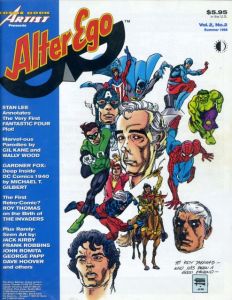
Roy Thomas: “The synopsis is printed here. (A retyped version appeared without fanfare in the 30th-anniversary F.F. #358, Nov. 1991, even duplicating typos such as “synopses” for “synopsis”; but, to the best of our knowledge, this is the first time the actual document, including traces of the original words under the crossed-out ones and a few handwritten numbers by Stan, has ever seen print.)”11

AlterEgov2n2

Thomas couldn’t have been more condescending in his letter to Comic Book Creator, taking Jon Cooke to task for not mentioning the synopses in his article “Kirby’s Kingdom”:

Like me, you’ve seen the plot pages done for portions of Fantastic Four #1 and #8. Jack made a lot of changes and additions to the plot of #1’s origin, most notably introducing the heroes dramatically before going into the flashback origin. That action was breathtaking and wonderful… but it didn’t create the characters or the main story, which was the origin. And in #8, as I pointed out while AE was still part of CBA, Stan’s plot even went into more detail about the actions of the Puppet Master and the F.F. than I would have imagined without reading that plot…12

Cooke would have none of it: “Of course I know of the Fantastic Four #1 synopsis, and you’re right to note its existence should have been mentioned in my piece, as well as Larry Lieber’s memories. But given the Kirby-Lee method of collaboration, its presence is an oddity, unusual for a pair who reportedly confabbed verbally in those early years, and it begs for context. Was it and the FF #8 plot written to clarify Lee-Kirby story conferences?”13 He went on to quote Mark Evanier from the Marvel court case against the Kirbys (see below).

The pedigree of the two synopses is so compelling that with a number of verbose explanations they practically stand on their own. Thomas obliged by adding new material to the discussion by email to John Morrow for inclusion in Stuf’ Said. After Cooke’s response, Thomas was back to having to assert the authenticity of the documents:

“Jerry [Bails] told me he had dropped Stan a line to ask for a copy of a Marvel script to go with ones he’d received from Julie Schwartz for Justice League and the like… In 1961 and 1962, Stan was working hard to keep a number of artists busy all at the same time, so it would make perfect sense that he might make up the first part of a story off the top of his head and send it off to Jack, figuring that either (a) he’d send the rest later, (b) he’d relate the last part of the story to Jack in person or over the phone by the time he needed it, or (c) Jack would devise an ending himself. If (b), then that old Black Magic ending might’ve been suggested by Jack when they talked. It’s even possible, though unlikely, that Stan was familiar with the Black Magic story.

“I’m sure other scenarios of what might have happened can be easily devised by any thoughtful reader—none of which need involve the existence of a nefarious plot by Stan Lee to write retroactive synopses for Fantastic Four stories in order to rob Jack Kirby of due credit. Having experienced Stan and the way he worked from mid-1965 on, it’s inconceivable to me that he would have bothered to concoct a ‘retroactive synopsis,’ least of all in the early ’60s.”14

Thomas has given this a lot of thought. As he sees it, many explanations fit the circumstances, and the most obvious or simplest explanation isn’t necessarily the correct one. The thoughtful reader is invited to devise a scenario that absolves Lee of nefarious intent; unthoughtful readers need not apply. (Maybe there’s a No Prize involved.) Rather than making it sound sensible, the over-explanations draw attention to the inconsistencies.

For balance, Stuf’ Said includes another case of contradictory earlier testimony: “…I saw Stan’s plot for Fantastic Four #1, but even Stan would never claim for sure that he and Jack hadn’t talked the idea over before he wrote this.”15

Mark Evanier: [ FF #1] feels an awful lot more like Jack’s earlier work than anything that Stan had done to that date. So I find it very difficult to believe that Jack did not have input into the creation of the characters prior to the – that synopsis, whenever it was composed. And, also, I have the fact that I talked to Stan many times, and he told me – and he said it in print in a few places – that he and Jack had sat down one day and figured out what the Fantastic Four would be.

QUINN. And they discussed the plot before they actually – the drawings were done?

A. They discussed the plot before the alleged synopsis was done also.16

Lee in Origins of Marvel Comics: “After kicking it around with Martin and Jack for a while I decided to call our quaint quartet The Fantastic Four. I wrote a detailed first synopsis for Jack to follow, and the rest is history.”17

Steve Ditko commented on readers ignoring the contradictory claims put in print by Lee: “…someone is lying.”18

The current campaign to institutionalize Lee’s fictitious Origins story incorporating the deceptive interpretation of the document was actually precipitated by Kirby’s TCJ interview. His final word on the subject was in print the year before the “synopsis” appeared in FF 358.

“I’ve never seen it, and of course I would say that’s an outright lie.” –Jack Kirby19

tcj134

THE KIRBY CASE

THOMAS: To tell you the truth, I really don’t know much about it. I did a deposition not for or against Kirby, because, thank heaven, I wasn’t involved in the way I was in matters like Marv Wolfman on Blade, or Steve Gerber on Howard the Duck, or my friend Gary Friedrich on Ghost Rider. With Jack, I was just there as somebody who was around in 1965 and who could report on a few things. So I really don’t know much about how and when… I just don’t know anything about it. I wasn’t involved in it at all. I just went and did my deposition, and I don’t even remember what I said there. [laughter]

Thomas wants to be seen as unbiased by characterizing his deposition as “not for or against.” He was second on Marvel’s witness list after Lee, however, and his allegiance to Lee and Marvel has never been in question. Even when he “went rogue” in 1981 he couldn’t bring himself to actually place unqualified blame on Lee for any of their issues.

Marvel had large swaths of the deposition transcripts redacted, but parts of Thomas’s deposition are visible at the Justia website.20 Let’s have a look at some passages…

STORIES ON SPEC

BY MS. KLEINICK:

Q. In the 1960s — from 1965 to 1970, are you aware of any instance where a writer came in and actually started working on a new series before Stan said: Go ahead and write the series?

A. No.

Q. Are you aware of any instances where an artist began work on a comic book issue before getting the assignment to do the issue from Stan?

A. No.

Q. Did writers or artists have any authority to assign themselves to do an issue without prior approval from Stan or Sol?

A. No. No.

Q. Are you aware of any instances where an artist submitted artwork for an issue that he hadn’t been assigned to, like on spec?

A. Only new artists who were turning in samples, not an established artist, not one that was already — was already doing work for Marvel.

BY MS. KLEINICK:

Q. Are you aware of any instance where Jack Kirby submitted artwork for an issue for a series that Stan or Sol had not already assigned him to?

MR. TOBEROFF: Leading.

THE WITNESS: No.

Thomas’ recollection disregards the physical evidence that still existed in the office while he was there. Kirby used concept sketches to present his characters on spec. As he related separately to Groth and Sherman, this is the way he introduced his Marvel characters to Goodman in 1961.

Even with the rambling Nick Fury creation tale Lee told in his May 2010 deposition online and visible to the public, Marvel Executive Editor Tom Brevoort endorsed Kirby’s MO when interviewed for Marvel’s website in 2015:

“Jack Kirby first broached the idea of doing a modern day strip with Nick Fury, and he produced a two-page ‘pilot sequence’ to show to Stan Lee, titled ‘The Man Called D.E.A.T.H.,’” he says. “Stan liked the idea of a modern day Fury strip, but reworked the basic concept with Kirby to create NICK FURY, AGENT OF S.H.I.E.L.D. And that two-page pilot story was never used. In fact, when Jim Steranko turned up at Marvel looking for work, Stan gave it to him as an inking test, which is why those pages are inked by Steranko.”21

Brevoort’s statement is backed up by the physical pages. Surely Thomas had access to historical artifacts like these or the Spider-Man presentation page Jim Shooter encountered22, yet he fixates on a “synopsis” that can’t definitively be placed in Kirby’s possession before FF #1 was created and written.

fury

NEXT: THE MARVEL METHOD

back 1 Roy Thomas, interviewed by Rob Gustaveson, The Comics Journal #61, Winter 1981.
back 2 Shop Talk, Jack Kirby interviewed by Will Eisner, Will Eisner‘s Spirit Magazine 39, July 1982.
back 3 Jack Kirby interviewed by Gary Groth, conducted in summer of 1989, The Comics Journal #134, February 1990.
back 4 Steve Sherman e-mail to Patrick Ford, February 2018.
back 5 Kate Willaert, Early Days Of Marvel – Release Schedule, Kirby Without Words.
back 6 “Stan the Man & Roy the Boy,” A Conversation Between Stan Lee and Roy Thomas, Comic Book Artist #2, Summer 1998.
back 7 “He Giveth and He Taketh Away,” The Avenging Mind, © 2008 S. Ditko.
back 8 “The cleverest trick used in propaganda against Germany during the war was to accuse Germany of what our enemies themselves were doing.” Joseph Goebbels, Nuremberg, 1934.
back 9 Ray Wyman, The Art of Jack Kirby, 1992.
back 10 Eric Stedman, Marvel Method group, 27 November 2018.
back 11 Roy Thomas, “A Fantastic First!, Alter Ego v3n2, Summer 1998.
back 12 Roy Thomas, Letter to the editor, Comic Book Creator #3, Fall 2013.
back 13 Jon B. Cooke, response to the Thomas letter to the editor, Comic Book Creator #3, Fall 2013.
back 14 Roy Thomas, e-mail to John Morrow, September 2018, quoted in Kirby & Lee: Stuf’ Said!, November 2018.
back 15 Roy Thomas interviewed by Jim Amash, published in The Jack Kirby Collector #18, September 1997.
back 16 Mark Evanier deposition, 9 November 2010, Justia, Dockets & Filings, Second Circuit, New York, New York Southern District Court, Marvel Worldwide, Inc. et al v. Kirby et al, Filing 65, Exhibit 8.
back 17 Stan Lee, Origins of Marvel Comics, Simon and Schuster, New York, 1974.
back 18 A Mini-History, “Wind-up,” The Comics v14n11 © 2003 S. Ditko.
back 19 Jack Kirby interviewed by Gary Groth, conducted in summer of 1989, The Comics Journal #134, February 1990.
back 20 See declarations by Randi Singer (Filing 65, 18 February 2011) and Marc Toberoff (Filing 77, 25 February 2011), Justia, Dockets & Filings, Second Circuit, New York, New York Southern District Court, Marvel Worldwide, Inc. et al v. Kirby et al.
back 21 Tj Dietsch, “C2E2 2015: S.H.I.E.L.D.,” Comics News blog, Marvel.com, 26 April 2015.
back 22 Jim Shooter, Writer. Creator. Large mammal. blog, Monday, March 21, 2011, and comment on Wednesday, March 30, 2011 post, left August 30, 2011.

All other Roy Thomas quotes are from “The Terrific Roy Thomas,” The Jack Kirby Collector #74, Spring 2018.

The History of Marvel According to Roy Thomas, Part Three

A NOTE ON WRITING

It’s important to note that each time Thomas or Lee used the word “artist” to describe Kirby or another one of the writers, it was designed to diminish their contribution and plant the idea that someone else was doing the writing. A better term would be writer/artist, and, in one instance, creator/writer/artist. Lee the perpetual self-promoter and originator of the Marvel Method story, was getting paid the page rate1 for the writing of his writing stable: Kirby, Ditko, Wood, and anyone who wanted to continue receiving assignments from him.

In the 1998 Comic Book Artist interview,2 Thomas asked Lee whether he was writing Kirby’s “monster stories” full script or Marvel Method. This obscures the real question of whether Lee was writing the stories at all—his signature was absent at a time he was in the habit of signing everything.

kathy2

Michael Vassallo: Stan had been signing his name on everything he touched from the moment he arrived at Timely. The idea that he wrote and didn’t sign it has been rejected by myself in analyzing his career. That said, could a signature have been accidentally left out, a stat fallen off? Of course. But for the most part, for 99% of everything he wrote, he signed. He even signed paper doll pages, fashion pages, letter pages, contest pages… pages that didn’t even require a signature to identify who put it together. Yet, he signed them. So it’s a safe bet to go under the impression that if Stan wrote it, he signed it. if he didn’t sign it, he most likely didn’t write it.3

The Stan-Roy “interview” was an orchestrated response to Groth’s Kirby interview, and it brings to light an important distinction: Kirby claimed he wrote specifically the monster books, therefore Lee and Thomas specifically addressed the writing credit on the monster books. This despite no signatures, and no mention of Larry Lieber. In real life, Kirby’s monster books, even after FF #1, bore Kirby’s pencilled dialogue in the balloons, sometimes with Lee’s corrections (see life-size examples here and here); still, Lee shied away from signing them. Larry Lieber said, “When Stan saw that the strips had potential, he started writing them.”4

KIRBY: Of course it was fulfilling. It was a happy time of life. But. But, slowly management suddenly realized I was making money. I say “management,” but I mean an individual. I was making more money than he was, OK? It’s an individual. And so he says, “Well, you know…” And the old phrase is born. “Screw you. I get mine.” OK? And so I had to render to Caesar what he considered Caesar’s.5

To phrase Lieber’s statement more accurately, when Lee saw that the strips had potential, he started signing them. Kirby’s account suggests that the writing page rate he was getting on the “monster” books caught Lee’s attention; Lee didn’t sign them because, as their sales dwindled, they didn’t speak “success” to him. After Goodman was persuaded to belay the order to shut down, each new title launched from a Goodman-approved Kirby presentation had its writing rate appropriated by Lee: first with signatures, then with misleading credit boxes, then using the Marvel Method as justification.

THE MARVEL METHOD

MR. TOBEROFF:

Q. What is the — have you ever heard of the term Marvel Method?

A. Yes.

Q. What is — when you came to Marvel in July of 1965, was the Marvel Method in use at that time?

MS. KLEINICK: Objection.

A. Yes.

Q. What is the Marvel Method?

A. The Marvel Method — sometimes also called the Stan Lee Method — but it didn’t totally originated with him, but mostly arose in the — I’m not really quite sure — but it was in place by the time I got there. Because Stan became too busy to write full scripts; and Larry Lieber, who had been writing the scripts from his plots, you know, was either too busy or was doing his westerns and things and somewhat withdrawing from doing the superheros.

Stan was — became — would come up with the idea for the plots, I guess, adapting from the way he had originally done plots that Larry would turn in the scripts. And he simply would give those plots to the artists, who would then draw the story, break them down into pictures, expanding them, whatever needed to be done to break them down into pictures.

They would then turn them in, and he would then add the — he would dialogue it, which means the dialogue and captions — he would add it later — instead of writing what we call script in advance, which is the more usual method of writing comic books beforehand.

Q. Are you aware that Stan Lee has been interviewed numerous times in which he has described the Marvel Method?

A. I’m sure he has, yes. I’m aware of that.

Q. Are you aware that Stan Lee, in interviews, has stated that in 1960s, under the Marvel Method, that artists were expected to plot stories?

MS. KLEINICK: Objection; states facts not in evidence.

A. I haven’t any knowledge of that. It would have, you know, surprised me; but if he did, he probably misspoke.

Q. Is it your understanding that at Marvel, artists were — part of their duties were to plot the stories through the — through their artwork and through notes in the margins and suggested dialogue?

MS. KLEINICK: Objection.

A. We didn’t use that, you know, think about that much or use that term then. But as I look back on it, and over the years and analyze it, I realize they were — I would say co-plotting the stories. I would not say plotting.

When you are given a story idea, even if it is a few sentence, quite often, and certainly if it was more, as it was in many cases, you’re certainly not plotting the story, you were co-plotting.

Q. Starting at the time you started — well, whether or not they were co-plotting or plotting — is it correct that artists were, at the time you got to Marvel in 1965, artists were expected to plot stories?

MS. KLEINICK: Objection.

A. They were expected to co-plot the stories.

Q. Okay.

A. As they — to do whatever is necessary to tell the story; that involved adding elements for the plot. So, I call it co-plotting.6

Thomas should know better than anyone alive that the Marvel Method began as nothing more than Lee’s version of a kickback scheme: the writer/artists would write the story as they drew, and Lee would take the writing page rate for filling in the dialogue and captions. Reluctance to participate was punishable by the withholding of assignments.

The supposed inspiration for the Marvel Method, Lee being too busy to write full scripts, doesn’t stand up to scrutiny. For March of 1953, the Atlas Tales website  credits Lee with 126 pages of script while he managed dozens of Timely titles. In March of 1961 Lee was allegedly too busy to write full scripts for 69 pages (46 western pages, 18 Millie story pages, 5 individually-signed Millie activity pages) while coordinating a line of eight monthly publications. We’ll leave the question of whether Lee did write scripts for another discussion, but it’s worth noting Ditko’s statement: “Lee never wrote a full script for me.”7

FinFangFoom_p8

Nearly forty years after the fact, it was “revealed” that Larry Lieber had written full scripts for Kirby’s monster stories, despite the stance held from 1974 through to the end of the ‘90s that Lee had written them unsigned. This new tack may not have been given sufficient thought in relation to the justification of the Marvel Method, because it would suggest Lee had been even less busy than he’d claimed.

Alternate scenario: Lee wasn’t busy because Kirby wrote his own stories. Lee added dialogue, captions, and his name to the books to divert the writing page rate. There is a grain of truth to the official story… Lee wasn’t writing, not because he was too busy, but because he wasn’t a writer. Kirby was doing the writing, and Lee had figured out how to get paid for it.

EISNER: Let me tail off this thing by going back into the technique of work. The laying out of a page. Since you write and draw, you regard yourself as I like to regard myself, as a total writer. Do you agree that this is a total dimension, that there is no separation between the words and pictures? That they’re integrated? Do you agree with that?

KIRBY: I believe that the man who draws the story should write it.8

Stan Taylor: I think that Stan’s singling out and praising the artists actually upset the artists, more than making them happy. Stan was quick to tell everyone how his artists not only pencilled, but plotted also, yet they knew they were only being paid for pencilling, and at a rate less than the competition, and getting nothing for plotting, while Stan was getting all the glory, and the big bucks for simply putting the finishing sheen on the artists stories. If it was me, I would get pretty mad about doing the work of one and a half people, while being paid less than the competitor paid just for pencilling, and then someone else takes the credit for my stories.9

Let’s take a look at some examples of Thomas’ participation in the Marvel Method.

“Jack agreed to do it—under one condition. He insisted that I plot out the stories, panel by panel, and send him that to pencil from. And I balked at that. I could see that Jack was determined that he wasn’t going to add one incident, one thought, to the story that I hadn’t given him. And if I was going to have to do that, I really didn’t see any special value in having Jack pencil the FF at that point. I’d prefer to work with Rich Buckler or someone else Kirby-influenced. So that was the end of my attempt to get Jack to do Fantastic Four.”10

Translation: “Jack really didn’t see any special value in having me get paid the writing page rate if he was going to be doing the writing.” Nothing better illustrates Thomas’s disconnect from Kirby’s grievances or the true purpose of the Marvel Method than this story. Except for the plotting credit, Thomas has just described Kirby’s reality working with Lee; this should tell him it wasn’t solely about the credit. Yet Thomas appears to continue to be mystified that Kirby did not want to be “reined in” by a non-plotting collaborator who was paid for writing and editing.

ROY THOMAS:“The first sour note for me on X-Men came with my second issue, #21. I learned that, for reasons never made clear, Stan had told [Werner Roth] that he would be plotting the upcoming issues, and I’d be simply writing dialogue and captions for them. Now, understand: in those days, Werner wouldn’t have received one extra cent if he had plotted all the stories with no input from me; I’d have received my full script rate, then probably $10 a page. But I felt that I, not Werner, should be plotting the stories. I said so to Stan and I prevailed…”11

Barry Windsor-Smith gave some insight into just what Thomas was offering Kirby, speaking in an interview regarding Conan: “I toiled passionately on the stories and art of those early issues. In fact, I worked so hard that I barely had a social life. I couldn’t afford to eat out and I had to make do with pizza and fish out of tins. I wasn’t paid nearly enough for my commitment to the work and I wasn’t credited or paid for my stories or dialogue.”12

Neal Adams followed suit: ‘Word is kind of getting around that Roy Thomas, my great dialoguing partner, and John Buscema, had something to do with the creating of the Kree Skrull War concept at Marvel… Roy dialogued it, and according to my agreement with Stan, Roy never wrote a script, nor an outline, or even notes to me, in any way. I was free to work the Marvel Method to do the Kree Skrull War. People should gain credit for what they do, but not gain credit for what they do not do, whatever the reason. I was totally in charge of the story, and there is not one word of writing from any editorial person that gave me any direction. Let’s keep the record straight. This is not an argument. I have no argument with anyone. This is simply a statement of facts. I love the dialoging that Roy did, (except in the case of the title of the first book, which I suggested be “Three cows shot me down”, and Roy changed to “Beachhead Earth ”.’13

Thomas responded to Adams: “Put simply and as politely as I can muster under the circumstances, Neal Adams is full of crap… Neal has deluded himself for years on some points.”14

Deluded? In 2013, Thomas suggested Kirby had suffered from delusions of grandeur:

‘What’s done on pp. 48-49 of CBC #1 is not far from the kind of statement Jack himself made, during the years when he had first left Marvel, when an interviewer tried to pin him down and ask him what Stan Lee did in those stories. “Stan Lee was my editor,” was all Jack would say. Jack, who of course was and remains even years after his demise one of the greatest artists in the history of the comic book medium, was given at that stage to delusions of grandeur that went far beyond even his massive talents and contributions.’15

1998

In September 1997, Roy Thomas told Jim Amash, “even Stan would never claim for sure that he and Jack hadn’t talked the idea over before he wrote [the FF #1 plot].”16

By 1998, Stan Lee had been alerted to a perceived assault on his carefully-crafted legacy. He mobilized his resources, including his attorney, Arthur Lieberman. Correcting Thomas’ errant comment was on the agenda.

In Comic Book Artist #2/Alter Ego v2n1, Thomas printed one of the versions of the FF #1 synopsis (warranting another verbose explanation of why there was more than one), and an interview of Lee conducted in May. In the synopsis piece, Thomas’ earlier comment was disavowed word for word by Lee. Among other subjects, the script for the interview targeted specific points from Kirby’s TCJ interview.

In June, Marvel used bankruptcy procedures to void the $1 million-a-year lifetime-employment contract with Lee. That also voided Lee’s exclusive assignment to Marvel of his rights to the Marvel characters.

Lee and Lieberman, along with their friend Peter Paul, formed a company called Stan Lee Media. Paul put in $500,000, while Lee assigned the company all his intellectual property rights, including his hypothetical rights to the Marvel characters.

BARRON’S: “It turned out that in November 1998 – a month after assigning his intellectual property to Stan Lee Media – Lee had gone to Marvel claiming half-ownership of Spider-Man, the X-Men and other characters, since Marvel had cancelled his previous rights assignment in its bankruptcy. Lee got a new contract for up to $1 million in annual salary and 10% of movie and TV profits, assigning Marvel his rights in those characters.”17

Thomas recently stated he’d started writing the Spider-Man newspaper strip around this time. He and Larry Lieber (who was already working on it) presumably agreed to the same Marvel conditions Herb Trimpe described in his New York Times article.18 (Similar wording appeared in the 1985 multi-page agreement Kirby refused to sign to get back his original art.)

Alter Ego v3n2 contained Thomas’ interview of Lieber (undated but printed in 1999) naming him as the writer of full scripts for Kirby’s monster stories. This is the revelation Thomas characterized as “repeatedly over the years,” and he thought he got the scoop for this interview. Lieber had earlier mentioned it in print in 1997’s Marvel Vision #20.

The change in the story is significant. Lee in Origins (1974): “Jack and I were having a ball turning out monster stories…” Although Lieber’s own 1975 Atlas bio doesn’t mention monster stories, it does contain this: “…Stan himself (who taught me that dialogue is more important that captions, and pay vouchers are more important than either).”

LieberAtlasBio

THOMAS AND THE EARLY ‘60s

Q. In the 1960s to early ’70s who decided which books or series Kirby would work on?

A. Stan Lee.

MR. TOBEROFF: Objection to 1960s again. We have a standing objection. 1960s means —

MS. KLEINICK: It’s a standing objection.

MR. TOBEROFF: — after July 1965; is that correct?

THE WITNESS: I always meant it to be.

MS. KLEINICK: You made the standing objection.

MR. TOBEROFF: I understand, but I don’t want the record to look like he’s talking about the early 1960s when he wasn’t there.

MS. KLEINICK: You made your objection.

THE WITNESS: I understand it as being from ’65 on, because I wouldn’t know anything about an earlier period. I wouldn’t have been paying as much attention.

Thomas admitted to Kirby lawyer Marc Toberoff that he had no first-hand knowledge of the years 1958-1963 (the period targeted by Marvel’s suit against the Kirbys) on account of his not actually being there. The information he hopes comes across as unbiased is single-sourced from Lee, with no room for interpretation in light of other eyewitness testimony. His encounters with “synopses” fail to place the documents in Kirby’s possession in time to inspire creation, but his arrival in 1965 and subsequent proximity to Lee are meant to be sufficient proof for anybody.

Reflections on leaving Marvel…

“There were times at Marvel when I couldn’t say anything because it would be taken away from me and put in another context, and it would be lost—all my connection with it would be severed. For instance, I created the Silver Surfer, Galactus and an army of other characters, and now my connection with them is lost… You get to feel like a ghost. You’re writing commercials for somebody and… It’s a strange feeling, but I experienced it and I didn’t like it much. “It wasn’t recognition so much—you just couldn’t take the character anywhere. You could devote your time to a character, put a lot of insight into it, help it evolve and then lose all connection with it. It’s kind of an eerie thing; I can’t describe it. You just have to experience that relationship to understand it.” –Kirby19

“It was that kind of shitty treatment on the part of Marvel which made me decide to do what I had avoided in 1974 and at other times–to talk to fanzines about Marvel Comics and my feelings about it… My point again, to reiterate what I said earlier, is that if your value to the company is subject to this kind of re-evaluation… if you can spend 15 years selling comics for the company and helping guide its direction… and then be turned on the way I was turned on, then why should anyone care about that company past making sure his next check is good? And the answer, really, is that you shouldn’t, because you’re not building anything.” –Thomas20

Rather than relating to Kirby, Thomas decided vindictiveness wasn’t so bad and joined the attack on Kirby’s claims after his death. Thomas’ own delusions of grandeur allow him to accuse Kirby of delusions of grandeur, and to minimize the part Kirby played in Lee having a legacy worthy of having Thomas as its guardian. Thomas and Lieber are the only ones left who can shed light on the truth of that legacy. Until that happens, a Thomas interview in a Kirby publication says it’s fine and well to extol Kirby’s contribution, but the company version needs to be given equal time.

cyclopean

back 1 Stan Lee deposition, 13 May 2010, Filing 102, Exhibit I, Page 17, Justia, Dockets & Filings, Second Circuit, New York, New York Southern District Court, Marvel Worldwide, Inc. et al v. Kirby et al.
back 2 “Stan the Man & Roy the Boy,” A Conversation Between Stan Lee and Roy Thomas, Comic Book Artist< #2, Summer 1998.
back 3 Dr Michael J Vassallo, Stan Lee (1922-2018) – The Timely Years, Timely-Atlas-Comics blog, December 8, 2018.
back 4 Larry Lieber interviewed by Roy Thomas, Alter Ego v3n2, Fall 1999.
back 5 Jack Kirby interviewed by Gary Groth, conducted in summer of 1989, The Comics Journal #134, February 1990.
back 6 Parts of Thomas’ deposition can be found in declarations by Randi Singer (Filing 65, 18 February 2011) and Marc Toberoff (Filing 77, 25 February 2011), Justia, Dockets & Filings, Second Circuit, New York, New York Southern District Court, Marvel Worldwide, Inc. et al v. Kirby et al.
back 7 “Creative Crediting,” The Avenging Mind, © 2008 S. Ditko.
back 8 “Shop Talk,” Jack Kirby interviewed by Will Eisner, Will Eisner’s Spirit Magazine 39, July 1982.
back 9 Stan Taylor, Kirby-L, the Jack Kirby Internet mailing list, 6 November 1999.
back 10 Roy Thomas, “The Terrific Roy Thomas,” The Jack Kirby Collector #74, Spring 2018.
back 11 Roy Thomas, Alter Ego #24, May 2003.
back 12 Barry Windsor-Smith interviewed by Wally Monk, Paint Monk’s Library, June 30, 2018
back 13 Neal Adams, response to Roy Thomas’ letter to Bleeding Cool, December 14, 2018.
back 14 Roy Thomas, response to the Adams response, Bleeding Cool, December 15, 2018.
back 15 Roy Thomas, Letter to the editor, Comic Book Creator #3, Fall 2013.
back 16 Roy Thomas interviewed by Jim Amash, published in The Jack Kirby Collector #18, September 1997.
back 17 Bill Alpert, “The Rage Offstage at Marvel”, Barron’s, June 30, 2008.
back 18 ‘May 17: Got a package from Marvel today, a pile of termination agreement paperwork. I’m supposed to sign forms swearing that I won’t talk trash about Marvel, won’t reveal any superheroes’ secret identities, won’t say anything mean about Stan Lee, won’t make a fuss, and other legal mumbo jumbo. If I don’t sign, I don’t get termination “benefits.”’ Herb Trimpe, “Old Superheroes Never Die, They Join the Real World,” New York Times, 7 January 2000.
back 19 Jack Kirby interviewed by Tim Skelly, “The Great Electric Bird” show, WNUR-FM, Northwestern University (Evanston, IL), 14 May 1971; later published in The Nostalgia Journal 27, Aug 1976.
back 20 Roy Thomas, interviewed by Rob Gustaveson, The Comics Journal #61, Winter 1981.

All other Roy Thomas quotes are from “The Terrific Roy Thomas,” The Jack Kirby Collector #74, Spring 2018.

March 1963

It was an event that signaled a number of endings, some of them permanent. Three of the titles that contained Kirby’s monster stories had transitioned to superheroes, and he already had an origin story for the fourth. His remaining genre work was limited to two western books and a single romance title.

In late 1962, as detailed by Larry Lieber in his 2010 deposition,1 Kirby stormed out of a story conference with Lee and tore up pages of a Hulk story. The pages contain Lee’s notes and a character that resembled Lee.2 They could have been intended for The Incredible Hulk #6, which was published with a March cover date, but ran with a Steve Ditko story in place of Kirby’s.†

Hulk 6, March 1963.
CC BY-SA 4.0 Grand Comics Database

In Kirby’s titles that month…

  • The Hulk: contained no Kirby content, the first issue since the title’s inception not entirely pencilled by Kirby.
  • Journey Into Mystery: contained no Kirby story after 36 consecutive story appearances (from September 1959) in monthly and bi-monthly issues, including the first seven Thor stories. Kirby was also absent from five of the next six issues, with a story in the June issue and a full-time return in October incorporating Tales of Asgard.
  • Tales to Astonish: no Kirby story after 31 consecutive issues (also dating back to September 1959), with a Kirby Ant Man installment in each of the previous six. During a hiatus consistent with the one on Journey Into Mystery, Kirby would return after three issues to introduce The Wasp in June and then did three issues with Giant-Man beginning in November. He then did nothing more until Ditko was stripped of the title in 1965.†
  • Strange Tales: no Kirby story after he’d missed only one issue in a 39-issue stretch beginning in February 1959, with a Kirby Torch installment in each of the previous five. Kirby had four more Torch stories, including a Captain America tie-in and an X-Men tie-in, spread out over 23 monthly issues before introducing Nick Fury to the title.
  • Rawhide Kid (April—there was no March issue): no Kirby story after 16 bi-monthly Kirby issues. February 1963 was his last regular issue with a 5-page story in June and 5 pages in December 1964.
  • Tales of Suspense: Kirby’s obvious Iron Man origin story was swapped out for one he’d laid out for Don Heck. It appeared in the following issue, with two more Kirby stories in the following three issues. Kirby was then absent from the title until he began Captain America 15 months later.

Kirby’s work did appear in the March 1963 issues of:

  • Two-Gun Kid: there were Kirby stories in eight of the last nine issues dating back to June 1960. This issue was his last.
  • Love Romances: ninth consecutive issue containing at least one Kirby story. He had 7 pages this issue and 13 pages in the following issue, which would be his last.
  • Fantastic Four (the only title where Kirby’s consecutive issue streak continued unbroken). His FF #12 story featured The Hulk in Marvel’s first Silver Age cross-over (tied with Kirby’s cover on that month’s Amazing Spider-Man #1).‡

The conventional wisdom says that Kirby and Lee got along famously until the Herald Tribune article in 1966, and that Lee had no warning that Kirby would ultimately quit. In 1962, Lee was just finding his way with the redirection of the writing pay and the consequences he could impose for not playing along. Regardless of whose initiative resulted in the dropped assignments, the page-tearing episode is evidence that Lee’s relationship with the freelance creative talent wasn’t the jovial operation he portrayed in the letters pages. From the start, the creator/writers bridled at the “freedom” the Marvel Method gave them to write without pay.

† In 1965, when Ditko demanded and received plotting credit, Lee relieved him of his regular assignment on The Hulk in Tales to Astonish and gave it to Kirby. Dave Rawlins: “I’d say the loss of the Hulk effectively wiped out any financial gain Ditko received via plotting credit for ASM and Doctor Strange, and then some.” 4

‡ Recent issues of the title may have contributed to the Hulk pages incident. Chris Tolworthy: ‘FF 9 is when Lee added credit boxes to claim he wrote it (previously it was just “Stan Lee and J Kirby”), and FF 10 and FF 11 can both be read as attacks on Lee. FF 10 is about Lee not having any ideas, then the villain pretends to be the good guy: they realise he is the villain because he is only interested in himself. And FF 11 has “the impossible man” who looks like Lee and acts like a kid playing pranks. When we put the dates together, it paints a very clear story: Lee steals the writing money; Kirby tells Lee exactly what he thinks; Lee punishes Kirby.’ 4

1 Larry Lieber deposition, 7 January 2011, Justia, Dockets & Filings, Second Circuit, New York, New York Southern District Court, Marvel Worldwide, Inc. et al v. Kirby et al, Filing 65, Exhibit 4.

2 Jack Kirby Museum & Research Centre website, Two more unused Hulk pencil pages from 1962 surface!

3 Dave Rawlins, Marvel Method group, 13 February 2019.

4 Chris Tolworthy, Marvel Method group, 15 February 2019.

Interviews

Interview snippets of Jack Kirby and others excerpted in large part from The Comics Journal, The Jack Kirby Collector and the Kirby Museum site, categorized and labeled by year. It’s important to have the ability to see that things Kirby said in the TCJ interview were nothing new.

“They’d take it away from me.”

1970 [Hamilton]1

BRUCE HAMILTON: Do you care to discuss your main reasons for switching to DC?

JACK KIRBY: I don’t mind at all. I can only say that DC gave me my own editing affairs, and if I have an idea I can take credit for it. I don’t have the feeling of repression that I had at Marvel. I don’t say I wasn’t comfortable at Marvel, but it had its frustrating moments and there was nothing I could do about it. When I got the opportunity to transfer to DC, I took it. At DC I’m given the privilege of being associated with my own ideas. If I did come up with an idea at Marvel, they’d take it away from me and I lost all association with it. I was never given credit for the writing which I did. Most of the writing at Marvel is done by the artist from the script.

As things went on, I began to work at home and I no longer came up to the office. I developed all the stuff at home and just sent it in. I had to come up with new ideas to help the strip sell. I was faced with the frustration of having to come up with new ideas and then having them taken from me.

1971 [Skelly]2

TCJ: What do you think the advantages are over at National?

KIRBY: The advantages? Well, I have a lot more leeway. I can think things out, do them my way and know I get credit for the things I do. There were times at Marvel when I couldn’t say anything because it would be taken away from me and put in another context, and it would be lost – all my connection with it would be severed. For instance, I created the Silver Surfer, Galactus and an army of other characters, and now my connection with them is lost.

TCJ: That sounds like a problem.

KIRBY: You get to feel like a ghost. You’re writing commercials for somebody and… It’s a strange feeling, but I experienced it and I didn’t like it much.

TCJ: Things are probably bad enough in the comics field as far as recognition goes.

KIRBY: Well, recognition comes to very few people. It wasn’t recognition so much – you just couldn’t take the character anywhere. You could devote your time to a character, put a lot of insight into it, help it evolve and then lose all connection with it. It’s kind of an eerie thing; I can’t describe it. You just have to experience that relationship to understand it.

1982 [Zimmerman]3

Kirby’s contributions to Marvel Comics are legendary. When asked what he received in return, he says, “A lot of ingratitude. It hasn’t left me bitter, it’s just that it shouldn’t work out that way.”

Jack Kirby…

…”saved Marvel’s ass”

1989 [Groth]4

KIRBY: Marvel was on its ass, literally, and when I came around, they were practically hauling out the furniture. They were literally moving out the furniture. They were beginning to move, and Stan Lee was sitting there crying. I told them to hold everything, and I pledged that I would give them the kind of books that would up their sales and keep them in business, and that was my big mistake.

1987 [Schwartz]5

JACK: The only thing I knew best was comics and I went back to Marvel and Marvel was in very poor straits–all comics were in poor straits–and boy I can tell you, when I went into Marvel they were crying–and Stanley was going into the publisher and lock up that very afternoon and I convinced him not to do it. And of course I didn’t change things in one day; but I knew that in a couple of months I could do it.

1986 [Pitts]6

KIRBY: My version is simple: I saved Marvel’s ass. When I came up to Marvel, it was closing that same afternoon, Stan Lee had his head on the desk and was crying. It all looked very dramatic to me, but I needed the job. I was a guy with a wife and three kids and a house, and I wanted to keep it. And so, having no rapport with Martin Goodman, who was the publisher– Stan Lee was his cousin– I told Stan Lee that we could keep the place going. And I told him to try to tell Martin to keep it going, because we could possibly revive it.

1985 [Van Hise]7

“When I came up to Marvel in the late Fifties, they were just about to close up, that very afternoon! I told them not to do it. Marvel is a case of survival. I guaranteed them that I’d sell their magazines, and I did. I did the monster stories or whatever they had and they began to liven up a bit.”

1982 [Zimmerman]8

My business with Joe was gone. I did a few things for Classics Illustrated which drove me crazy. I wanted a little stability, and I needed the work. Marvel seemed to be the place, and comics seemed to be the only thing I was really good at. And I already had responsibilities; I was a father, I owned property, I had to work.

Marvel was going to close,” Kirby recalls. “When I broke up with Joe, comics everywhere were taking a beating. The ones with capital hung on. Martin Goodman [publisher of Marvel] had slick paper magazines, like Swank and the rest. It was just as easy for Martin to say, ‘Oh, what the hell. Why do comics at all?’ And he was about to—Stan Lee told me so. In fact, it looked like they were going to close the afternoon that I came up. But Goodman gave Marvel another chance.”

1982 [Eisner]9

KIRBY: Okay, I came back to Marvel there. It was a sad day. I came back the afternoon they were going to close up. Stan Lee was already the editor there and things were in a bad way. I remember telling him not to close because I had some ideas. What had been done before, I felt, could be done again. I think it was the time when I really began to grow. I was married. I was a man with three children, obligations.

1989 [Groth]10

GROTH: So it was to a large extent circumstance that compelled you to produce–

KIRBY: Circumstances forced me to do it. They forced me.

GROTH: Was there a sense of excitement during that period when Marvel was starting to take off?

KIRBY: No, there wasn’t a sense of excitement. It was a horrible, morbid atmosphere. If you can find excitement in that kind of atmosphere – the excitement of fear. The excitement of, “What to do next?” The excitement of what’s out there. And that’s the excitement that always existed in the field. What am I going to do now that I’m not doing anything more for this publisher? I can go to another publisher. I have to make a living.

GROTH: Did you approach Marvel or –

KIRBY: It came about very simply. I came in [to the Marvel offices] and they were moving out the furniture, they were taking desks out – and I needed the work! I had a family and a house and all of a sudden Marvel is coming apart. Stan Lee is sitting on a chair crying. He didn’t know what to do, he’s sitting in a chair crying –he was just still out of his adolescence. I told him to stop crying. I says. “Go in to Martin and tell him to stop moving the furniture out, and I’ll see that the books make money.”

Drew Friedman: 11 My dad (Bruce Jay Freidman) actually worked at Magazine Management, which was the company that owned Marvel Comics in the fifties and sixties, so he knew Stan Lee pretty well. He knew him before the superhero revival in the early sixties, when Stan Lee had one office, one secretary and that was it. The story was that Martin Goodman who ran the company was trying to phase him out because the comics weren’t selling too well.

Dick Ayers: 12 I worked right through. Things had started getting really bad, I guess, in 1958. And still Stan kept me working. And one day, when I went in, he looked at me and he said, “Gee whiz, my uncle goes by and he doesn’t even say hello to me.” He meant Martin Goodman. And he proceeds to tell me, “You know, it’s like a ship sinking and we’re the rats. And we’ve got to get off.” So he told me, “Try to find something else.”

Larry Lieber: 13 Back then Marvel was Timely Comics. At the time I worked there, Magazine Management was big when the comics were big… it was small when the comics were small. At one time in the late ’50s it was just an alcove, with one window, and Stan was doing all the corrections himself; he had no assistants.

Jim Vadeboncouer: 14 It wasn’t until December 1958/January 1959 that Lee gathered around him the core of what was to be Marvel Comics: Kirby, Ditko, Heck, Ayers, and Reinman. This lends credence to Kirby’s claim to have found Lee despondent on his desk, ready to throw in the towel. If the inventory was depleted and sales were down and growth was restricted, what was a man to do but give it all up?

Flo Steinberg: 15 Well, it was March of ’63… And I went up and talked to this man, Stan Lee. And the interview was in this teeny little cubbyhole of an office… And the whole Magazine Management company was in one big floor [of 625 Madison Avenue] with partitions set up. And Marvel Comics was the teeniest little office on the floor. There was Stan and his desk, then another small desk.

Michael Vassallo: 16 Jack’s recollection of seeing Stan crying shouldn’t be dismissed out of hand. When I constructed a timeline of job numbers, I was shocked to find that Joe Maneely’s last story and Jack’s first story in Strange Worlds #1 (“I Discovered the Secret of the Flying Saucers!”) were only a few digits apart. I immediately asked Dick Ayers to check his work records on an equally close western he did and his work records corroborated that all these stories were commissioned within one or two days of Joe Maneely’s death on June 8th 1958! Immediately it made possible sense to me that if Jack had in fact arrived looking for work on the following Monday, June 10th he would have found Stan Lee in his office inconsolable, and predicting the soon demise of Goodman’s already tenuous line of 8 titles a month.

Whatever anyone may want to say about Stan, he was very close to Maneely, had worked with him since late 1949, and depended on him to launch many/most of the Atlas character features in the western, war comics throughout the 1950’s. He was the fastest artist he had (Jack Kirby fast, possibly faster, by all accounts) and after the implosion he was drawing most of the covers and handling the Two-Gun Kid feature. There just wasn’t enough new material to keep him busy so he was also simultaneously at DC and also Charlton. But even more importantly for Stan, he was a partner on their Mrs. Lyons’ Cubs newspaper syndicated feature, both hoping to catch lightning in a bottle and leave the dregs of the comic book industry.

So taking all of that together, the timing and the relationship, it is “very” likely Jack did find Stan, not necessarily bawling his eyes out, but very upset that morning when he went in looking for work.

…while doing monster books, persuaded Marvel to try superheroes

1989 [Groth]17

GROTH: Did you enjoy doing those?

KIRBY: I always enjoyed doing monster books. Monster books gave me the opportunity to draw things out of the ordinary. Monster books were a challenge – what kind of monster would fascinate people? I couldn’t draw anything that was too outlandish or too horrible. I never did that. What I did draw was something intriguing. There was something about this monster that you could live with. If you saw him you wouldn’t faint dead away. There was nothing disgusting in his demeanor. There was nothing about him that repelled you. My monsters were lovable monsters. [Laughter.] I gave them names – some were evil and some were good. They made sales, and that’s always been my prime object in comics. I had to make sales in order to keep myself working. And so I put all the ingredients in that would pull in sales. It’s always been that way.

1982 [Eisner]18

EISNER: So the ideas for superheroes at Marvel and DC were ideas cooked up by you and Stan.

KIRBY: No. That was cooked up by me!

EISNER: So you did the first one all by yourself, then.

KIRBY: Oh, yes. Spider-Man wasn’t the first one I did. I began to do monster books. The kind of books Goodman wanted. I had to fight for the superheroes. In other words, I was at the stage now where I had to fight for those things and I did. I had to regenerate the entire line. I felt that there was nobody there that was qualified to do it. So I began to do it. Stan Lee was my vehicle to do it. He was my bridge to Martin [Goodman].

1975 [Sherman]19

SHERMAN: At this time, you also started again at Marvel.

KIRBY: Right. I was given monsters, so I did them. I would much rather have been drawing Rawhide Kid. But I did the monsters… we had Grottu and Kurrgo and It… it was a challenge to try to do something–anything with such ridiculous characters. But these were, in a way, the forefathers of the Marvel super-heroes. We had a Thing, we had a Hulk… and we tried to do them in a more exciting way.

Hebert [1969]20

KIRBY: I tried to work it out with Stan [Lee], to hint about superheroes. There were a few still going but they didn’t have the big audience they had. There was a thing I was involved in, The Fly, which got a reaction and because of that I told Stan that there might be a hope for superheroes. “Why don’t we try Captain America again?” I kept harping on it and Marvel was quiet in those days, like every other office, and then things began to pick up and gain momentum.

…wrote and penciled the pages he turned in to Stan Lee

Early 1990s [Danzig/Thibodeaux]21

GLENN: A lot of people don’t know that you actually scripted a lot of these stories – most of them. Even the Marvel stuff.

JACK: I did.

1985 [Van Hise]22

I was a penciller and a storyteller, and I insisted on doing my own writing. I always wrote my own story no matter what it was. Nobody ever wrote a story for me. I created my own characters. I always did that. That was the whole point of comics for me. I created my own concepts and I enjoyed doing that. That’s how I created the Silver Surfer.

1982 [Eisner]23

EISNER: In the stuff you worked on with Stan, was he writing at the time?

KIRBY: No. Stan Lee was not writing. I was doing the writing. It all came from my basement and I can tell you that if I ever began to intellectualize, it was then… All right. That’s unimportant. All right, I’ll tell you from a professional point of view. I was writing them. I was drawing them.

EISNER: But you do not necessarily subscribe to the idea of someone else, regardless of who it is, putting balloons in on a completely penciled page. I have a prejudice on it but I want to get your opinion.

KIRBY: My opinion is this: Stan Lee wrote the credits. I never wrote the credits.

1982 [Zimmerman]24

In his Bring on the Bad Guys, Origins of Marvel Comics Villains, Stan Lee explains the genesis of the group: “Much as I hate to admit it, I didn’t produce our little Marvel Masterpieces all by myself. No, mine was the task of originating the basic concept, and then writing the script… However, I’ve long been privileged to collaborate with some of the most talented artists of all, artists who would take my rough-hewn plots and refine them into the illustrated stories… Heading the list of such artists… is Jolly Jack Kirby.”

Kirby remembers it somewhat differently. “I wrote them all,” he states flatly. But what about all those “Smilin’ Stan” and “Jolly Jack” credit boxes? Kirby responds diplomatically. “Well, I never wrote the credits. Let’s put it that way, all right? I would never call myself ‘Jolly Jack.’ I would never say the books were written by Lee.”

1990 [Hour 25]25

Caller: Hi, yeah, I was reading Jack Kirby teamed up with Stan Lee with Marvel Comics in the early 60s, so it’s sort of an honor for me. My question is, and I don’t think this has been talked about, how was the collaboration, which to me was the modern age of comics started with Stan Lee and Jack Kirby working together. How did that either come about and how did that develop in terms of how you wrote a story?

KIRBY: I wrote the story.

Caller: Huh?

KIRBY: I wrote the complete story. I drew the complete story. And after I came in with the pencils, the story was given to an inker and the inker would ink the story and a letterer would letter it and I would give the story to Stan Lee or whoever had the editor’s chair and I would leave it there. I would tell them the kind of story I would do to follow up and then I went home and I would do that story, and I wouldn’t come into the office until I had that story finished. And nobody else had to work on a story with me.

Caller: Hmm! Ok. That’s actually a little bit of a surprise. Ok, thank you.

Host: Thank you. It’s the revision of history going on at Marvel for the last few years.

KIRBY: Yeah, well…

1989 [Groth]26

GROTH: I just want to clear one thing up–did you write the Challengers, too?

KIRBY: Yes. I wrote the Challengers. I wrote everything I did. When I went back to Marvel, I began to create the new stuff.

GROTH: Did you find that fulfilling?

KIRBY: Of course it was fulfilling. It was a happy time of life. But. But, slowly management suddenly realized I was making money. I say “management,” but I mean an individual. I was making more money than he was, OK? It’s an individual. And so he says, “Well, you know…” And the old phrase is born. “Screw you. I get mine.” OK? And so I had to render to Caesar what he considered Caesar’s. And there was a man who never wrote a line in his life – he could hardly spell – you know, taking credit for the writing. I found myself coming up with new angles to keep afloat. I was in a bad spot. I was in a spot that I didn’t want to be in and yet I had to be to make a living. So I went to DC, and I began creating for them.

GROTH: Was Stan your basic contact with Marvel? He was the one that you – ?

KIRBY: Yes. I’d come in, and I’d give Stan the work, and I’d go home, and I wrote the story at home. I drew the story at home. I even lettered in the words in the balloons in pencil.

ROZ KIRBY: Well, you’d put them in the margins.

KIRBY: Sometimes I put them in the margins. Sometimes I put ’em in the balloons, but I wrote the entire story. I balanced the story…

1987 [Schwartz]27

JACK: It was in my generation that the publisher came to learn that sales depended on how you treated the artist… I wrote the stories. I wrote the plots. I did the drawings–I did the entire thing because nobody else could do it. They didn’t know how to do it and they didn’t give a damn. They were taking money they invested in the magazines and putting it in something else. But I made a living off that. So I put out magazines that sold. I made sure they sold.

BEN: In the last two or three years people have finally come out and said you were the prime voice at Marvel. But the Marvel version has always been that you and Stan Lee did it, or these were all his ideas.

JACK: Well, the Marvel version is that the Marvel outfit will give credit to nobody except Stanley, see? Stanley’s one of the family, okay? And he’s the kind of a guy who’ll accept it.

Stan Lee put his name all over the magazines. “Stan Lee presents” and “Stan Lee this” and “Stan Lee that.” And there’s nothing you could do about it because he was the publisher’s cousin and if you wanted to sell, that’s how you sold.

1986 [Borax]28

JACK: The artists were doing the plotting – Stan was just coordinating the books, which was his job. Stan was production coordinator. But the artists were the ones that were handling both story and art. We had to – there was no time not to!

1986 [Pitts]29

KIRBY: What I’m trying to do is give the atmosphere up at Marvel. I’m not trying to attack Stan Lee. I’m not trying to put any onus on Stan Lee. All I’m saying is; Stan Lee was a busy man with other duties who couldn’t possibly have the time to suddenly create all these ideas that he’s said he created. And I can tell you that he never wrote the stories– although he wouldn’t allow us to write the dialogue in the balloons. He didn’t write my stories.

PITTS: You plotted and he did the dialogue?

KIRBY: You can call it plotted. I call it script. I wrote the script and I drew the story. I mean, there was nothing on the first or second page that Stan Lee ever knew would go there. But I knew what would go there. I knew how to begin the story. I wrote it in my house. Nobody was there around to tell me. I worked strictly in my house; I always did. I worked in a small basement in Long Island.

PITTS: Okay, take me through a typical Lee-Kirby comic. Say, from start to finish, an issue of the F.F.

KIRBY: Okay, I’ll give it to you in very short terms: I told Stan Lee what I wrote and what he was gonna get and Stan Lee accepted it, because Stan Lee knew my reputation. By that time, I had created or helped create so many different other features that Stan Lee had infinite confidence in what I was doing.

…created characters and brought them to Stan Lee

1999 [Amash]30

JOHN SEVERIN: Though Jack and I rarely saw one another whilst “S.H.I.E.L.D.” was being produced, I do recall a bit earlier when he and I were at a business conference near Columbus Circle. When it was concluded, we–Jack and I–adjourned to a coffee house, nearby where Anastasia was shot down.

Jack wanted to know if I’d be interested in syndication. He said we could be partners on a script idea he had. The story would be set in Europe during WWII; the hero would be a tough, cigar-smoking Sergeant with a squad of oddball G.I.s–sort of an adult Boy Commandos.

Like so many other grand decisions I have made in comics, I peered through the cigar smoke and told him I wasn’t really interested in newspaper strips. We finished cigars and coffee and Jack left, heading towards Marvel and Stan Lee.

1989 [Groth]31

GROTH: Stan says he conceptualized virtually everything in The Fantastic Four – that he came up with all the characters. And then he said that he wrote a detailed synopsis for Jack to follow.

ROZ KIRBY: I’ve never seen anything.

KIRBY: I’ve never seen it, and of course I would say that’s an outright lie.

GROTH: Well, this is probably going to shock you, but Stan takes full credit for creating the Hulk. He’s written, “Actually, ideas have always been the easiest part of my various chores.” And then he went on to say that in creating The Hulk, “It would be my job to take a clichéd concept and make it seem new and fresh and exciting and relevant. Once again, I decided that Jack Kirby would be the artist to breathe life into our latest creation. So the next time we met, I outlined the concept I’d been toying with for weeks.”

KIRBY: Yes, he was always toying with concepts. On the contrary, it was I who brought the ideas to Stan. I brought the ideas to DC as well, and that’s how business was done from the beginning.

GROTH: How did all those books in the ’60s come to be created? Would someone at Marvel say, “We need another book”?

KIRBY: No. I’d come up with them.

GROTH: You would just come up with them on your own?

KIRBY: Yes, I would come up with them.

GROTH: How do you feel when he talks about what a great guy you are, what a terrific co-worker you were, which he does frequently when asked about the good ol’ days?

KIRBY: Why wouldn’t he say that?

ROZ KIRBY: Yeah. Look what Jack did for Marvel.

KIRBY: Why wouldn’t he say that? If I hadn’t saved Marvel and if I hadn’t come up with those features, he would have nothing to work on. He wouldn’t be working right now. I don’t know what he’d be doing now. He wouldn’t be in any editorial position.

GROTH: Do you think he believes that, or is that a public relations facade?

KIRBY: What’s that?

GROTH: Oh, that he thinks you’re a great guy, and he loved working with you.

KIRBY: I say it’s a facade, and what he really means is he loved taking me. I just hope that you don’t find yourselves in a position where you have to deal with that kind of a personality.

ROZ KIRBY: I’d like to say something if I could. Jack created many characters before he even met Stan. He created almost all the characters when he was associated with Stan, and after he left Stan, he created many, many more characters. What has Stan created before he met Jack, and what has he created after Jack left?

KIRBY: And my wife was present when I created these damn characters. The only reason I would have any bad feelings against Stan is because my own wife had to suffer through that with me. It takes a guy like Stan, without feeling, to realize a thing like that. If he hurts a guy, he also hurts his family. His wife is going ask questions. His children are going to ask questions.

1987 [Earthwatch]32

KIRBY: I can tell you that I was deeply involved with creating Spider-man. I can’t go any further than that, really, because there’d been so many variations and different things done with Spider-man, but I can tell you at the beginning, I was deeply involved with him.

1986 [Pitts]33

PITTS: Now, Stan has said many times that he conceived Spider-Man and gave it to you and that he turned down the version you came up with because it was too “heroic” and “larger than life”-looking for what he had in mind.

KIRBY: That’s a contradiction and a blatant untruth.

PITTS: Are there any other Marvel flagship characters that you feel you created and didn’t get the credit for?

KIRBY: All of them. All of them came from my basement. The Avengers, Daredevil, the X-Men… all of them. The X-Men, I did the natural thing there. What would you do with mutants who were just plain boys and girls and certainly not dangerous? You school them. You develop their skills. So I gave them a teacher, Professor X.

PITTS: You obviously feel that you haven’t gotten the credit that’s due you for the contributions you’ve made. How does that fact set with you?

ROZ: [TO KIRBY] What he’s trying to bring out is… we are hurt about how Marvel treated you.

KIRBY: Well, yes, I am hurt because up at Marvel, I’m a non-person. They say Stan Lee created everything. And of course, Stan Lee didn’t. And Ditko is hurt; Ditko never got his due. The fellas who did make all the sales for the magazines were never given credit for them. They were abused in one way or another. I can tell you that that’s painful. You live with that. You live with that all your life. I have to live with the fact of all those lies, which are being done for pure hype.

1982 [Eisner]34

EISNER: You mean Spider-Man was cooked up between you and Joe Simon, and you brought it to Stan.

KIRBY: That’s right. It was the last thing Joe and I had discussed. We had a strip called the, or a script called The Silver Spider. The Silver Spider was going into a magazine called Black Magic. Black Magic folded with Crestwood and we were left with the script. I believe I said this could become a thing called Spider-Man, see, a superhero character. I had a lot of faith in the superhero character, that they could be brought back, very, very vigorously. They weren’t being done at the time. I felt they could regenerate and I said Spider-Man would be a fine character to start with. But Joe had already moved on. So the idea was already there when I talked to Stan.

1970 [Hamilton]35

BRUCE: Was the concept of the Fantastic Four your idea or Stan Lee’s?

JACK: It was my idea. It was my idea to do it the way it was; my idea to develop it the way it was. I’m not saying that Stan had nothing to do with it. Of course he did. We talked things out. As things went on, I began to work at home and I no longer came up to the office. I developed all the stuff at home and just sent it in. I had to come up with new ideas to help the strip sell.

1970 [San Diego]36

AUDIENCE: In the Marvel line in the 1960s, what part exactly did you play in creating the line? Besides art; I mean also plot and characterization of all the magazines you worked on in the early issues when they were just developing. What part did you play besides art?

KIRBY: Quite a substantial part. That’s all I’m gonna say. [laughter]

1969 [Hebert]37

TCJ: You drew almost everything.

KIRBY: I did, just about.

TCJ: You created and drew all of Marvel’s standard heroes.

KIRBY: That’s right.

TCJ: And they were all the same – Thor, Ant Man, Iron Man –

KIRBY: In spite of it.

TCJ: Exactly. Except for the Hulk who was quite different.

KIRBY: I created the Hulk, too, and saw him as a kind of handsome Frankenstein.

Early 1980s [Kirby]38

In the early ’80s during his original art dispute with Marvel, Kirby was asked by his legal team to make some notes about his work for the company. According to Mark Evanier, Kirby dictated the notes to Roz before signing them. In addition to the details of creation and credit, he touched on the circumstances that brought him and the company back together in their time of mutual need.

When I arrived at Marvel in 1959, it was closing shop that very afternoon, according to what was related to me by “Stan Lee.”

The comic book dept. was another victim of the Dr. Wertham negative cycle + definitely was following in the wake of EC Comics, “The Gaines Publishing House.”

In order to keep working I suggested to Stan Lee that to initiate a new line of “Super Heroes” he submit my ideas to Martin Goodman the Publisher of Marvel.

To insure sales I also did the writing which I was not credited for as “Stan Lee” wrote the credits for all of the books which I did not contest because of his relationship with the publisher “Martin Goodman.”

Although I was not allowed to write the “Balloon” dialogue, the stories, the characters + the additional planning for the scripts progress was strictly due to my own foresight + literary workmanship.

There were no scripts. I created the characters + wrote the stories in my own home + merely brought them into the office each month.

Workflow

1989 [Groth]39

GROTH: Stan wrote, “Jack and I were having a ball turning out monster stories.” Were you having a ball, Jack?

KIRBY: Stan Lee was having the ball.

GROTH: I’ve seen original art with words written on the sides of the pages.

KIRBY: That would be my dialogue.

GROTH: You would talk to Stan on the phone – what was a typical conversation like when you were plotting the Fantastic Four: what would he say and what would you say?

KIRBY: On The Fantastic Four, I’d tell him what I was going to do, what the story was going to be, and I’d bring it in – that’s all.

GROTH: How long were your discussions with Stan Lee when you were discussing the next Thor or the next Avengers or the next Fantastic Four? How long would you talk to Stan about it?

KIRBY: Not much. I didn’t particularly care to talk to Stan, and I just gave him possibly some idea of what the next story would be like, and then I went home. I told him very little, and I went home, and I conceived and put down the entire story on paper.

1987 [Earthwatch]40

KNIGHT: Well, let’s turn then, to the environment, which may be equally as important, the environment out of which Spider-man was created. Of course, you were involved in the historic partnership with Stan Lee at Marvel. So, what was the working environment like there? How was it different from the other companies? What was the Merry Marvel Marching Society like?

KIRBY: Well, it wasn’t… it wasn’t… well, I didn’t consider it merry. I considered it very… well, in those days, it was a professional type thing. You turned in your ideas and you got your wages and you took them home. It was a very, very simple affair. It’s nothing that could be dramatized or glorified or glamorized in any way. It was a very, very simple affair. I created the situation and I analyzed them. I did them panel by panel. I did everything but put the words in the balloons. But all of it was mine, except the words in the balloons.

REECE: But Jack, what about these legendary story conferences of you and Stan, or Stan and whomever, acting the stories out, in the office, jumping up on the desks and so forth, making things considerably more lively than when it was just an office consisting of Stan and Fabulous Flo Steinberg, having people stick their faces in the door, from Magazine Management, going, “Hurry up, little elves, Santa will be coming soon!”

KIRBY: Uh, I’d have to disagree with that. It wasn’t like that at all. It may have been like that after I shut the door and went home.

1971 [Skelly]41

TCJ: How do you feel about your days at Marvel? Did you like working with Stan Lee?

KIRBY: Well, I didn’t exactly work with Stan Lee. I worked at home and I wasn’t at the office much. I’d come in maybe once or twice a month and deliver my drawings. Stan Lee would usually be pretty busy, being the editor there, and I’d deliver my stuff and that would be all there was to it. I’d tell Stan Lee what the next story was going to be, and I’d go home and do it.

1989 [Groth]42

GROTH: When you went to Marvel in ’58 and ’59, Stan was obviously there.

KIRBY: Yes, and he was the same way.

GROTH: And you two collaborated on all the monster stories?

KIRBY: Stan Lee and I never collaborated on anything! I’ve never seen Stan Lee write anything. I used to write the stories just like I always did.

1982 [Eisner]43

KIRBY: Stan Lee wouldn’t let me fill in the balloons. Stan Lee wouldn’t let me put in the dialogue. But I wrote the entire story under the panels. I never explained the story to Stan Lee. I wrote the story under each panel so that when he wrote that dialogue, the story was already there. In other words, he didn’t know what the story was about and he didn’t care because he was busy being an editor. I was glad because he was doing the same thing Joe did. He left me alone.

EISNER: We’re running out of time here. Let me tail off this thing by going back into the technique of work. The laying out of a page. Since you write and draw, you regard yourself as I like to regard myself, as a total writer. Do you agree that this is a total dimension, that there is no separation between the words and pictures? That they’re integrated? Do you agree with that?

KIRBY: I believe that the man who draws the story should write it.

1971 [Skelly]44

TCJ: There was a distinct difference between the stories you drew, and that probably had a lot to do with the writing…

KIRBY: Well, the policy there is the artist isn’t allowed to do the dialogue, and therefore has to confine himself to the script. What the artist does is the script and the drawing, and the dialogue is filled in by the writer in the balloons. The artist writes the action in the margin of the illustration board and the writer is therefore able to follow the action in each individual panel. What the artist does is make the framework for the dialogue writer.

Kirby’s Inspiration

1982 [Zimmerman]45

My mother was a great storyteller,” Kirby reveals. “She came from somewhere near Transylvania and she told me stories that would stand your hair on end. I loved my mother and I loved those stories. The art of storytelling, certainly, is in all of us. But to tell it dramatically, to tell it right, you have to be influenced, I think, in a certain manner. Somewhere along the line, whoever is good has been raised by people who are good in the same manner.”

Fantastic Four

1992 [Prisoners of Gravity]46

Q: In the early 1960s, you created hundreds of heroes to populate the Marvel universe. What did the Fantastic Four represent to you?

JACK: The Fantastic Four were the team, they were the young people. I love young people, I love teenagers. You’ll find that the Fantastic Four represent that group in many ways. They’re very vital and very active. The teens certainly are in that category. So the Fantastic Four was my admiration for young people.

The Thing was really myself. If you’ll notice the way the Thing talks and acts, you’ll find that the Thing is really Jack Kirby. He has my manners, he has my manner of speech, and he thinks the way I do. He’s excitable, and you’ll find that he’s very, very active among people, and he can muscle his way through a crowd. I find that I’m that sort of person.

1975 [Sherman]47

SHERMAN: As the fifties drew to a close, the super-heroes began to return. When you began the Challengers of the Unknown, were you striving more for a super-hero rebirth or for breaking into science fiction and adventure material more?

KIRBY: The issues I did were still formative and I can’t answer for what DC did with them. But they were heading for the super-hero image when I left. In many ways, they were the predecessors of the FF.

1969 [Hebert]48

TCJ: Then the Fantastic Four came along, which was a small revolution in itself.

KIRBY: Well, it was a revolution in the sense that it was now – the superhero had become now. I felt like experimenting with gimmicks. When I drew a gimmick, it wasn’t the old type of gimmick; it was everything based on right now and what people saw everyday and what they might see five or ten years from now. I could take electronic setups and just let them run riotus, and that led to the gadgets you might see today. That’s how the Negative Zone came about. I began to experiment with that kind of stuff and that’s how Ego came about. I began to throw my mind out in all different directions.

1989 [Groth]49

GROTH: Looking back on it, do you see the Challengers as a precursor to the Fantastic Four?

KIRBY: Yes, there were always precursors to the Fantastic Four – except the Fantastic Four were mutations. When people began talking about the bomb and its possible effect on human beings, they began talking about mutations because that’s a distinct possibility. And I said, “That’s a great idea.” That’s how the Fantastic Four began, with an atomic explosion and its effect on the characters. Ben Grimm who was a college man and a fine looking man suddenly became the Thing. Susan Storm became invisible because of the atomic effects on her body. Reed Richards became flexible and became a character that I could work with in various ways. And there were others – mutation effects didn’t only affect heroes, it affected villains too. So I had a grand time with the atomic bomb. [Laughter.]

Benjamin Grimm

1989 [Groth]50

GROTH: Jack, did you put a lot of yourself into the character of Ben Grimm?

KIRBY: Well, they associated me with Ben Grimm. I suppose I must be a lot like Ben Grimm. I never duck out of a fight; I don’t care what the hell the odds are, and I’m rough at times, but I try to be a decent guy all the time. That’s the way I’ve always lived. Because I have children… In other words, my ambition was always to be a perfect picture of an American. An American is a guy, a rich guy with a family, a decent guy with a family with as many kids as he likes, doing what he wants, working with people that he likes, and enjoying himself to his very old age.

Thor

1992 [Prisoners of Gravity]51

Q: What prompted you to reinvent Thor for the comics in 1962?

JACK: Well, I knew the Thor legends very well, but I wanted to modernize them. I felt that might be a new thing for comics, taking the old legends and modernizing them. I believe I accomplished that.

1969 [Hebert]52

KIRBY: There was a time when I had to do a story about a living planet. A planet that was alive; a planet that was intelligent. That was nothing new either because there had been other stories on live planets but that’s not acceptable. Oh, I could tell you that there was a living planet somewhere and you would say, “Yeah, that’s wild,” but how do you relate to it? Why is it alive? So I felt somewhere out in the universe, the universe turns liquid – becomes denser and turns liquid – and that in this liquid, there was a giant multiple virus, and if this multiple virus remained isolated for millions and millions of years, it would begin to think. It would begin to evolve by itself and it would begin to think. By the time we reached it, it might be quite superior to us – and that was Ego. That was acceptable because I was answering questions that someone might ask about it. It’s a concept. I feel somewhere – in fact, it almost makes sense – that the universe gets denser and the atoms grow more compact and possibly nothingness becomes something and that something gets bigger and it gets bigger and it might resolve itself into some kind of liquid atoms. Why not?

1985 [Van Hise]53

I did a version of Thor for DC. In the Fifties before I did him for Marvel. He had a red beard but he was a legendary figure, which I liked. I liked the figure of Thor at DC and I created Thor at Marvel because I was forever enamored of legends. I knew all about these legends which is why I knew about Balder, Heimdall and Odin. I tried to update Thor and put him in a superhero costume. He looked great in it and everybody loved him, but he was still Thor.

1989 [Groth]54

KIRBY: I loved Thor because I loved legends. I’ve always loved legends. Stan Lee was the type of guy who would never know about Balder and who would never know about the rest of the characters. I had to build up that legend of Thor in the comics.

GROTH: The whole Asgardian…

KIRBY: Yes. The whole Asgardian company, see? I built up Loki. I simply read Loki was the classic villain and, of course, all the rest of them. I even threw in the Three Musketeers. I drew them from Shakespearean figures. I combined Shakespearean figures with the Three Musketeers and came up with these three friends who supplemented Thor and his company, and this is the way I kept these strips going by creative little steps like that.

Galactus

1987 [Viola]55

KV: There was an incredible run of issues of the Fantastic Four, in which you created Galactus, the Silver Surfer, the Inhumans, and the Black Panther.

JK: Yes, that’s true.

KV: Do you recall that period of creative breakthrough, and your inspirations?

JK: My inspirations were the fact that I had to make sales and come up with characters that were no longer stereotypes. In other words, I couldn’t depend on gangsters, I had to get something new.

For some reason I went to the Bible, and I came up with Galactus. And there I was in front of this tremendous figure, who I knew very well because I’ve always felt him. I certainly couldn’t treat him in the same way I could any ordinary mortal. And I remember in my first story, I had to back away from him to resolve that story. The Silver Surfer is, of course, the fallen angel. When Galactus relegated him to Earth, he stayed on Earth, and that was the beginning of his adventures.

1985 [Van Hise]56

I’d been using gangsters and it wasn’t fair for superheroes to fight gangsters. My basic philosophy, if you want to call it that, is fairness. I believe in fairness. Gangsters wouldn’t stand a chance against superheroes so I had to find people as good as superheroes who could compete on their own level and that gave rise to the supervillain. I found myself coming out with the most powerful villain, and the most controversial (which is great for sales), and that’s Galactus. I felt that somewhere around the cosmos are powerful things that we know nothing about and from that came Galactus. He was almost like a god and that’s where I came up with the god concepts. There might be things out there that are ultimates compared to us.

1989 [Groth]57

GROTH: How did you come up with Galactus?

KIRBY: Galactus was God, and I was looking for God. When I first came up with Galactus, I was very awed by him. I didn’t know what to do with the character.

Everybody talks about God, but what the heck does he look like? Well, he’s supposed to be awesome, and Galactus is awesome to me. I drew him large and awesome. No one ever knew the extent of his powers or anything, and I think symbolically that’s our relationship [with God].

Doctor Doom

1982 [Eisner]58

KIRBY: I began to define characters.

EISNER: Give me an example.

KIRBY: Okay, I’ll give you Doctor Doom, who is one of my characters. Dr. Doom is a handsome guy… But first, I began with the classics that were very powerful. What comics were doing all the time was updating the classics. So, I borrowed from Dr. Jekyll and Mr. Hyde. I felt there was a Mr. Hyde in all of us and that was a character I wanted and I called him the Hulk. In the legend of Thor, I began to update Thor. I felt that Thor needed friends so I went to the Four Musketeers, and that was the basis.

1969 [Hebert]59

KIRBY: Dr. Doom is paranoid. He thinks he’s ugly and he wants the whole world to be like him. Dr. Doom is the fox who had his tail cut off, and he’s trying to talk the whole world into having their tails cut off so when everyone has his tail cut off, he becomes the most handsome fox. That’s ridiculous, because paranoids are insane people who never get their way. Hitler tried it, you know.

The Hulk

1982 [Zimmerman]60

I did a mess of things. The only book I didn’t work on was Spider-Man, which Steve Ditko did. But Spider-Man was my creation. The Hulk was my creation. It was simply Dr. Jekyll and Mr. Hyde. I was borrowing from the classics. They are the most powerful literature there is… I was beginning to find myself as a thinking human being. I began to think about things that were real. I didn’t want to tell fairy tales. I wanted to tell things as they are. But I wanted to tell them in an entertaining way. And I told it in the Fantastic Four and I told it in Sgt. Fury… If I wanted to tell the entire truth about the world, I could do it with Robinson Crusoe, and do Robinson Crusoe for the rest of my life.”

1969 [Hebert]61

KIRBY: I created the Hulk, too, and saw him as a kind of handsome Frankenstein.

TCJ: Strangely enough, that was my first impression, but everyone else thought he was a monster to be pitied.

KIRBY: I never felt the Hulk was a monster, because I felt the Hulk was me. I feel all the characters were me. Being a monster is just the surface thing. I won’t accept that either because I want to know why the Hulk jumps around, what the limits of his strength are. I feel that the Hulk’s strength is unlimited for some damn reason I don’t understand. It’s just unlimited, and when I had him fight with the Thing, I felt the Hulk broke it off at a point where he hadn’t fully tested his strength. I feel it should be that way.

The Black Panther

1986 [Borax]62

MARK: The Panther.

JACK: The Panther. I got to hemming and hawing – “You know, there’s never been a black man in comics.” And I brought in a picture of this costumed guy which was later modified so he could have a lot more movement. Actually, at first he was a guy with a cape, and all I did was take the cape off and there he was in fighting stance, unencumbered. The Black Panther came in, and of course we got a new audience! We got the audience we should’ve gotten in the first place. We began to accumulate new readers and Marvel got back on its feet and then – (pause) – I left.

1989 [Groth]63

GROTH: How did you come up with the Black Panther?

KIRBY: I came up with the Black Panther because I realized I had no blacks in my strip. I’d never drawn a black. I needed a black. I suddenly discovered that I had a lot of black readers. My first friend was a black! And here I was ignoring them because I was associating with everybody else. It suddenly dawned on me – believe me, it was for human reasons – I suddenly discovered nobody was doing blacks. And here I am a leading cartoonist and I wasn’t doing a black. I was the first one to do an Asian. Then I began to realize that there was a whole range of human differences. Remember, in my day, drawing an Asian was drawing Fu Manchu – that’s the only Asian they knew. The Asians were wily…

The Silver Surfer

1986 [Borax]64

JACK: I got the Silver Surfer, and I suddenly realized here was the dramatic situation between God and the Devil! The Devil himself was an archangel. The Devil wasn’t ugly – he was a beautiful guy! He was the guy that challenged God.

MARK: That’s the Surfer challenging Galactus.

JACK: And Galactus says, “You want to see my power? Stay on Earth forever!”

MARK: He exiled the Surfer out of Paradise.

JACK: And of course the Surfer is a good character, but he got a little bit of an ego and it destroyed him. That’s very natural. If we got an ego it might destroy us. People say, “Look at him – who does he think he is? We knew him when.” They throw tomatoes at you. Of course, Galactus, in his own way, and maybe the people of his type, are also doing that to the Surfer. They were people of a certain class and power, and if any one of ’em became pretentious or affectacious, they would do the same thing. We would do the same thing. If a movie star walked past you and gave you the snub, you’d give him a hot foot just to show him, “I paid my money to see you – and that’s what you’re living on.” You’re not just a face in the crowd – you’re a moviegoer, you plunk your dough down, and this guy lives off it.

1970 [San Diego]65

AUDIENCE: What was your inspiration for the Silver Surfer?

KIRBY: Gee, I don’t know. The Silver Surfer came out of a feeling; that’s the only thing I can say. When I drew Galactus, I just don’t know why, but I suddenly figured out that Galactus was God, and I found that I’d made a villain out of God, and I couldn’t make a villain out of him. And I couldn’t treat him as a villain, so I had to back away from him. I backed away from Galactus, and I felt he was so awesome, and in some way he was God, and who would accompany God, but some kind of fallen angel? And that’s who the Silver Surfer was. And at the end of the story, Galactus condemned him to Earth, and he couldn’t go into space anymore. So the Silver Surfer played his role in that manner. And, y’know, I can’t say why; it just happened. And that was the Silver Surfer, I suppose you might call it – I don’t know, some kind of response to an inner feeling.

1989 [Groth]66

KIRBY: My conception of the Silver Surfer was a human being from space in that particular form. He came in when everybody began surfing – I read about it in the paper.

The kids in California were beginning to surf. I couldn’t do an ordinary teenager surfing so I drew a surfboard with a man from outer space on it.

Telling the truth

1986 [Pitts]67

KIRBY: The only thing I can add is that I’ve been telling the truth and I’ll never speak to another person without telling the truth. I’ve been a cruel man in my time, I’ve been a devious man in my time, like everybody else. I’ve told lies in my time. But I’ve seen enough suffering to experiment with the truth.

Since I’ve matured, since the war itself–I’ve always been a feisty guy, but since the war itself, there are people that I didn’t like, but I saw them suffer and it changed me. I promised myself that I would never tell a lie, never hurt another human being, and I would try to make the world as positive as I could.

Legacy

1989 [Groth]68

KIRBY: I can say that I’ve done my job extremely well. My only beef is that a lot of people have put their fingers in whatever I’ve done and tried to screw it up, and I’ve always resented that. I always resent anybody interfering with anybody else trying to do his job. Everybody has his own job to do. If he’s good, he’ll do well, but if he’s mediocre, he’s not going to do as well as he should. I believe that I’m in a thorough, professional class who’ll give you the best you can get. You won’t get any better than the stuff that I can do… I’ve never done anything half-heartedly. It’s the reason my comics did well. It’s the reason my comics were drawn well. I can’t do anything bad. I won’t do anything bad, and I resent very deeply bad people who haven’t got the ability, who try to interfere with the kind of work I’m trying to do because nobody’s going to benefit from it. If you’re a thorough professional, and they won’t let you do a professional job, nobody’s going to benefit from it. The people who produce it won’t benefit. The people who buy it won’t benefit from it. They’re going to get a half-assed product, and I believe that’s what the editorial people in comics at that time bought. They bought a half-assed product, or they created a half-assed product, and that’s what they got in return, they got half-assed returns… If I’ve done it myself, I’ve always been satisfied. If somebody interfered, it always created a bad period in my life.

Footnotes

The repetition in the footnotes allows linking back to specific quotes.

back 1 Bruce Hamilton interview, conducted shortly after Jack left Marvel in 1970, published in Rocket’s Blast Comicollector #81, 1971 (TJKC 18, Jan 1998).

back 2 Tim Skelly conducting, “The Great Electric Bird” show, WNUR-FM, Northwestern University (Evanston, IL), 14 May 1971; later published in The Nostalgia Journal 27, Aug 1976.

back 3 Howard Zimmerman, “Kirby Takes on the Comics,” Comics Scene #2, March 1982.

back 4 Gary Groth, conducted in summer of 1989, The Comics Journal #134, February 1990.

back 5 Ben Schwartz, UCLA Daily Bruin. Conducted 4 Dec 1987, published 22 Jan 1988 (The Jack Kirby Collector 23, Feb 1999).

back 6 Leonard Pitts, Jr., conducted in 1986 or 1987 for a book titled “Conversations With The Comic Book Creators”. Posted on The Kirby Effect: The Journal of the Jack Kirby Museum & Research Center.

back 7 James Van Hise, “Superheroes: The Language That Jack Kirby Wrote,” Comics Feature #34, March-April 1985.

back 8 Howard Zimmerman, “Kirby Takes on the Comics,” Comics Scene #2, March 1982.

back 9 Shop Talk, Jack Kirby interviewed by Will Eisner, Will Eisner’s Spirit Magazine 39, July 1982.

back 10 Gary Groth, conducted in summer of 1989, The Comics Journal #134, February 1990.

back 11 “An interview with Drew Friedman,” conducted by Kliph Nesteroff, WFMU’s Beware of the Blog, August 08, 2010.

back 12 Dick Ayers interviewed by Roy Thomas and Jim Amash, Alter Ego V3No31, December 2003.

back 13 “A Conversation with Artist-Writer Larry Lieber,” interviewed by Roy Thomas, Alter Ego V3No2, Fall 1999.

back 14 Jim Vadeboncouer (based on a story uncovered by Brad Elliot), “The Great Atlas Implosion,” The Jack Kirby Collector #18, January 1998.

back 15 Flo Steinberg interviewed by Jim Salicrup and Dwight Jon Zimmerman, Comics Interview #17, November 1984.

back 16 Michael Vassallo, by email, 22 October 2014 and 4 January 2015.

back 17 Gary Groth, conducted in summer of 1989, The Comics Journal #134, February 1990.

back 18 Shop Talk, Jack Kirby interviewed by Will Eisner, Will Eisner’s Spirit Magazine 39, July 1982.

back 19 Steve Sherman, 1975, The Jack Kirby Collector #8, January 1996. (Originally presented in the 1975 Comic Art Convention program book.)

back 20 Mark Hebert, conducted early 1969, appeared in The Nostalgia Journal #30, November 1976, and #31, December 1976.

back 21 Glenn Danzig with Mike Thibodeaux, conducted early 1990s, The Jack Kirby Collector #22, December 1998.

back 22 James Van Hise, “Superheroes: The Language That Jack Kirby Wrote,” Comics Feature #34, March-April 1985.

back 23 Shop Talk, Jack Kirby interviewed by Will Eisner, Will Eisner’s Spirit Magazine 39, July 1982.

back 24 Howard Zimmerman, “Kirby Takes on the Comics,” Comics Scene #2, March 1982.

back 25 Mike Hodel’s Hour 25, Jack Kirby radio interview conducted by J. Michael Strazcynski and Larry DiTillio, 13 April 1990. Transcript posted on The Kirby Effect: The Journal of the Jack Kirby Museum & Research Center.

back 26 Gary Groth, conducted in summer of 1989, The Comics Journal #134, February 1990.

back 27 Ben Schwartz, UCLA Daily Bruin. Conducted 4 Dec 1987, published 22 Jan 1988 (The Jack Kirby Collector 23, Feb 1999).

back 28 Mark Borax interview, Comics Interview #41, 1986.

back 29 Leonard Pitts, Jr., conducted in 1986 or 1987 for a book titled “Conversations With The Comic Book Creators”. Posted on The Kirby Effect: The Journal of the Jack Kirby Museum & Research Center.

back 30 John Severin interviewed by Jim Amash, The Jack Kirby Collector #25, August 1999.

back 31 Gary Groth, conducted in summer of 1989, The Comics Journal #134, February 1990.

back 32 Robert Knight’s Earthwatch, Jack Kirby radio interview conducted by Warren Reece and Max Schmid, WBAI New York, 28 August 1987. Transcript posted on The Kirby Effect: The Journal of the Jack Kirby Museum & Research Center.

back 33 Leonard Pitts, Jr., conducted in 1986 or 1987 for a book titled “Conversations With The Comic Book Creators”. Posted on The Kirby Effect: The Journal of the Jack Kirby Museum & Research Center.

back 34 Shop Talk, Jack Kirby interviewed by Will Eisner, Will Eisner’s Spirit Magazine 39, July 1982.

back 35 Bruce Hamilton interview, conducted shortly after Jack left Marvel in 1970, published in Rocket’s Blast Comicollector #81, 1971 (TJKC 18, Jan 1998).

back 36 San Diego Golden State Comic-Con panel, 1 August 1970, printed in The Jack Kirby Collector #57, Summer 2011.

back 37 Mark Hebert, conducted early 1969, appeared in The Nostalgia Journal #30, November 1976, and #31, December 1976.

back 38 Handwritten notes signed by Jack Kirby, Justia, Dockets & Filings, Second Circuit, New York, New York Southern District Court, Marvel Worldwide, Inc. et al v. Kirby et al, Filing 97, Exhibit RR. Posted on The Kirby Effect: The Journal of the Jack Kirby Museum & Research Center.

back 39 Gary Groth, conducted in summer of 1989, The Comics Journal #134, February 1990.

back 40 Robert Knight’s Earthwatch, Jack Kirby radio interview conducted by Warren Reece and Max Schmid, WBAI New York, 28 August 1987. Transcript posted on The Kirby Effect: The Journal of the Jack Kirby Museum & Research Center.

back 41 Tim Skelly conducting, “The Great Electric Bird” show, WNUR-FM, Northwestern University (Evanston, IL), 14 May 1971; later published in The Nostalgia Journal 27, Aug 1976.

back 42 Gary Groth, conducted in summer of 1989, The Comics Journal #134, February 1990.

back 43 Shop Talk, Jack Kirby interviewed by Will Eisner, Will Eisner’s Spirit Magazine 39, July 1982.

back 44 Tim Skelly conducting, “The Great Electric Bird” show, WNUR-FM, Northwestern University (Evanston, IL), 14 May 1971; later published in The Nostalgia Journal 27, Aug 1976.

back 45 Howard Zimmerman, “Kirby Takes on the Comics,” Comics Scene #2, March 1982.

back 46 Rick Green, Prisoners of Gravity, TVOntario, 1992. Transcript published in The Jack Kirby Collector #14, February 1997.

back 47 Steve Sherman, 1975, The Jack Kirby Collector #8, January 1996. (Originally presented in the 1975 Comic Art Convention program book.)

back 48 Mark Hebert, conducted early 1969, appeared in The Nostalgia Journal #30, November 1976, and #31, December 1976.

back 49 Gary Groth, conducted in summer of 1989, The Comics Journal #134, February 1990.

back 50 Gary Groth, conducted in summer of 1989, The Comics Journal #134, February 1990.

back 51 Rick Green, Prisoners of Gravity, TVOntario, 1992. Transcript published in The Jack Kirby Collector #14, February 1997.

back 52 Mark Hebert, conducted early 1969, appeared in The Nostalgia Journal #30, November 1976, and #31, December 1976.

back 53 James Van Hise, “Superheroes: The Language That Jack Kirby Wrote,” Comics Feature #34, March-April 1985.

back 54 Gary Groth, conducted in summer of 1989, The Comics Journal #134, February 1990.

back 55 Ken Viola, “Jack Kirby – The Master of Comic Book Art,” transcript of his interview of Kirby for the film, The Masters of Comic Book Art, conducted February, 1987. Published in The Jack Kirby Collector #7, October 1995.

back 56 James Van Hise, “Superheroes: The Language That Jack Kirby Wrote,” Comics Feature #34, March-April 1985.

back 57 Gary Groth, conducted in summer of 1989, The Comics Journal #134, February 1990.

back 58 Shop Talk, Jack Kirby interviewed by Will Eisner, Will Eisner’s Spirit Magazine 39, July 1982.

back 59 Mark Hebert, conducted early 1969, appeared in The Nostalgia Journal #30, November 1976, and #31, December 1976.

back 61 Mark Hebert, conducted early 1969, appeared in The Nostalgia Journal #30, November 1976, and #31, December 1976.

back 62 Mark Borax interview, Comics Interview #41, 1986.

back 63 Gary Groth, conducted in summer of 1989, The Comics Journal #134, February 1990.

back 64 Mark Borax interview, Comics Interview #41, 1986.

back 65 San Diego Golden State Comic-Con panel, 1 August 1970, printed in The Jack Kirby Collector #57, Summer 2011.

back 66 Gary Groth, conducted in summer of 1989, The Comics Journal #134, February 1990.

back 67 Leonard Pitts, Jr., conducted in 1986 or 1987 for a book titled “Conversations With The Comic Book Creators”. Posted on The Kirby Effect: The Journal of the Jack Kirby Museum & Research Center.

back 68 Gary Groth, conducted in summer of 1989, The Comics Journal #134, February 1990.

The Marvel Method according to Jack Kirby, Part One

We don’t know. We weren’t there.

No one was there to witness the inception of the Marvel Universe but Stan Lee and Jack Kirby. Oh, and Roz, Susan, Neal, Barbara, and Lisa, since Kirby worked from his home. A quarter century after Kirby’s most famous telling of his version of events, the question that needs to be asked is how is it that Stan Lee’s version was awarded the status of historical fact? Charles Hatfield in Hand of Fire: 1

It would be an exaggeration to credit Kirby with full authorship of his work at Marvel… Lee’s presence was sustaining, generative, and overwhelming; his verbal swagger and editorial cunning were definitive to Marvel, and documentary evidence suggests he was, early on, both Kirby’s guide and active collaborator in envisioning such properties as The Fantastic Four.

Hatfield’s take is one variation on the nearly universally-accepted doctrine regarding the Kirby/Lee relationship during the late ’50s and early ’60s. Even Kirby-centric historical narratives begin with the assumption that Lee fed Kirby ideas and plots during the formative years, and that Kirby’s claims of authorship are not to be taken seriously. Hatfield: 2

…in a sometimes-volcanic interview given to The Comics Journal in 1989, Kirby… disputed Lee’s share of creative contribution to the early Marvels, claiming sole authorship… “I used to write the stories just like I always did,” he said.

Hatfield cites what he calls “documentary evidence,” the Fantastic Four plot synopses, to prove the Accepted Version. He disputes Kirby’s version by saying, “Lee explicitly denied all this,” and quotes Groth saying, “most observers and historians consider Kirby’s claims to be excessive.” Hatfield qualifies the proof using the words “seemingly,” “reportedly,” and “under what circumstances and at precisely what stage remains unclear.”

In a recent Kirby Collector, John Morrow endorsed Lee’s version of events: 3 “In the early days before Jack started adding heavy margin notes for Stan, Lee was presumably providing scripts to Jack, and Kirby would leave blank areas for Stan’s dialogue.”

The Accepted Version is so thoroughly supported that even a lauded work of Kirby scholarship and a long-running Kirby publication embrace Lee’s version and dispute Kirby’s. Jack Kirby spoke very clearly on all of these issues. When asked specifically about Lee’s first-issue synopsis, he said, “I’ve never seen it, and of course I would say that’s an outright lie.” 4 He denied ever working from a Lee script.

Mr Miracle_06_01

Today, Lee’s creator credit for anything and everything is ubiquitous. Stan Lee and Marvel are synonymous, and reference to his creation of the characters is automatic. The recent settlement between Marvel and the Kirby family calls Jack a co-creator, a condition under which the truth of the matter is unlikely to come to light. In 2015, Lee and Roy Thomas continue to spread the Accepted Version. 5 They might be required to call Kirby co-creator, but they don’t let that interfere with them sticking to their story, and Thomas calls dissenters “crazy.” (There are cracks in the dam, however: shortly after Lee and Thomas appeared in print together, Marvel Executive Editor Tom Brevoort revealed a character creation scenario that blatantly contradicted Lee’s sworn testimony.)

How did we get here?

After their 1968 purchase of Marvel, it would have been in the interests of Perfect Film & Chemical to minimize the contributions of a freelance creator. It was particularly important in Kirby’s case because Marvel had no contract, not even a paycheck, to document his working relationship with the company.

In 1974, Lee’s Origins of Marvel Comics 6 committed Marvel’s authorized version of events to book form.

On numerous occasions in the ’70s and ’80s, Kirby spoke frankly describing his creative contributions (see the “Interviews” post). Rather than being permitted to set the record straight, he was attacked. Special acrimony was reserved for his 1989 interview, despite the fact that Kirby had made the same claims in many interviews for over twenty years.

In 2010, Lee was deposed in the suit brought by Marvel against the Kirby family. He testified that the Origins creation stories were not truthful, that any representation of Kirby participating in the creation of copyrighted characters and plots was only included to make Kirby feel good when he read the Origins book. One by one, Lee explicitly claimed sole credit for the creation of Spider-Man, the Hulk, Iron Man, Thor, Daredevil, the X-Men, Nick Fury, the Avengers, Ant-Man/Giant Man, and the Rawhide Kid; even though he couldn’t claim he created the Silver Surfer, he had the seemingly more important “responsibility” of making him a “separate character.” He also revealed that he was paid by the page for writing Kirby’s stories. 7

Year Lee Kirby
1963 Steve created Doctor Strange.
1966 Jack created the Surfer.
1968 Jack created Ego… he needed no plot at all. I created the Inhumans.
1969 I created the Hulk, too, and saw him as a kind of handsome Frankenstein.
1970 I was faced with the frustration of having to come up with new ideas and then having them taken from me.
1971 I’d tell Stan Lee what the next story was going to be, and I’d go home and do it. I created the Silver Surfer, Galactus and an army of other characters, and now my connection with them is lost.
1974 I must have gone through a dozen pencils and a thousand sheets of paper in the days that followed… But I kept coming back to the same ludicrous idea: the only way to top the others would be with Super-God. I created the FF, the Hulk, Spider-Man, Thor, Doctor Strange.
1982 The ideas were cooked up by me!
1986 All the concepts were mine. I wrote the script and I drew the story.
1987 The Marvel outfit will give credit to nobody except Stanley, see?
1989 I wrote everything I did. When I went back to Marvel, I began to create the new stuff.
1990 I wrote the complete story. I drew the complete story.
1998 Jack tended toward hyperbole.
2010 I tried to write them to make it look as if he and I were just doing everything together, to make him feel good. I created Spider-Man, the Hulk, Iron Man, Thor, Daredevil, the X-Men, Nick Fury, the Avengers, Ant-Man/Giant Man, and the Rawhide Kid.

We’ve lost sight of what we once knew about Stan Lee. Mid- and late-1960s satirical swipes in Sick magazine and DC’s Angel and the Ape presaged Kirby’s own Funky Flashman, painting Lee as the guy who signed his name to other people’s work. In the early ’60s he confided to Jerry Bails that Doctor Strange was Ditko’s creation (he later recanted in Origins). In 1986, Bails was under no illusions when he said, “Kirby should be advised to sign on the biggest legal guns and fight for the characters he created.” 8 It’s Lee who has charmed us into believing that Jack Kirby is a liar, and we’re convinced of it even while trying to work out when Stan Lee last told the truth.

The TCJ interview still draws fire, much of it from people who haven’t read it. The condemnation is mystifying, since there are dozens of earlier Kirby interviews ready to rise up to take its place, dating back to 1968. Meeting with Gary Groth in the summer of 1989 was not the first time Jack Kirby had been given the opportunity to dispute Lee’s widely-believed creation story: Kirby had been telling the same version for twenty years (see the “Interviews” post).

When Stan Lee speaks, his “recollections” are treated as history. Many of Lee’s pronouncements have proven to be false with no obvious effect on his credibility; Kirby has been labeled a liar simply because his story is at odds with what Lee says. What would it look like if we treated Jack Kirby’s account with the same reverence and awe given Lee’s? What if we were to give more scrutiny to Lee’s version, along with the accounts and motivations of those who corroborate it?

Memories

In 1998, Roy Thomas cautioned against putting stock in “Stan’s memory or Jack’s memory.” 9 Since he was one of the advocates of Lee’s version, Thomas was referring specifically to the old man memories Jack Kirby had shared with Gary Groth. Three decades earlier, Kirby and Lee were both interviewed for print; only one of them told a story that wouldn’t change.

Lee had credited Steve Ditko with creating Doctor Strange in a 1963 letter to Jerry Bails: 10

Well, we have a new character in the works for STRANGE TALES (just a 5-page filler named DR. STRANGE–) Steve Ditko is gonna draw him. Sort of a black magic theme. The first story is nothing great, but perhaps we can make something of him– ’twas Steve’s idea, and I figgered we’d give it a chance, although again, we had to rush the first one too much. Little sidelight: Originally decided to call him MR. STRANGE, but thought the MR. bit too similar to MR. FANTASTIC– now however, I just remember we had a villain called DR. STRANGE just xxxxxx recently in one of our mags– hope it won’t be too confusing! Oh well…

In 1968, Kirby and Lee were in the midst of their professional relationship. Lee was hampered by his own credit boxes: he couldn’t say the “artists” were doing the plotting—it might come back to bite him in the wallet; he couldn’t reveal that, for more than a year, he’d had no inkling of what Steve Ditko was going to put in the next Spider-Man; he couldn’t admit that he never provided Jack Kirby with a plot. On the other hand, Kirby’s wording was only tempered by his employment situation.

Castle of Frankenstein, 1968 11
STAN: Some artists, of course, need a more detailed plot than others. Some artists, such as Jack Kirby, need no plot at all. I mean I’ll just say to Jack, “Let’s let the next villain be Dr. Doom”… or I may not even say that. He may tell me. And then he goes home and does it. He’s so good at plots, I’m sure he’s a thousand times better than I. He just about makes up the plots for these stories. All I do is a little editing… I may tell him that he’s gone too far in one direction or another. Of course, occasionally I’ll give him a plot, but we’re practically both the writers on the things.

Excelsior No. 1, 1968 . 12
Q: Who created the Inhumans, you or Stan Lee?

JACK: I did.

Q: Do you plot the Fantastic Four stories by drawing the basic story and then having Stan write the dialogue?

JACK: This is Stanley’s editorial policy. As a Marvel artist, I carry it out

WBAI Radio with Neil Conan, 1968 13
NC: Well, I can remember trembling with anticipation waiting for the next Thor during the period when you had Id, the Living Planet, or Ego, the Living Planet I think that was it.

SL: Yeah. That was Jack’s idea too. I remember I said, “You’ve got to be kidding.” He said, “No, let’s get a living planet, a bioverse.” Well, I didn’t want him to think I was chicken. I said, “All right, you draw it, I’ll write it.” And, yeah, I think it turned out pretty good.

The year after the Excelsior interview, Kirby was still in Marvel’s employ when he told Mark Hebert what he was thinking when he created The Hulk. Roy Thomas should be pleased to learn that Kirby didn’t let his memories of uncredited work get old before getting them published, but did so while the memories were still fresh, still being made.

Mr Miracle_06_03top

It was Lee’s story that changed over the years, and not because of a poor memory. He was aware that the claim often absolved him of criticism. “As you know, I have the worst memory in the world…” 14 One-time collaborator Ditko took Lee to task in a recent essay: 15 “Poor memory advocates — too often — want to be given a blank check for what comes out of their mouths. Can a man/mind with a claimed poor memory have any authentic, personal integrity? There are those who make reference to, justifications for, their poor memory but poor memory doesn’t stop them from still claiming facts, truth, credit.

Thomas and the entire industry have been the enablers for Lee’s “bad memory” cover story. Thomas’s casual interview comment was meant to suggest both men were afflicted; Kirby denounced the idea in the Mark Borax interview: 16

MARK: Jack, even though each of you, in your own hearts, know who did what —

JACK: We know!

MARK: — do you think that time has obscured some of —

JACK: NO! It hasn’t obscured it. He knows it, I know it.

Six years after the Castle of Frankenstein and Excelsior interviews, Stan Lee published the first of his Official Versions, Origins of Marvel Comics. 17 Thomas told Jim Amash that any deviations from the truth in the tales told therein should be excused on account of Kirby working for the competition (Jack had left for DC in 1970): 18

ROY: I think once Jack left, there was a natural tendency to mentally downgrade his contributions… you don’t necessarily play up the guy who’s quit and gone to the competition.

TJKC: A lot of people were really upset about Origins of Marvel Comics, because it seemed like Stan had really downplayed Jack’s contributions a lot there.

ROY: The problem there may also have been the legalities…

Note that Lee later disowned his Origins tales, saying he had exaggerated when he credited Kirby. From his 2010 depositions: 19

So I tried to write these—knowing Jack would read them, I tried to write them to make it look as if he and I were just doing everything together, to make him feel good. And we were doing it together. But with something like Galactus, it was me who said, “I want to do a demigod. I want to call him Galactus.” Jack said it was a great idea, and he drew a wonderful one and he did a great job on it. But in writing the book, I wanted to make it look as if we did it together. So I said we were both thinking about it, and we came up with Galactus.

In a series of essays on Steve Ditko in 2012, 20 Stephen Bissette assessed the state of public perception regarding the company and its creators.

Let’s face it: Marvel and Stan Lee have controlled the mainstream dialogue about Marvel Comics since 1947 (and the article that year by Lee in Writer’s Digest). With the sole exception of [Dan Raviv’s] Comic Wars… every book about Marvel since Stan Lee’s Origins of Marvel Comics (1974) has been either a Marvel Comics and/or Stan Lee self-promotional confection. In fact, I’d date that love affair back to 1947, and the publication of Stan Lee’s chapbook The Secrets of Comics, which handily wrote Joe Simon and Jack Kirby out of the creation of Captain America (chalking it all up to publisher Martin Goodman).

Bissette goes on to ask why Stan Lee’s “account” is given credence, while Ditko‘s own account (“A Mini-History,” published in 16 parts in Robin Snyder’s The Comics), is ignored: 21

Why, oh why, continue to favor Stan Lee’s account, with so much self-evident conflict-of-interest as a benchmark of his entire comics and media career; so many conflicting self-accounts from Stan himself; and such a clear, public record of Stan’s profiting and profiteering for much of his life from sustaining and spinning his own self-aggrandizing accounts?

Ditko is still in the process of telling his story in new essays, and Jack Kirby left us with a wealth of his thoughts and experiences in dozens of interviews over the decades (see the “Interviews” post). When researching the events to which only the three men were party, is it too much to ask for the facts to be checked against the sayings or writings of the two the least likely to have misled us, the two who stuck to their story from the start?

Mr Miracle_06_23bFootnotes

Repetition for citations allows linking back to individual quotes.

back 1 Charles Hatfield, Hand of Fire: The Comics Art of Jack Kirby. University Press of Mississippi, 2012.

back 2 Charles Hatfield, Hand of Fire: The Comics Art of Jack Kirby. University Press of Mississippi, 2012.

back 3 John Morrow, “Ghost Writing,” The Jack Kirby Collector #62, Winter 2013.

back 4 Jack Kirby interviewed by Gary Groth, conducted in summer of 1989, The Comics Journal #134, February 1990.

back 5 Brian Hiatt, “Stan Lee on the Incredible Hulk’s Path to ‘Age of Ultron’: Marvel Comics legend and writer/Ultron creator Roy Thomas offer history lessons on heroes and villains,” rollingstone.com, April 29, 2015.

back 6 Stan Lee, Origins of Marvel Comics, Simon and Schuster, New York, 1974.

back 7 Stan Lee deposition, 13 May 2010, Justia, Dockets & Filings, Second Circuit, New York, New York Southern District Court, Marvel Worldwide, Inc. et al v. Kirby et al, Filing 102, Exhibit I, and 8 December 2010, Justia, Dockets & Filings, Second Circuit, New York, New York Southern District Court, Marvel Worldwide, Inc. et al v. Kirby et al, Filing 102, Exhibit J.

back 8 Jerry Bails, “We the Undersigned,” The Comics Journal #105, February 1986.

back 9 Roy Thomas interviewed by Jim Amash, conducted by phone in September 1997, published in The Jack Kirby Collector #18, January 1998.

back 10 Stan Lee, letter to Jerry Bails, 1/9/63, Justia, Dockets & Filings, Second Circuit, New York, New York Southern District Court, Marvel Worldwide, Inc. et al v. Kirby et al, Filing 65, Exhibit 27.

back 11 Castle of Frankenstein (Ted White, Bhob Stewart), 1968 [details]

back 12 Excelsior No. 1 (1968) [details]

back 13 Stan Lee interviewed by Neil Conan, WBAI radio, 12 August 1968.

back 14 “Stan the Man & Roy the Boy,” A Conversation Between Stan Lee and Roy Thomas, Comic Book Artist #2, Summer 1998.

back 15 Steve Ditko, “Essay #34: Memory,” The Four-Page Series #5, February 2014. Published and © by Robin Snyder and Steve Ditko.

back 16 Mark Borax interview, Comics Interview #41, 1986.

back 17 Stan Lee, Origins of Marvel Comics, Simon and Schuster, New York, 1974.

back 18 Roy Thomas interviewed by Jim Amash, conducted by phone in September 1997, published The Jack Kirby Collector #18, January 1998.

back 19 Stan Lee deposition, 13 May 2010, Justia, Dockets & Filings, Second Circuit, New York, New York Southern District Court, Marvel Worldwide, Inc. et al v. Kirby et al, Filing 102, Exhibit I, and 8 December 2010, Justia, Dockets & Filings, Second Circuit, New York, New York Southern District Court, Marvel Worldwide, Inc. et al v. Kirby et al, Filing 102, Exhibit J.

back 20 Stephen Bissette, “Digging Ditko, Part 3,” SRBissette.com, September 14th, 2012.

back 21 Stephen Bissette, “Digging Ditko, Part 3,” SRBissette.com, September 14th, 2012.

© 2015, Michael Hill

The Marvel Method according to Jack Kirby, Part Two

Evidence

Synopses

1974’s Origins was a company-directed retelling of the creation of the Marvel Universe, with some of the principals relegated to minor roles. As if to give credence to the ridiculous tales, an authentic-looking synopsis for FF #1 turned up. At John Byrne’s insistence that Marvel editor Roger Stern discovered the synopsis in Stan Lee’s old desk, Patrick Ford asked Stern about the desk. Stern said it was David Anthony Kraft who found the synopsis. 1 If this discovery took place in the early ’80s, why was the synopsis not mentioned until the late ’90s?

Daniel Best: 2
…the veracity of this document has been called into question with such a degree that, as believable evidence, it appears to be about as genuine as Bob Kane’s 1934 sketches of Batman… Some claim that it’s not believable at all and are stunned if anyone, even Stan Lee, believes that this was written before Jack Kirby began to draw the first issue. Those who subscribe to that theory believe that it was written well after the event, possibly after the book was produced, perhaps in the 1970s or even the 1980s, in which event it’s not likely that Stan wrote this as a guide for Kirby to follow. It’s just too perfect to be true.

In 2013, Roy Thomas sent a brutally condescending letter 3 to Comic Book Creator in response to Jon Cooke’s first-issue article, “Kirby’s Kingdom.”

You make the mistake that a lot of rank amateur analysts make (even though you are obviously not one of those) in assuming that, if an artist draws pictures which tell a story and then writes out margin notes which clarify points and suggest dialogue to go with it, that necessarily means that the artist made up the story out of whole cloth… that he was not given any directions beforehand as to what the story was. You cannot honestly and reasonably assume that, simply because there is no paper trail of a plot from Stan Lee…

Like me, you’ve seen the plot pages done for portions of Fantastic Four #1 and #8. Jack made a lot of changes and additions to the plot of #1’s origin, most notably introducing the heroes dramatically before going into the flashback origin. That action was breathtaking and wonderful… but it didn’t create the characters or the main story, which was the origin. And in #8, as I pointed out while AE was still part of CBA, Stan’s plot even went into more detail about the actions of the Puppet Master and the F.F. than I would have imagined without reading that plot…

You start out with a defensible aim… to show that Jack did more than he was paid for… and turn it into not much more than a more sophisticated form of Lee-bashing… What’s done on pp. 48-49 of CBC #1 is not far from the kind of statement Jack himself made, during the years when he had first left Marvel, when an interviewer tried to pin him down and ask him what Stan Lee did in those stories. “Stan Lee was my editor,” was all Jack would say. Jack, who of course was and remains even years after his demise one of the greatest artists in the history of the comic book medium, was given at that stage to delusions of grandeur that went far beyond even his massive talents and contributions… and your garbled characterization of the early Lee-Kirby work merely contributes to the fog.

As he admits, Thomas was no more present during story conferences than was Cooke (only Lee and Kirby were). Cooke, who may not be a rank amateur analyst but sure behaves like one according to Thomas, shouldn’t be allowed to interpret the overwhelming evidence when Thomas’s take should be sufficient for anyone. Meanwhile it’s the rank professional historian who’s spewing fog: Thomas blindly supports the Lee version of events, knowing better than anyone the questionable reliability of its author. From his indefensible position, he joins Lee in making Kirby and others out to be the liars. Delusions of grandeur? It’s that grandeur that still provides the payroll, his portion of which allows Thomas to conveniently dismiss the truth while kicking dirt on Jack Kirby’s reputation.

Thomas’s certainty regarding the FF #1 synopsis has grown with age. In his 1997 Kirby Collector interview he wasn’t so sure: 4 “Later I saw Stan’s plot for Fantastic Four #1, but even Stan would never claim for sure that he and Jack hadn’t talked the idea over before he wrote this.” [emphasis mine]

The light was made to dawn on Thomas as soon as the interview saw print: Marvel recognized the misstep and persuaded him the synopsis was authentic. As soon as it could be scheduled in Alter Ego, Thomas printed the document along with a rebuttal of his comment by Lee and company: yes of course it was written before discussion with Kirby. The AE synopsis exposé 5 reads like an ad taken out by Marvel’s lawyers touting Lee’s new, improved memory. In it, Thomas revealed he had initially seen the synopsis in Lee’s office, “late-1960s,” making the timing of even the initial discovery suspect. That would place it at the time Perfect Film & Chemical were looking for documentation to prove Kirby wasn’t involved in creation. From then on, Thomas never waffled on the pedigree of the synopsis.

Mr Miracle_06_22bot

If the AE article weren’t convincing enough, Comic Book Artist #2 on the flip side contained an interview of Stan Lee by Roy Thomas. Lee needed to set the record straight following Kirby’s TCJ interview, and Thomas provided the avenue. He assisted Lee in giving birth to memories that refuted Kirby’s claims, some (again) of events that took place before Thomas was around to witness them. 6

Roy: By Fantastic Four #1, you had developed what later came to be called “the Marvel style.” But you were doing this all along for some monster stories, some time before this. How far back does that go?

Stan: You mean just doing synopses for the artists? Was I doing them before Marvel?

Roy: I know that you did it for Fantastic Four. [Stan’s synopsis for F.F. #1 is printed in Alter Ego, Vol. 2, #2, backing this issue of CBA.] So I figured with Jack as the artist—and maybe Ditko, too—in these minor stories that you mostly wrote, along with Larry Lieber, you must have been doing it since the monster days.

Stan: You know something, Roy? Now that you say it, that’s probably true; but I had never thought of that. I thought that I started it with the Fantastic Four, but you’re probably right.

If the FF #1 synopsis did not precede Kirby’s work on the issue, the other observations made by Thomas and Lee in the interview are clearly apocryphal. Mark Evanier was asked about the item in his 2010 deposition: 7

[ FF #1] feels an awful lot more like Jack’s earlier work than anything that Stan had done to that date. So I find it very difficult to believe that Jack did not have input into the creation of the characters prior to the – that synopsis, whenever it was composed. And, also, I have the fact that I talked to Stan many times, and he told me – and he said it in print in a few places – that he and Jack had sat down one day and figured out what the Fantastic Four would be.

QUINN. And they discussed the plot before they actually – the drawings were done?

A. They discussed the plot before the alleged synopsis was done also.

Did Jack Kirby have something to say on the subject of the synopsis? He was unequivocal: 8

I’ve never seen it, and of course I would say that’s an outright lie.

The second synopsis that surfaced is even easier to discount. In a 1964 issue of K-A CAPA-alpha,9 Jerry Bails reproduced a plot for FF #8 Lee had sent him. In the accompanying text, he wrote: “Stan writes a one-page synopsis of an entire FF story; then Kirby breaks down the whole story even before any dialogue or captions are written. Naturally then, there can be little in the way of real plot carried in the ‘script’. Captions must be limited largely to describing the action in the box, and dialogue must consist mainly of wisecracks, both of which can be added directly to the pencilled drawings.”

Aside from the spot-on assessment of Lee’s dialogue and captions, Bails has got it wrong, presumably because his information came straight from Lee. Perhaps Lee was asked for a script, and he scrambled to improvise. He grabbed an issue he had on hand and performed a little reverse engineering to create the synopsis. It was an unfortunate choice.

In Pure Images #2,10 Greg Theakston presented a transcription of the same synopsis, conspicuously missing the last page. He reserved comment while devoting a page of the article to comparing the last four panels of “Voodoo on Tenth Avenue” in Black Magic #4 (1951) to the nearly identical last three panels of Fantastic Four #8 (1962). Oops, Lee chose the wrong story to synopsize. Although it would be amusing to see how he would have outlined the plot on that “missing” last page, it’s safe to say he had no prior input into a story whose plot Kirby re-used from an eleven-year-old story in his own repertoire.

The charitable view on the synopses is that Lee wrote them for his own reference after Kirby related each story to him. Skeptics, however, will insist they were a device manufactured sometime after the fact to “confirm” the details of a history rewritten.

Plots

Stan Taylor uncovered a myriad of Kirby plots in early Marvel comics while researching his Spider-Man article. He began by detailing Jack’s re-use of his earlier work in The Shield and The Fly when plotting the first appearances of Spider-Man and Thor, and found a pattern: 11

This cross-pollination of a character from one story, and a plot from another is classic Kirby. Kirby’s touches are repetitive and easily identifiable. It appears that Kirby did not cross match the Fly and the Shield one time; he did it twice, and both simultaneously. For Spider-Man, Kirby took the basic character traits (insect), and the villain (petty crook) from the Fly, and the origin gimmick (scientific, older teen), and the dramatic ending (mourning a lost friend) from the Shield. For Thor, Kirby reversed himself, taking the origin element, (finding of a mystical artifact) and ending, (transformation back to hapless human) from the Fly, and the villain (rampaging aliens) from the Shield, plus adding in a hero from an earlier DC fantasy story. (Tales of the Unexpected #16).

Is this use of a Kirby plot, in a book not drawn by Kirby, unusual for Marvel at the time? No! Iron Man’s origin, from Tales Of Suspense #39, uses a Kirby plot, first seen in a Green Arrow story from 1959. (“The War That Never Ended”, Adventure Comics 255). Similarly, the origin of Dr. Strange is a reworking of the origin of Dr. Droom from Amazing Adventures #1.(Atlas Pub. June 1961). The idea that Kirby would plot the origin of a new character is the rule at Marvel in the early ’60s. It would actually be an anomaly if Kirby hadn’t provided the origin.

But it doesn’t stop there, for while I was cross-referencing the plots to see if any matched up with AF #15, I noticed another striking coincidence, and this staggered me! Not only does it appear that Kirby provided the plot for AF #15, it appears that he also assisted in plotting some of the following Spidey stories. The second and third Spider-Man stories have plot elements taken directly from the second and third Private Strong stories. That’s correct; the first three Spidey stories mirror the first three Shield stories.

Taylor went on to list earlier Kirby stories containing elements that resurfaced in Amazing Spider-Man #1 and #2: Kirby’s first Green Arrow story, the second Yellow Claw story, the third Doctor Droom tale, the second Fantastic Four story, the second Ant-Man, the third Thor story, Fighting American #7, the test appearance of Captain America in Strange Tales #114, Captain America #7, Headline Comics #24, the third Doctor Droom story, and Challengers of the Unknown #3, all fed elements into the two books. Taylor: 12

What are the odds, if Kirby didn’t assist on the plots, that the first three Spider-Man stories would mirror the first three Shield stories? Wouldn’t one think that Stan Lee, and Steve Ditko would have their own plotting patterns? So it seems clear that Kirby’s participation with Spider-Man extended further than just a rejected proposal. It appears that he not only created the character, he also assisted greatly in the origin and early story lines and added many early plot elements.

Again, is this out of character? No. Kirby helped Stan with the plotting of several characters even when not specifically drawing them. The plot to the origin of Iron Man, several of the early Thor stories, and some of the Torch stories from Strange Tales, not drawn by Kirby, have unmistakable Kirby supplied villains, plots, and dramatic elements. Daredevil showed some early Kirby involvement. Why wouldn’t Kirby assist Stan on Spider-Man? The early Marvel titles and characters were never considered private domains. Stan certainly had no compunction about Kirby doing the first 2 covers, or a back up story.

Marvel had a modus operandi also. Evidence shows that Kirby helped out on just about every new project, even the ones he didn’t draw.

Concept pages

You’ve seen them—Jack Kirby presentation pages for proposed titles. Examples have been published featuring Starman Zero from the ’40s; the New Gods in the ’60s; Kamandi, OMAC and Atlas from the ’70s at DC.13 Kirby’s concept page for Boomerang was printed in Tales to Astonish #81. Two ’60s Marvel presentation images (including one for the original Captain Victory) have been featured on covers of Jack Kirby Collector. Still others that no longer exist in presentation form may have been turned into covers (Iron Man’s debut, for instance, on Tales of Suspense #39) or Marvel Masterworks Posters.

According to Susan and Neal Kirby, Jack worked on new character pages for the FF and Thor in the basement.

From Susan Kirby’s deposition: 14

FLEISCHER: Do you have any recollection of discussing with your father the work he was doing for Marvel?

A. Yes. I was in his office a lot, because he had a vast library of books, because he was into everything. And I used to go down there and read, so I used to read his books, and stuff, and one day I was upstairs, and mom told me to go downstairs because Dad was creating some new super heroes. So I went downstairs, and he said, “I want you to see this.” He said, I named the female super hero after you, her name is Sue,” Sue Storm he was talking about, it was the Fantastic Four.

Q. What did you say to him? What did he say to you?

A. I said it looked great. There were three characters on the board, three of the four. And I asked about who they are, and he told me who each one was. And I said, “It looks great, they look great”.

Q. Did your mother ever discuss with you any other characters that were published by Marvel that your father created or didn’t create?

A. Well, the Incredible Hulk. I was there when he was creating him. He called me over, and said, “I want you to see a new super hero.” He said, “This is the Incredible Hulk. What do you think of him?” I said, “He is incredible.”

From Neal Kirby’s deposition: 15

FLEISCHER What story were you talking about?

A I believe it was when he was creating Thor.

Q And what do you recall telling Lisa at that time about Thor, its creation?

A Well, my father was always very interested, he loved mythology, he loved studying religion and history, just knew all about it, his bookshelves were just loaded with that kind of stuff, so as a kid I was always at that time more into history than I was science but we would have long discussions about it. But I kind of got into it, I guess you might say, on a more practical basis and I remember kind of standing by his drawing board as he was kind of doing the Thor character and he had the big, if I remember right, either Thor or one of the other characters that had big horns coming out of the helmet and I said a real Viking wouldn’t have big horns coming out of his helmet and we were laughing and that was about it. I think my father kind of laughed and made some statement that well, this isn’t, you know, Viking reality, it is a visual impact, so he gave me a little art lesson there.

Q And how did you, what is the basis for your belief that it was the first?

A I recall his – we were – we were talking about the – about Thor’s costume and he was doing it for the first time and, again, there were other things. I think I had made some comment about the big circles on the front of the character and, you know, again my father was, you know, jokingly, jokingly referring to visual impact other than possible reality of what a true Viking might have worn.

Q What led you to believe it was the first drawing your father was doing concerning the Thor?

MR. TOBEROFF: Asked and answered.

A Again, the same thing. The basic creation of the costume.

Q Did your father tell you that this was the first drawing he was making of Thor?

A He did refer to doing a new character, yes.

Q And was it the Thor character or some other character that became part of the Thor comic book?

A No, it was the Thor character.

Q And your recollection is that part of the costume that he was creating had a helmet with horns?

A I believe so, yes.

In almost all surviving cases, the presentation pages act as model sheets and describe plots and characters. The Starman Zero example and the DC pages suggest plots for one or more issues of the proposed title. This fits in with Stan Taylor’s observation that Kirby plotted, not just initial issues of a title, but succeeding issues as well. Jim Shooter held a Spider-Man presentation page (not the initial 5-page story Steve Ditko was asked to ink): 16

I saw, and held in my hand, exactly one such [Kirby Spider-Man] page. It was a page of design drawings. I remember that his version of Spider-Man had a “Web-Gun” and wore trunks, I think, like Captain America’s. He was far bigger and bulkier than Ditko’s version. There were no similarities to Ditko’s Spider-Man costume. I think he had boots with flaps. There were notes in the margin that described the character, again, nothing like the Ditko version. I think there was something about him being related to, or having some connection with a police official, which was how he’d find out about trouble going on. It was a long time ago, I can’t swear to that last item, but I can swear to the fact that it wasn’t similar to the Ditko version. I remember thinking, “This isn’t at all like Ditko’s.”

Kurt Busiek transcribed the Don Heck interview conducted by Richard Howell and Carol Kalish, originally for ARTFORM magazine (it was ultimately published in Comics Feature #21). 17 “What Don said was that any time you saw a Kirby cover with a nice clear shot of a new villain or costume design on it, it meant Jack had designed and more than likely created that character, and the cover was a way of getting him paid for the design job… When [Kirby] was doing interior layouts, he was surely plotting, and would include character sketches to show his intent. But on, say, the Swordsman and Power Man covers, those are basically dynamic-looking design sketches with a cover framed around them. And Boomerang being an ex-ballplayer was used.”

Despite Judge McMahon’s contention that teenagers shouldn’t have a say in court, the recollections of Susan and Neal Kirby, along with Shooter’s, indicate that Kirby gave to Lee (at a minimum) presentation pieces for the Fantastic Four, Thor, Iron Man and Spider-Man.

Original art and chapter breaks

The Heritage Auctions website provides a great resource for examining comic art at high resolution. Forensic examination of these yields clues about Kirby’s workflow during specific periods of his work. On a Tales of Suspense #28 page, penciled by Kirby and inked by Russ Heath, Kirby’s penciled lettering is visible in the balloons. This often indicates that Kirby wrote the story, since Lee has stated that according to the Marvel Method, his dialogue and captions were added after he received the penciled pages.

Pages from X-Men #5 (1963), penciled by Kirby, inked by Paul Reinman, have Stan Lee margin notes. Does this prove that Lee wrote the plot on Kirby’s art board before the penciling stage? Of course not… Marvel did not supply Kirby’s materials; as a freelancer he supplied his own. Lee’s margin notes could only have been added during the story conference, confirming Kirby’s version of events that he finished the story, then told Lee what was happening.

In addition to these examples, Kirby is generally credited with writing the stories he did for Stan Lee in the period of 1956-57. The Grand Comics Database has writing credits for no one but Kirby on the stories he penciled. Lee never missed a chance to assert his writing credit: he signed everything he wrote, and as he admits, even things he didn’t. Speaking strictly of the fantasy line, Michael Vassallo wrote (with Vassallo quotes for emphasis): ‘in the post-code fantasy period Stan Lee wrote absolutely “nothing”. There are “no” stories signed by him and I’ve seen almost all of them.’ 18 Contrary to Lee’s minor stories “recollection” (above), Nick Caputo says the evidence indicates that Kirby wrote specific stories during the monster period: 19

In 1959, concurrent with his output on monster, western and romance stories, Kirby was assigned a number of interesting war stories. Based on a reading of many early stories, it appears that Kirby also scripted many early stories, especially pre 1960 (an examination of his possible scripts on other genre stories will appear at a later date). There are many similarities in style, tone, emphasis of words, phrases, use of quotation marks and sound effects that point to Kirby’s input.

Kirby’s trademark chapter breaks are well-known from his non-Marvel work, from Challengers of the Unknown and Bullseye to Kamandi, The Demon and OMAC. Curiously, they also show up in Marvel origin stories supposedly plotted by Lee (The Hulk, Fantastic Four) or scripted by Larry Lieber (Thor’s origin in Journey Into Mystery), as well as Kirby’s monster stories. If Lieber scripted chapter breaks, why did they not show up in stories Lieber scripted for other “artists”? Why do chapter breaks not appear in other origin stories supposedly plotted by Lee but drawn by Ditko or Everett? The exception, as Stan Taylor notes, is Spider-Man: the origin in Amazing Fantasy #15 has a “Part 2” splash, and the first story in Amazing Spider-Man #1 has chapter breaks. Mike Gartland: 20

About this synopsis: one thing that always bothered me was that stories weren’t done in chapters by Lee until Kirby came along and incorporated them in the monster stories. Jack was doing stories this way for years. I could be wrong of course, but if Lee wrote the synopsis without input from Jack, why would he break it down into chapters ala Kirby? To me this is a telling example that, if the synopsis is real, then Lee must have worked out the plot with Kirby, because the story is broken down the way Jack would do it. In my opinion if Kirby didn’t have any input, as Lee attests, then the synopsis was typed after the story was drawn; as Jack attests!

Footnotes

Repetition for citations allows linking back to individual quotes.

back 1 “Stan Lee’s Fantastic Four synopsis,” Byrne Robotics: The John Byrne Forum, 19 October 2008; “Roger Stern’s Superman (and more!) on Kindle,” DC Archives Message Board Forum, 24 May 2013.

back 2 Daniel Best, “Marvel Worldwide, Inc. et al v. Kirby et al – Stan Lee’s FF #1 Synopsis & Jerry Bails,” 20th Century Danny Boy blog, 10 April 2011.

back 3 Roy Thomas, Letter to the editor, Comic Book Creator #3, Fall 2013.

back 4 Roy Thomas interviewed by Jim Amash, conducted by phone in September 1997, published The Jack Kirby Collector #18, January 1998.

back 5 Roy Thomas, “A Fantastic First!,” Alter Ego Vol. 2, #2, Summer 1998.

back 6 “Stan the Man & Roy the Boy,” A Conversation Between Stan Lee and Roy Thomas, Comic Book Artist #2, Summer 1998.

back 7 Mark Evanier deposition, 9 November 2010, Justia, Dockets & Filings, Second Circuit, New York, New York Southern District Court, Marvel Worldwide, Inc. et al v. Kirby et al, Filing 65, Exhibit 8.

back 8 Jack Kirby interviewed by Gary Groth, conducted in summer of 1989, The Comics Journal #134, February 1990.

back 9 Jerry Bails, “Agent X-ASOCTCRASIDCIWWS Reporting,” K-A CAPA-alpha #2, November 1964.

back 10 Greg Theakston, “The Birth of Marvel Comics,” Pure Images #2, Pure Imagination, January 1990.

back 11 Stan Taylor, “Spider-Man: The Case for Kirby,” 2003. Posted on The Kirby Effect: The Journal of the Jack Kirby Museum & Research Center.

back 12 Stan Taylor, “Spider-Man: The Case for Kirby,” 2003. Posted on The Kirby Effect: The Journal of the Jack Kirby Museum & Research Center.

back 13 Starman Zero and OMAC presentation pages, Kirby Unleashed, TwoMorrows Publishing, 2004. Boomerang, Jack Kirby Collector #13.

back 14 Susan Kirby deposition, 25 October 2010, Justia, Dockets & Filings, Second Circuit, New York, New York Southern District Court, Marvel Worldwide, Inc. et al v. Kirby et al, Filing 102, Exhibit H.

back 15 Neal Kirby deposition, 30 June 2010, Justia, Dockets & Filings, Second Circuit, New York, New York Southern District Court, Marvel Worldwide, Inc. et al v. Kirby et al, Filing 102, Exhibit G.

back 16 Jim Shooter, Writer. Creator. Large mammal. blog, Monday, March 21, 2011, and comment on Wednesday, March 30, 2011 post, left August 30, 2011.

back 17 Kurt Busiek, “Don Heck interview,” kirbyville (Internet mailing list), 28 November 2010.

back 18 Michael Vassallo, Kirby-L, the Jack Kirby Internet mailing list, 18 November 1999.

back 19 Nick Caputo, “More Kirby War: Battle,” Marvel Mysteries and Comics Minutiae blog, 30 November 2012.

back 20 Mike Gartland, in a comment to the Kirby Dynamics blog. Included by Robert Steibel in “My Interview Questions for Stan Lee Part 3: Chapter Breaks,” Kirby Dynamics blog,  Jack Kirby Museum & Research Center, April 7, 2012.

© 2015, Michael Hill